Posts Tagged acoustical materials
DIY: Isolation Stand for Speakers and Instrument Amplifiers
Posted by Acoustics First in Articles, Broadcast Facilities, DIY, Home Entertainment, Home Theater, HOW TO, Music Rehearsal Spaces, Music Tracking Room, Product Applications, Recording Facilities, Recording Studio, Studio Control Room on March 21, 2013
DIY Project – Float your Loudspeakers and Monitors
Keep your Amps and Monitors from shaking the house down!
Instrument amplifiers, loudspeakers, and studio monitors all have the potential to cause structural vibrations. These vibrations can have an adverse effect on the listening environments, and can bleed into other microphones and instruments. Here’s an easy DIY project for floating those noisy guitar and bass cabinets (this project can be scaled up or down – from studio monitors to subwoofers).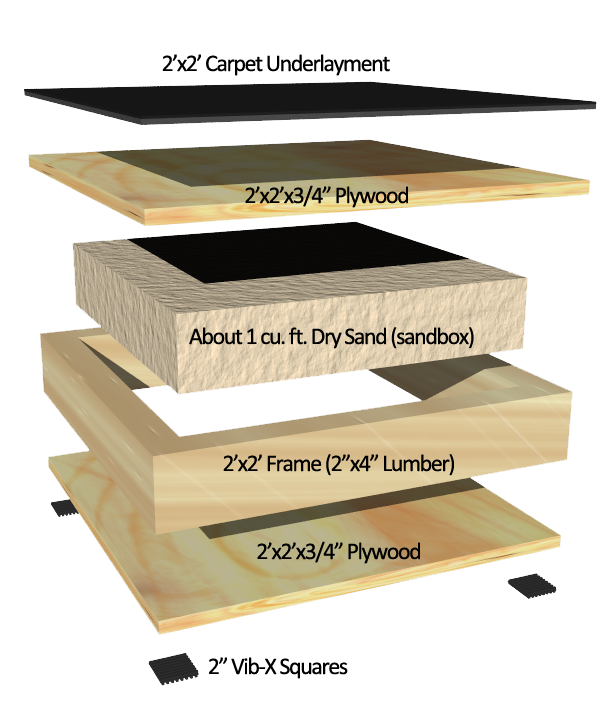
Stuff you will need:
- 2 – 2’x2’x3/4” Plywood (whatever size you want)
- 2’x2’ Carpet Underlayment (Same size as Plywood)
- 2”x4”x8’ Lumber for frame (More if scaling larger)
- About 1 cu.ft. Clean Dry Sand (Sandbox Sand)
- 3’x3’ Industrial Carpet (Enough to cover platform)
- Vib-X Pad to cut at least 4 – 2” Squares for feet
- Construction Adhesive
Simple assembly
- Create Frame and attach to bottom Plywood
- Attach Vib-X feet to bottom
- Fill with Sand
- Attach Plywood top
- Adhere Carpet Underlayment to top
- Carpet Box
 This plan is for a 2’x2’ platform. You can scale these or use more than one. Scale with caution – the sand makes these extremely heavy. What you are building is a floating platform. Keeping the sound from being transmitted into the floor below effectively decouples the speaker, making it “float”. In essence, the vibrations are being absorbed before getting to a solid surface, allowing for a more transparent listening experience and keeping the vibrations from interfering with other instruments in the area.

This simple DIY project is provided as a way for our customers to learn better ways to use our products and get more value out of the products they buy. If you are looking for more ways to use the products you have, look to Acoustics First for Ideas. http://www.acousticsfirst.com
————————————————————————————————————————————————————————————
Acoustics First Corporation supplies acoustical panels and soundproofing materials to control sound and eliminate noise in commercial, residential, government, and institutional applications worldwide. Products include the patented Art Diffusor®, sound absorbers, noise barriers, acoustical fabrics and accessories. Acoustics First® products are sold for O.E.M applications, direct, and through dealers. For more information on acoustical materials and their application, please visit www.AcousticsFirst.com or call Toll Free 1-888-765-2900 (US & Canada).
Setting the Stage for Acoustics First
Posted by Acoustics First in Articles, Home Entertainment, Home Theater, Product Applications, Studio Control Room on February 28, 2013

Setting the Stage for Acoustics First
by Nick Colleran
Originally Published in Productions Magazine Sept/Oct 2012 issue.
Early acoustical theaters were just that – acoustic. The good news and the bad news are usually the same news when a venue sounds incredibly good at the start. An auditorium that projects natural sound well is most often over-powered and overloaded by modern musical performances and the line array sound systems that reinforce them. That’s the bad news in the good news. This type of good room will need to be modified to handle high-powered sound from modern music performances while keeping its sound-enhancing properties. All efforts can be directed into the “how” of doing the job when everyone has heard the “why” it needs to be done.
Re-engineering reinforcement – Modifications for “loud”
The hard back wall of the stage is a significant source for monitor splash-back into the performers’ microphones, reducing gain-before-feedback and enhancing opportunities for system squeals. This is in addition to promoting timing confusion due to slap-back that is usually out of sync with the music. This disturbance and annoyance can be overcome by using materials from the province of industrial noise control. A factory finish, that is a finish for the factory, is also both “roadie-proof” and “on-the-road” compatible. Yes, you can take it with you. This allows one set of materials to follow the performances from one venue to the next.
Curtain call – Reflecting on the stage
The industrial curtains called QFM for Quilted Fiberglass Materials accomplish multiple functions:
Bass control from an internal limp mass, Absorption from quilted fiberglass, and Resistance to abuse from a tough vinyl cover.
The covering is thin enough to avoid reduced effectiveness at all but the highest frequencies and strong enough to withstand stage and road wear. Hanging mass (at one time plywood) with an absorptive cover is a long-standing studio technique to control low frequencies. The newer, non-rigid barriers allow a curtain configuration that is invisible to the audience, while providing a clean sound source for the both the performers and the listeners.
Overhead, not overheard – Many are baffled
Above the stage, there is almost always a large cavity designed for lights and to accommodate rigging. This space can act as an unintended echo chamber. Being out of harms way, the area allows for a lighter and less costly sound treatment with acoustical baffles. Besides the obvious requirement that they work acoustically, they need only to be invisible (usually black) and pass the proper fire code. Acoustically, they have about twice the exposed sound absorbing surface as a wall-mounted panel, by hanging in free space. It’s more surface, less reverberation, out-of-sight and within budget. They are light enough and small enough to travel well if strung in a way that allows easy removal for relocation, such as threaded onto aircraft cable and hung in a line from side-to-side. Adding a fabric finish to the baffles, produces a more decorative product, suitable to the audience side of the auditorium when a more permanent ceiling solution is required.
Stage One – Separating Sound
Stage one of acoustical control often is the stage. Both on-stage and in-studio sound isolation usually begin with structure borne sound traveling through the floor. It is always wise to implement isolation between instruments from the beginning, where it is a “cheap” fix rather a costly solution. This can be accomplished by floating the stage surface, and doing it in several separate sections. As noted previously with the hanging back of stage curtains, mass matters. Mass can come from many different materials whose properties are heavy and dense. They can be common materials such as gypsum or sand as well as more acoustically specific items like sheet lead or mass loaded vinyl barrier. (BlockAid® is a readily available example.) Added mass damps the damage of vibration and reduces ringing resonance.
Once the stage goes “thud” when hit due to its added mass rather than a cartoonish “boing”, it is time to handle the hollow space beneath the stage and fill it with fluffy stuff. This can be whatever attic insulation that is on sale at the local home improvement store. It need only trap the air to prevent its becoming a big bass drum when stomped upon.
Way back in the days of Disco (or Disco daze), complications arose in the studio from the required “lead-foot” kick drum getting into the acoustical piano by traveling through the studio floor as vibration and transmitted up the piano legs. Although studio floors are usually isolated from other rooms, they can still connect within a room. This problem was solved by floating the drum booth independent of the common recording studio floor. At that time this author’s studio went so far as to construct a sand-filled floor set on nine truck tires. The sand provided mass and inertia while the tires created de-coupling from the common structure. Today it is accomplished with high mass materials and off-the-shelf vibration pads, at about the same cost. Independent and transportable compact structures can be created for the individual instruments and be moved with very little heavy lifting.
After stage resonance is reduced by adding a layer of mass loaded vinyl to its surface and the cavity below is stuffed with fiberglass to prevent its ringing or singing along with the music, a second stage may be layered on top of the original and floated on ribbed neoprene pads every 12 inches along standard, 16” on-center bracing. This keeps the guitar amp’s sound out of the vocal microphone stand, bass drum out of the piano legs, and so on, to create increased clarity and improved separation in the live performance.
Islands in the stage will stop transmission transit and are relatively cheap to build into the plan. Separate sections for drums, piano, singer, bassist and guitar amplifier can be buffered with half-inch strips of flexible resilient neoprene without being seen. Much like vocals can be modulated when source through the same speaker as the bass, surfing the bass wave in the stage floor can also add an undesirable tremolo (or vibrato) effect to voice or other wind instrument. (This effect can be demonstrated by auditioning a vocal through the bass player’s amplifier while playing.)
Dome details – Round and around
One technique used in early acoustical performance theaters was the overhead dome. This feature captured wasted sound energy and focused it back to the audience to reinforce sonic energy in areas where it had diminished with distance from the source. With new systems the level is electronically reinforced, not needing further enhancement, which confuses rather than clarifies. In addition, the dome creates a sonic racetrack where the sound moves around the edge in a swirling motion. Anyone who has been in a domed facility during a thunderstorm has heard how sound travels around the perimeter. The RCA dome in Indianapolis provided a good example to CEDIA attendees a few years ago . This phenomenon of raceway runaway can be abated with acoustical “speed bumps” of Melamine foam which easily bends to conform to curves*, keeping the look while truncating the travel of the fast moving sound waves. In this case being unfocused is a desirable trait.
To reduce sound getting into the dome from the line arrays and the like, hanging baffles can be placed around the front half of the perimeter of the ellipse. These may be fabric covered to blend with the décor of the audience area and made from two-inch, seven pound per cubic foot density acoustical fiberglass to extend its absorption range. Being hanging baffles they do not permanently change the original architecture, where that is a concern.
(Don’t Look) Behind the curtain – Unseen, Unheard
When acoustical treatments must be essentially permanent, high efficiency at low cost can be achieved with utility finishes that can be field-cut to fit spaces in cavities behind auditorium side curtains. Factory fit panels require precise measurements to install within curves. Field cutting skips this step as it is, by definition being, done in real time to as-built measurements rather than made to out-of-date plans. Savings derived from the unseen, utilitarian treatments can be applied to upscale finishes for panels in plain sight.
Balcony bounce-back
Another common problem for an older theater in the modern world is sound returning from the balcony face. These are usually concave surfaces that not only send sound back but focus it for feedback as well. Convex curves such as polycylindrical “barrel shapes or semi-reflective half-round, hollow traps can control concave characteristics when interspersed with thicker, flat acoustical wall panels to achieve a combined “Flat” curve.
Definition by Diffusion
Sound intensity can be reduced by the decision to destroy or diffuse. Absorption is the destructive choice, eliminating the problem by eliminating the sound. Care needs to be taken to use only what is necessary and no more.
The other alternative is to spread the sound over a larger area to reduce intensity. This can be likened to spreading peanut butter on bread – it becomes easier to swallow although it is the same quantity as the original lump from the jar. With diffusion, a little goes long way. A single barrel shaped diffuser can clear up the cacophony of a board room without the deadness of absorption required for the same amount sound clarification.
Check back After Launch
With venue retrofits, some tweaks can be made after opening. Covering all walls before there is an evaluation with performers and audience, is not always a good idea. While it may be theoretically possible to model and predict acoustical performance, it can be more economical and efficient to get the room in a reasonable range and polish to the real world result. An informed conclusion, upon hearing the room in use, can produce an optimum result.
*Contrary to popular belief, acoustical foam can be painted to match décor without affecting its performance. (The author has a copy of the independent lab report comparing painted to unpainted natural. Painted measured better, but not significantly.)
The Author
Nick Colleran is past-president of SPARS (Society of Professional Audio Recording Services), past president of the VPSA (Virginia Productions Services Association), a former recording artist and audio engineer.
Starting in 1978, his company began supplying unique acoustical materials. Nick now leads a “quiet life” as a principal of Acoustics First Corporation. The company holds patents for several innovative acoustical products.
Acoustics First designs, manufactures and distributes products to control sound and eliminate noise for commercial, residential and industrial uses.
Materials Mentioned:
Vib-X™ vibration pads | BlockAid® mass loaded vinyl noise barrier | Stratiquilt™ quilted industrial blankets | Cloudscape® Baffles hanging acoustical baffles | Sonora® acoustical wall and ceiling panels | Select Sound™ black fiberglass board | Geometrix™ half-round broadband absorbers
Download of article available here: http://acousticsfirst.com/article-setting-the-stage-for-acoustics-first-productions-mag.htm
—————————————————————————————————————————-
Acoustics First Corporation supplies acoustical panels and soundproofing materials to control sound and eliminate noise in commercial, residential, government, and institutional applications worldwide. Products include the patented Art Diffusor®, sound absorbers, noise barriers, acoustical fabrics and accessories. Acoustics First® products are sold for O.E.M applications, direct, and through dealers. For more information on acoustical materials and their application, please visit www.AcousticsFirst.com or call Toll Free 1-888-765-2900 (US & Canada).
Originally published by Home Toys.
Acoustics First releases video on Vibration Isolation
Posted by Acoustics First in HOW TO, Press Release, Product Applications, Sound proofing, Video on February 1, 2013
 Acoustics First has conjured up yet another video demonstration. As the fourth in a series designed to help explain common acoustic principles, this video briefly reveals what is necessary to provide vibration isolation.
Vibration isolation can quickly prove to be obtuse and relatively difficult to understand. Common problems like footfall from upstairs neighbors, industrial noise from machinery and HVAC equipment or isolating speakers and scientific devices can require completely different approaches. Most often, an on site assessment should be completed by a qualified engineering professional to determine an appropriate acoustic solution. In many cases the solution will require a modification to the structure and implement more than a single strategy.
This simple vibration demonstration challenges to provide a basic understanding of how acoustical materials may be used to prevent the spread of mechanical noise and vibration through existing structures like walls, floors and ceilings.
In this acoustic demonstration, a surface mounted piezo transducer connected to an analog meter will register levels of sound vibrations transmitted to the table. A vibrating device placed directly on the surface will transmit sound vibrations and resonate loudly throughout the table. These vibrations will register on the analog meter. By inserting isolation materials between the device and the surface, the mechanical sound transmission is reduced and sound no longer registers on the meter.
VIBRATION ISOLATION DEMONSTRATION: Controlling Mechanical Sound Transmission
CLICK HERE FOR MORE ON: VIBRATION CONTROL PRODUCTS
Acoustics First’s acoustical wall fabric saves $Green$ while being Green!
Posted by Acoustics First in Art Galleries, Auditorium, Broadcast Facilities, Classrooms, Fitness, Government, Gymnasium, Home Entertainment, Hospitals, Medical Facilites, Multipurpose Rooms, Museums, Music Rehearsal Spaces, Offices, Press Release, Products, Recording Facilities, Restaurants, School & Educational Facilities, Studio Control Room, Teaching Rooms, Teleconferencing, Theater, Universities, Vocal Booth, Voice Over, Worship Facilities on October 18, 2012
For Immediate Release
Acoustical wall fabric saves $Green$ while being Green!
 Sound Channels® acoustical wall fabric is manufactured from 100% Post-Consumer Recycled material, making this a quick ship, easy, no thought acoustic solution.
Sound Channels® is applied directly to vertical surfaces, is easy to cut and installs like wall carpet. This absorptive wall fabric is a great choice to moderate speech frequencies in any application. Great to soften sound in conference rooms, distance learning, offices, and day care facilities, this material can also be used as a base layer in home theaters, recording studios and broadcast facilities.
Not only is this economical acoustical treatment available in countless colors, it is manufactured from recycled materials, reducing environmental impact!
Sound Channels in manufactured using Eco-fi fibers. Eco-fi is a high-quality polyester fiber made from 100% certified recycled plastic bottles. It can go into any textile product such as clothing, blankets, carpets, wall coverings, auto interiors, home furnishings, and craft felt. Eco-fi can also be blended with other fibers, such as cotton or wool, for enhanced qualities.
AN EASY GUIDE: 15 bottles = 1 yard of wall covering
Why buy Eco‐fi products?
We have the capacity to keep billions of plastic bottles out of the world’s landfills each year by using post-consumer plastic bottles instead of virgin materials in the fiber manufacturing process. By doing this, we can lower harmful air emissions and save millions of barrels of oil from being used which, in turn, reduces the harmful effects of acid rain, global warming, and smog. Fabrics made from Eco-fi fiber are chemically and functionally nearly identical to those made from non-recycled fiber. The difference is that Eco-fi fiber is made without depleting the Earth’s natural resources. With properties such as strength, softness, shrinkage-resistance, and colorfastness, market applications for Eco-fi products are expanding every day.
Click here for more information on the Sound Channels acoustical wall fabric.
http://www.acousticsfirst.com/sound-channels-wall-covering.htm
——————————————————————————————————————————————-
Acoustics First Corporation supplies acoustical panels and soundproofing materials to control sound and eliminate noise in commercial, residential, government, and institutional applications worldwide. Products include the patented Art Diffusor®, sound absorbers, noise barriers, acoustical fabrics and accessories. Acoustics First® products are sold for O.E.M applications, direct, and through dealers. For more information on acoustical materials and their application, please visit www.AcousticsFirst.com or call Toll Free 1-888-765-2900 (US & Canada).
|
www.AcousticsFirst.com Acoustics First Corporation PH: (804) 342-2900 |
Sign up for Future Press Releases http://eepurl.com/hxZCs |
Acoustical Material Design and Uses Q&A
Posted by Acoustics First in Q&A on June 28, 2012
 Below is a Q&A session about acoustical materials.
How would you describe the existing landscape relating to acoustical systems? Where is the greatest need/ the most demand?
-Acoustical systems are deployed throughout many market segments. Demand truly depends upon the specific type of acoustical requirement. Applications can range from improving sound in a residential home theater to solutions to abate jet airplane noise. Many of these projects must be examined on a case by case basis.
Popular Products
–Fabric wrapped panel: http://www.acousticsfirst.com/sonora-wall-panels.htm
–Sound Barrier: http://www.acousticsfirst.com/blockaid-vinyl-sound-barrier.htm
–Art Diffusors: http://www.acousticsfirst.com/diffuser-art-diffusor.htm
What are some major issues that come up or problems to be faced?
-Most problems center around improving speech intelligibility or keeping sound from disturbing others.
Improve Intelligibility with Absorbers: http://www.acousticsfirst.com/sound-absorbers.htm
Block Sound with Barriers and Isolation Poducts: http://www.acousticsfirst.com/barriers-vibration-isolation.htm
When developing different types of sound proofing/ sound dampening materials what have proved to be the most useful materials to form composites out of? Where do you usually procure these base materials?
-Many absorber products are manufactured from fluffy or porous materials such as acoustical foam and glass fiber.
–Noise barriers are made from dense and heavy materials and isolation materials range from metal springs to neoprene rubber.
You can read more about the basic categories of products here: http://www.acousticsfirst.com/acoustics-first-products-overview.htm
Which materials or composites combinations have proved to be the most successful?
-The success of the material can only be measured in comparison with the application in which the material is used. Not all applications will require the absolute best composite material. There are varying degrees of requirements and materials that should be specified by a professional who can evaluate the project requirements. Acoustical consultants are often used to determine the appropriate material and amounts of material for the specific project.
What surprises have you encountered while developing acoustical systems?
-Sometimes that physical limitations of materials or structures to support the materials may change the design or specification of an acoustic material. For example, when blocking sound, massive and dense materials should be used, however, you must be sure the structure will be able to support the additional weight. A prototype design may have the best intentions of being a great acoustical material but may have limitations when manufacturing, shipping or installing.
How big is the market for aesthetically pleasing sound proofing/ dampening systems?
-These days most markets segments are looking for materials that are aesthetically pleasing while at the same time needing them to be economical. Visual trends are constantly changing and consumers may choose to compromise the look of a material to match their project’s budget.
Do you see any future trends? Where do they align?
-Trends are always changing based on market demand whereas material design and availability change based on the availability of access to raw goods at a fair price. One constant that could maintain is that as the population grows one can anticipate the need for noise and sound control materials will also increase.
Do you think there is a need or interest in easily movable/ modifiable/ adjustable sound proofing/ dampening?
-Many customers would like to have the ability to remove or move their acoustical materials. Much of this depends on the type of acoustical problem and how the will be installed.
Do you think there is a need or interest in sound proofing/ dampening that is easily cleaned? In what market do you think these exist?
-Some commercial applications such as hospitals, food service, or industrial facilities need materials that can be wiped down. This depends on the environment in which the materials will be used.
What are some markets that have unmet needs? What is the need?
-Any markets that have sound and noise problems.
——————————————————————————————————————————————-
Acoustics First Corporation supplies acoustical panels and soundproofing materials to control sound and eliminate noise in commercial, residential, government, and institutional applications worldwide. Products include the patented Art Diffusor®, sound absorbers, noise barriers, acoustical fabrics and accessories. Acoustics First® products are sold for O.E.M applications, direct, and through dealers. For more information on acoustical materials and their application, please visit www.AcousticsFirst.com or call Toll Free 1-888-765-2900 (US & Canada).
 Acoustics First BLOG
You must be logged in to post a comment.