Archive for category Art Galleries
Acoustic Transformation at New Harmony: Preserving Art, Improving Sound
Posted by Acoustics First in Absorption, Art Galleries, Articles, Customer Feedback, Diffusion, Multipurpose Rooms, Museums, Music Rehearsal Spaces, Product Applications on April 27, 2026
In New Harmony, Indiana, there is a former Odd Fellows Lodge repurposed as a private residence—the main hall doubles as an event and performance space. Measuring 80 by 40 feet with a 14-foot ceiling, the room features a mezzanine, raised stage, large windows, and an extensive collection of artwork. While visually striking, the space presented serious acoustic challenges.
Acoustics veteran, John Gardner was engaged to address these issues after experiencing a VIP performance tied to a blues festival. The goal was clear: improve the sound without disturbing the artwork or compromising the room’s aesthetic.
The Challenge: Excessive Reverberation and Harsh Reflections
Initial assessment and measurements revealed a highly reverberant and reflective environment:
- Reverberation times:
- ~3.5 seconds at 500 Hz
- Over 4 seconds at 1 kHz
- A pronounced “chatter” or flutter echo that degraded clarity
- Strong reflections from walls, mezzanine face, and windows
- Poor intelligibility for both speech and live music
Further analysis showed:
- Extended decay times in mid frequencies
- A rising frequency response:
- +12 dB from 63 Hz to 6.3 kHz
- High-frequency roll-off beginning near 8 kHz
- Noticeable slap-back echoes from rear wall surfaces
The Solution: Integrated, Art-Conscious Treatments
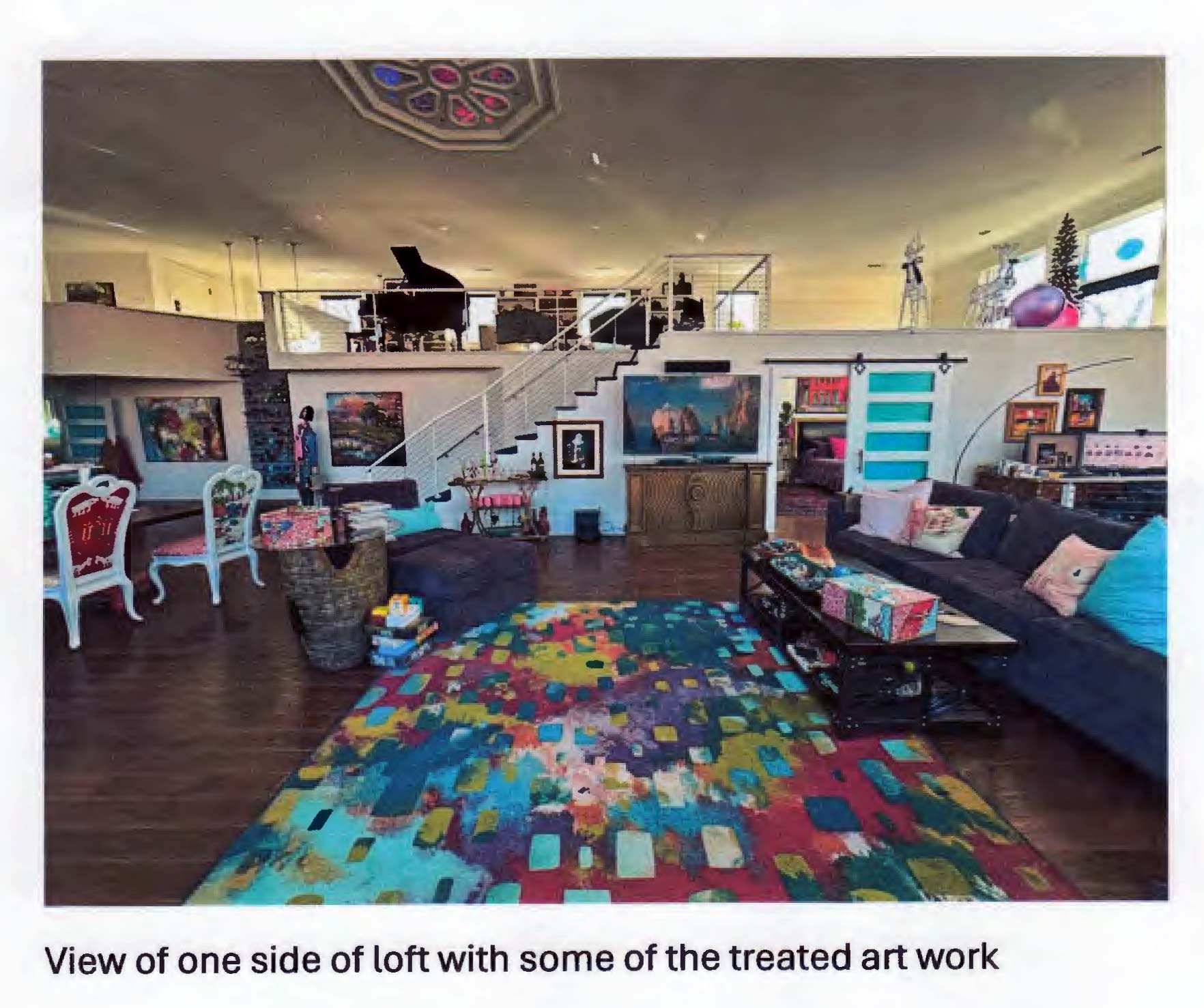
Given the requirement to preserve the room’s visual identity, all treatments were carefully selected and adapted to blend seamlessly into the environment.
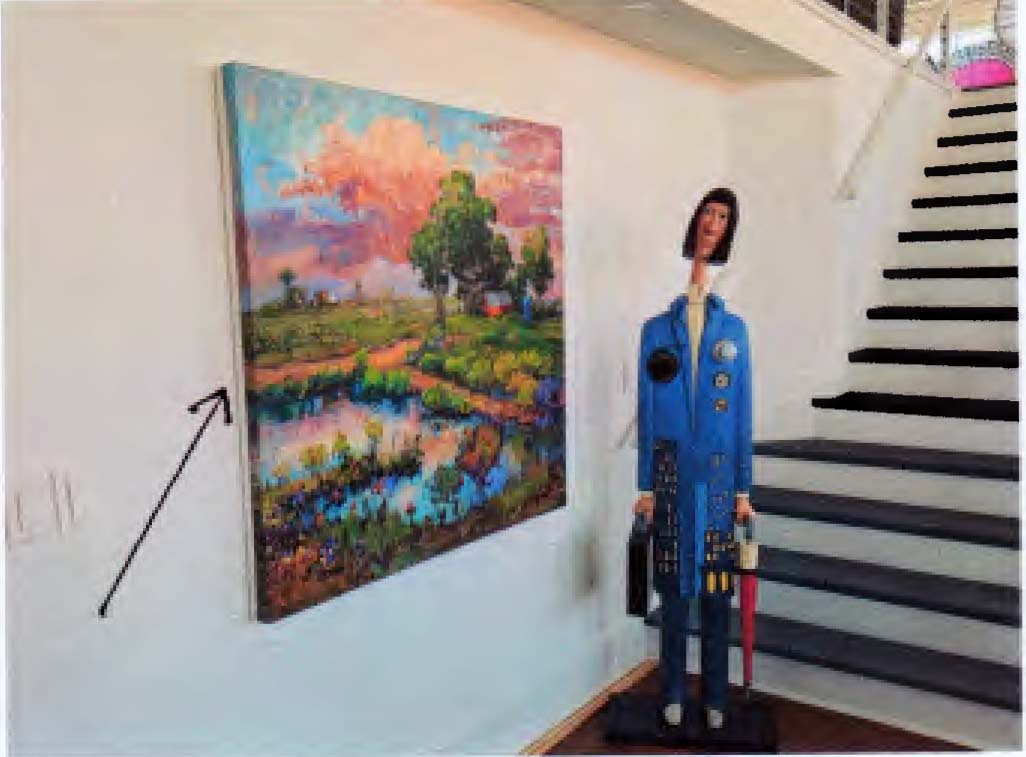
Key treatments included:
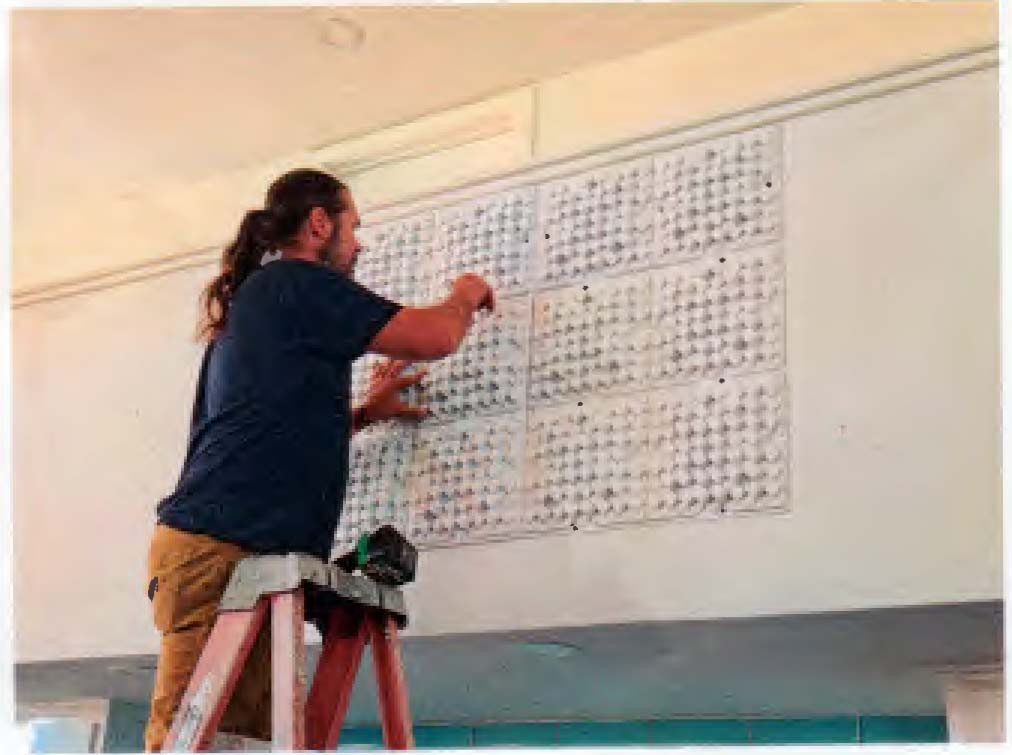
- Mezzanine Face – Diffusion
- Installed a series of ArtDiffusor® Model F diffusors
- Arranged in a continuous matrix across the mezzanine face
- Positioned against existing molding for a clean, intentional look
- Purpose: break up reflections and reduce flutter echo without deadening the space
- Rear Wall – Absorption
- Installed Tone Tiles®
- Artist-painted to match the room while maintaining acoustic performance
- Purpose: reduce slap and high-frequency reflections
- Reflective Wall Treatment – Absorption + Aesthetic Matching
- Covered a large reflective wall with Sound Channels® wall fabric
- This material is acoustically absorptive, not transparent.
- Original paintings were reinstalled over the treated surface
- Artwork Enhancement – Distributed Absorption
- Added Sonora® panels (1-inch thick) behind existing canvas artwork
- Turned each piece into a functional absorber
- Created slight diaphragm damping effect due to the air gap behind canvases
- Maintained full visual integrity of the collection
- Window Treatment – Removable Absorption
- Installed custom-fit Sonora® panels within window frames
- Panels secured with minimal hardware and used only during performances
- Addressed reflections from large glass surfaces near the stage
Results: Balanced Acoustics Without Visual Compromise
Post-treatment measurements showed clear improvement:
- Reverberation reduced to:
- ~2.1 seconds at 500 Hz
- ~3.4 seconds at 1 kHz
- Reduced flutter echo and slap-back reflections
- More controlled and even frequency response
Performance Outcome: Proven in Practice
The ultimate validation came during the following year’s festival:
- The returning headline performer commented on how good the room sounded
- Performers were able to clearly hear themselves on stage
- Audience members and owners noted significantly improved clarity and warmth
Conclusion
The New Harmony project highlights how thoughtful acoustic design can coexist with architectural and artistic priorities. By using targeted solutions like ArtDiffusor® Model F Diffusors, Tone Tiles®, Sound Channels®, and Sonora® panels, John Gardner successfully transformed a challenging space into an acoustically balanced performance environment—without compromising its character.
Absorption & Diffusion – The Construction Specifier
Posted by Acoustics First in Absorption, Art Galleries, Articles, Auditorium, Broadcast Facilities, Diffusion, Home Entertainment, Home Theater, HOW TO, Industrial Facilities, Media Room, Multipurpose Rooms, Music Rehearsal Spaces, Offices, Product Applications, Recording Facilities, Studio Control Room, Teleconferencing, Theater on April 29, 2022
For the May 2022 edition of “The Construction Specifier,” Acoustics First was asked to illustrate the use of absorption and diffusion in creating optimal acoustic spaces. The article is a great reference for understanding the types of acoustic absorbers and diffusers, as well as some use scenarios like offices, critical listening spaces, and larger communal spaces.
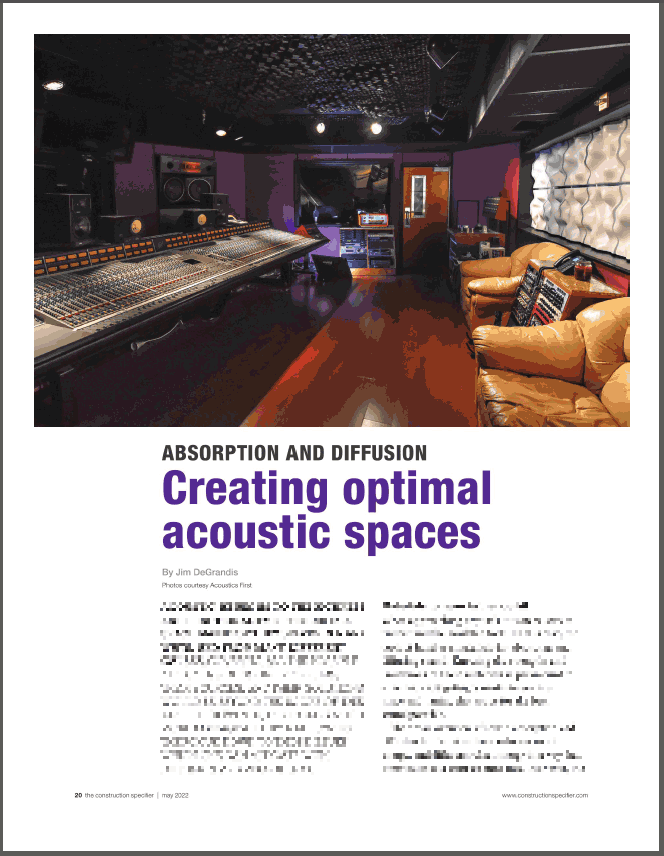
Note: This version has been edited and the advertisements are removed. The full published version of the May 2022 digital edition can be found on The Construction Specifier’s website here.
Big Room… Big Boom.
Posted by Acoustics First in Absorption, Art Galleries, Auditorium, Customer Feedback, Gymnasium, Multipurpose Rooms, Music Rehearsal Spaces, Products, School & Educational Facilities, Teaching Rooms on August 22, 2013
When Pippin Barnett contacted Acoustics First about an acoustical issue he was having with a new multipurpose space that was constructed for the Sabot School, he was in desperate need of a solution. This space was needed for functions, activities, art displays, music classes, plays, and more, but was almost completely unusable due to the acoustics.
 The large space was well conceived; large open floor plan, hydraulic door to open the space to the courtyard, bathrooms, storage and lots of display space for the student’s artwork and creations. The building was also efficiently constructed using SIPS (Structural Insulated Panel Systems), which created a grand open space with no support pillars.
 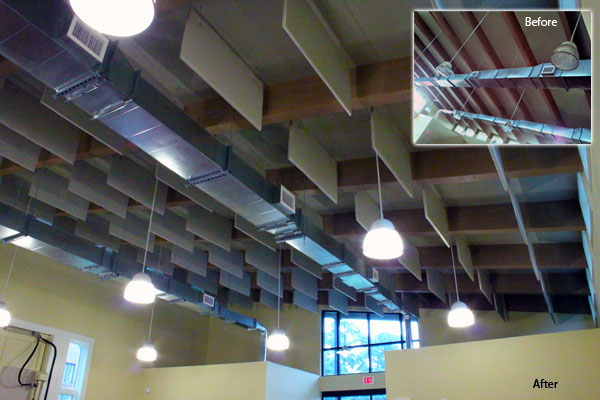 This space was ready to be used, but there was a problem – whenever they tried using the space, you couldn’t understand what anyone was saying. To say that the acoustics were “not optimal” is like saying that the destruction of the entire universe would be “inconvenient” – an incredible understatement.
Upon arrival, we took some physical measurements of the space to calculate the surface area and volume of the room, as well as got some acoustic measurements.
Click here for a balloon pop before acoustic treatment.
Whoa… Big Boom! What you are hearing is a 3+ second RT60 time; That’s more than 3 seconds of time that the sound lingers in your space at a level audible enough to interfere with other sounds.
Which is “Inconvenient,” and “Not Optimal.”
So with some magic calculations performed by Joe Horner over at the quietest office in Acoustics First,(no really – he likes it really quiet,) a solution was developed to create a space that sounded as good as it looked.
Joe prescribed 100 2’x4′ Cloudscape ceiling baffles as well as 157 sq ft of 1″ thick Sonora Wall panels to cover the solid hydraulic door – and we listen to Joe (he’s done this a lot!)
So, a short while later, the Baffles and Panels are installed and we receive an e-mail from Pippin…
“I’d say you were right on the money!”
Click here for a balloon pop after acoustic treatment.
RT60 from 3+ seconds down to right about 1 second. I’d say that’s right on the money too, Pippin!

The Sabot School regained the use of its space and everyone lived happily ever after.
I love happy endings.
DIY: Super Bass Trap
Posted by Acoustics First in Absorption, Art Galleries, Articles, Classrooms, DIY, Home Entertainment, Home Theater, HOW TO, Music Tracking Room, Product Applications, Products, Recording Facilities, Recording Studio, School & Educational Facilities, Studio Control Room, Teaching Rooms, Teleconferencing, Theater, Universities, Vocal Booth, Voice Over, Worship Facilities on May 16, 2013
Take a couple of products and make your corner into a super trap!

One of the most pervasive problems in recording and listening environments is the problem of bass build up in the corners. If you want to get the most out of your room, try making your corner into a DIY super trap!
Stuff you’ll need:
- 2’x4’x4” (or 2”)Back-Beveled Sonora® Wall Panel (beveled on the rear to fit corners or a standard panel with angle brackets)
- 48” Bermuda Triangle Trap® or 2 PhaseFOAM™ Bass traps (or a 1’x4’x1” raw fiberglass panel hung across the corner.)
- Foam Adhesive
- Sonora® Mounting brackets
Simple installation instructions:
- Use the adhesive to attach the Foam Bass trap to the wall
- Use the brackets to attach the Sonora® Panel across the corner over the trap
Super simple. Super effective.
As simple as it seems, this method of installing these products is an ideal way to get extra trapping in your corners. This solution changes the corner density multiple times as the sound waves pass through it –as well as introduces a layer of air space. This installation method takes the strengths of the two products and has them working together to eliminate that build-up of energy in the corners – it literally sucks it up like a sponge!

This simple DIY project is provided as a way for our customers to learn better ways to use our products and get more value out of the products they buy. If you are looking for more ways to use the products you have, look to Acoustics First for Ideas. http://www.acousticsfirst.com
————————————————————————————————————————————————————————————
Acoustics First Corporation supplies acoustical panels and soundproofing materials to control sound and eliminate noise in commercial, residential, government, and institutional applications worldwide. Products include the patented Art Diffusor®, sound absorbers, noise barriers, acoustical fabrics and accessories. Acoustics First® products are sold for O.E.M applications, direct, and through dealers. For more information on acoustical materials and their application, please visit www.AcousticsFirst.com or call Toll Free 1-888-765-2900 (US & Canada).
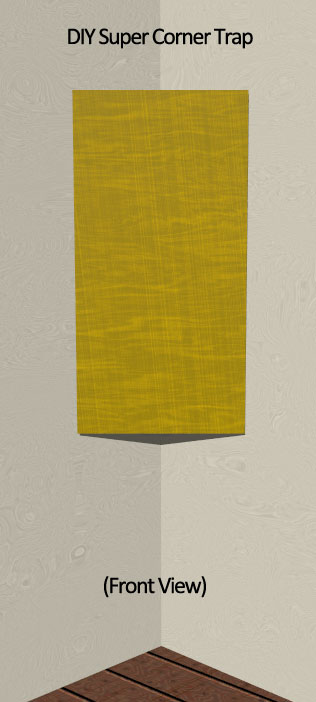
Acoustic First Ceiling Tiles get a face lift for the perfect fit to any application
Posted by Acoustics First in Absorption, Art Galleries, Auditorium, Broadcast Facilities, Classrooms, Fitness, Government, Home Entertainment, Home Theater, Hospitals, Media Room, Museums, Offices, Press Release, Product Applications, Recording Facilities, Restaurants, School & Educational Facilities, Studio Control Room, Teaching Rooms, Teleconferencing, Theater, Universities, Vocal Booth, Voice Over, Worship Facilities on March 28, 2013
For Immediate Release
Acoustic First Ceiling Tiles get a face lift for the perfect fit to any application.
 Acoustics First® has expanded their line of acoustical ceiling tiles allowing you to dress up any ceiling grid with a generous number of finish options. The legacy line of Sonora® ceiling tiles includes fabric faced ceiling tiles in either the standard square edge or a tegular edge that reveals below the grid. These tiles are available in a multitude of fabric colors and can be utilized in a wide range of applications to provide an upscale ceiling system that looks as good as it sounds. If you are looking for the absence of color, there are now two white options. The Sonora® UltraWHITE facing provides a basic smooth white finish while the Sonora® Nubby tile provides a texture white appearance. White ceiling tiles are an excellent choice for areas where a seamless look is desired and maintaining a room that is both bright and vibrant. Alternatively, if your application requires the ceiling to disappear, a black scrim version is also available. These black scrim ceiling tiles are a popular choice for public theaters, home theaters, restaurants or any application where a dark ceiling is desired. Additionally, choose from either a PVC faced or encapsulated ceiling tile if your application requires a wipe-able surface for resistance to liquids and dirt. Test labs, animal shelters, restaurants and similar facilities may require their ceiling tiles to be cleaned on a regular basis. In addition the ample amount of absorptive ceiling tiles, Acoustics First® also carries a wide range of diffusive ceiling tiles including the patented Art Diffusor® Model C and Model F. Product information, specifications and pricing can be found on the website @ http://www.acousticsfirst.com/sonora-ceiling-tiles.htm.
Image Downloads: http://www.mediafire.com/?21id1fsb0btrq
www.AcousticsFirst.com
Acoustics First Corporation
————————————————————————————————————————————————————————————
Acoustics First Corporation supplies acoustical panels and soundproofing materials to control sound and eliminate noise in commercial, residential, government, and institutional applications worldwide. Products include the patented Art Diffusor®, sound absorbers, noise barriers, acoustical fabrics and accessories. Acoustics First® products are sold for O.E.M applications, direct, and through dealers. For more information on acoustical materials and their application, please visit www.AcousticsFirst.com or call Toll Free 1-888-765-2900 (US & Canada).
 Acoustics First BLOG
You must be logged in to post a comment.