Archive for category School & Educational Facilities
Anechoic Chambers – Standards for Acoustic Measurement
Posted by Acoustics First in Absorption, Anechoic Chambers, Product Applications, Products, School & Educational Facilities, Uncategorized on September 3, 2026
Everything you wanted to know about anechoic chambers… but were afraid to ask.
An anechoic chamber is a specialized room engineered to eliminate sound reflections. Its walls, ceiling, and—in the case of a full anechoic chamber—the floor are covered with wedge-shaped foam or fiberglass absorbers that prevent sound waves from reflecting back into the test space. This creates a highly controlled acoustic environment that approximates free-field conditions, allowing the sound source to behave as though it were suspended in open air with no nearby reflective surfaces.
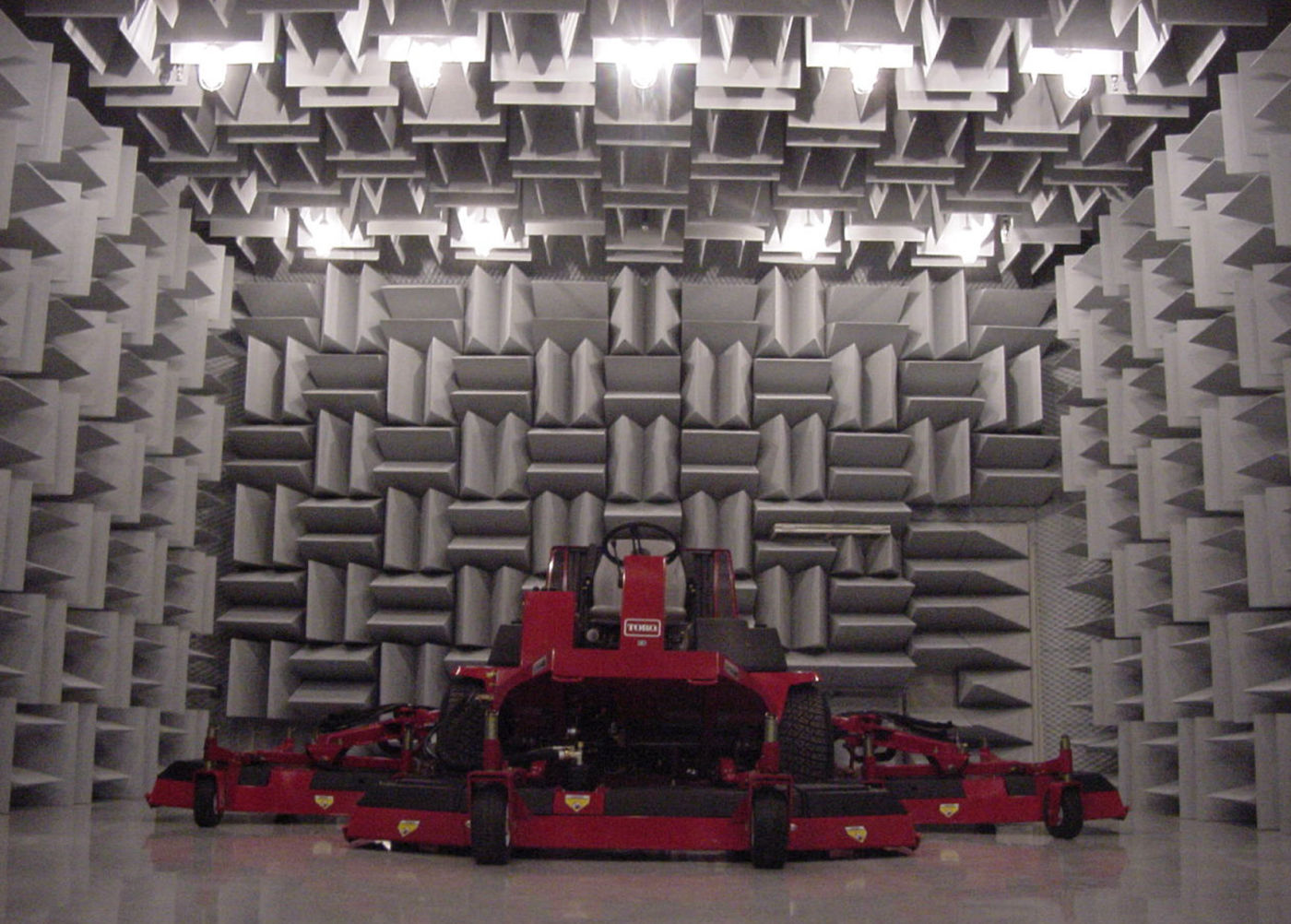
Such an environment is essential because acoustic measurements—including sound power, directivity, and frequency response—must be performed under known, reflection-free conditions to ensure repeatable, standards-compliant results. In the absence of these conditions, room reflections influence the measurements, causing the results to depend on the characteristics of the test room rather than the performance of the product being evaluated.
Here is a list of common measurement standards and the chamber/test requirements for each.
Precision Sound Power Measurement (ISO 3745)
ISO 3745 is the reference standard for precision sound power determination. It requires testing to be conducted in either a full anechoic or hemi-anechoic chamber that has been qualified to satisfy stringent free-field deviation requirements over the frequency range of interest. Chamber qualification requires demonstrating that the inverse-square law is maintained within ±1 dB at all specified measurement locations.
The typical chamber cut-off frequency ranges from 80 to 200 Hz, depending on the chamber dimensions and the depth of the acoustic wedges. Below the cut-off frequency, the chamber no longer provides true free-field behavior.
Engineering Sound Power Measurement (ISO 3744)
ISO 3744 establishes engineering-grade methods for sound power determination. While less stringent than ISO 3745, it still requires testing to be performed in a hemi-anechoic environment. The standard permits the application of environmental correction factors when the test environment does not achieve ideal anechoic performance, making it well suited for production-floor test cells and other facilities that approximate, but do not fully satisfy, free-field conditions.
Qualification of Free-Field Environments (ISO 2610)
ISO 26101 specifies the procedures for verifying that a test environment satisfies free-field performance requirements. It is the standard used to qualify an anechoic or hemi-anechoic chamber by confirming that the chamber’s acoustic characteristics meet the required free-field criteria and deliver the level of performance claimed for the facility.
Other Standards
- ECMA-74: IT equipment noise measurement (uses ISO 3745 or ISO 3744 as the underlying acoustic method)
- ANSI S12.55 / S12.56: North American equivalents of ISO 3744/3745
- ISO 11201-11205: Various sound pressure level determination methods, some requiring free field conditions
Chamber Size and Absorber Performance
The physical dimensions of an anechoic chamber determine its lowest usable frequency. As a general guideline, the chamber must be sufficiently large so that the distance between the sound source and each measurement microphone is at least one wavelength at the lowest frequency of interest.
For a chamber with a 100 Hz cut-off frequency, the minimum source-to-microphone distance is approximately 3.4 meters. Consequently, the internal chamber dimensions (excluding the absorber wedges) should be approximately 7–8 meters on each side for a hemi-anechoic chamber.
The depth of the acoustic absorber wedges governs the chamber’s low-frequency performance. Increasing wedge depth improves absorption at lower frequencies.
| Wedge Depth | Approximate Low-Frequency Cut-off |
| 200 mm | ~500 Hz |
| 500 mm | ~200 Hz |
| 1000 mm | ~80–100 Hz |
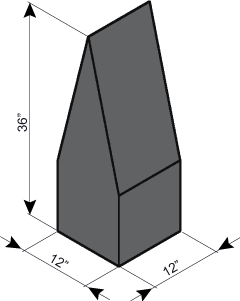
Common absorber materials include melamine foam (https://www.acousticsfirst.com/acoustical-foam-anechoic-chamber-wedges.htm , which is lightweight and inherently fire-retardant, and fiberglass, which provides superior low-frequency absorption but has a greater mass and higher cost.
Chamber Ambient Noise Floor
In addition to controlling sound reflections, an anechoic chamber must provide effective isolation from external noise sources. The ambient noise level within the chamber, measured with no test source operating, should be at least 6 dB—and preferably 15 dB—below the sound pressure level produced by the test object at the specified measurement positions.
Achieving these background noise levels typically requires a chamber constructed with multiple layers of high-mass materials, such as concrete and steel, combined with vibration-isolated mounting systems to minimize the transmission of structure-borne noise.
Alternatives to an Anechoic Chamber
Not every organization can justify the investment required for a purpose-built anechoic chamber, which typically ranges from $500,000 to more than $2 million. Fortunately, several practical alternatives are available, depending on the measurement objectives and required level of accuracy.
Sound Intensity Method (ISO 9614)
The sound intensity method, defined in ISO 9614, is inherently less sensitive to room reflections because sound intensity is a vector quantity. Unlike sound pressure, it differentiates between outgoing acoustic energy radiated by the test source and incoming energy reflected from surrounding surfaces. As a result, sound power can be determined in ordinary rooms without the need for anechoic treatment.
The primary trade-off is that this method requires specialized sound intensity probes and more complex measurement procedures than conventional sound pressure measurements.
Acoustic Test Boxes
For small products, such as electronic devices, individual components, and transducers, a desktop acoustic test box provides a controlled, low-noise environment that approximates anechoic conditions over a defined frequency range. These systems offer a significantly lower-cost alternative to a full-sized anechoic chamber and can be integrated directly into production-line testing.
Portable Acoustic Arrays
Modern acoustic imaging systems, commonly referred to as acoustic cameras, use portable microphone arrays to identify and localize noise sources in situ, whether on the factory floor, along a production line, or in field applications, without requiring an anechoic environment. Although these systems are not a substitute for standards-compliant sound power measurements, they provide a rapid and effective means of diagnosing and visualizing noise sources that would previously have required dedicated chamber testing.
Contact Acoustics First about your acoustic chamber project to find what sort of treatment is best suited for your application!
From Utility to Engineered Performance: Comparing Armstrong® 1B Perforated Tiles Vs. HiPer Panels®
Posted by Acoustics First in Absorption, Diffusion, Music Tracking Room, Product Applications, Products, Recording Facilities, Recording Studio, School & Educational Facilities, Studio Control Room, Vocal Booth, Voice Over on June 30, 2026
For decades, perforated acoustic panels have played an important role in shaping the sound of recording studios, broadcast facilities, civic buildings, and public spaces. While the iconic Armstrong® 1B perforated mineral fiber tile represented the standard for practical noise control throughout much of the twentieth century, modern acoustic engineering has transformed what perforated panels can accomplish. A comparison between the Armstrong® 1B and today’s Acoustics First® HiPer Panel® family illustrates just how far acoustic technology has advanced.

The Armstrong® 1B tile was designed as a utilitarian acoustic treatment. Manufactured from thin mineral fiber, the 1′ x 1′ panels featured either linear or random perforation patterns that allowed sound energy to enter the porous material for absorption – which increased the NRC of these tiles to a 0.55-0.60. Originally developed during WWII and used in military barracks and installations, these tiles eventually found their way into countless municipal buildings, schools, government facilities, and even legendary recording environments such as RCA and Sun Recording Studios. Their modest absorption characteristics, ease of installation, and economical construction made them a practical solution for reducing reverberation in a wide variety of spaces.

Despite their historical significance, the Armstrong® 1B tiles were fundamentally simple acoustic absorbers. The mineral fiber substrate behaved much like compressed fiberboard or heavy paper, relying solely on the porous material itself for sound absorption. While the perforations exposed more surface area to incoming sound, there was no engineered reflective face, no constrained barrier layer, and no intentional diffusion characteristics. Their primary function was simply to absorb a portion of the reflected sound energy.
Modern critical listening spaces demand considerably more sophisticated performance.
The Acoustics First® HiPer Panel® family builds upon decades of acoustic research using high-performance fiberglass substrates and engineered panel construction. Rather than functioning as simple absorbers, HiPer Panels® are carefully designed hybrid acoustic devices that combine broadband absorption with controlled reflection and diffusion. Where the Armstrong tiles had an NRC of 0.55 – 0.60, the HiPer panels increase this to a 0.90 NRC – but they also introduce tuned absorption and diffusion.

The original laminated HiPer Panel® incorporates a perforated fiberglass bonded to a constrained barrier septum layer. This engineered assembly allowed portions of the sound spectrum to be reflected while some acoustic energy passed into the fiberglass absorber, creating a more balanced acoustic response than a conventional porous panel. The result is an environment that maintains clarity, spaciousness, and natural musical energy instead of becoming acoustically “dead.”

The Hiper Panel® Impact takes a slightly different approach by utilizing a durable perforated reflective face over the fiberglass core. Its optimized perforation pattern and reflective surface are specifically engineered to provide controlled diffusion on top of tuned absorption, making it well suited for performance venues, mastering rooms, critical listening spaces, and recording studios where preserving acoustic life is just as important as controlling excessive reflections. This tuned absorption allows the low frequencies to be absorbed, while leaving the high frequencies so that the diffusion characteristics of the device (over 4Khz) will be more effective in creating a feeling of openness in the room.

The differences between these products extend well beyond appearance. While both feature perforated surfaces, the Armstrong 1B’s small perforations simply exposed a thin mineral fiber absorber. By contrast, the HiPer Panel® systems use perforation geometry, reflective facings, engineered barrier layers, and high-density acoustic fiberglass to create a far more efficient and balanced acoustic device. Instead of merely reducing reverberation, they help shape the acoustic character of a room.
More than fifty years after their introduction, Armstrong® 1B perforated tiles remain recognizable symbols of an earlier era of architectural acoustics. Many continue to serve in municipal offices, schools, police interview rooms, and other institutional settings where functional noise control is sufficient. In modern recording studios, listening rooms, and performance spaces, however, engineered systems like the Acoustics First® HiPer Panel® and Hiper Panel® Impact represent the evolution of acoustic treatment—combining advanced materials, acoustic science, and carefully tuned performance to meet the demands of today’s most critical listening environments.
Autism Spectrum Disorder and Acoustics
Posted by Acoustics First in Classrooms, Product Applications, Products, School & Educational Facilities, Sound proofing, Teaching Rooms on March 25, 2026
People with Autism Spectrum Disorder (ASD) frequently report different sensory experiences, especially with sound. Many experience hypersensitivity (overreaction to stimuli like noise or light) or hyposensitivity (reduced response, requiring stronger input). Unlike most individuals, they may not adapt to constant background noise, which can remain overwhelming. Tools like noise-canceling headphones and stim/fidget toys can help manage stress and support self-regulation.

Some autistic individuals also experience auditory processing disorder (APD), where sounds are heard but not easily understood. This can make following speech in noisy environments—like classrooms—especially difficult, even if other auditory skills remain strong.
Research on autism has often focused on traits, causes, and treatments, sometimes framing autistic individuals as the problem. A more balanced, modern, view considers how environments and nonautistic people contribute to disabling experiences. Under the social model of disability, society shares responsibility for reducing these challenges. Recent perspectives expand beyond individual traits to include social attitudes, accessibility tools, inclusive education, and building design.
The design of built environments plays a major role in comfort and performance, yet acoustics are often overlooked compared to lighting or air quality. Poor sound conditions—such as low signal-to-noise ratios—can hinder learning, particularly for children, people with hearing difficulties, or nonnative listeners. While accessibility standards address physical barriers, they rarely consider acoustic needs for autistic individuals. Studies show that high noise levels can increase distress-related behaviors in children living with autism. Both children and adults report that schools can be overwhelming due to noise, bright lights, and unpredictability, leading to fatigue and reduced learning.
To create more inclusive spaces, designers should focus on acoustics. This includes organizing layouts predictably, adding quiet “escape” areas, separating noisy and quiet zones, and using transitional spaces to ease sensory shifts. Effective sound isolation—through walls, windows, and floor/ceiling—is essential, as is reducing internal noise from building systems and other noise sources. Windows are often the weakest link through which sound can leak, but this can be mitigated with multi-pane window construction with an appropriately airtight and resilient joint sealant. The Sound Transmission Class (STC) and Outdoor-Indoor Transmission Class (OITC) of cavity wall systems can be improved with added mass, resilient layers and cavity absorption. Partitions should extend to their full height and be sealed to the structure of the roof deck or floor above. Penetrations through sound isolating partitions should be avoided. Wherever penetrations are unavoidable, they should be packed with insulation and sealed with a resilient joint sealant to minimize the leakage of sound.
Using sound-absorbing materials can further improve comfort. Sound Channels acoustic wall fabric is often specified in classrooms and “escape” rooms as it a very durable and cleanable material that provides sound absorption within speech frequencies, reducing echoes and overall noise levels.
Overall, designing for acoustic accessibility requires recognizing the diverse sensory experiences of autistic individuals. Inclusive environments should be shaped through thoughtful design and collaboration with autistic individuals, ensuring their lived experiences guide meaningful improvements.
References:
Caldas, Fernanda; Underwood, Samuel; Masiero Bruno S. and Wang, Lily M. Autism and Indoor Sounds Acoustics Today 20 (2) 21-29.
Acoustical Considerations for Classrooms
Posted by Acoustics First in Absorption, Articles, Classrooms, Product Applications, Products, School & Educational Facilities, Teaching Rooms on September 19, 2024
Poor classroom acoustics has long been the invisible problem that has the farthest reaching implications for learning. Excessive noise and reverberation degrade speech intelligibility, resulting in reduced understanding and therefore reduced learning. In many classrooms in the United States, the speech intelligibility rating is 75% or less. That means, in speech intelligibility tests, listeners with normal hearing can only understand 75% of the words read from a list. Imagine reading a textbook with every fourth word missing. Wouldn’t that make comprehension near impossible? Fortunately, poor classroom acoustics can usually be remedied with some basic knowledge and commercially available treatment. But before getting into specific treatment, let’s go over some basic acoustic principles.
Noise
Obviously, it’s difficult to understand what the instructor is saying when there is a lot of naturally occurring noise in the room. A glut of factors can be considered noise sources, including HVAC “rumble”, traffic outside the building and students moving in their chairs. These sources contribute to a “noise floor” that makes understanding speech very difficult. Since there is no one “cure-all” for an excessive noise floor, it is often best to seek the assistance of a professional acoustical consultant to properly diagnose and find a solution to these issues.
Reverberation: Undesirable vs Useful Reflections
When not attributed to a noise issue, the culprit of poor classroom acoustics is often excessive reverberation. In simple terms, reverberation is the sound energy that remains in the listening environment as a result of lingering reflections. As mentioned before, these reflections can easily interfere with speech intelligibility. As you may have experienced at some point, it can be difficult to understand what is being said when reflections from old information cover up what is newly spoken.
The reverberation time (RT or RT60) is used to determine how quickly sound decays. The RT is dependent upon the volume and surface materials of a given room. Large spaces with hard materials (tile, drywall, etc.) have longer reverberation times, while small rooms built with “softer” materials sound more “dead”. Ideally, classrooms should have relatively short RT’s, somewhere in the .6-.8 second range.
A long reverberation time is not the only factor that should be considered when treating a classroom with poor acoustics. Flutter echo is a particularly significant problem when it occurs between the side walls at the front of the classroom where the teacher is speaking. This condition can be heard as a “ringing” sound (when one claps) as the sound rapidly bounces back and forth between two parallel walls. Flutter and other discrete echoes are considered “undesirable reflections” and should be controlled with absorptive or diffusive materials.
Not all reflections are bad though. There are “useful reflections” that reinforce spoken word, rather than cover it up. The teacher’s voice can be propagated throughout the room by shaping a sound reflecting gypsum board ceiling over the front of the room or by making the center of the ceiling a hard, reflecting surface (see figure 1). This will help project the speaker, so they don’t have to strain their voice to be heard over the students.

Reducing Reverberation
Often reducing the dimensions of a classroom to attain a more suitable reverberation time is not feasible, but one can improve the acoustics by introducing sound absorptive materials. Typical classrooms usually have a dropped “acoustical” ceiling that has some absorptive qualities. In classrooms that don’t have this ceiling, reverberation can be reduced by installing an acoustical ceiling or a number of fabric faced fiberglass panels, like Sonora® Ceiling Clouds. Likewise, if there isn’t carpeting in the room, you can marginally reduce the reverberation time by installing sound absorptive flooring.
Wall treatment: Acoustic Panels
If the ceiling and floor are at least rudimentarily treated, then hard walls are usually at fault for poor speech intelligibility. Absorptive wall panels, like Acoustics First Sonora® panels, are a common treatment to control lateral reflections and reverberation.
These panels are popular because they can be customized with a variety of colors, edge designs and fabric facings. They also can come with a high-density fiberglass adder that improves durability. In classrooms, these “Hi-impact” panels are particularly useful because the adder allows for the panels to be used as tack boards. This brings an extra level of functionality to the panels outside of their absorptive properties.
Though wall panels are a perfectly suitable treatment, uncovered areas between the panels can sometimes allow a few hard reflections and/or flutter echo to still occur (although full treatment of the walls would likely result in a room sounding too “dead”). For these situations, Acoustics First often recommends Sound Channels® acoustic wall fabric.

Acoustical Wall Fabric
In many instances, acoustic wall fabric is actually a viable alternative to traditional wall panels. Unlike a typical “wall carpet”, Sound Channels® is made of 100% recycled content and has ridges to increase surface area and absorption. Perhaps most importantly, the uniform coverage you get by treating the walls with acoustic wall fabric eliminates the flutter/slap from reflective parallel walls (without making the space too “dead”). Acoustic wall fabrics are generally light weight and most can be put up just like any other wallcovering.
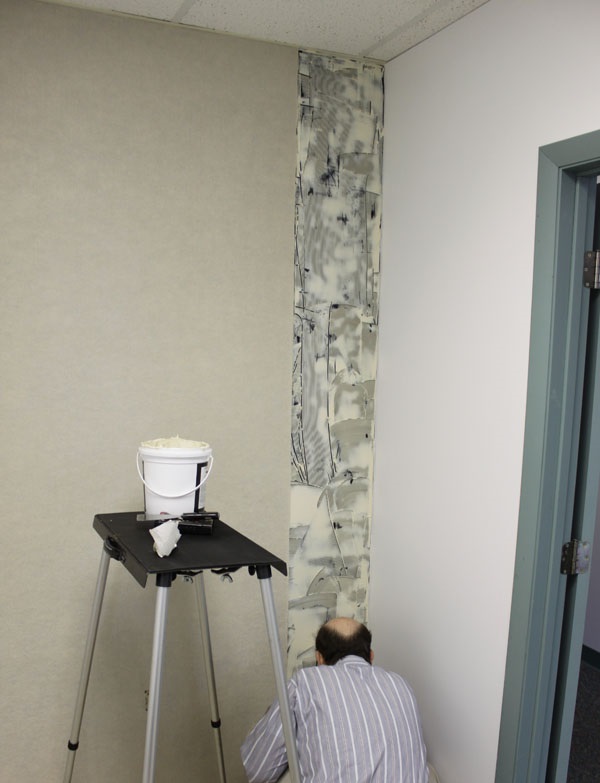
Also of note are the additional benefits when using Sound Channels® in early education classrooms. The effective range that this wall fabric controls is the higher speech frequencies, which is the ideal range for classrooms with younger children (there are not many bass/baritone kindergarteners). Another advantage is in keeping the treatment clean. Wall panels may suck up sound, but they can also absorb fluids (like the occasional juice box). Sound Channels®, on the other hand, is resistant to moisture, mildew and rot. It is also is non-allergenic, easy to clean, and is highly resilient to common wear.
Acoustical Considerations for Classrooms
Although this knowledge has been around for decades, classrooms across the country continue to be plagued by a lack of acoustical forethought. Perhaps as this information becomes more readily available to architects, contractors, administrators and teachers we will begin to see (and hear) better sounding classrooms. School is challenging enough on students and teachers as it is, let’s not compound their daily obstacles by continuing to overlook classroom acoustics.
(Originally published in Christian School Products Magazine – November, 2015)
Taming the Cube with Cloudscape®
Posted by Acoustics First in Absorption, Classrooms, Customer Feedback, Manufacturing, Media Room, Product Applications, School & Educational Facilities, Teaching Rooms, Universities on October 21, 2022
When the University of the Pacific reached out to help tame the acoustics of their makerspace called “The Cube”, many different concerns were underlined about the space, its uses, and the problems they faced.
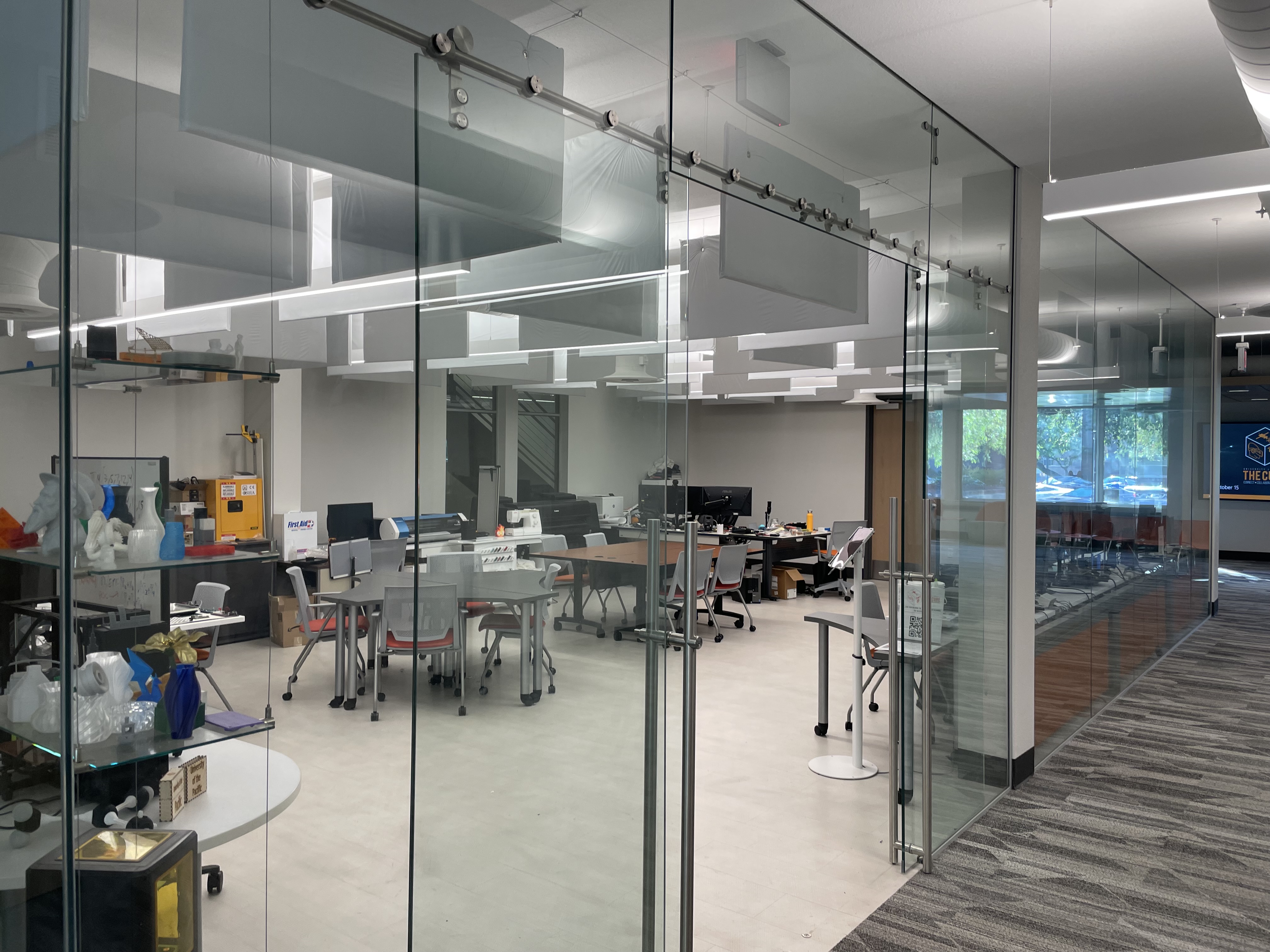
These concerns covered more than just the room dimensions – size, height, HVAC, glass walls, etc…. there were functional requirements for collaboration, classes, and workshops. The overwhelming acoustic problems involved the near constant noises generated by the vast array of equipment in this space – sewing machines, large format printers, plotting cutters, 3D printers, scanners, and every other modern tool for allowing the creative minds at their school to create. It was a cacophony of stepper motors, fans, and moving parts – which made collaboration very difficult.
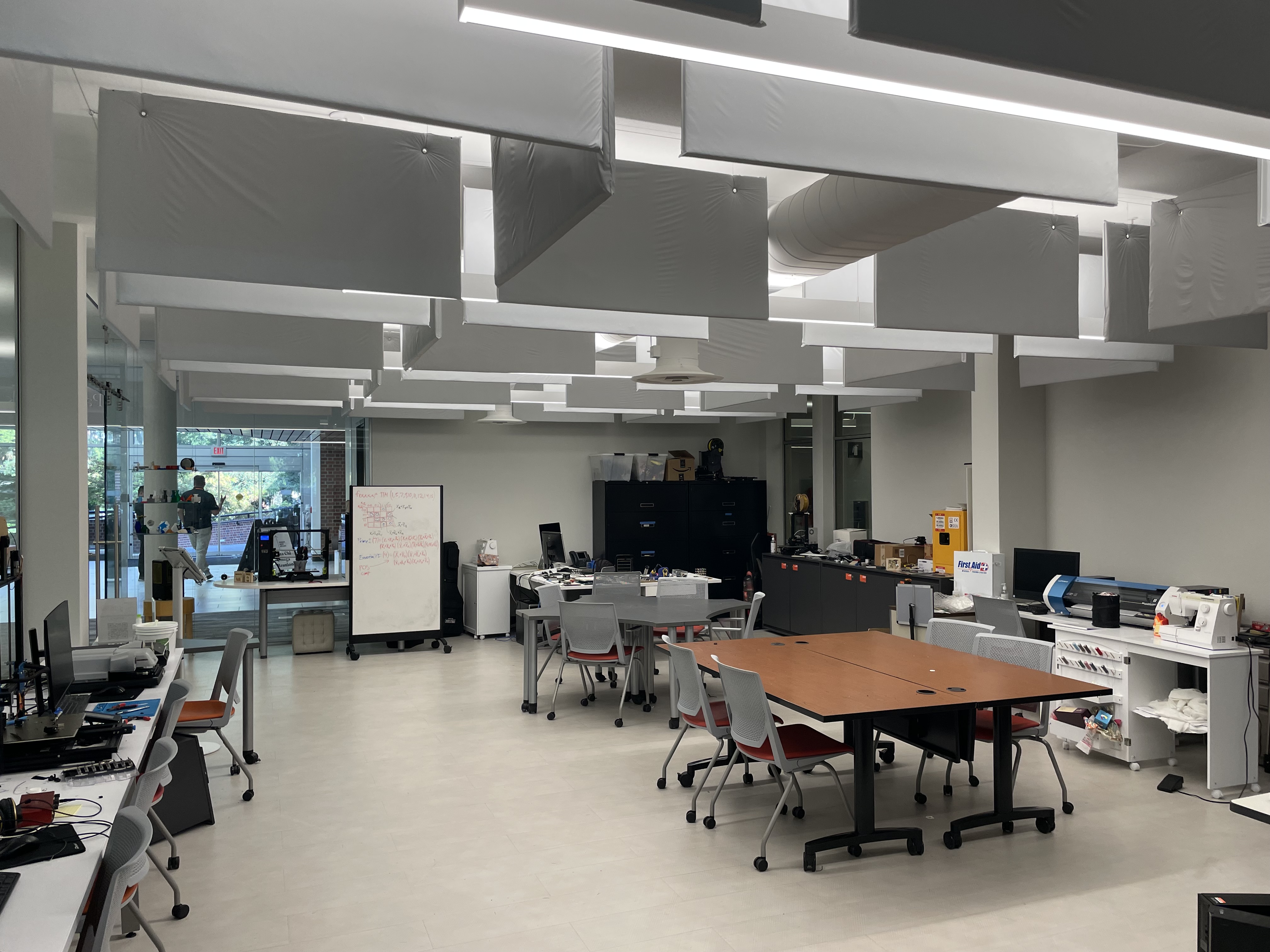
The other parameter that needed to be maintained was the ability to reconfigure the layout of the equipment without affecting the acoustic treatment in the space. This removed almost all of the walls in the space as possible locations for treatment. This left the ceiling as the only viable space left for treatment, but with an array of lights and exposed HVAC systems, there were few treatments that would be easy to implement and still be effective.

The decision was made to creatively weave Cloudscape® Baffles into all the spaces available in the ceiling. Dodging duct-work and suspended lighting rails was made possible with careful planning and execution – and the results were immediately notable. (Also noticeable was that the baffles had very little impact on the lighting which is vital in any makerspace.)
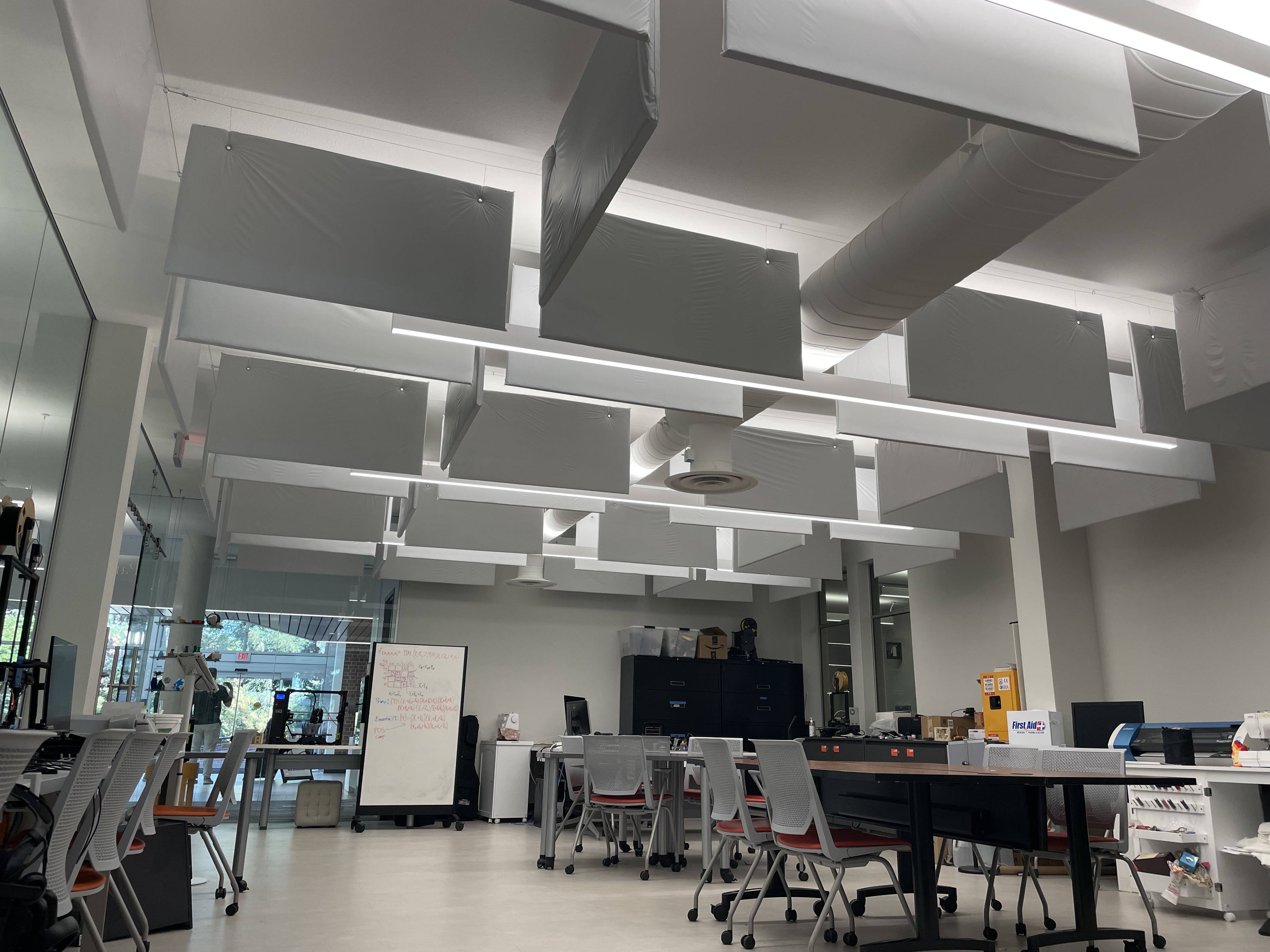
“…The sound baffles you recommended finally got installed in my makerspace about two weeks ago and I wanted to send a quick thank you since they’ve made a very noticeable acoustic difference to the room, and it’s a lot more pleasant in here now. “
Chris Crawford – Innovation Spaces Manager (University of the Pacific)
 Acoustics First BLOG
You must be logged in to post a comment.