Archive for category Product Applications
Yocumtown gets Peace and Quiet
Posted by Acoustics First in Absorption, Customer Feedback, Gymnasium, Multipurpose Rooms, Product Applications, School & Educational Facilities, Theater, Worship Facilities on May 14, 2014
Yocumtown Church of God had a bit of an issue with their multipurpose room – They couldn’t understand anything anyone was saying.
While the space was designed well with a full court, dampers on the HVAC, a stage, movie screen and a good speaker system – they couldn’t overcome the poor acoustics of the space. A great deal of work had gone into the design and they wanted an unobtrusive way to treat the acoustic problems… enter Acoustics First.
We started the work of gathering information about the space; dimensions, some pictures and a few balloon pops.
Here’s what we got.

Big Gym – perfect example of a common problem space.
Wow! This room is big, all the surfaces are parallel and hard, there’s very little to break up the sound… You can almost imagine what it sounds like.
You actually don’t need to imagine. Here’s a balloon pop. CLICK HERE!
What you’re hearing is about 3.5 seconds of reverberation after the balloon pop. (Not good.)
So, whatever shall we do? How will we tame this space?!?!?! Will they ever be able to have movies for youth groups!?
Sure they will! We have Joe. You remember Joe from the Sabot School Big Room Big Boom Post?
Well, I would say that Joe has a 6th sense for hearing, but since that’s one of the 5 standard ones anyway, we’ll just say Joe has great ears – and they should be. Joe’s been using his ears as his primary tools for the past 40+ years; from Studio Engineer to Acoustic Engineer. His ears are tuned instruments, and we rely on his expertise with them to get the job done right – time and time again. (He also makes a mean spreadsheet.)
So after listening to the room, looking at the data, and running some numbers – Joe magically answers the question of what do they need? (Ok it isn’t magic – Joe’s just really good at this… did I mention his spreadsheet skills?)
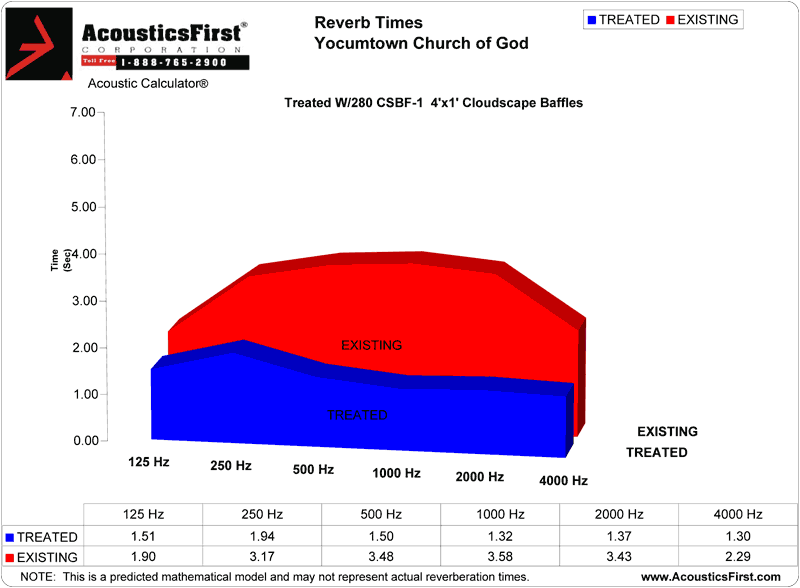
When he says, “this is what you need,” he also shows you what you have and what it will do.
So Joe says, “You put 280 – 4’x1′ Cloudscape®baffles up on that ceiling and you’ll bring that room down from about 3.5 seconds to about 1.5 seconds.”
Joe knows.
So, Yocumtown goes from a 3.5 second balloon pop (Here) to a 1.5 second balloon pop (Here).
Not only does it look great…

NICE!
… But now they say that they can watch movies and it sounds just like you’re in a movie theater.
That’s about the best compliment you can give us.
(And the best compliment I can give Joe is, his calculation for RT60 time was about 1.5 seconds. When I ran the measurement of the “treated balloon pop” – I got 1.501 seconds. This is why we have Joe – he can tell you what you will get, before you even start!)
Barrett’s Technology Solutions has a Happy Easter
Posted by Acoustics First in Absorption, Customer Feedback, Diffusion, Home Theater, Media Room, Product Applications, Theater, Uncategorized on April 20, 2014
Sometimes at Acoustics First we get a call from someone who is so knowledgeable that we can’t help but be tickled that they called us to help them. We received one such phone call from Pete Heskin at Barrett’s Technology Solutions in Naperville, IL.
Pete and his team were putting together an acoustic treatment for a listening room at their facility and wanted the room’s acoustics to really showcase their lineup of high-end audiophile speakers. No joke here – these guys have over 50 years of experience in the audio industry – and they keep on the bleeding edge of audio and video. This treatment is serious acoustic business – and these are some of the most discriminating ears in audio.
Happy Easter guys!

Happy Easter Guys!
In keeping with their high-standards and cutting edge approach, they were looking for an acoustic treatment that is as visually stunning as it is capable of treating a room containing some of the world’s greatest sound sources. As you can see, the results are simple and elegant.
The room contains an array of Sonora® panels, Silent Pictures® and clusters of ArtDiffusor® Model D‘s to make this space sound as good as it looks. (While all of their gear makes the gear junkies at Acoustics First drool…)
So, if you find yourself near Chicago, or on a “Wayne’s World” pilgrimage, stop into Barrett’s – and if you fancy yourself an audiophile – put your money where your ears are, and hear how discriminating ears listen to music…
… No Stairway to Heaven.
Quiet that fan… Ceiling Fan – With Vib-X
Posted by Acoustics First in DIY, HOW TO, Product Applications, Products on December 10, 2013
Airflow is good. Circulating stagnant air has many health benefits, but what do you do when that ceiling fan is just making too much noise?
To start, check all the normal suspects; is it balanced, cleaned, level, blah blah blah… You’ve probably already checked these anyway. It’s an older fan, the motor hums, because older fans hum. If it’s vibrating through the structure, there may be something you can do to isolate that extra vibration – and at least keep the other occupants happy.
When most people think of Vib-X pads, they think of a musical function; Isolate your speakers, isolate an amplifier, isolate a (insert name of miscellaneous musical gear here)… but there are some really useful everyday functions for this wonderful material. Like keeping that fan from vibrating the entire house!

Isolate that ceiling fan with Vib-X!
The simple install may involve a contractor, or at least some one who knows electricity, so you don’t electrocute yourself… but after shutting off the power to the fan, it’s pretty quick. Take down the fan and find the box. Disconnect the box. Cut some Vib-X to separate the box from the wood. Cut some Vib-X squares to use as washers. Remount the box using the diagram, a couple fender washers, maybe a couple optional grommets if you desire – then re-install the fan.
Ceiling fans are usually mounted to an electrical junction box in the ceiling, which is usually just screwed to a ceiling joist or some simple wooden frame. By using the Vib-X to isolate the electrical box from the wood, the vibrations do not directly transfer from the fan into the structure of the house, turning that old, vibrating ceiling fan – into a breath of fresh air.
Simple. Thought so. Don’t forget to balance, level, and clean that ceiling fan while you’re doing all this. Turn that power back on and enjoy the breeze.
Model D @ DesignDC & WBWV
Posted by Acoustics First in Broadcast Facilities, Diffusion, Product Applications, Products, Recording Facilities, Recording Studio, Uncategorized on September 12, 2013
That’s right. Acoustics First will be unfurling some of the wrapping and exposing the newest addition to the ArtDiffusor® Family of diffusers… the Model D. Where can you see it?

DesignDC 2013
September 25-26th, 2013
Walter E. Washington Convention Center, Washington DC
Acoustics First will be set up in the main exhibit hall (in Booth 507), showing off the Model D, the newest release into the ArtDiffusor® family. Come on down to see for yourself what all the noise is about – pardon the pun.
Another interesting development is the first install of Model D’s in a Broadcast studio. In a move to “liven-up” the very “dead” studio to better accommodate the live recording of in-studio musicians, WBWV 88.7 FM in Beckley, WV pointed to the New Model D as their solution.

WBWV 88.7 FM Beckley, WV
FInally, don’t forget that you can check out any new developments or products at Acousticsfirst.com, where the Model D page has a couple “Bonus Features” like:
- How diffusion works Video.
- Photo Gallery
- Early “Alien” promo video
- Model D Pattern Designer
Big Room… Big Boom.
Posted by Acoustics First in Absorption, Art Galleries, Auditorium, Customer Feedback, Gymnasium, Multipurpose Rooms, Music Rehearsal Spaces, Products, School & Educational Facilities, Teaching Rooms on August 22, 2013
When Pippin Barnett contacted Acoustics First about an acoustical issue he was having with a new multipurpose space that was constructed for the Sabot School, he was in desperate need of a solution. This space was needed for functions, activities, art displays, music classes, plays, and more, but was almost completely unusable due to the acoustics.
 The large space was well conceived; large open floor plan, hydraulic door to open the space to the courtyard, bathrooms, storage and lots of display space for the student’s artwork and creations. The building was also efficiently constructed using SIPS (Structural Insulated Panel Systems), which created a grand open space with no support pillars.
 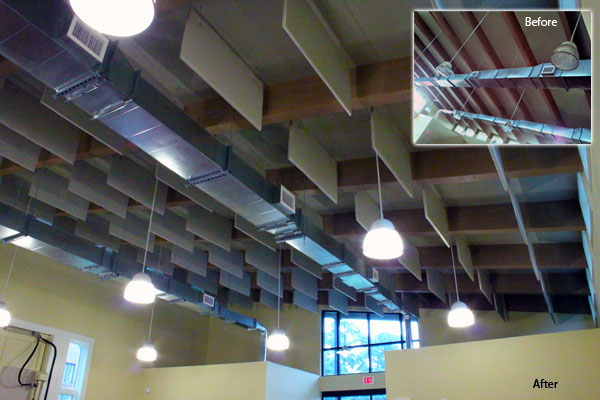 This space was ready to be used, but there was a problem – whenever they tried using the space, you couldn’t understand what anyone was saying. To say that the acoustics were “not optimal” is like saying that the destruction of the entire universe would be “inconvenient” – an incredible understatement.
Upon arrival, we took some physical measurements of the space to calculate the surface area and volume of the room, as well as got some acoustic measurements.
Click here for a balloon pop before acoustic treatment.
Whoa… Big Boom! What you are hearing is a 3+ second RT60 time; That’s more than 3 seconds of time that the sound lingers in your space at a level audible enough to interfere with other sounds.
Which is “Inconvenient,” and “Not Optimal.”
So with some magic calculations performed by Joe Horner over at the quietest office in Acoustics First,(no really – he likes it really quiet,) a solution was developed to create a space that sounded as good as it looked.
Joe prescribed 100 2’x4′ Cloudscape ceiling baffles as well as 157 sq ft of 1″ thick Sonora Wall panels to cover the solid hydraulic door – and we listen to Joe (he’s done this a lot!)
So, a short while later, the Baffles and Panels are installed and we receive an e-mail from Pippin…
“I’d say you were right on the money!”
Click here for a balloon pop after acoustic treatment.
RT60 from 3+ seconds down to right about 1 second. I’d say that’s right on the money too, Pippin!

The Sabot School regained the use of its space and everyone lived happily ever after.
I love happy endings.


You must be logged in to post a comment.