Archive for category Sound proofing
Reverberation, the Invisible Architecture
Posted by Acoustics First in Absorption, Articles, Sound proofing on June 13, 2016
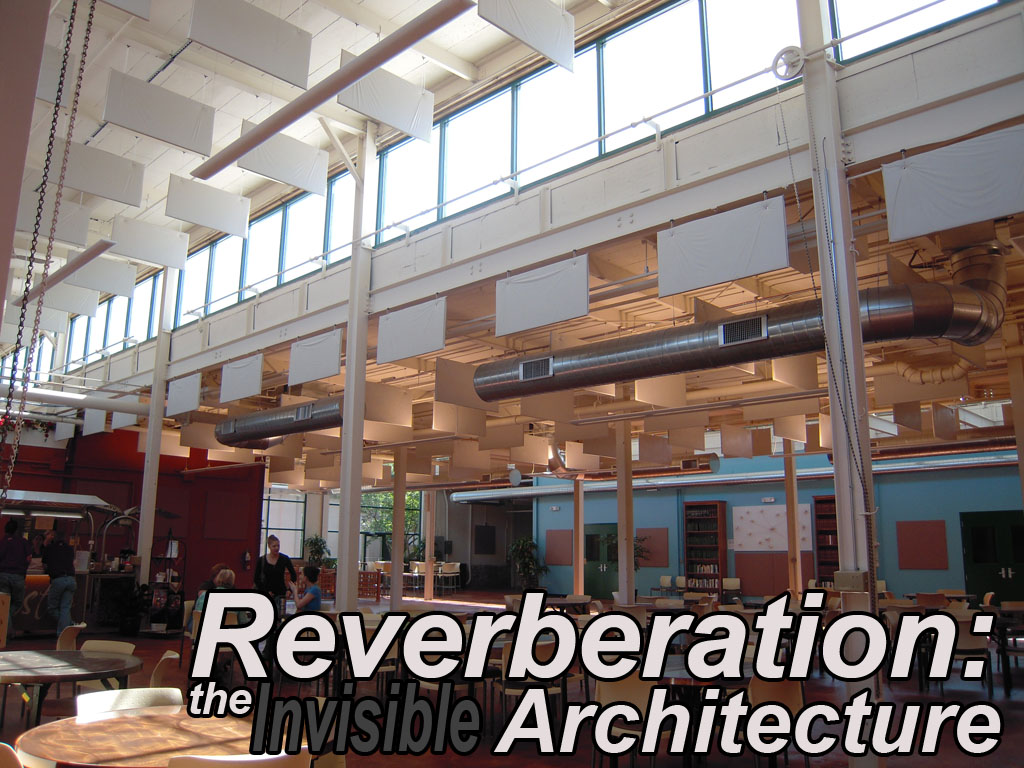
Cloudscape® Baffles and Sonora® Panels change the sonic architecture – making the space sound smaller and more intimate.
Ever wonder what gives us a sense of space? Obviously, our eyes visually tell us what’s going on, but there are other senses that contribute. Peak your head into a dark front hall closet, and even without seeing much, you can “feel” the close proximity of the walls and perhaps even the presence of the coats. Walk in to New York’s Grand Central Station, and you are confronted by a completely different sensation. Close your eyes, and the raucous environment tells you are in a large room with a lofty ceiling. Often times we take for granted the relationship that sound has to our spatial perception.
This sonic “sense of space” can be generally attributed to the room’s reverberation qualities. In simple terms, reverberation is the sound energy that remains in the listening environment as a result of lingering reflections. Reverberation time (RT or RT60) quantifies how quickly an impulse sound decays in a space. RT60 is how quickly the amplitude (volume) of short exciting signal decreases by 60dB in a large room. Reverberation time is dependent upon the volume and surface materials of a given room. Large spaces with hard materials (tile, drywall, etc.) like Grand Central Station have longer reverberation times, while small rooms furnished with “softer” materials, like the coat closet, sound much more “dead”.
Excessive reverberation is one of the most common acoustic issues that we encounter on a daily basis. As you may have experienced at some point, it’s difficult to understand what is being said when reflections from old information cover up what is newly spoken. In spaces where speech intelligibility is paramount, like classrooms or conference rooms, a short reverberation time (under 1 second) should be targeted.
That said, sometimes a long reverberation time is desirable. In spaces like cathedrals and orchestral halls, reverberation helps create ambience for the audience by sustaining musical notes, while allowing choirs and orchestras to blend more easily. These spaces may lack a sound system, and instead utilize the room to propagate sound. Rock venues, on the other hand, have amplified instruments, so a medium-short reverb time is needed to ensure that the music won’t become “muddy” and difficult to perform and enjoy.
There are a number of questions that an acoustician must ask when recommending appropriate treatment. These questions include, but are not limited to: Is there live music in this room? What kind of music is being performed? Is speech intelligibly important? What’s the audience size and where are they in relation to the sound source? So, the ideal amount of reverberation in a space is wholly dependent on the use of the space.
Listed below are the ranges of “ideal” reverberation times at mid-frequency (average of 500 and 1000 Hz) for a variety of rooms. The numbers are derived from David Eagan’s Architectural Acoustics (New York: McGraw-Hill, 1988), in which he breaks down rooms into Speech, Music and Speech/Music spaces. We hope you find this helpful.
Optimum Reverberation Times (T60)
“Speech” Rooms
Recording and Broadcasting Studio – .3 to .7 seconds
Classroom (elementary size) – .6 to .8 seconds
Conference/Lecture Room – .6 to 1.1 seconds
Intimate Drama – .9 to 1.1s“Speech & Music” Rooms
Cinema – .8 to 1.2 seconds
Small Theaters – 1.2 to 1.4 seconds
Multi-Purpose Auditoriums – 1.5 to 1.8 seconds
Worship Spaces – 1.4 (Churches) to 2+ seconds (Cathedrals)“Music” Rooms
Dance Clubs and Rock Venues (w/ Sound System) – 1 to 1.2 seconds
Semi classical Concerts/Chorus (w/ Sound System) – 1.2 to 1.6 seconds
Symphonic Concerts (Classical) – 1.6 to 2.3 seconds
Liturgical (Organ/Chorus) – 2+ seconds
Contact Acoustics First to have our acousticians help you find the ideal reverb time for your space.
Exploring Green Acoustic Treatment: Sound Channels® Acoustical Wall Fabric
Posted by Acoustics First in Absorption, Press Release, Products, Sound proofing on March 15, 2016
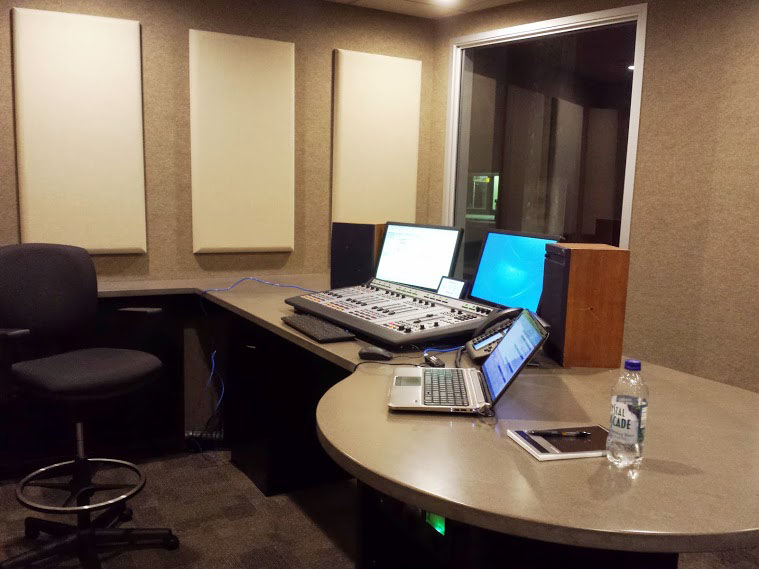
Sound Channels® Acoustical Wall Treatment – Made from Plastic Bottles?
Buzz words like “renewable”, “100% recycled” and “eco-friendly” seem to be everywhere we look, from coffee cups to building codes. This preoccupation with all things “green” has long passed the point of being just another fad. The desire for environmentally responsible products has shifted from being simply in vogue to being firmly requisite.
Leadership in Energy and Environmental Design (LEED) certification has become a standard benchmark for most modern buildings. To achieve the most points towards a LEED certified building, many architects are looking for “green” materials that show a commitment to the environment and responsible, eco-friendly practices. This includes the focus on materials that go beyond how much is used; to get a better understanding of what’s in the materials they specify for buildings and the effect those components have on human health and the environment. LEED certification also requires a more performance-based approach to indoor environmental quality to ensure improved occupant comfort. Specifying Sound Channels® acoustic wall fabric can help designers realize the above goals.
Obviously, specifying acoustic materials that use recycled content gets big points towards LEED certification. That said, the use of recycled content for acoustical products is not necessarily unique. For example, the fiberglass substrate for our Sonora Panels are made of 52 percent pre-consumer and 5 percent post-consumer recycled content. What is truly unique is the extent that Sound Channels® utilizes the waste product of one of our most widespread habits: the use of plastic water bottles.
Sound Channels – Recycled Textiles by the Numbers:
One yard of Sound Channels® acoustic wall fabric utilizes 15 post consumer plastic bottles. Recycling one ton of plastic from bottles saves approximately 7.4 cubic yards of landfill space. This means that 36.5 million pounds of Sound Channels® fiber saves 365 million bottles from landfills, 91,250 barrels of oil and over 64,000 tons of emissions!
How does a discarded plastic bottle become wall fabric? Let’s take a look at the process…
First, bottles are picked up at recycling centers then sorted by type and color. Then labels and caps are removed; the bottles are washed, crushed and chopped into very small pieces called “flakes”. These flakes are melted down and color is added. Lastly, anti-microbial technology is added before the product is made into Sound Channels® acoustical wall fabric. Sound Channels® then can be recycled back into fiber at the end of its life cycle.
Besides the “green” benefits, there are performance advantages with Sound Channels® acoustic wall fabric. The anti-microbial technology incorporates silver and copper ions into the root fiber which naturally attack microbes. This technology works against the types of airborne bacteria that we are most concerned about, making this product ideal for hospitals and classrooms.
Recently, an improved design has increased its sound absorption by 25% (NRC of .25). The uniform coverage you get with treating the walls with Sound Channels® eliminates the flutter/slap from reflective parallel walls, while helping to control excessive reverberation and noise buildup.
Whatever your application, Sound Channels® acoustical wall fabric and Acoustics First can help you towards your “green” goals!
DIY – Treating a Wall – BlockAid® and SoundChannels®
Posted by Acoustics First in Absorption, Animal Shelters, Auditorium, Broadcast Facilities, Classrooms, DIY, Fitness, Government, Gymnasium, Home Entertainment, Home Theater, HOW TO, Media Room, Multipurpose Rooms, Music Rehearsal Spaces, Music Tracking Room, Product Applications, Recording Facilities, Recording Studio, School & Educational Facilities, Sound proofing, Studio Control Room, Teaching Rooms, Teleconferencing, Theater, Uncategorized, Vocal Booth, Voice Over on July 16, 2015
 On many occasions, we get asked about common ways to treat a wall (or walls) either for broadcast, podcast, or other voice recording scenario – where they not only want to tame the reflections within the room, but also block a certain amount of sound coming into – or leaving the room.
Budget is frequently an issue, major construction is usually unwanted, but effective results are always required.
We’re going to show you how to handle a room upgrade – cut down on the sound transmission and cut the room reflections – all with the same skills required to hang high quality wall coverings! Let’s see how you can cover a wall with BlockAid® vinyl sound barrier to block unwanted sound, then go back and cover that with an absorptive layer of Sound Channels® wall covering to finish it off!
This treatment is not recommended for renters, as this is not an easy upgrade to undo. However, if you have an extra bedroom you are using as Podcast studio, this is a great way to treat it… Let’s get started!
Installing BlockAid®
 1. Measure the wall for the first panel length. Mark the panel width on the wall. |
 2. Measure and Mark the length of the wall on the BlockAid® |
 3. Use a straightedge and a razor to cut the BlockAid®. |
 4. Using a trowel, apply vinyl tread adhesive to the wall, covering the whole area where the first panel is going. (You marked the wall right?) |
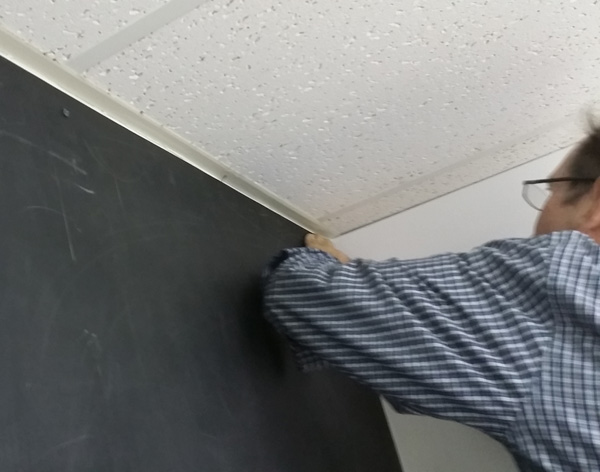 5. Hang the panel starting at the top, install a few screws to hold it in place while the adhesive sets. (You will probably need a friend to help, as BlockAid® is a pound per square foot!) |
 6. Using your hands and a putty knife, smooth out all the air bubbles from behind the BlockAid® so that you get a good bond when the adhesive cures. |
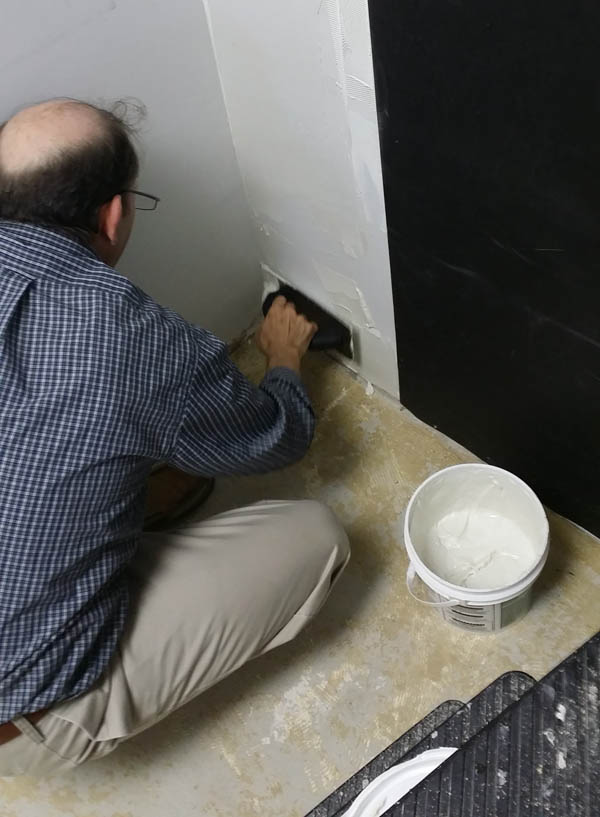 7. Repeat the steps for the next strip. Measure, Mark, Cut, Trowl, Hang… |
 8. Make sure you line up those seams! push them right up agaist each other. Smooth out the air bubbles, cut out any outles, trim any extra… Let dry! |
Good job! Now, take a breather while that dries, and notice how much less sound is passing through the walls. This is when you will notice that the sounds are now coming from under the door, and through the leaky old window. These can be taken care of in different ways…. but the easiest way is the same way you deal with keeping the cold out! Get some weather strip, a door skirt, seal the gaps around the frame of the door, and windows, maybe go out and buy some heavy curtains for the windows… if you have some leftover BlockAid®, you can always get some Industrial Velcro and temporarily stick a piece over the window!
Installing Sound Channels®
 1. Remove the Screws from the BLockAid® – if you didn’t already… then same as BlockAid®, measure the wall, mark it, measure and cut a piece of Sound Channels® and start troweling on the Chapco! |
 2. Well, when you get tired, make your friend finish troweling out the adhesive to cover where the panel is going. (You are going to overlap the seams.) |
 3. Starting at the top, hang the Sound Channels® overlapping the seam of the BlockAid® under it. Smooth out the air bubbles with your hands. Make sure it lines up well. No screws needed! |
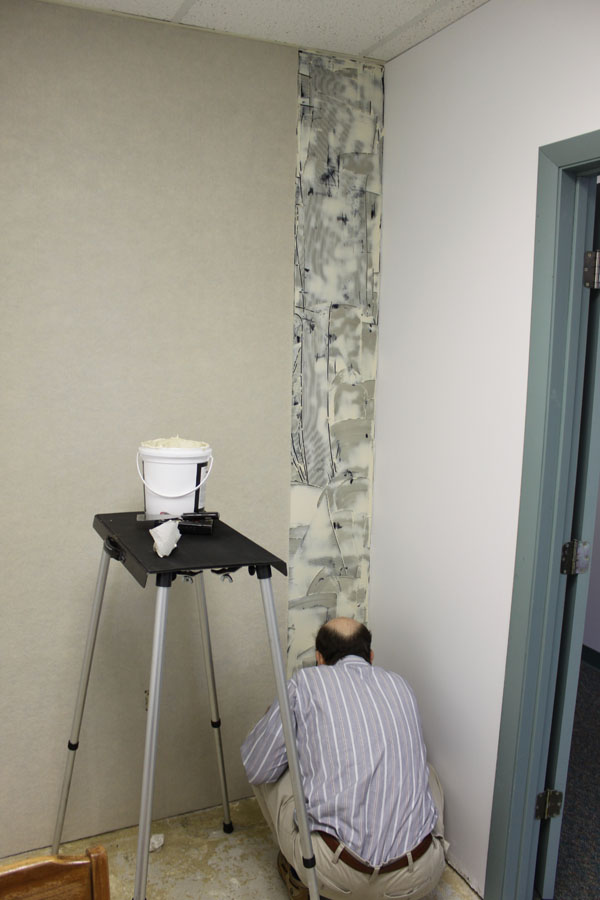 4. Measure and cut the next strip, carefully following a rib in the fabric, while your friend, (who is way better at troweling than you are anyway,) preps the next section with adhesive. |
 5. Best practice is to run the fabric in the same direction every time. Not just with the ribs, but in the same direction it comes off the roll. So find the top. |
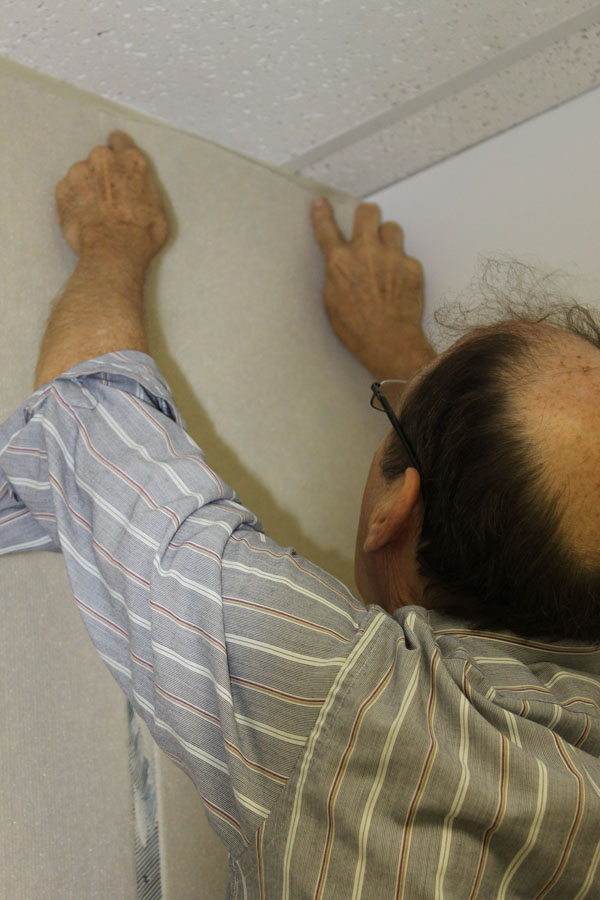 6. After you find the top, start hanging from the top, lining up the seams and smoothing out the bubbles as you go. |
 7. Keep those seams tight as you go. Keep smoothing… almost done! |
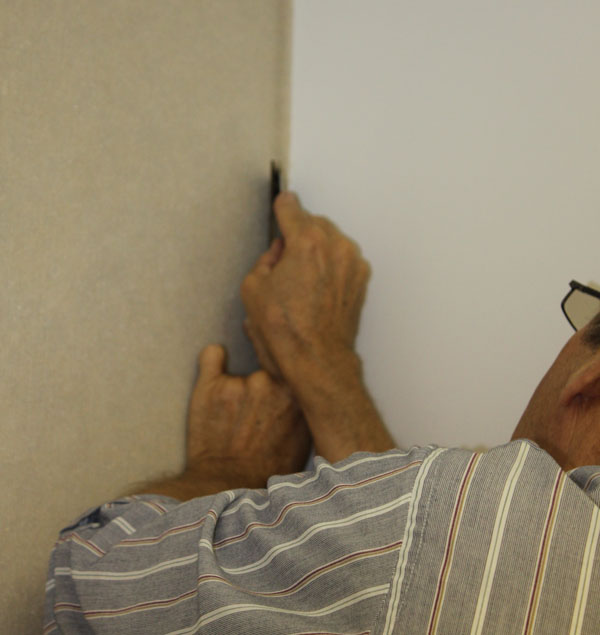 8. Trim up the extra and repeat as many times as needed. |
That’s it!

Don’t forget to trim around those outlets!
This treatment is a common first step in treating many professional broadcast studios – it gives you extra isolation with the barrier and takes the edge of the sound reflections. Many professional environments then go back and add some additional treatments such as bass traps, diffusers, and broadband absorber panels – especially if these studios are planning on bringing in any musical guests.
This isn’t just for home studios. It works great for kids play rooms, bedrooms, home theaters, home gyms, and any place you want to block sound and tame the sound inside the room.
Customize your space as you will, but this treatment is a consistent winner for cost and performance, and is a great way to get started without breaking the bank!
DIY: StratiQuilt™ Room Treatment
Posted by Acoustics First in Absorption, Animal Shelters, Articles, Broadcast Facilities, Construction Sites, DIY, Home Entertainment, Home Theater, HOW TO, Music Rehearsal Spaces, Music Tracking Room, Product Applications, Products, Recording Facilities, Recording Studio, Sound proofing, Studio Control Room, Vocal Booth, Voice Over on June 6, 2013
There are some situations where people are looking for a more temporary (yet still durable and effective) room treatment. Maybe you have a garage, or a practice space, or a place where you are looking for a usable solution that isn’t a permanent installation. Here is a great (not to mention tax deductible) treatment that can address many of the isolation and absorption issues of a space, while remaining durable (Washable), and easy to remove and reuse.

Stuff you need:
- Enough StratiQuilt™ Double-Faced Barrier Blanket to cover all of the wall and ceiling surfaces of the room you need to treat.
- 2”x4” lumber for the edges (Used to attach the barrier to the walls and maintaining an air gap.)
- Short Lag bolts and Washers
- Misc. hardware to attach 2”x4” lumber to walls.
Here’s what you do.
Attach the 2”x4” lumber to the walls with enough spacing to line up the grommets on two overlapped edges of the StratiQuilt™ blankets – if you have purchased the roll, the finished edges are 4 feet wide. Leave enough room to overlap the edges and bolt the quilts to the 2”x4” lumber as shown in the diagram above. Continue around the room, overlapping the edges of the StratiQuilt™ blankets to seal off the room. The blankets can be left loose over doors to allow for entry and egress while maintaining a good acoustic seal.
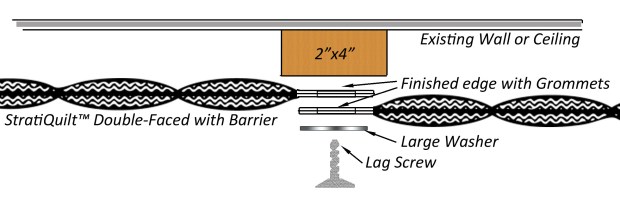
If desired, continue the process across the ceiling to “lock in” the room acoustics. This treatment may be considered by some to be a little on the “dead” side (High Absorption); however, The benefits of the treatment far outweigh this issue, which can be compensated for by adding a few acoustically reflective surfaces to the room (Drum Kit, Amplifiers, Racks, Diffusers, etc.)
Why use this system?
Other than it being very simple to install, take down and move with minor modifications to the structure, it performs a few vital acoustic tasks – all with one product. The StratiQuilt™ design is two layers of quilted acoustic fiberglass with a layer of BlockAid® barrier in the middle. The BlockAid® help the soundproofing of the room by it’s STC of 29, which will add significant isolation to the room. Mounting on the 2”x4” lumber is not just done for ease – adding the air gap behind the barrier increases both its STC and NRC allowing it to work as a limp mass barrier/absorber. The material absorbs on both sides (being double-faced), forcing in-room reflections to be attenuated immensely through the many layers of material it must pass through.
And on a final note, this economical start-up solution has the benefit of not being a “Building Material” for tax purposes, allowing for its immediate deduction as an expense.
Record your garage band without sounding like you’re in a garage, Try StratiQuilt™.
This simple DIY project is provided as a way for our customers to learn better ways to use our products and get more value out of the products they buy. If you are looking for more ways to use the products you have, look to Acoustics First for Ideas. http://www.acousticsfirst.com
————————————————————————————————————————————————————————————
Acoustics First Corporation supplies acoustical panels and soundproofing materials to control sound and eliminate noise in commercial, residential, government, and institutional applications worldwide. Products include the patented Art Diffusor®, sound absorbers, noise barriers, acoustical fabrics and accessories. Acoustics First® products are sold for O.E.M applications, direct, and through dealers. For more information on acoustical materials and their application, please visit www.AcousticsFirst.com or call Toll Free 1-888-765-2900 (US & Canada).
DIY: How to quiet down that noisy equipment rack
Posted by Acoustics First in Absorption, Auditorium, Broadcast Facilities, Data Centers, DIY, Government, Home Entertainment, Home Theater, HOW TO, Media Room, Music Rehearsal Spaces, Music Tracking Room, Product Applications, Recording Facilities, Recording Studio, Sound proofing, Studio Control Room, Vocal Booth on May 2, 2013
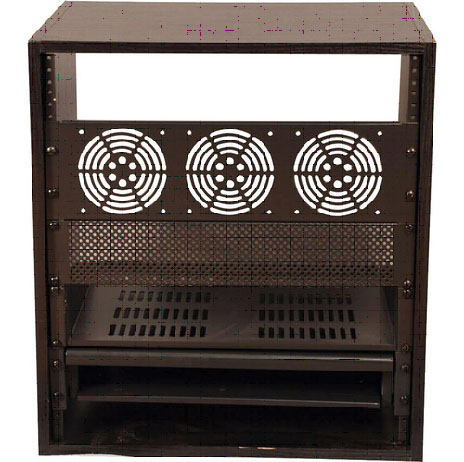 DIY Project – Rack issues
Take a few seconds and DIY fix some of the common problems with using equipment racks!
Not too many people think about their equipment racks, but many of us use them. Usually it’s something like what you see to the right – the great, sturdy, utilitarian box. Unfortunately, there are a couple inherent problems with these:
- Ringing – The metal resonates causing a ringing effect – may be masked by program material.
- Reflections – many times your rack is near sound sources causing reflections off the hard surfaces.
- Noise – Fans and other devices in the rack can make noises that are disruptive to recording.
Here are a few DIY fixes for these common problems.
- Composite foam with adhesive backing is perfect for stopping the ringing of filler panels.
- FireFlex™ acoustical foam the inside of your rack to keep the noise down.
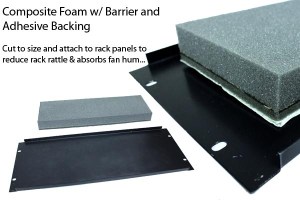

- Use some Composite Foam to line your trays, drawers and shelves to keep items from rattling around inside the case.
- Cover your rack in Sound Channels® fabric to keep the case from causing harsh reflections.
- Make a temporary cover for the front and back with BlockAid® sound barrier with minimal ventilation cut-outs to use during takes if rack-borne noise is problematic.
This simple DIY project is provided as a way for our customers to learn better ways to use our products and get more value out of the products they buy. If you are looking for more ways to use the products you have, look to Acoustics First for Ideas. http://www.acousticsfirst.com
————————————————————————————————————————————————————————————
Acoustics First Corporation supplies acoustical panels and soundproofing materials to control sound and eliminate noise in commercial, residential, government, and institutional applications worldwide. Products include the patented Art Diffusor®, sound absorbers, noise barriers, acoustical fabrics and accessories. Acoustics First® products are sold for O.E.M applications, direct, and through dealers. For more information on acoustical materials and their application, please visit www.AcousticsFirst.com or call Toll Free 1-888-765-2900 (US & Canada).
 Acoustics First BLOG
You must be logged in to post a comment.