Archive for category Product Applications
Demystifying Acoustic Data: Part 1 – Absorption vs Isolation
Posted by Acoustics First in Absorption, Articles, Product Applications, Products, Sound proofing, Video on August 16, 2016
For anyone new to the world of acoustics, there is a multitude of terms, coefficients and numbers that are thrown around. This flood of information can seem intimidating, especially to beginners. In this series, acoustician Cameron Girard of Acoustics First® hopes to help you distinguish between what’s useful and what’s not.

Part 1: Acoustic Terminology – Sound Absorption vs Sound Isolation
In order to make informed decisions about acoustical treatment, it is vital to know the difference between materials that are meant to absorb sound within a room and materials that are meant to block sound from leaving or entering it. In an overly reverberant auditorium, absorptive treatment is needed to reduce echoes and improve speech intelligibility. If the problem is sound passing in between spaces, like offices or apartments, then isolation treatment is required. These are two separate acoustic issues which require separate solutions.
In both scenarios, it is important to know which data is relevant and helpful. Also, given sheer volume of information available on the internet, it is perhaps unavoidable that some info will be incomplete or simply incorrect. It should not be assumed that something which sounds technical is, in fact, backed up by proper testing.
Terms for Sound Absorption
We recently encountered an acoustical ceiling tile which was said to “absorb 50% of sound”. On the surface this sounds like an extremely efficient product. However, let’s delve in closer and decipher what is actually usable information, and what is just marketing.
When sound waves meet a room surface such as a wall, ceiling or floor, some of the sound energy is reflected back into the room and the rest is considered to be “absorbed”. The absorbed sound energy has not vanished, it’s actually been converted into kinetic (vibration of a solid material) and thermal energy (heat due to friction within a porous material) or has simply passed right through the material (transmission). The more surface area a certain material has the better absorber it will likely be. “Soft” materials, like heavy blankets, fabric and fiberglass, have loads of nooks and crannies, which sound tries to “fill”. These porous materials are great for reducing reverberation within a room, but will only marginally reduce the sound that leaves it (but more on that later).

Sonora® wall and ceiling panels are used for absorbing sound within a space.
When comparing sound absorbing products, there is a particular set of terms you should look for: The Sound Absorption Coefficient (SAC) and Noise Reduction Coefficient (NRC). These are used to specify the fraction of incident sound that a material absorbs per 1’x1’ area. An NRC of 1.0 indicates perfect absorption (an open 1’x1’ window) and a value of 0.0 represents perfect reflection (polished concrete has an NRC of .02).
To measure sound absorption, a large sample of the material is placed in a reverberation room with all other surfaces being hard and reflective. The time it takes a test sound signal to decay by 60dB (rough point of inaudibility) after the source of sound is stopped is measured first with the sample in the room and again with the room empty. The difference in decay time defines the efficiency of the absorbing material and thus the absorption coefficients. Large spaces with low-NRC materials (tile, drywall, etc.) have longer reverberation times, while small rooms furnished with high-NRC materials sound much more “dead”.
Clearly, a single 2’x2’ ceiling tile is not going to reduce the reverberation in a real-world space by 50%. So is the above claim false? Not exactly… The ceiling panels do have an NRC rating of .50, so the tile does absorb 50% of incident sound. However, one might assume a much more drastic improvement based on the “50%” claim. In reality you’d need a large square footage of these ceiling tiles to cut the amount of total reflected sound in half. Always be sure to check the NRC number!
Terms for Sound Isolation
Our customers often call with issues related to neighbor noise or office-to-office privacy and are looking for “sound proofing” treatment. Unfortunately, many do not realize that simply installing acoustic foam or fiberglass panels will not appreciably reduce the level noise entering and leaving their space. These absorptive materials are great at reducing unwanted reflections within a room because they are porous and air/sound energy can flow through them. That being said, they are generally poor sound barriers for this exact reason. They will help to reduce noise buildup in a room and improve the ‘acoustics’, but will do very little to “block” sound coming in or out.

BlockAid® is a heavy, impermeable barrier for stopping the transmission of sound.
Sound is like water; it will “flow” into an adjacent space if everything isn’t sealed up. Materials that are air tight and heavy, like our BlockAid® sound barrier, provide the most relief of air-born sound transmission. Continuous coverage of floors/ceilings or walls is necessary to ensure that sound doesn’t ‘flank’ around these barriers. Multiple layers of varying materials, the use of resilient clips or channels, and additional walls will provide even more control. For a demonstration of how different materials affect sound isolation, check out our video http://acousticsfirst.com/educational-videos-the-barrier-and-the-bell.htm
Like NRC for sound absorption, there is also a laboratory tested figure that can be used to compare the sound “blocking” properties of acoustic barriers and wall constructions: Transmission Loss (TL) and Sound Transmission Class (STC). These describe how much air-born sound is attenuated through a given material.
In the lab, the material to be tested is mounted over an opening between two completely separated rooms, one with a speaker (source) and the other with a microphone (receiver). Save for the open “window”, these rooms are completely isolated with thick and massive walls, so virtually all the sound energy transmitted between rooms will be through the test specimen. The difference between sound levels in the source room and the receiving room is the transmission loss (TL). The TL is measured at multiple frequencies, which is fitted to a Sound Transmission Class (STC) “curve” at speech frequencies (125Hz-4kHz). The STC of the material is the TL value of the fitted curve at 500 Hz. For example, a material with an STC of 27 typically “blocks” 27dB of sound. Keep in mind though, the STC’s of materials do not add up linearly; in other words, adding a material with an STC of 27 to an existing wall with an STC 45 will not result in an STC of 72.
As always, Acoustics First is here answer questions and help you find the best solutions.
DIY – Back Wall Diffuser Array/Bass Trap: Revisited
Posted by Acoustics First in Absorption, Articles, Broadcast Facilities, Customer Feedback, Diffusion, DIY, Home Entertainment, Home Theater, HOW TO, Media Room, Music Rehearsal Spaces, Music Tracking Room, Product Applications, Recording Facilities, Recording Studio, Studio Control Room, Teleconferencing, Theater, Vocal Booth, Voice Over on July 14, 2016

DIY – Diffuser Array/Bass Trap
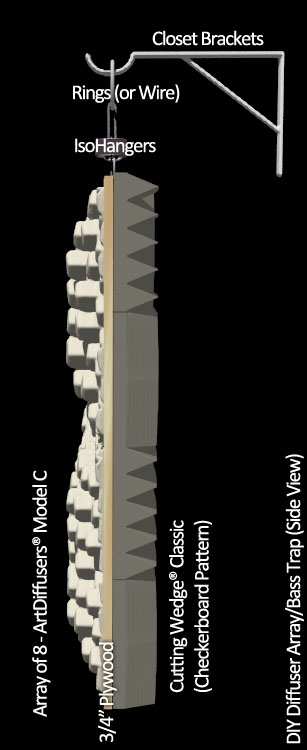 This month we thought we’d share a few Real-Life pictures of an idea we first introduced back in summer of 2013: The “Back Wall Diffuser Array/Bass Trap”.
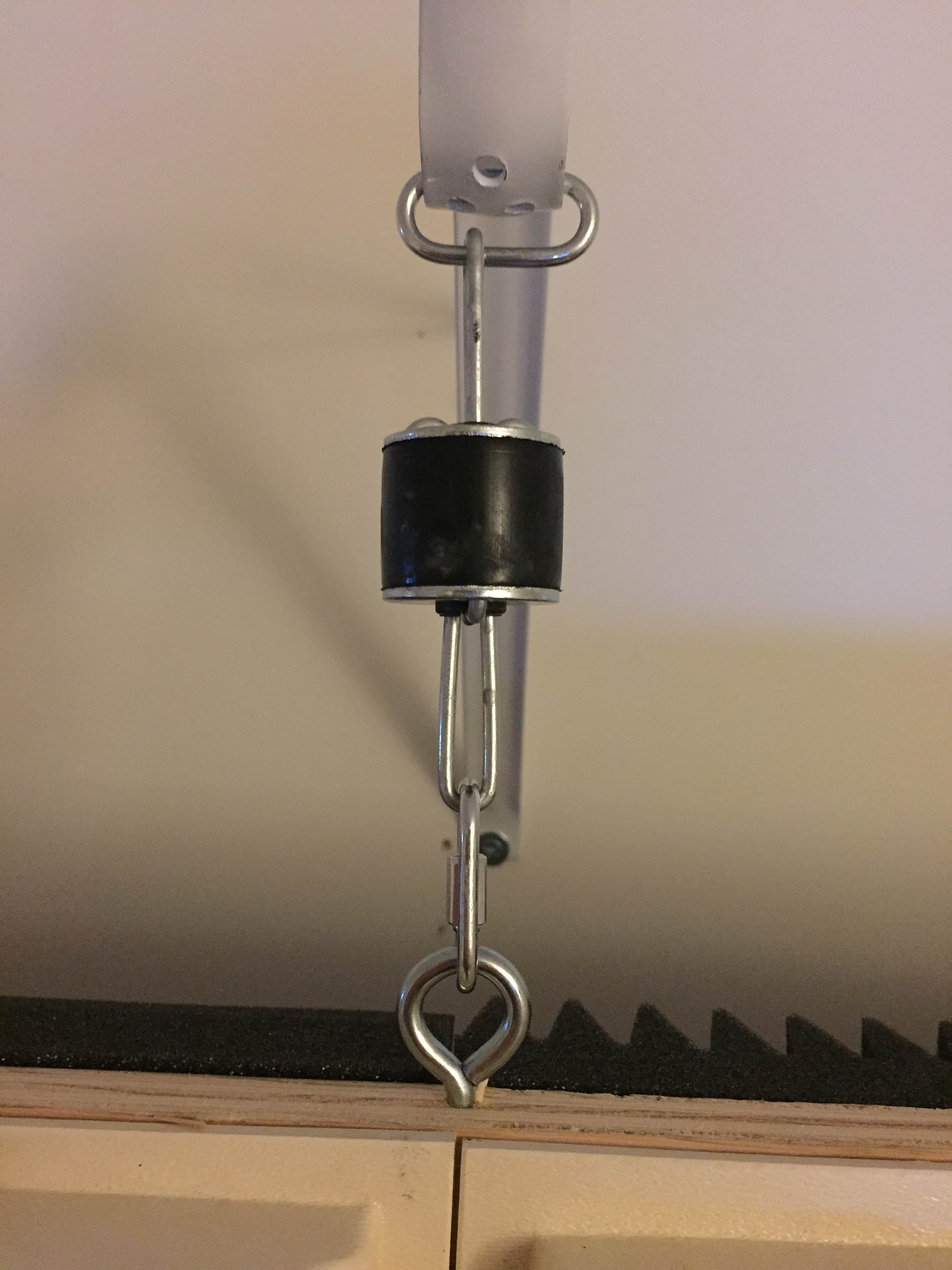
Isolation Hanger
This is the DIY project which incorporates our Art Diffusors®, Cutting Wedge® foam and a couple of isolation hangers into one large free-floating unit, which is acoustically decoupled from the wall.
This particular array was put together by a music producer/bass player for his home. As you can tell from the pics, the construction of this unit was executed beautifully and it’s very close to the original concept drawings.
It’s never too late to get started on your own DIY project.
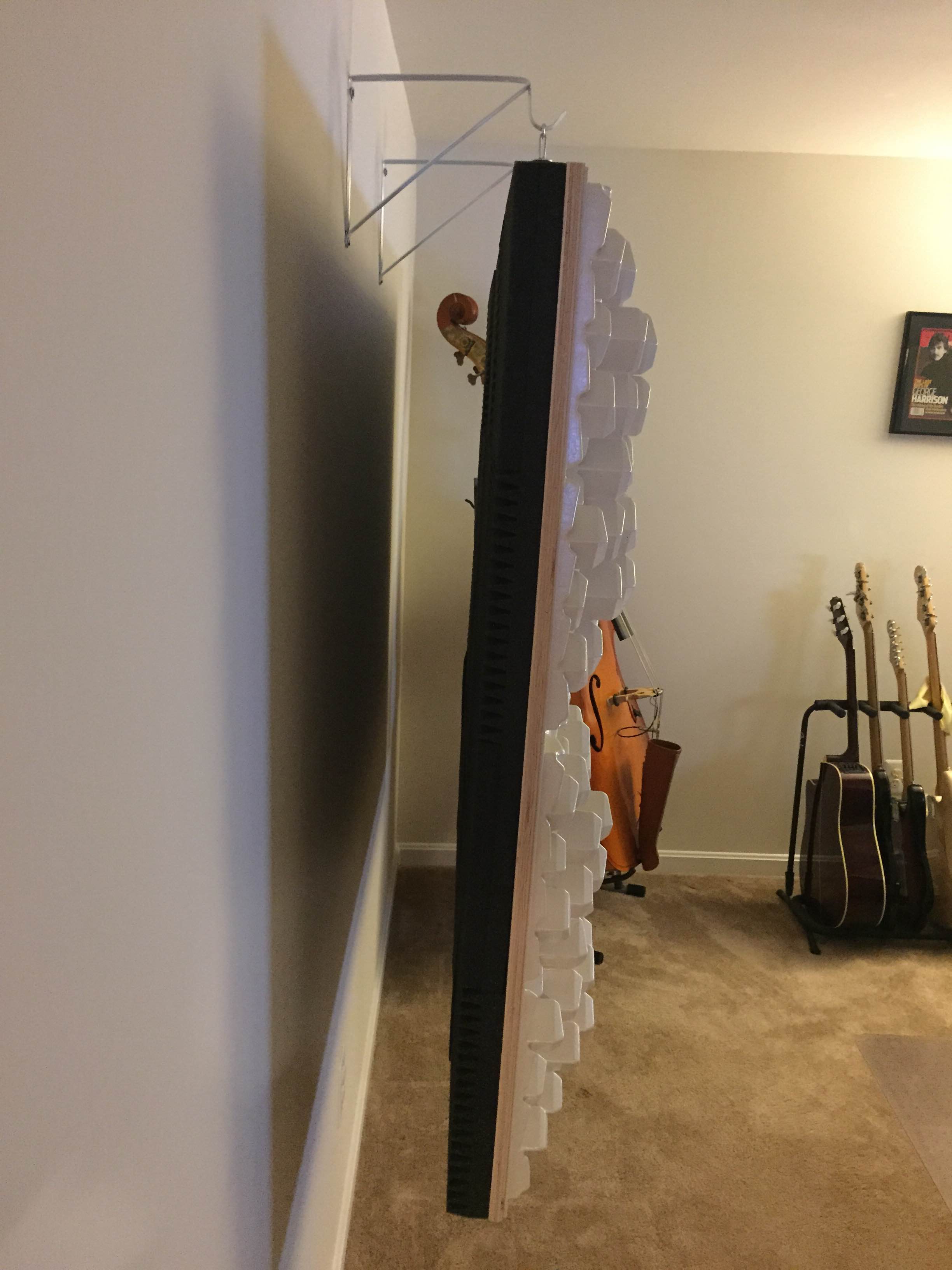 Real World – DIY |

Visit the Original DIY page to find out how to make your own.
Acoustic Treatment for your Home Theater or Listening Room
Posted by Acoustics First in Absorption, Diffusion, DIY, Home Entertainment, Home Theater, HOW TO, Media Room, Products on January 19, 2016
Any good theater or listening is acoustically treated to ensure the sound coming from the speakers is what arrives at the listener’s ears. Conditions common in small/medium rooms, such as flutter echo and comb filtering, degrade the clarity of music and speech. Here are some tricks to get a full and accurate sound out of your home theater or listening room. For those visually inclined individuals, the accompanying video shows how a critical listening space would ideally be treated.
Bass Traps – low-end control
Low frequency problems are common to almost any room, regardless of size. The good news is that most of the time the solution is simple. By installing bass traps in the corners of the room you can prevent the excessive bass build-up. If bass frequencies are allowed to build in the corners, it causes the bass frequencies to become muddy and undefined. The more corners you cover with a good trap, the better bass response you get from the room.
Having bass traps in all corners is best. That said, if you only have budget for two, having bass traps in the front corners of the room should be the highest priority. Fabric wrapped absorbers look as good as they sound, and Geometrix™ by Acoustics First, fit the corners like a glove.
Broadband Absorption – tame the ring.
To control the flutter echo caused by reflective parallel walls, it’s vital that the first refection points are treated with broadband absorption (wall panels). More than likely, your TV and/or sound system is in a fixed position, and your listening position will be relatively fixed as well. This should make the early reflection surfaces easy to locate. Sound travels in all directions from the speaker, including behind it, so put absorbers behind it on the wall. Don’t forget the floors, ceiling, and the wall behind you – sound will bounce off those as well.
Hang broadband absorbers over all the early reflection points – left, right, front and back so they are centered at ear height. Placement is the first key to getting this reflection free zone. The second is the right choice of absorber. To match your fabric wrapped bass traps, the simple choice is get some more panels wrapped in fabric. The Sonora® line of broadband absorbing panels coordinate with the bass traps, and come in a plethora of sizes and mounting options to work in your space.
Diffusers – put life back into your space.
Diffusion will give us something we couldn’t attain through absorption – a sense of open space. Even after treating with absorbers, there are still areas of the room where sound waves will sit, because your room is a fixed box with fixed speakers. Diffusers scatter the energy, creating ambiance with residual energy. This simple step does not remove energy from your room, but redistributes it into a soundscape that can make you forget you are in a room at all. In order of priority, the rear walls, front wall and ceiling are the most important surfaces to install diffusers.
There are many ways to diffuse the sound and coordinate with your room, from the fabric covered HiPer™ Panel and Double Duty Diffusers™, to the striking line of Art Diffusors® like the Model C, which can be painted to match your décor.
Sound Channels® – Top Product!
Posted by Acoustics First in Absorption, Classrooms, Customer Feedback, Mentions, Press Release, School & Educational Facilities on December 22, 2015
Acoustics First® Sound Channels® wall fabric has been named a ‘2015 Top Product’ by Christian School Products magazine!
http://www.cspmagdigital.com/publication/?i=284531&p=18

Christian School Products – 2015 Top Products
This article from their November issue explains why:
Merry Christmas and Happy New Year from all of us at Acoustics First!
Custom Panels and the Aesthetics of Acoustics
Posted by Acoustics First in Absorption, Product Applications, Products, School & Educational Facilities on September 29, 2015
There is a saying in our industry: When it comes to designing a space, acoustic consultants are blind and architects are deaf. In reality, it is in both parties best interest to consider the other side when designing a space, so visual form meets acoustic functionality.
Let’s be real, standard acoustic treatment is far from sexy. Typical 2’x4’ panels, while fully functional, don’t present the architects with much in terms of visual interest. This is where Acoustics First can supplement the design goals of the architect/interior designer with our technical expertise to find a custom solution that sounds and looks great.
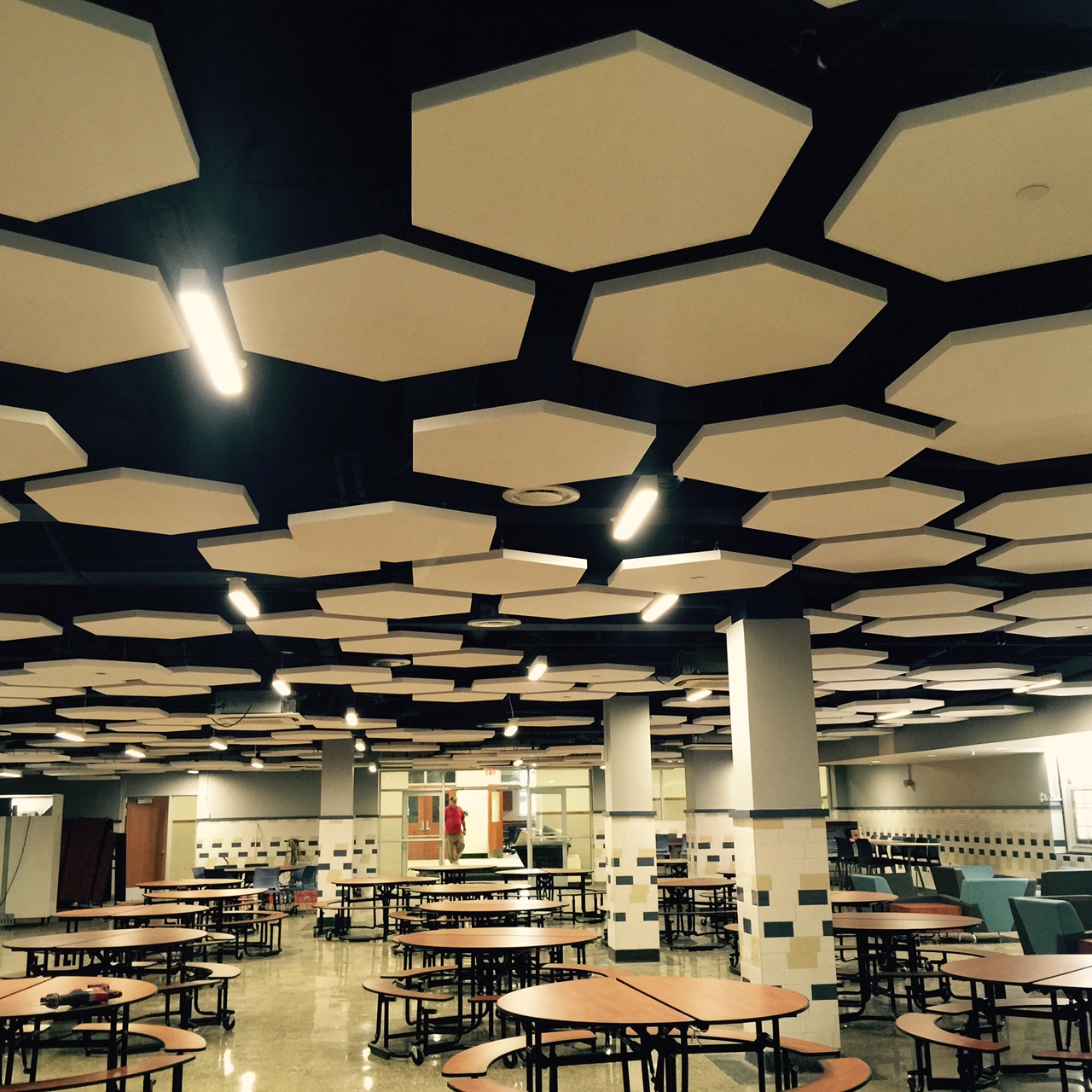
Hexagonal ToneTiles™ at Kramer Middle School.
Recently, Acoustics First® was asked to provide the custom panels for the cafeteria at Kramer Middle School in Washington DC. It was settled that hexagonal ToneTiles™ would be suspended as clouds in a geometric pattern around the ceiling. The resulting “honeycomb” effect is not only visually appealing, but the treatments effectively cut down the overall reverberation; increasing speech intelligibility and making the space more comfortable for a variety of activities.
Acoustics First® enjoys the inherent challenge in making these custom panels a success. We have plenty of experience in fulfilling the design goals of architects and interior designers. Interested in seeing more of these custom projects?
Visit http://acousticsfirst.com/installations-education-school-museum.htm to see some more examples.
Feel free to give Acoustics First® a call to discuss your custom treatment needs!
 Acoustics First BLOG
You must be logged in to post a comment.