Archive for category Product Applications
DIY – Back Wall Diffuser Array/Bass Trap: Revisited
Posted by Acoustics First in Absorption, Articles, Broadcast Facilities, Customer Feedback, Diffusion, DIY, Home Entertainment, Home Theater, HOW TO, Media Room, Music Rehearsal Spaces, Music Tracking Room, Product Applications, Recording Facilities, Recording Studio, Studio Control Room, Teleconferencing, Theater, Vocal Booth, Voice Over on July 14, 2016

DIY – Diffuser Array/Bass Trap
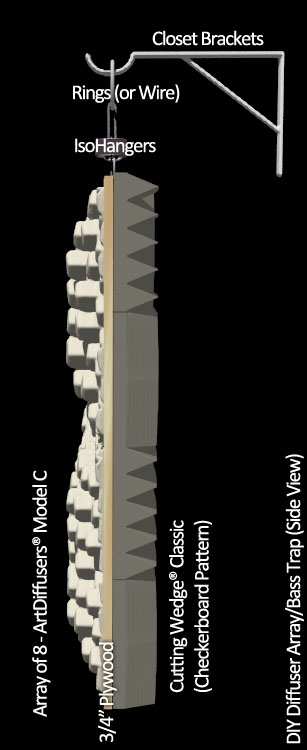 This month we thought we’d share a few Real-Life pictures of an idea we first introduced back in summer of 2013: The “Back Wall Diffuser Array/Bass Trap”.
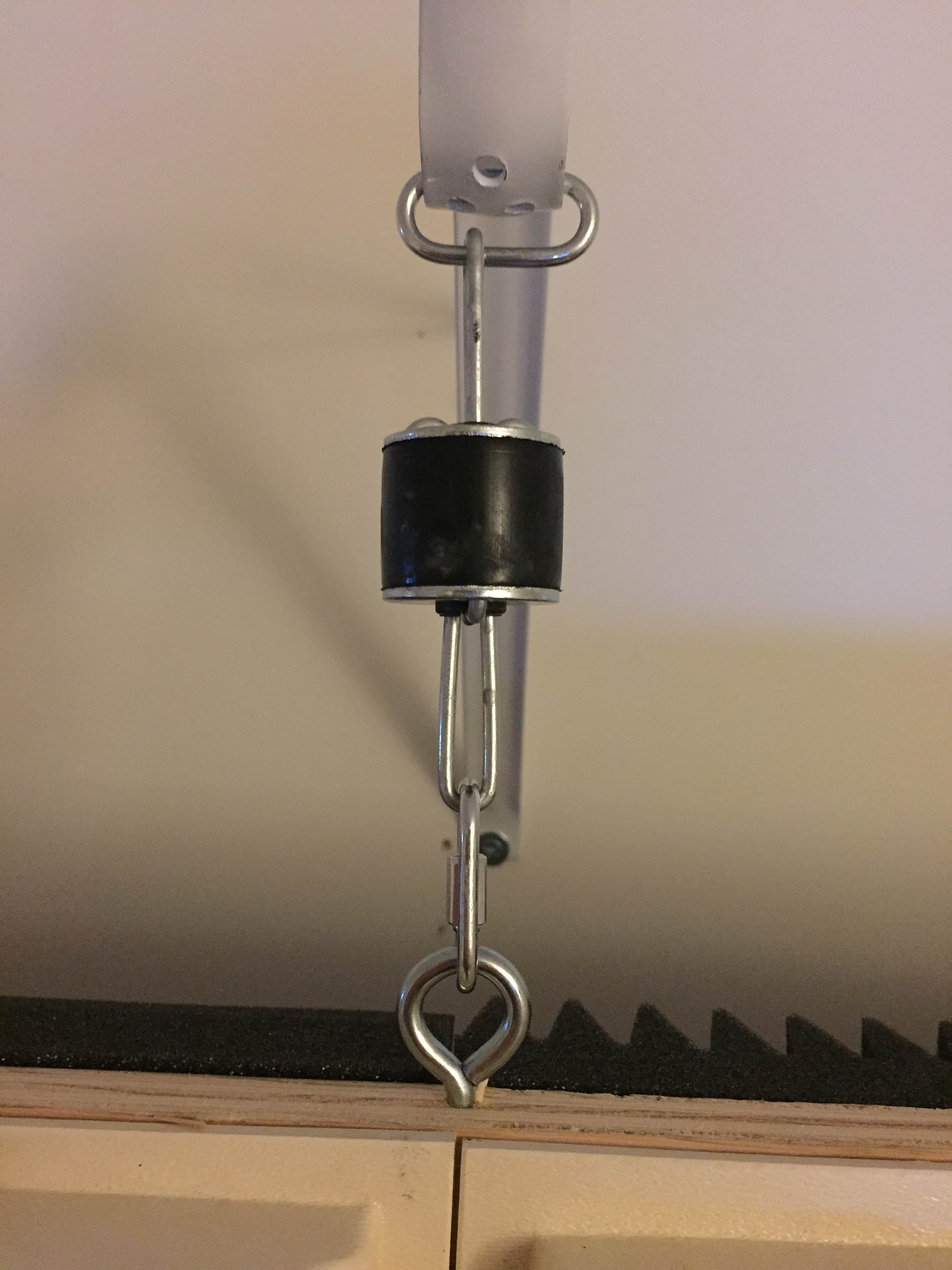
Isolation Hanger
This is the DIY project which incorporates our Art Diffusors®, Cutting Wedge® foam and a couple of isolation hangers into one large free-floating unit, which is acoustically decoupled from the wall.
This particular array was put together by a music producer/bass player for his home. As you can tell from the pics, the construction of this unit was executed beautifully and it’s very close to the original concept drawings.
It’s never too late to get started on your own DIY project.
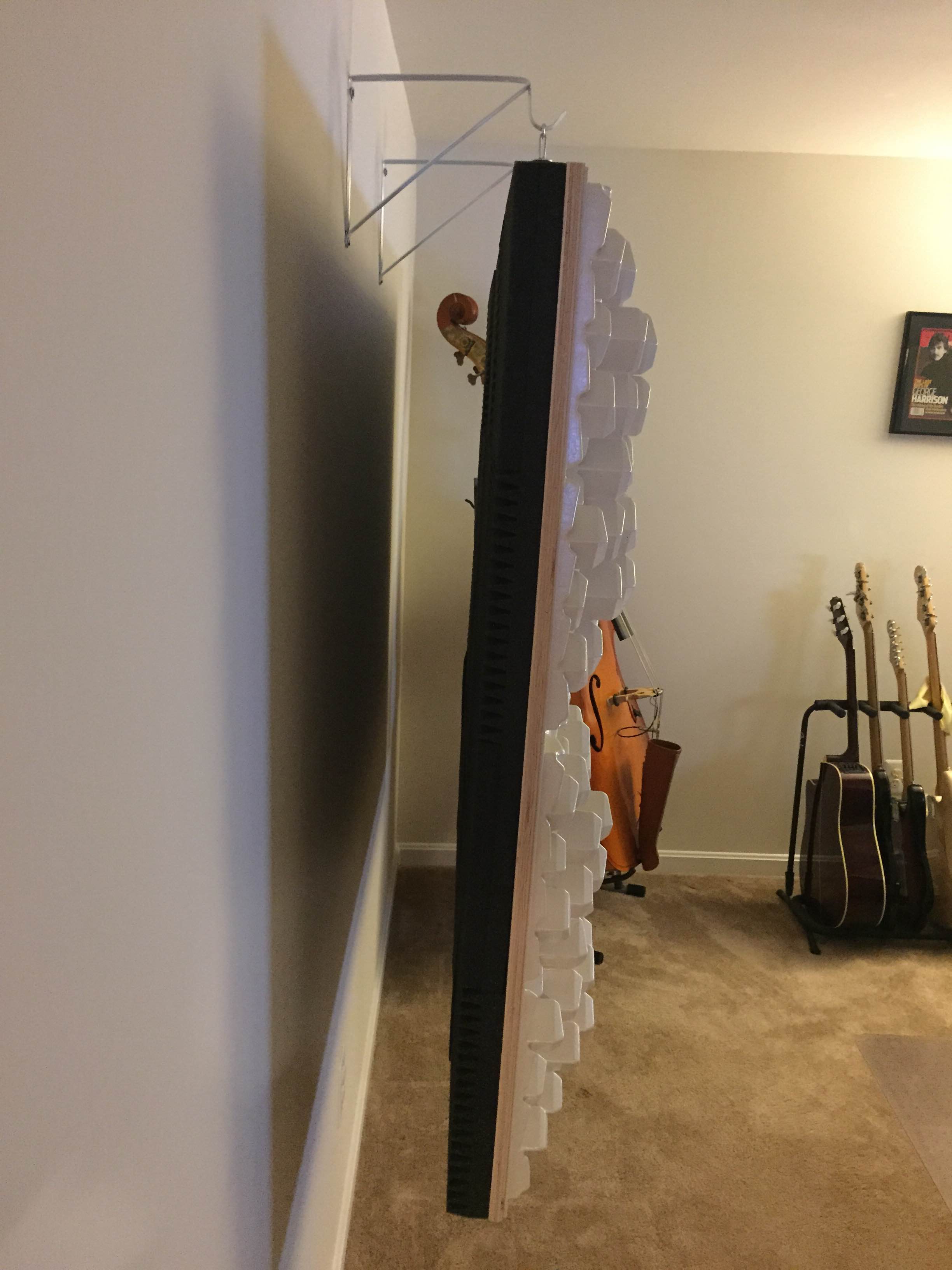 Real World – DIY |

Visit the Original DIY page to find out how to make your own.
Acoustic Treatment for your Home Theater or Listening Room
Posted by Acoustics First in Absorption, Diffusion, DIY, Home Entertainment, Home Theater, HOW TO, Media Room, Products on January 19, 2016
Any good theater or listening is acoustically treated to ensure the sound coming from the speakers is what arrives at the listener’s ears. Conditions common in small/medium rooms, such as flutter echo and comb filtering, degrade the clarity of music and speech. Here are some tricks to get a full and accurate sound out of your home theater or listening room. For those visually inclined individuals, the accompanying video shows how a critical listening space would ideally be treated.
Bass Traps – low-end control
Low frequency problems are common to almost any room, regardless of size. The good news is that most of the time the solution is simple. By installing bass traps in the corners of the room you can prevent the excessive bass build-up. If bass frequencies are allowed to build in the corners, it causes the bass frequencies to become muddy and undefined. The more corners you cover with a good trap, the better bass response you get from the room.
Having bass traps in all corners is best. That said, if you only have budget for two, having bass traps in the front corners of the room should be the highest priority. Fabric wrapped absorbers look as good as they sound, and Geometrix™ by Acoustics First, fit the corners like a glove.
Broadband Absorption – tame the ring.
To control the flutter echo caused by reflective parallel walls, it’s vital that the first refection points are treated with broadband absorption (wall panels). More than likely, your TV and/or sound system is in a fixed position, and your listening position will be relatively fixed as well. This should make the early reflection surfaces easy to locate. Sound travels in all directions from the speaker, including behind it, so put absorbers behind it on the wall. Don’t forget the floors, ceiling, and the wall behind you – sound will bounce off those as well.
Hang broadband absorbers over all the early reflection points – left, right, front and back so they are centered at ear height. Placement is the first key to getting this reflection free zone. The second is the right choice of absorber. To match your fabric wrapped bass traps, the simple choice is get some more panels wrapped in fabric. The Sonora® line of broadband absorbing panels coordinate with the bass traps, and come in a plethora of sizes and mounting options to work in your space.
Diffusers – put life back into your space.
Diffusion will give us something we couldn’t attain through absorption – a sense of open space. Even after treating with absorbers, there are still areas of the room where sound waves will sit, because your room is a fixed box with fixed speakers. Diffusers scatter the energy, creating ambiance with residual energy. This simple step does not remove energy from your room, but redistributes it into a soundscape that can make you forget you are in a room at all. In order of priority, the rear walls, front wall and ceiling are the most important surfaces to install diffusers.
There are many ways to diffuse the sound and coordinate with your room, from the fabric covered HiPer™ Panel and Double Duty Diffusers™, to the striking line of Art Diffusors® like the Model C, which can be painted to match your décor.
Sound Channels® – Top Product!
Posted by Acoustics First in Absorption, Classrooms, Customer Feedback, Mentions, Press Release, School & Educational Facilities on December 22, 2015
Acoustics First® Sound Channels® wall fabric has been named a ‘2015 Top Product’ by Christian School Products magazine!
http://www.cspmagdigital.com/publication/?i=284531&p=18

Christian School Products – 2015 Top Products
This article from their November issue explains why:
Merry Christmas and Happy New Year from all of us at Acoustics First!
Custom Panels and the Aesthetics of Acoustics
Posted by Acoustics First in Absorption, Product Applications, Products, School & Educational Facilities on September 29, 2015
There is a saying in our industry: When it comes to designing a space, acoustic consultants are blind and architects are deaf. In reality, it is in both parties best interest to consider the other side when designing a space, so visual form meets acoustic functionality.
Let’s be real, standard acoustic treatment is far from sexy. Typical 2’x4’ panels, while fully functional, don’t present the architects with much in terms of visual interest. This is where Acoustics First can supplement the design goals of the architect/interior designer with our technical expertise to find a custom solution that sounds and looks great.
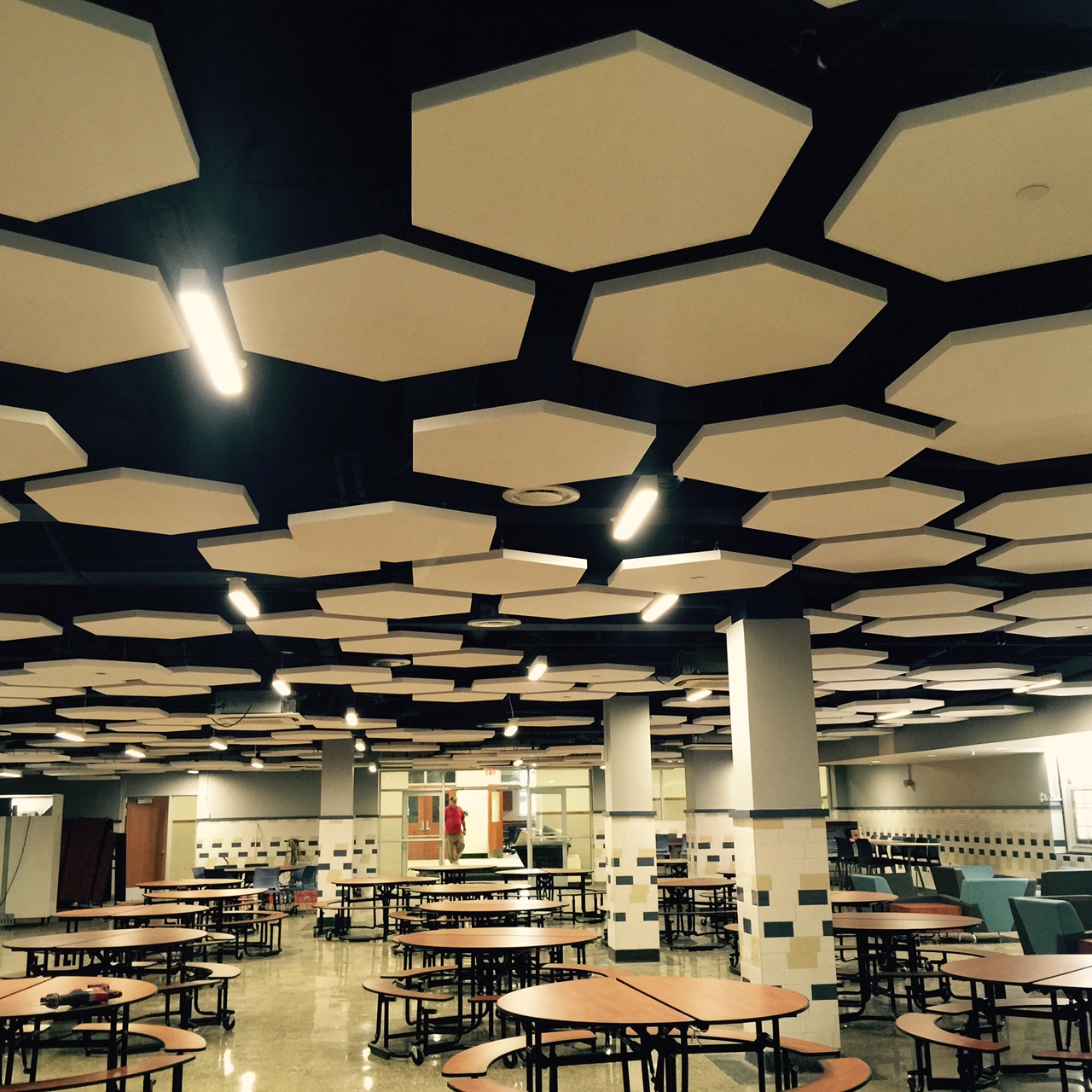
Hexagonal ToneTiles™ at Kramer Middle School.
Recently, Acoustics First® was asked to provide the custom panels for the cafeteria at Kramer Middle School in Washington DC. It was settled that hexagonal ToneTiles™ would be suspended as clouds in a geometric pattern around the ceiling. The resulting “honeycomb” effect is not only visually appealing, but the treatments effectively cut down the overall reverberation; increasing speech intelligibility and making the space more comfortable for a variety of activities.
Acoustics First® enjoys the inherent challenge in making these custom panels a success. We have plenty of experience in fulfilling the design goals of architects and interior designers. Interested in seeing more of these custom projects?
Visit http://acousticsfirst.com/installations-education-school-museum.htm to see some more examples.
Feel free to give Acoustics First® a call to discuss your custom treatment needs!
DIY – Treating a Wall – BlockAid® and SoundChannels®
Posted by Acoustics First in Absorption, Animal Shelters, Auditorium, Broadcast Facilities, Classrooms, DIY, Fitness, Government, Gymnasium, Home Entertainment, Home Theater, HOW TO, Media Room, Multipurpose Rooms, Music Rehearsal Spaces, Music Tracking Room, Product Applications, Recording Facilities, Recording Studio, School & Educational Facilities, Sound proofing, Studio Control Room, Teaching Rooms, Teleconferencing, Theater, Uncategorized, Vocal Booth, Voice Over on July 16, 2015
 On many occasions, we get asked about common ways to treat a wall (or walls) either for broadcast, podcast, or other voice recording scenario – where they not only want to tame the reflections within the room, but also block a certain amount of sound coming into – or leaving the room.
Budget is frequently an issue, major construction is usually unwanted, but effective results are always required.
We’re going to show you how to handle a room upgrade – cut down on the sound transmission and cut the room reflections – all with the same skills required to hang high quality wall coverings! Let’s see how you can cover a wall with BlockAid® vinyl sound barrier to block unwanted sound, then go back and cover that with an absorptive layer of Sound Channels® wall covering to finish it off!
This treatment is not recommended for renters, as this is not an easy upgrade to undo. However, if you have an extra bedroom you are using as Podcast studio, this is a great way to treat it… Let’s get started!
Installing BlockAid®
 1. Measure the wall for the first panel length. Mark the panel width on the wall. |
 2. Measure and Mark the length of the wall on the BlockAid® |
 3. Use a straightedge and a razor to cut the BlockAid®. |
 4. Using a trowel, apply vinyl tread adhesive to the wall, covering the whole area where the first panel is going. (You marked the wall right?) |
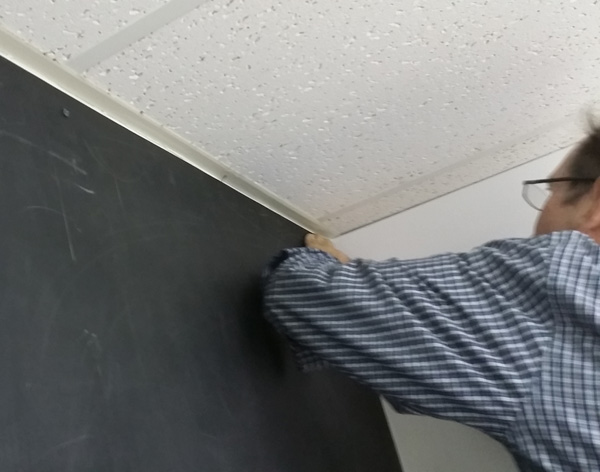 5. Hang the panel starting at the top, install a few screws to hold it in place while the adhesive sets. (You will probably need a friend to help, as BlockAid® is a pound per square foot!) |
 6. Using your hands and a putty knife, smooth out all the air bubbles from behind the BlockAid® so that you get a good bond when the adhesive cures. |
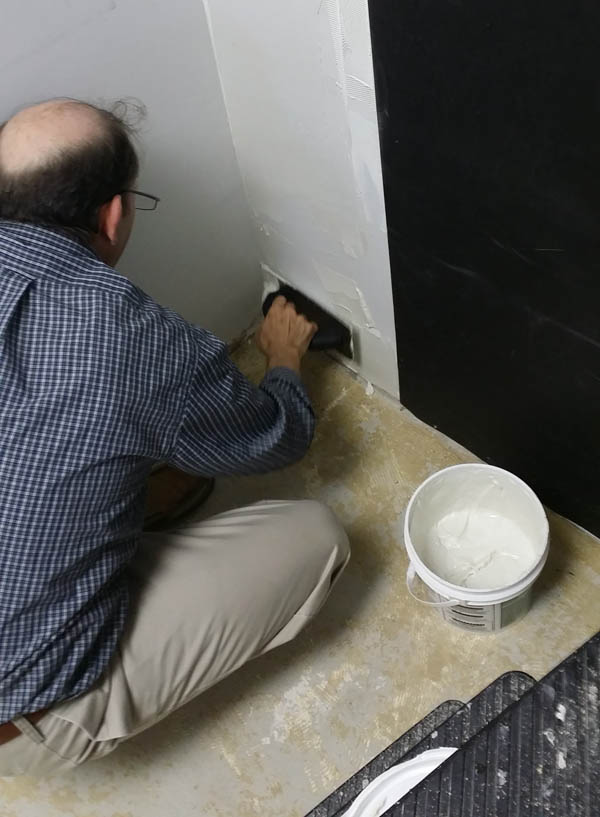 7. Repeat the steps for the next strip. Measure, Mark, Cut, Trowl, Hang… |
 8. Make sure you line up those seams! push them right up agaist each other. Smooth out the air bubbles, cut out any outles, trim any extra… Let dry! |
Good job! Now, take a breather while that dries, and notice how much less sound is passing through the walls. This is when you will notice that the sounds are now coming from under the door, and through the leaky old window. These can be taken care of in different ways…. but the easiest way is the same way you deal with keeping the cold out! Get some weather strip, a door skirt, seal the gaps around the frame of the door, and windows, maybe go out and buy some heavy curtains for the windows… if you have some leftover BlockAid®, you can always get some Industrial Velcro and temporarily stick a piece over the window!
Installing Sound Channels®
 1. Remove the Screws from the BLockAid® – if you didn’t already… then same as BlockAid®, measure the wall, mark it, measure and cut a piece of Sound Channels® and start troweling on the Chapco! |
 2. Well, when you get tired, make your friend finish troweling out the adhesive to cover where the panel is going. (You are going to overlap the seams.) |
 3. Starting at the top, hang the Sound Channels® overlapping the seam of the BlockAid® under it. Smooth out the air bubbles with your hands. Make sure it lines up well. No screws needed! |
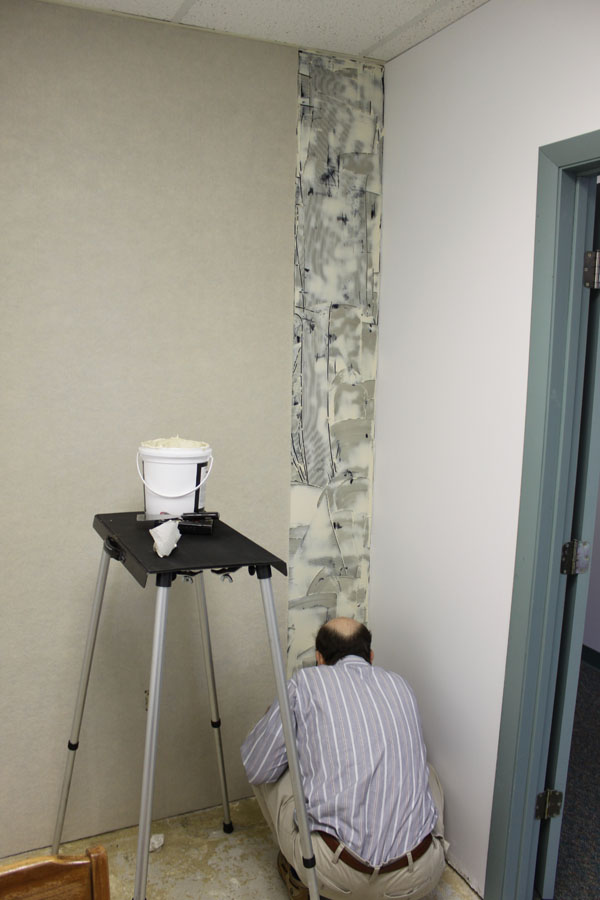 4. Measure and cut the next strip, carefully following a rib in the fabric, while your friend, (who is way better at troweling than you are anyway,) preps the next section with adhesive. |
 5. Best practice is to run the fabric in the same direction every time. Not just with the ribs, but in the same direction it comes off the roll. So find the top. |
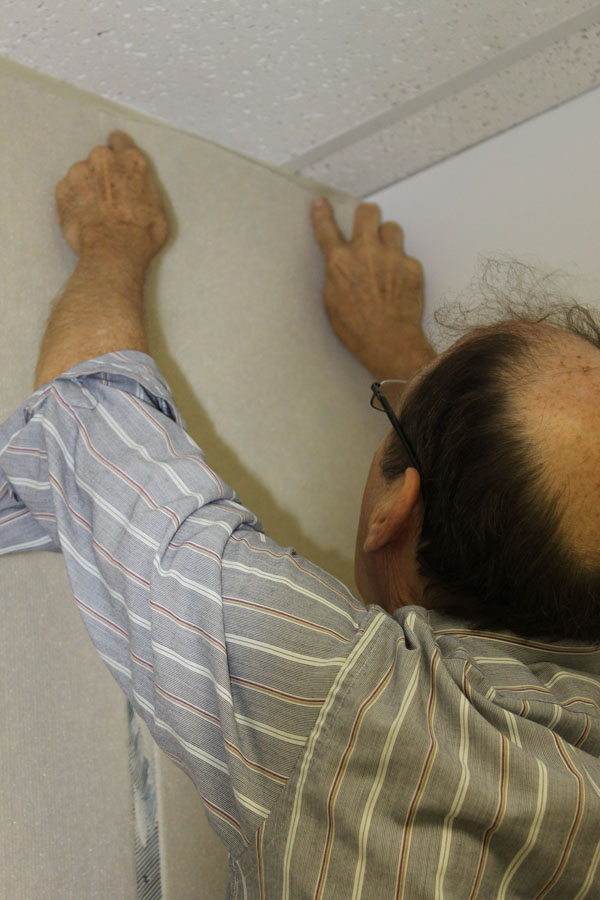 6. After you find the top, start hanging from the top, lining up the seams and smoothing out the bubbles as you go. |
 7. Keep those seams tight as you go. Keep smoothing… almost done! |
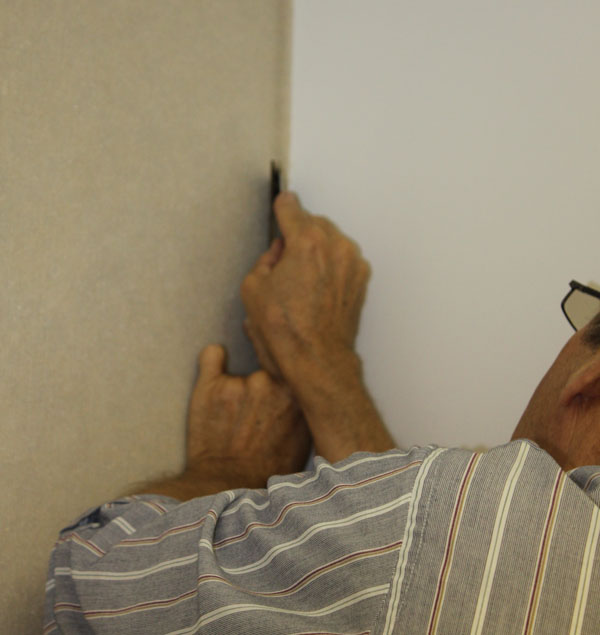 8. Trim up the extra and repeat as many times as needed. |
That’s it!

Don’t forget to trim around those outlets!
This treatment is a common first step in treating many professional broadcast studios – it gives you extra isolation with the barrier and takes the edge of the sound reflections. Many professional environments then go back and add some additional treatments such as bass traps, diffusers, and broadband absorber panels – especially if these studios are planning on bringing in any musical guests.
This isn’t just for home studios. It works great for kids play rooms, bedrooms, home theaters, home gyms, and any place you want to block sound and tame the sound inside the room.
Customize your space as you will, but this treatment is a consistent winner for cost and performance, and is a great way to get started without breaking the bank!


You must be logged in to post a comment.