Archive for category Multipurpose Rooms
Then and now… Diffusers and Don Juan.
Posted by Acoustics First in Auditorium, Broadcast Facilities, Classrooms, Diffusion, Home Entertainment, Home Theater, Media Room, Multipurpose Rooms, Music Rehearsal Spaces, Music Tracking Room, Recording Facilities, Recording Studio, Studio Control Room, Teaching Rooms, Teleconferencing, Uncategorized, Vocal Booth, Voice Over on July 4, 2013
 Four score and seven years ago (1926), movies had just begun integrating sound along with the visuals, as Warner Brothers released Don Juan – syncing a 33 1/2 rpm audio disc to the video as part of the new Vitaphone system. The era of talkies had arrived, as did a new era of fake accents.
While we still have those fake accents from the days of yore (and Johnny Depp as Don Juan), we have new technologies to bring us our entertainment – high-definition video on big screens with 10.2 digital surround sound, playing in home theaters that rival the best public theatrical venues.
While we have seen (and heard) the technological evolution of movies to what they are today, we have also seen (and heard) the evolution of acoustics – and the one area I’m going to discuss today is one of the fastest evolving acoustic disciplines – Diffusion.
Diffuser design has come far from the early days of scattering sound by changing the angle of your wall, or the shape of the room to negate, dilute, or diffuse unwanted or undesirable acoustic waves. Today, acoustic diffusers are mathematical and scientific wonders, designed to be elements that are inserted into your listening environment to create an acoustic space that is open and airy.
During this evolution of diffusion we have seen the rise of many shapes; The Pyramid, the Barrel, the Binary Arrays, Flat Panel, 1D and 2D QRDs, and more… a veritable cornucopia of geometric shapes and mathematically produced profiles, which are scientifically sound, but fundamentally, inorganic.
The notes on the instruments we play, are based on math and physics, but the music we play ebbs and flows from the pounding of drums to the smooth bass lines, from the intimate vocals to screaming, and from the heavy metal acts to classical symphonies (with or without a heavy metal act). Diffusers have followed suit, changing their shape along with the changing industry – making advances as new discoveries are made.
Diffusers have become important acoustic treatments in listening rooms, recording rooms, sound stages, and theaters – embrace the diffusers! Embrace the future Don Juan’s and their terrible accents… ok… just diffusers… fine.
DIY: Back Wall Diffuser Array/Bass Trap
Posted by Acoustics First in Absorption, Auditorium, Broadcast Facilities, Diffusion, DIY, Home Entertainment, Home Theater, HOW TO, Media Room, Multipurpose Rooms, Music Rehearsal Spaces, Music Tracking Room, Product Applications, Products, Recording Facilities, Recording Studio, Restaurants, Studio Control Room, Teleconferencing, Theater, Vocal Booth, Voice Over, Worship Facilities on June 20, 2013
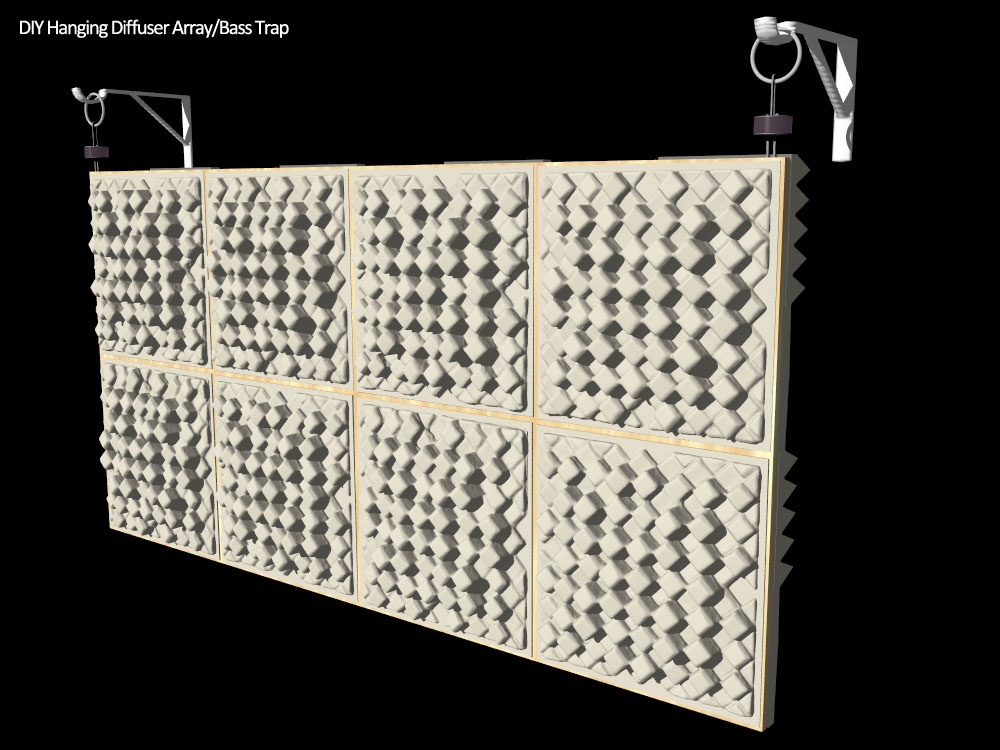
Getting more out of your back wall diffuser array with a simple hanging DIY array/bass trap.
One of the big “back wall” questions people have is “If I have a large diffuser array, how can I get the bass trapping I need?” A great answer to this question is to turn the entire array into a hanging bass absorber. If you are already planning on getting diffusion for your back wall, here is a great way to use that wall space for more than just diffusion.
Stuff you need:
- 4’x 8’ sheet of 3/4” Plywood
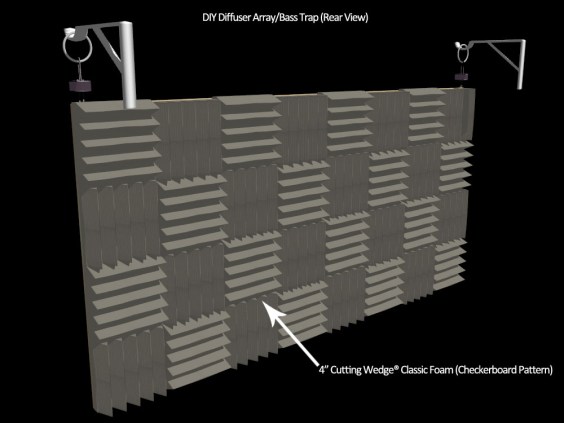
- 32 sq/ft of 4” Cutting Wedge® Classic Foam (Or similar absorber)
- 8 x Art Diffusers® – Model C (or Model F, Quadrapyramid™, or other comparable diffuser)
- 2 x IsoHangers
- 2 x Heavy rings (Think big Curtain Rings or Hanging Wire will also work)
- 2x Closet Rod/Shelf Brackets
- 2 x 7/8” wood screws and fender washers
- Construction Adhesive (Make sure it’s safe for Foam)

Assembly instructions
- Screw the two IsoHangers to the plywood, using a fender washer on each screw. These should be about an inch in from each end -drill small pilot holes first. (These will be used to hang the panel, this side will be designated as the back from here on out.)
- Use Construction adhesive to attach the Cutting Wedge® Foam to the back of the panel in a checkerboard pattern (each panel 90° rotated from adjacent)
- Use Construction adhesive again to attach the 8 Diffusers to the front of the Plywood (Follow the installation instructions for adhesive placement)
- Attach the Rings or Wire to the free end of the IsoHangers.
What you have created is a hanging panel that will diffuse mid-high frequencies and trap the lows. The hanging mass absorbs low frequency energy by moving slightly when pushed by the energy of the Low frequency Waves. The rear facing fiberglass also absorbs low frequencies by dampening the panel, but it also absorbs any of the waves that happen to get trapped behind the panel.
Hanging the Diffuser/Trap Assembly
- Measure and attach the Closet Brackets to the Wall – Use appropriate anchors! If you have standard or double wall construction without Resilient Channels, use the studs – The IsoHangers will keep vibrations from transmitting through the wall.
- Hang the panel on the Closet Brackets using the rings/wire with the Diffusers facing you and that’s it!
 This simple DIY project is provided as a way for our customers to learn better ways to use our products and get more value out of the products they buy. For those customers who are planning on purchasing diffusers to make an array, or maybe already have an array and are looking to try a new configuration – this project may be what you’re looking for.
A little History…
If you embark on this little construction project, you will be constructing studio elements that have remained basically unchanged since at least the early 1970’s. Hanging plywood wrapped in studio foam or fiberglass has been used “behind the curtains” of many of the top studios for effective bass control for over 40 years – just no one has ever seen it, as it has been hidden in walls; masked as a false wall of fabric stretched across wooden louvers!
————————————————————————————————————————————————————————————
Acoustics First Corporation supplies acoustical panels and soundproofing materials to control sound and eliminate noise in commercial, residential, government, and institutional applications worldwide. Products include the patented Art Diffusor®, sound absorbers, noise barriers, acoustical fabrics and accessories. Acoustics First® products are sold for O.E.M applications, direct, and through dealers. For more information on acoustical materials and their application, please visit www.AcousticsFirst.com or call Toll Free 1-888-765-2900 (US & Canada).
DIY: How to build a Studio GoBo
Posted by Acoustics First in Absorption, Articles, Broadcast Facilities, Diffusion, DIY, HOW TO, Multipurpose Rooms, Music Tracking Room, Product Applications, Recording Facilities, Recording Studio, Studio Control Room, Vocal Booth, Voice Over on April 18, 2013
DIY Project: Diffuser Array/Absorber GOBO
By: James DeGrandis
Mobile DIY option for creating new spaces with GOBOs!
As studio spaces get smaller, and budgets get tighter, we like to find new ways to maximize our budgets and our spaces, without removing quality. One issue with small room recording is getting sufficient separation between instruments – and here’s one DIY project to help you master your space without compromise.
Stuff you need:
4’x 6’ sheet of 3/4” Plywood (This can be scaled up or down depending on need.)
32 sq/ft of 4” Cutting Wedge® Classic Acoustical Foam (Or similar absorber)
4 x Art Diffusors® – Model C (or Model F, Quadrapyramid™, or other comparable diffuser)
Construction adhesive
6-8 Hook and loop straps (To attach to Mic Stands – one option)
2x Mic Stands (unless building frame)
2”x4”x10’ wood for frame construction (optional)
3 x Low profile Casters for rolling frame (optional)

Assembly instructions
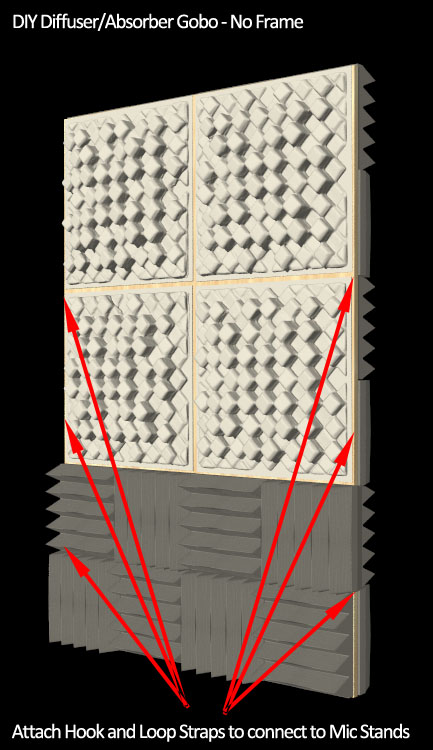 A simple “no-frame” construction method is first described to give you the quick and easy option of just attaching some straps to a couple mic stands.
Use Construction adhesive to attach the Cutting Wedge® Foam to the back of the panel in a checkerboard pattern (each panel 90° rotated from adjacent.) Then flip the panel and attach the 8 Cutting Wedge® panels to the bottom of the front. (the bottom of the gobo creates a corner with the floor, we want to put absorption there to limit the bass.)
Use Construction adhesive again to attach the 4 Diffusers to the top and front of the Plywood (Follow the installation instructions for adhesive placement)
If you with to attach to mic stands, just attach the hook and loop straps to the panel along the edge, roughly where the diagram to the right is indicating, and you are done…
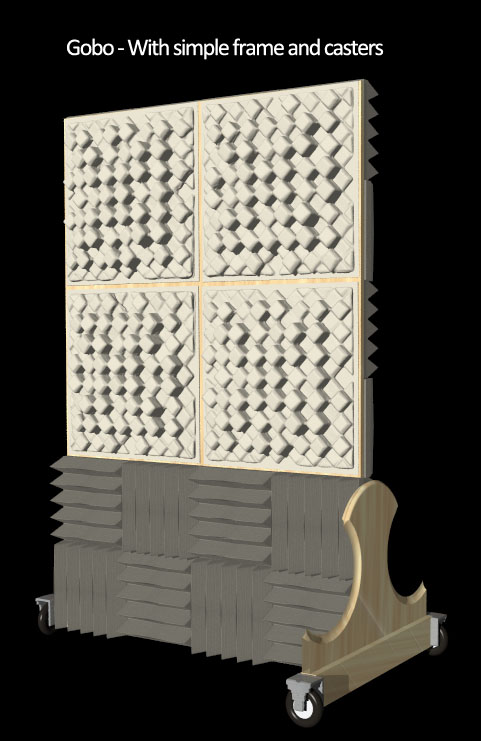
If you would like to create a simple rolling frame, a design for one is shown in the bottom diagram on the right. Other frame designs can be used; they can even be hung from the ceiling if you are going to keep reusing the same configuration, or if the configuration is going to be used long term.
One of the great benefits of building gobos is the flexibility you have in your use and placement of them. They can allow for your space to seem much larger, by creating separation between instruments. They are easily made, easy and quick to set up, they can be stored away, or just lean up against a wall or corner to provide more acoustic treatment when not in use.
 Create a mini vocal booth.
Use as a giant corner bass trap.
Enclose your noisy drummer.
Gobos have hundreds of uses.
Make your own today!
This simple DIY project is provided as a way for our customers to learn better ways to use our products and get more value out of the products they buy. If you are looking for more ways to use the products you have, look to Acoustics First for Ideas. http://www.acousticsfirst.com
A little History…
If you embark on this little construction project, you will be constructing studio elements that have remained basically unchanged since at least the early 1970’s. Handmade Gobos have been used in many of the top studios for effective noise control for over 40 years – These versions pay homage to those early pioneers who built what they needed, because it was the only way to get exactly what they needed.

————————————————————————————————————————————————————————————
Acoustics First Corporation supplies acoustical panels and soundproofing materials to control sound and eliminate noise in commercial, residential, government, and institutional applications worldwide. Products include the patented Art Diffusor®, sound absorbers, noise barriers, acoustical fabrics and accessories. Acoustics First® products are sold for O.E.M applications, direct, and through dealers. For more information on acoustical materials and their application, please visit www.AcousticsFirst.com or call Toll Free 1-888-765-2900 (US & Canada).
Acoustics First’s acoustical wall fabric saves $Green$ while being Green!
Posted by Acoustics First in Art Galleries, Auditorium, Broadcast Facilities, Classrooms, Fitness, Government, Gymnasium, Home Entertainment, Hospitals, Medical Facilites, Multipurpose Rooms, Museums, Music Rehearsal Spaces, Offices, Press Release, Products, Recording Facilities, Restaurants, School & Educational Facilities, Studio Control Room, Teaching Rooms, Teleconferencing, Theater, Universities, Vocal Booth, Voice Over, Worship Facilities on October 18, 2012
For Immediate Release
Acoustical wall fabric saves $Green$ while being Green!
 Sound Channels® acoustical wall fabric is manufactured from 100% Post-Consumer Recycled material, making this a quick ship, easy, no thought acoustic solution.
Sound Channels® is applied directly to vertical surfaces, is easy to cut and installs like wall carpet. This absorptive wall fabric is a great choice to moderate speech frequencies in any application. Great to soften sound in conference rooms, distance learning, offices, and day care facilities, this material can also be used as a base layer in home theaters, recording studios and broadcast facilities.
Not only is this economical acoustical treatment available in countless colors, it is manufactured from recycled materials, reducing environmental impact!
Sound Channels in manufactured using Eco-fi fibers. Eco-fi is a high-quality polyester fiber made from 100% certified recycled plastic bottles. It can go into any textile product such as clothing, blankets, carpets, wall coverings, auto interiors, home furnishings, and craft felt. Eco-fi can also be blended with other fibers, such as cotton or wool, for enhanced qualities.
AN EASY GUIDE: 15 bottles = 1 yard of wall covering
Why buy Eco‐fi products?
We have the capacity to keep billions of plastic bottles out of the world’s landfills each year by using post-consumer plastic bottles instead of virgin materials in the fiber manufacturing process. By doing this, we can lower harmful air emissions and save millions of barrels of oil from being used which, in turn, reduces the harmful effects of acid rain, global warming, and smog. Fabrics made from Eco-fi fiber are chemically and functionally nearly identical to those made from non-recycled fiber. The difference is that Eco-fi fiber is made without depleting the Earth’s natural resources. With properties such as strength, softness, shrinkage-resistance, and colorfastness, market applications for Eco-fi products are expanding every day.
Click here for more information on the Sound Channels acoustical wall fabric.
http://www.acousticsfirst.com/sound-channels-wall-covering.htm
——————————————————————————————————————————————-
Acoustics First Corporation supplies acoustical panels and soundproofing materials to control sound and eliminate noise in commercial, residential, government, and institutional applications worldwide. Products include the patented Art Diffusor®, sound absorbers, noise barriers, acoustical fabrics and accessories. Acoustics First® products are sold for O.E.M applications, direct, and through dealers. For more information on acoustical materials and their application, please visit www.AcousticsFirst.com or call Toll Free 1-888-765-2900 (US & Canada).
|
www.AcousticsFirst.com Acoustics First Corporation PH: (804) 342-2900 |
Sign up for Future Press Releases http://eepurl.com/hxZCs |
Acoustic Solutions for Industrial Noise Control (Blocking and reducing industrial sound)
Posted by Acoustics First in Articles, Construction Sites, Government, HOW TO, Industrial Facilities, Manufacturing, Multipurpose Rooms, Product Applications, Products on October 9, 2012

Industrial facilities include a wide range of applications like manufacturing, processing plants, construction sites and more. The typical sound problem in most industrial applications is the need to lower the overall level of sound or lower the decibel level of specific machinery. Machinery can include punch presses, printing equipment, crushers, grinders, air tools, drills, jack hammers, pumps, etc. The noise generated by these machines not only fatigue operators but may not meet OSHA safety requirements or other local noise ordinances.
To lower the sound level of these machines, the best course of action is to create a sound proof enclosure around the source of the noise. This will eliminate noise and prevent sound from permeating into the rest of the facility or neighboring areas. There are many ways to accomplish this, however, most methods will require some type of massive and/or dense material and possibly the addition of a fluffy absorptive material.
To create sound proof enclosures, you may wish to consider using a combination of the following materials:
BlockAid Sound Barrier is a mass loaded vinyl used in composite structures to add mass and aid to increase the STC (Sound Transmission Loss) of a system. This material weighs one pound per square foot, ships on rolls and can be easily cut with a utility knife.
 Alternatively, like in the image at the top of the page, a machine or enclosure can be lined with a composite foam. This material has a layer of the vinyl sound barrier floating between two layers of acoustical foam. This material combines a layer of massive/dense material (vinyl sound barrier) to block sound with two layers of absorptive acoustical foam. Suspending the barrier as a limp mass between the two layers of acoustical foam decouple it from the existing surface of the enclosure, improving its effectiveness.
In addition, StratiQuilt Blankets can be installed on-site around machinery to reduce the mechanical noises. These quilted fiberglass blankets can be manufactured with or without a barrier septum and available with grommets for hanging. Optional outdoor coverings can be quoted when the material requires UV protection.
Subsequently, Cloudscape ceiling baffles can be installed in large open areas and metal buildings with engineered truss systems to reduce overall reverberation and sound pressure levels (SPL) within the room.
—————————————————————————————————————————————————
Acoustics First Corporation supplies acoustical panels and soundproofing materials to control sound and eliminate noise in commercial, residential, government, institutional applications worldwide. Products include the patented Art Diffusor®, sound absorbers, noise barriers, acoustical fabrics and accessories. Acoustics First® products are sold for O.E.M applications, direct, and through dealers. For more information on acoustical materials and their application, please visit www.AcousticsFirst.com or call Toll Free 1-888-765-2900 (US & Canada).
 Acoustics First BLOG
You must be logged in to post a comment.