Posts Tagged diffusers
Barrett’s Technology Solutions has a Happy Easter
Posted by Acoustics First in Absorption, Customer Feedback, Diffusion, Home Theater, Media Room, Product Applications, Theater, Uncategorized on April 20, 2014
Sometimes at Acoustics First we get a call from someone who is so knowledgeable that we can’t help but be tickled that they called us to help them. We received one such phone call from Pete Heskin at Barrett’s Technology Solutions in Naperville, IL.
Pete and his team were putting together an acoustic treatment for a listening room at their facility and wanted the room’s acoustics to really showcase their lineup of high-end audiophile speakers. No joke here – these guys have over 50 years of experience in the audio industry – and they keep on the bleeding edge of audio and video. This treatment is serious acoustic business – and these are some of the most discriminating ears in audio.
Happy Easter guys!

Happy Easter Guys!
In keeping with their high-standards and cutting edge approach, they were looking for an acoustic treatment that is as visually stunning as it is capable of treating a room containing some of the world’s greatest sound sources. As you can see, the results are simple and elegant.
The room contains an array of Sonora® panels, Silent Pictures® and clusters of ArtDiffusor® Model D‘s to make this space sound as good as it looks. (While all of their gear makes the gear junkies at Acoustics First drool…)
So, if you find yourself near Chicago, or on a “Wayne’s World” pilgrimage, stop into Barrett’s – and if you fancy yourself an audiophile – put your money where your ears are, and hear how discriminating ears listen to music…
… No Stairway to Heaven.
Model D @ DesignDC & WBWV
Posted by Acoustics First in Broadcast Facilities, Diffusion, Product Applications, Products, Recording Facilities, Recording Studio, Uncategorized on September 12, 2013
That’s right. Acoustics First will be unfurling some of the wrapping and exposing the newest addition to the ArtDiffusor® Family of diffusers… the Model D. Where can you see it?

DesignDC 2013
September 25-26th, 2013
Walter E. Washington Convention Center, Washington DC
Acoustics First will be set up in the main exhibit hall (in Booth 507), showing off the Model D, the newest release into the ArtDiffusor® family. Come on down to see for yourself what all the noise is about – pardon the pun.
Another interesting development is the first install of Model D’s in a Broadcast studio. In a move to “liven-up” the very “dead” studio to better accommodate the live recording of in-studio musicians, WBWV 88.7 FM in Beckley, WV pointed to the New Model D as their solution.

WBWV 88.7 FM Beckley, WV
FInally, don’t forget that you can check out any new developments or products at Acousticsfirst.com, where the Model D page has a couple “Bonus Features” like:
- How diffusion works Video.
- Photo Gallery
- Early “Alien” promo video
- Model D Pattern Designer
Then and now… Diffusers and Don Juan.
Posted by Acoustics First in Auditorium, Broadcast Facilities, Classrooms, Diffusion, Home Entertainment, Home Theater, Media Room, Multipurpose Rooms, Music Rehearsal Spaces, Music Tracking Room, Recording Facilities, Recording Studio, Studio Control Room, Teaching Rooms, Teleconferencing, Uncategorized, Vocal Booth, Voice Over on July 4, 2013
 Four score and seven years ago (1926), movies had just begun integrating sound along with the visuals, as Warner Brothers released Don Juan – syncing a 33 1/2 rpm audio disc to the video as part of the new Vitaphone system. The era of talkies had arrived, as did a new era of fake accents.
While we still have those fake accents from the days of yore (and Johnny Depp as Don Juan), we have new technologies to bring us our entertainment – high-definition video on big screens with 10.2 digital surround sound, playing in home theaters that rival the best public theatrical venues.
While we have seen (and heard) the technological evolution of movies to what they are today, we have also seen (and heard) the evolution of acoustics – and the one area I’m going to discuss today is one of the fastest evolving acoustic disciplines – Diffusion.
Diffuser design has come far from the early days of scattering sound by changing the angle of your wall, or the shape of the room to negate, dilute, or diffuse unwanted or undesirable acoustic waves. Today, acoustic diffusers are mathematical and scientific wonders, designed to be elements that are inserted into your listening environment to create an acoustic space that is open and airy.
During this evolution of diffusion we have seen the rise of many shapes; The Pyramid, the Barrel, the Binary Arrays, Flat Panel, 1D and 2D QRDs, and more… a veritable cornucopia of geometric shapes and mathematically produced profiles, which are scientifically sound, but fundamentally, inorganic.
The notes on the instruments we play, are based on math and physics, but the music we play ebbs and flows from the pounding of drums to the smooth bass lines, from the intimate vocals to screaming, and from the heavy metal acts to classical symphonies (with or without a heavy metal act). Diffusers have followed suit, changing their shape along with the changing industry – making advances as new discoveries are made.
Diffusers have become important acoustic treatments in listening rooms, recording rooms, sound stages, and theaters – embrace the diffusers! Embrace the future Don Juan’s and their terrible accents… ok… just diffusers… fine.
DIY: Back Wall Diffuser Array/Bass Trap
Posted by Acoustics First in Absorption, Auditorium, Broadcast Facilities, Diffusion, DIY, Home Entertainment, Home Theater, HOW TO, Media Room, Multipurpose Rooms, Music Rehearsal Spaces, Music Tracking Room, Product Applications, Products, Recording Facilities, Recording Studio, Restaurants, Studio Control Room, Teleconferencing, Theater, Vocal Booth, Voice Over, Worship Facilities on June 20, 2013
Getting more out of your back wall diffuser array with a simple hanging DIY array/bass trap.
One of the big “back wall” questions people have is “If I have a large diffuser array, how can I get the bass trapping I need?” A great answer to this question is to turn the entire array into a hanging bass absorber. If you are already planning on getting diffusion for your back wall, here is a great way to use that wall space for more than just diffusion.
Stuff you need:
- 4’x 8’ sheet of 3/4” Plywood
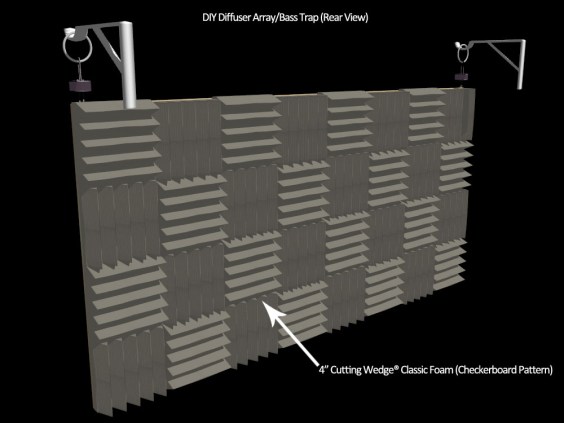
- 32 sq/ft of 4” Cutting Wedge® Classic Foam (Or similar absorber)
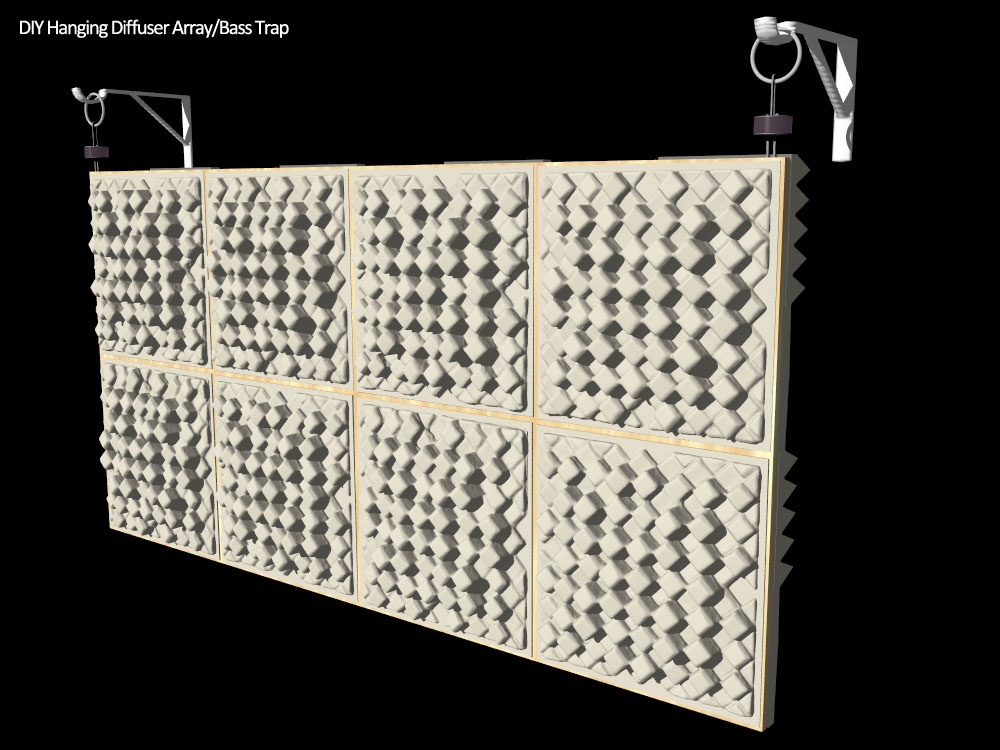
- 8 x Art Diffusers® – Model C (or Model F, Quadrapyramid™, or other comparable diffuser)
- 2 x IsoHangers
- 2 x Heavy rings (Think big Curtain Rings or Hanging Wire will also work)
- 2x Closet Rod/Shelf Brackets
- 2 x 7/8” wood screws and fender washers
- Construction Adhesive (Make sure it’s safe for Foam)

Assembly instructions
- Screw the two IsoHangers to the plywood, using a fender washer on each screw. These should be about an inch in from each end -drill small pilot holes first. (These will be used to hang the panel, this side will be designated as the back from here on out.)
- Use Construction adhesive to attach the Cutting Wedge® Foam to the back of the panel in a checkerboard pattern (each panel 90° rotated from adjacent)
- Use Construction adhesive again to attach the 8 Diffusers to the front of the Plywood (Follow the installation instructions for adhesive placement)
- Attach the Rings or Wire to the free end of the IsoHangers.
What you have created is a hanging panel that will diffuse mid-high frequencies and trap the lows. The hanging mass absorbs low frequency energy by moving slightly when pushed by the energy of the Low frequency Waves. The rear facing fiberglass also absorbs low frequencies by dampening the panel, but it also absorbs any of the waves that happen to get trapped behind the panel.
Hanging the Diffuser/Trap Assembly
- Measure and attach the Closet Brackets to the Wall – Use appropriate anchors! If you have standard or double wall construction without Resilient Channels, use the studs – The IsoHangers will keep vibrations from transmitting through the wall.
- Hang the panel on the Closet Brackets using the rings/wire with the Diffusers facing you and that’s it!
 This simple DIY project is provided as a way for our customers to learn better ways to use our products and get more value out of the products they buy. For those customers who are planning on purchasing diffusers to make an array, or maybe already have an array and are looking to try a new configuration – this project may be what you’re looking for.
A little History…
If you embark on this little construction project, you will be constructing studio elements that have remained basically unchanged since at least the early 1970’s. Hanging plywood wrapped in studio foam or fiberglass has been used “behind the curtains” of many of the top studios for effective bass control for over 40 years – just no one has ever seen it, as it has been hidden in walls; masked as a false wall of fabric stretched across wooden louvers!
————————————————————————————————————————————————————————————
Acoustics First Corporation supplies acoustical panels and soundproofing materials to control sound and eliminate noise in commercial, residential, government, and institutional applications worldwide. Products include the patented Art Diffusor®, sound absorbers, noise barriers, acoustical fabrics and accessories. Acoustics First® products are sold for O.E.M applications, direct, and through dealers. For more information on acoustical materials and their application, please visit www.AcousticsFirst.com or call Toll Free 1-888-765-2900 (US & Canada).
Setting the Soundstage: How to treat your home theater like a real theater
Posted by Acoustics First in Articles, Home Entertainment, Home Theater on March 14, 2013
 Modern AVR’s include all kinds of wizardry for speaker setup, positioning and room equalization. Anyone in the know will tell you that room EQ hardware and software should be a last resort. Correct acoustical treatments will pay much bigger dividends.
If you are like many people, you have recently upgraded your home theater, or you’re getting ready to do so. During this process you’ve likely learned that the speakers in the TV are sub-par and you should upgrade your audio experience to include an external sound system. This has become common practice and common knowledge. What you haven’t learned, and which is probably even more important, is how to upgrade the room itself.
One of the things people overlook when trying to make a home theater, is that a real theater pays a lot of attention to the design and treatment of the theater environment. They have good left-right design symmetry (see the diagram for a sample home theater layout). A good theater also has acoustically treated the space so that people can hear everything that is happening, from anywhere in the theater. This article will teach you some of the tricks of getting that great big theater soundstage into your home theater.

Bass Traps – the low-down solution.
Low frequency problems are common to almost any room, regardless of size. The good news is that, most of the time, the solution is simple: put bass traps in the corners of the room. This is one place where it pays to put a little extra in the budget. Corners are defined as the intersection of two or more surfaces. There are not just corners at the end of each wall, but also along the floor and ceiling where the walls intersect them. The more corner you cover with a good trap, the better bass response you get – it’s that simple. Bass loves the corners, and by putting bass traps there, you keep the bass crisp and natural. If bass frequencies are allowed to build in the corners, it causes the bass frequencies to become muddy and undefined – trap them.
Some bass traps work double duty as broadband absorbers as well, which can keep your costs down when considering covering a bunch of square footage with absorbers. Bass traps alone can solve many problems in your room, and due to the simplicity of the implementation, I recommend you start with these first – at least fill the four main corners.
Foam works. But this is a theater, not a studio. Fabric wrapped absorbers look as good as they sound, and Geometrix™ by Acoustics First, fit the corners like a glove. Pick a fabric and get some quarter rounds to fill your corners – that’s it.
Broadband Absorption – tame the ring.
Another common problem in home environments can be easily verified with a clap test. Go into your room and clap your hands. Most likely you will hear more than just the initial clap. Depending on the severity of the problem, you will hear a flutter, ring, or echo after the initial *pop*. This is caused by the sound waves bouncing around off the hard surfaces of the room and returning to your ears after a delay – the more times they bounce without losing energy, the longer the delay. The best way to remove energy from these waves is to use broadband absorption, but where do you put them?
More than likely, your TV and sound system are going to be in a fixed position, and your listening position will also be fixed – so the early reflection surfaces should be easy to locate. You will need a friend for this activity, a mirror, and a pencil. Have your friend place the mirror flat against the side wall and move it around until you can see the speakers in the reflection from your seat – then mark the wall. This is where you are going to place the absorber. The diagram shows a good place to start looking for these reflection paths. Repeat this for all the walls from all the seats.
What you are looking to create is a reflection free zone, which basically means, wherever the sound could bounce off a surface and get to your ears, we are going to absorb energy from it. You can spend a good deal of time on this, but this is the only step that requires this time and effort, so make it count. Sound travels in all directions from the speaker, including behind it, so put absorbers behind it on the wall. Don’t forget the floors, ceiling, and the wall behind you – sound will bounce off those as well.
This simple process will show you where you need to treat. Hang broadband absorbers over all the early reflection points – left, right, front and back. Absorber clouds should be hung on the ceiling, and place a nice thick carpet on the floor. Placement is the first key to getting this reflection free zone. The second is the right choice of absorber.
To match your fabric wrapped bass traps, the simple choice is get some more panels wrapped in fabric. The Sonora® line of broadband absorbing panels coordinate with the bass traps, and come in a plethora of sizes and mounting options to work in your space. Need 2’x4’ behind the speakers, 4’x4’ on the sidewalls, 2’x6’ on the back wall, and a 2’x6’ ceiling cloud – all in material that match those bass traps? Done.
Finally, use broadband absorption with caution, specifically using too much. If you plan on covering more than 50% of your walls with this stuff, you’re going to notice a muffled almost claustrophobia inducing deadness. We are not trying to suck the life out of the room. We are just trying to take enough energy away from those early reflections to keep the focus on the initial sound produced by the speakers.
Diffusers – put life back into your space.
The steps we have taken up to this point have been using absorption to control excess energy that can have an adverse effect on the listening environment. We have removed the unwanted direct reflections and we have tamed the bass, but there is something more we can do to give life to this room – diffusion.
Diffusion will give us something we couldn’t attain through absorption – a sense of open space. Even after treating with absorbers, there are still areas of the room where sound waves will sit, because your room is a fixed box with fixed speakers. Diffusers scatter the energy, creating ambiance with residual energy, like sitting quietly in a forest – the energy around you being directionless, omni-present, and spacious. This simple step does not remove energy from your room, but redistributes it into a soundscape that can make you forget you are in a room at all.
There are many ways to diffuse the sound and coordinate with your room, from the fabric covered HiPer™ Panel and Double Duty Diffusers™, to the striking line of Art Diffusors® like the Model C, which can be painted to match your décor.
Advances in acoustic treatments are being made all the time, bridging form with function, creating products as visually stunning as they sound – and helping your theater, or any theater, be the best that it can be. So use these tips to set up your home theater like a real theater, and experience the difference a soundstage upgrade makes.
————————————————————————————————————————————————————————————
Acoustics First Corporation supplies acoustical panels and soundproofing materials to control sound and eliminate noise in commercial, residential, government, and institutional applications worldwide. Products include the patented Art Diffusor®, sound absorbers, noise barriers, acoustical fabrics and accessories. Acoustics First® products are sold for O.E.M applications, direct, and through dealers. For more information on acoustical materials and their application, please visit www.AcousticsFirst.com or call Toll Free 1-888-765-2900 (US & Canada).
The complete article is posted at the following link: http://acousticsfirst.com/article-setting-the-sound-stage-how-to-treat-your-home-theater-like-a-real-theater.htm
 Acoustics First BLOG
You must be logged in to post a comment.