Archive for category Product Applications
A “Stand off” (clip) is a good thing.
Posted by Acoustics First in Absorption, Product Applications, Products, Uncategorized on July 19, 2019
When people order acoustic panels, whether it be Sonora Panels®, Tone Tiles®, or Silent Pictures®, the mounting method is sometimes overlooked.
“A panel mounted to the wall is a panel mounted to the wall… right?”
This isn’t entirely accurate, and we are going to focus this installment on the often misunderstood Stand off clip.

2″ Stand off Clips
What makes the Stand off clip different is that it doesn’t hold the panel flush to the wall, but it leaves a gap between the wall and the panel.
Why would you want this?
There are a few very important reasons, both acoustic and aesthetic.
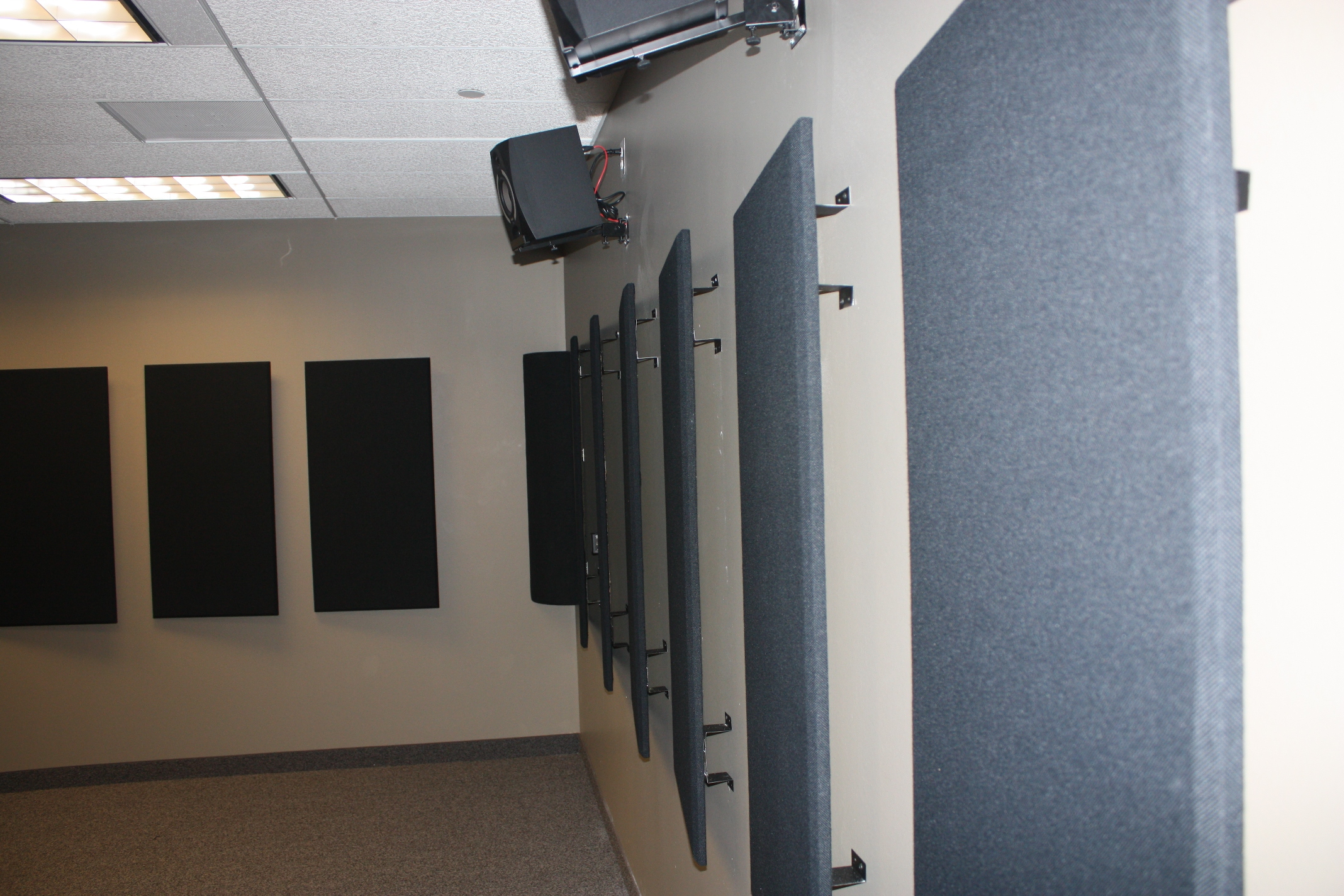
Sonora® Panels with 2″ Stand off clips.
Acoustically.
Sound travels around all exposed surfaces, and by raising the panel off the wall, you expose the back surface to sound, more like a baffle, which is a great absorber. Also, sound will pass through a panel into the space behind, bounce off the wall, and then have to pass through the panel again. This transition from panel to air and back changes the medium sound must travel through – this effectively changes impedance, which strips energy from sound. These are just a couple of the acoustic benefits of using a standoff clip – there are others.

Tone Tiles® and Silent Pictures® can be mounted with Stand off Clips.

Sonora® Panel back-lit on Stand off Clips
Aesthetically.
Wall mounted Sonora® panels take on a whole new dimension when using Stand off clips – they appear to float in mid air a couple of inches off the wall. This alone adds visual interest to a standard panel, but it can then be further accented by back-lighting the panel – changing the simple panel into a focal point in the lighting scheme.
Stand off clips can also be used with Tone Tiles® or Silent Pictures® – allowing your artwork to literally jump off the wall and float in the space in front of it.
So, a stand off is a good thing, with Sonora® Panels, Tone Tiles® and Silent Pictures® – acoustically and aesthetically.
Acoustics First @ The Kentucky Center for African American Heritage
Posted by Acoustics First in Absorption, Multipurpose Rooms, Museums, Press Release, Products on June 27, 2019
When Acoustics First® was approached with the ideas for the Main Hall of the Kentucky Center for African American Heritage (KCAAH), they needed acoustic materials that would not only work to acoustically tame the large space, but to have some be the focal point for attention – while others needed to blend in.
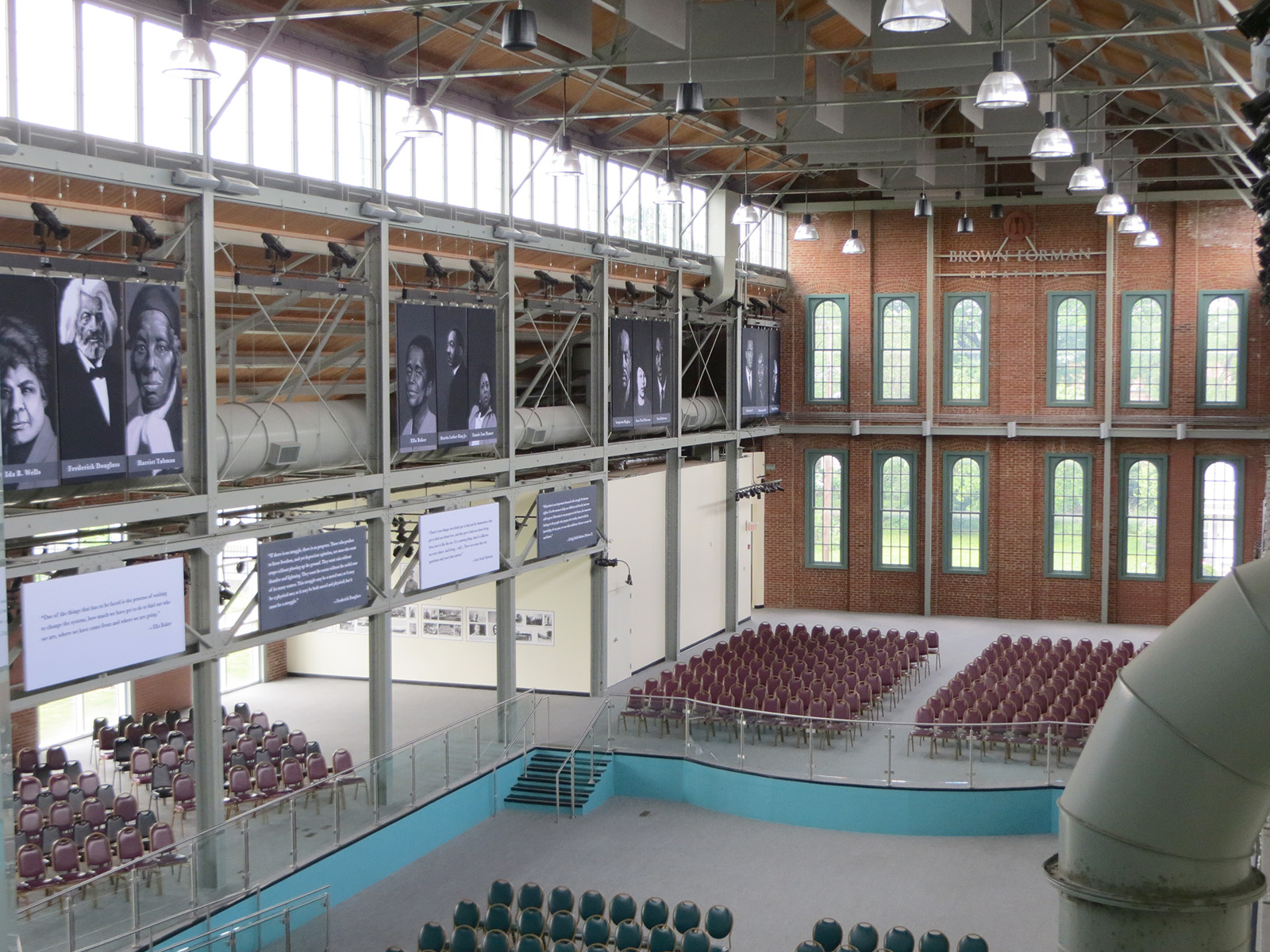
The Brown Forman Great Hall at KCAAH, showing the Silent Pictures®/Sonora® baffle portraits and quotes on the left, and the gray Cloudscape® baffles above.
Aukram Burton of KCAAH wanted to have large portraits of civil rights icons, not only nationally, but paying particular attention to leaders with a connection to Kentucky. He also wanted to have large panels with quotes from these figures. These would be a custom printed Silent Pictures®/Sonora® Baffle Hybrid – with a 1″ Custom printed Silent Pictures® panel on one side, and a grey fabric wrapped Sonora® Baffle on the back. These would maximize sound absorption due to all of the surfaces being exposed to sound – while being aesthetically significant to the space. Their sheer size presented some technical challenges – with the portraits being 4′ x 8′ and the quotes being 4′ x 10′ – creating custom artwork on this scale required many technical consultations, as many photographs were not easily scaled to this size.

The impact of the portraits in the hall can only be described as ‘impressive.’
They did not want the other treatments to distract from the portraits, so they chose to install large Cloudscape® Baffles in a gray material that closely matched the gray color scheme of the support beams, trusses, and HVAC elements that are exposed and prevalent in the hall. This allowed the large 4′ x 8′ baffles to blend into the background, while still taming the acoustics of the large hall. The acoustics make the hall feel like a much more intimate venue than its imposing size suggests.

Randy Lambert, Designer (Left), Jim DeGrandis (Center), and Aukram Burton of KCAAH (Right)
To get the full effect of the visual impact of the space, Aukram sent over a video tour of the facility.
Case Study: Hidden Creek HOA Clubhouse
Posted by Acoustics First in Absorption, Multipurpose Rooms, Product Applications, Products on May 30, 2019

Hidden Creek – Before
Hidden Creek Home Owners Association contacted Acoustics First® to remediate the poor acoustics of their clubhouse meeting hall. Hard surfaces and tall ceilings contributed to excessive reverberation and poor speech intelligibility. The HOA board wanted to address the acoustics of the meeting hall during an upcoming renovation of the space.
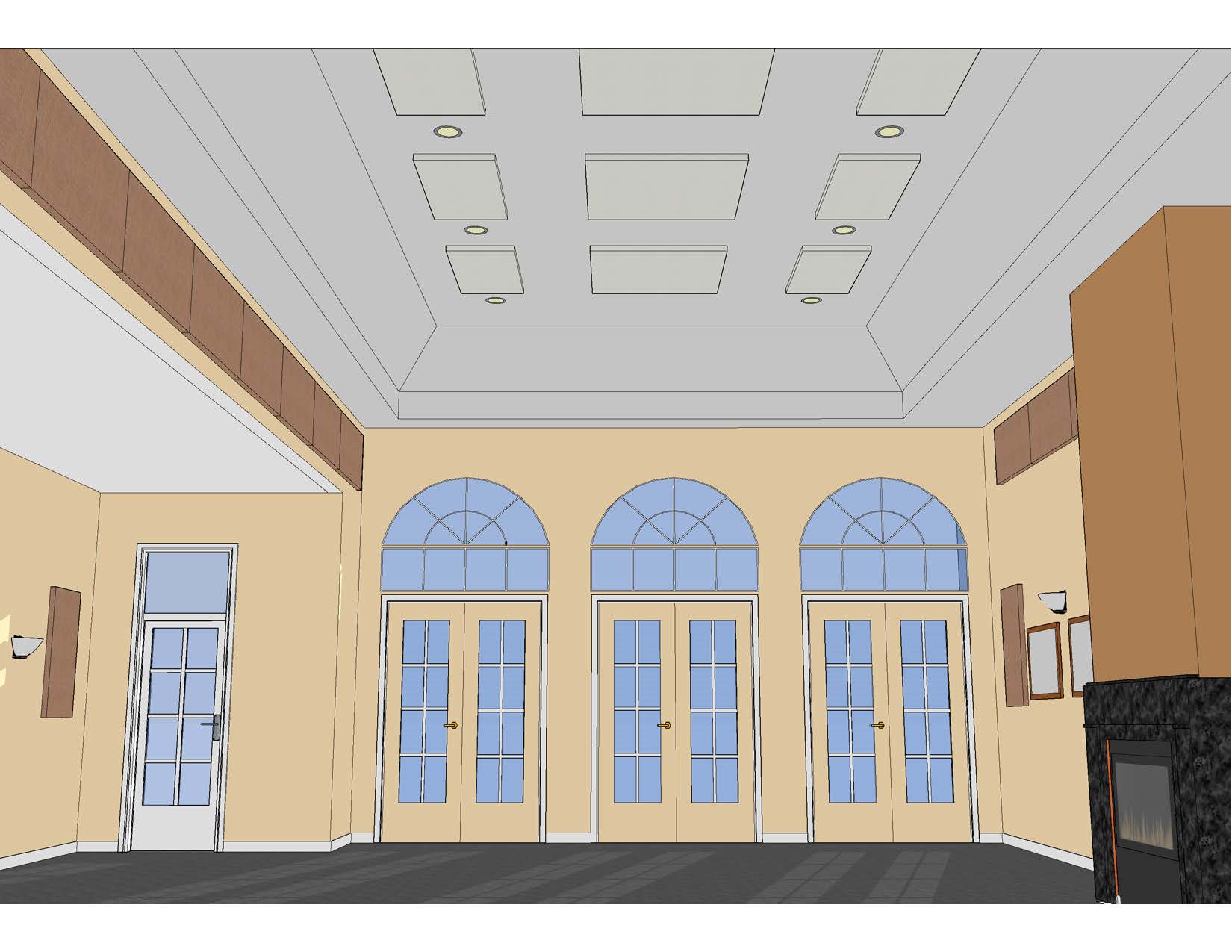
Hidden Creek – Treatment Rendering: Ceiling
Hidden Creek HOA submitted pictures and plans of the clubhouse to design consultant Cameron Girard. After calculating the amount of absorptive treatment needed to obtain an ideal reverb time, he submitted a treatment proposal with Sonora® panels that would ensure a significant acoustic improvement. Cameron provided detailed renderings to the board, allowing them to better visualize the layout of the panels as they reached a final decision on treatment.

Hidden Creek – Post Treatment
A single skilled contractor installed the panels in a few days, leaving Hidden Creek residents with a much more suitable acoustic environment for meetings and small group gatherings.
University of Miami – Frost School of Music
Posted by Acoustics First in Classrooms, Press Release, School & Educational Facilities, Uncategorized, Universities on April 29, 2019
Students at the Frost School of Music had an “ear-opening” experience when their Computational Psycho-acoustics class was lectured by Jim DeGrandis of Acoustics First last month. The topics ranged from engineering to human perception of ultrasonic frequencies. The students were exposed to concepts and demonstrations of ultrasonic frequencies which have been modified in ways to make them audible, and ultrasonic anomalies affecting the audible range in ways that are very blatant and obvious.
One of the most stark examples of “audible ultrasound” being the demonstration of a Parametric Speaker, which modulates the ultrasonic carrier to produce very directional audible frequencies.

Computational Psycho-Acoustics at Frost School of Music – University of Miami. Dr. Chris Bennett (far left) and Jim DeGrandis (in signature cap – center) [photo credit: Gonzalo Mejia]
Jim also spoke at the student forum about misconceptions of what it really means to be “in the industry” …and did an encore demo of the Parametric Speaker – which had apparently been such a novel experience for the Psycho-Acoustics class that they ‘demanded’ it be experienced again by a wider audience. (and it was just plain fun!)
The QuadraPyramid™ – A Multi-Faceted Gem
Posted by Acoustics First in Diffusion, Product Applications, Recording Facilities, Recording Studio, Uncategorized on March 15, 2019
With all the Diffusers on offer from Acoustics First® these days, this gem is sometimes overlooked: the QuadraPyramid™. Here’s an install pic of a few in the ceiling of a control room at the University of the Pacific!

University of the Pacific
There’s a reason why various pyramidal diffusers have been used for decades. They work, and they work well! The QuadraPyramid™ is our own take on this classic design, using four offset pyramids to create 16 angles of reflection on a single unit. Also, when mounted directly to a wall, these diffusers can double as a ‘mid-bass’ absorber, like in the project studio below.
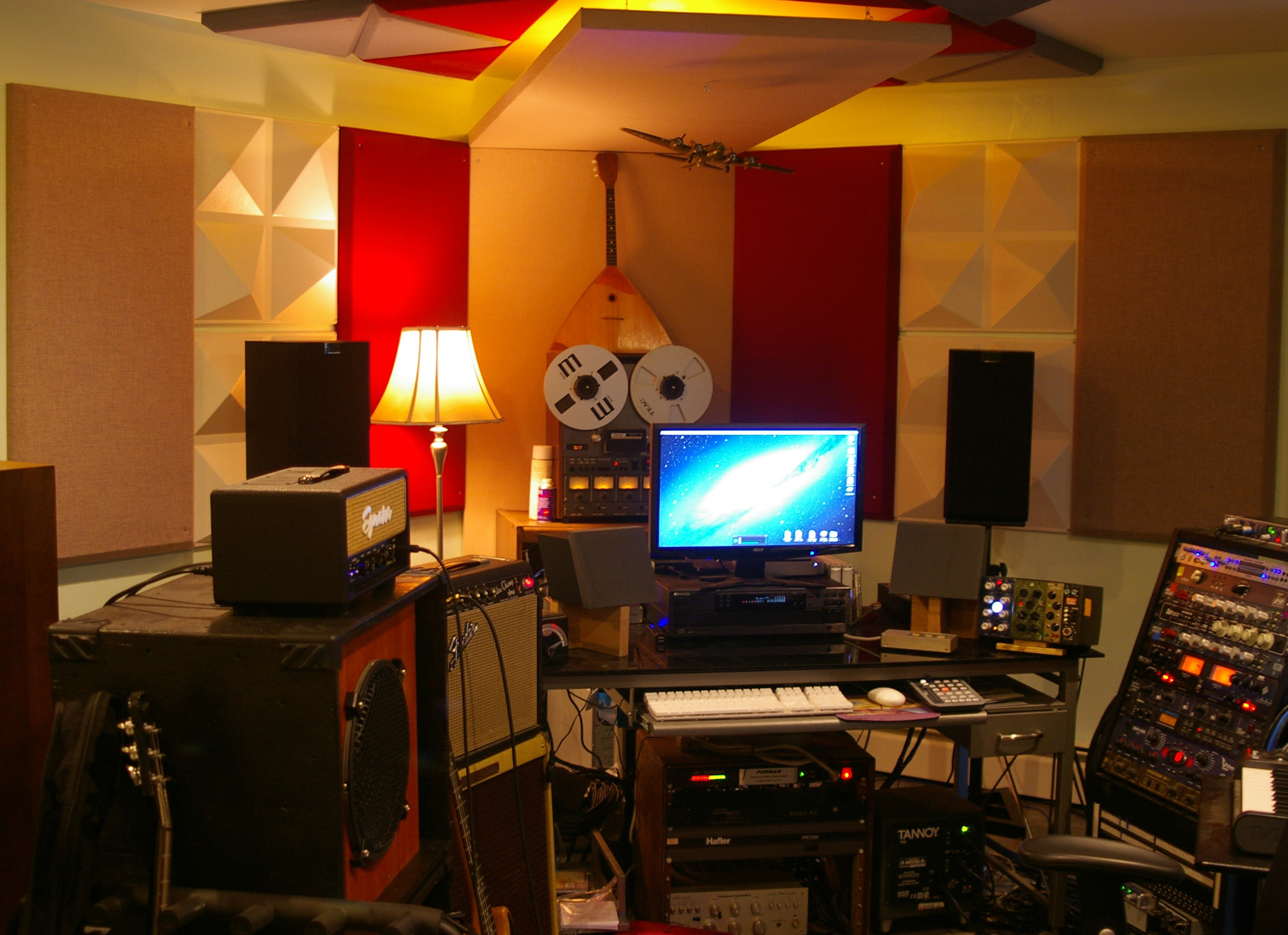
Spence Burton’s Project Studio
 Acoustics First BLOG
You must be logged in to post a comment.