Archive for category Home Entertainment
DIY: StratiQuilt™ Room Treatment
Posted by Acoustics First in Absorption, Animal Shelters, Articles, Broadcast Facilities, Construction Sites, DIY, Home Entertainment, Home Theater, HOW TO, Music Rehearsal Spaces, Music Tracking Room, Product Applications, Products, Recording Facilities, Recording Studio, Sound proofing, Studio Control Room, Vocal Booth, Voice Over on June 6, 2013
There are some situations where people are looking for a more temporary (yet still durable and effective) room treatment. Maybe you have a garage, or a practice space, or a place where you are looking for a usable solution that isn’t a permanent installation. Here is a great (not to mention tax deductible) treatment that can address many of the isolation and absorption issues of a space, while remaining durable (Washable), and easy to remove and reuse.

Stuff you need:
- Enough StratiQuilt™ Double-Faced Barrier Blanket to cover all of the wall and ceiling surfaces of the room you need to treat.
- 2”x4” lumber for the edges (Used to attach the barrier to the walls and maintaining an air gap.)
- Short Lag bolts and Washers
- Misc. hardware to attach 2”x4” lumber to walls.
Here’s what you do.
Attach the 2”x4” lumber to the walls with enough spacing to line up the grommets on two overlapped edges of the StratiQuilt™ blankets – if you have purchased the roll, the finished edges are 4 feet wide. Leave enough room to overlap the edges and bolt the quilts to the 2”x4” lumber as shown in the diagram above. Continue around the room, overlapping the edges of the StratiQuilt™ blankets to seal off the room. The blankets can be left loose over doors to allow for entry and egress while maintaining a good acoustic seal.
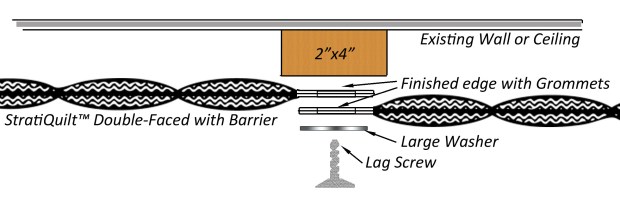
If desired, continue the process across the ceiling to “lock in” the room acoustics. This treatment may be considered by some to be a little on the “dead” side (High Absorption); however, The benefits of the treatment far outweigh this issue, which can be compensated for by adding a few acoustically reflective surfaces to the room (Drum Kit, Amplifiers, Racks, Diffusers, etc.)
Why use this system?
Other than it being very simple to install, take down and move with minor modifications to the structure, it performs a few vital acoustic tasks – all with one product. The StratiQuilt™ design is two layers of quilted acoustic fiberglass with a layer of BlockAid® barrier in the middle. The BlockAid® help the soundproofing of the room by it’s STC of 29, which will add significant isolation to the room. Mounting on the 2”x4” lumber is not just done for ease – adding the air gap behind the barrier increases both its STC and NRC allowing it to work as a limp mass barrier/absorber. The material absorbs on both sides (being double-faced), forcing in-room reflections to be attenuated immensely through the many layers of material it must pass through.
And on a final note, this economical start-up solution has the benefit of not being a “Building Material” for tax purposes, allowing for its immediate deduction as an expense.
Record your garage band without sounding like you’re in a garage, Try StratiQuilt™.
This simple DIY project is provided as a way for our customers to learn better ways to use our products and get more value out of the products they buy. If you are looking for more ways to use the products you have, look to Acoustics First for Ideas. http://www.acousticsfirst.com
————————————————————————————————————————————————————————————
Acoustics First Corporation supplies acoustical panels and soundproofing materials to control sound and eliminate noise in commercial, residential, government, and institutional applications worldwide. Products include the patented Art Diffusor®, sound absorbers, noise barriers, acoustical fabrics and accessories. Acoustics First® products are sold for O.E.M applications, direct, and through dealers. For more information on acoustical materials and their application, please visit www.AcousticsFirst.com or call Toll Free 1-888-765-2900 (US & Canada).
DIY: Super Bass Trap
Posted by Acoustics First in Absorption, Art Galleries, Articles, Classrooms, DIY, Home Entertainment, Home Theater, HOW TO, Music Tracking Room, Product Applications, Products, Recording Facilities, Recording Studio, School & Educational Facilities, Studio Control Room, Teaching Rooms, Teleconferencing, Theater, Universities, Vocal Booth, Voice Over, Worship Facilities on May 16, 2013
Take a couple of products and make your corner into a super trap!
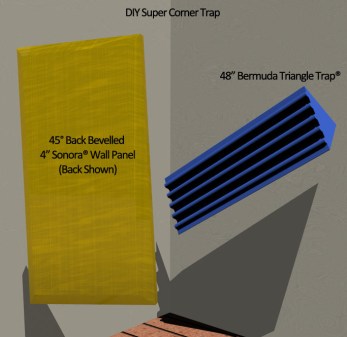
One of the most pervasive problems in recording and listening environments is the problem of bass build up in the corners. If you want to get the most out of your room, try making your corner into a DIY super trap!
Stuff you’ll need:
- 2’x4’x4” (or 2”)Back-Beveled Sonora® Wall Panel (beveled on the rear to fit corners or a standard panel with angle brackets)
- 48” Bermuda Triangle Trap® or 2 PhaseFOAM™ Bass traps (or a 1’x4’x1” raw fiberglass panel hung across the corner.)
- Foam Adhesive
- Sonora® Mounting brackets
Simple installation instructions:
- Use the adhesive to attach the Foam Bass trap to the wall
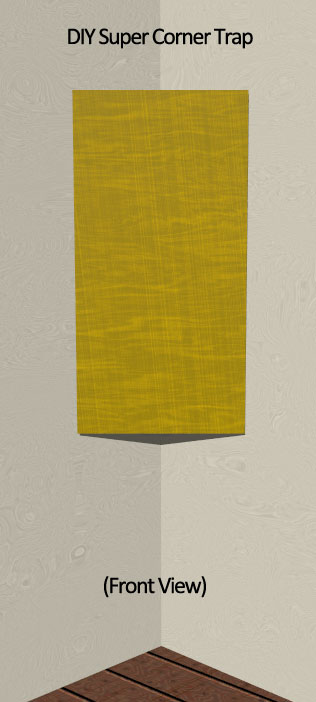
- Use the brackets to attach the Sonora® Panel across the corner over the trap
Super simple. Super effective.
As simple as it seems, this method of installing these products is an ideal way to get extra trapping in your corners. This solution changes the corner density multiple times as the sound waves pass through it –as well as introduces a layer of air space. This installation method takes the strengths of the two products and has them working together to eliminate that build-up of energy in the corners – it literally sucks it up like a sponge!

This simple DIY project is provided as a way for our customers to learn better ways to use our products and get more value out of the products they buy. If you are looking for more ways to use the products you have, look to Acoustics First for Ideas. http://www.acousticsfirst.com
————————————————————————————————————————————————————————————
Acoustics First Corporation supplies acoustical panels and soundproofing materials to control sound and eliminate noise in commercial, residential, government, and institutional applications worldwide. Products include the patented Art Diffusor®, sound absorbers, noise barriers, acoustical fabrics and accessories. Acoustics First® products are sold for O.E.M applications, direct, and through dealers. For more information on acoustical materials and their application, please visit www.AcousticsFirst.com or call Toll Free 1-888-765-2900 (US & Canada).
DIY: How to quiet down that noisy equipment rack
Posted by Acoustics First in Absorption, Auditorium, Broadcast Facilities, Data Centers, DIY, Government, Home Entertainment, Home Theater, HOW TO, Media Room, Music Rehearsal Spaces, Music Tracking Room, Product Applications, Recording Facilities, Recording Studio, Sound proofing, Studio Control Room, Vocal Booth on May 2, 2013
 DIY Project – Rack issues
Take a few seconds and DIY fix some of the common problems with using equipment racks!
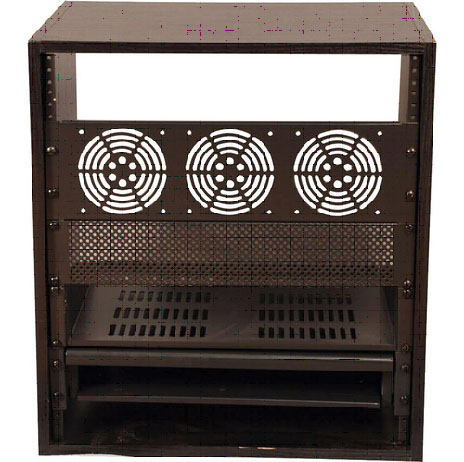
Not too many people think about their equipment racks, but many of us use them. Usually it’s something like what you see to the right – the great, sturdy, utilitarian box. Unfortunately, there are a couple inherent problems with these:
- Ringing – The metal resonates causing a ringing effect – may be masked by program material.
- Reflections – many times your rack is near sound sources causing reflections off the hard surfaces.
- Noise – Fans and other devices in the rack can make noises that are disruptive to recording.
Here are a few DIY fixes for these common problems.
- Composite foam with adhesive backing is perfect for stopping the ringing of filler panels.
- FireFlex™ acoustical foam the inside of your rack to keep the noise down.
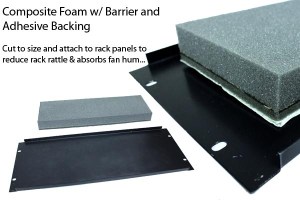

- Use some Composite Foam to line your trays, drawers and shelves to keep items from rattling around inside the case.
- Cover your rack in Sound Channels® fabric to keep the case from causing harsh reflections.
- Make a temporary cover for the front and back with BlockAid® sound barrier with minimal ventilation cut-outs to use during takes if rack-borne noise is problematic.
This simple DIY project is provided as a way for our customers to learn better ways to use our products and get more value out of the products they buy. If you are looking for more ways to use the products you have, look to Acoustics First for Ideas. http://www.acousticsfirst.com
————————————————————————————————————————————————————————————
Acoustics First Corporation supplies acoustical panels and soundproofing materials to control sound and eliminate noise in commercial, residential, government, and institutional applications worldwide. Products include the patented Art Diffusor®, sound absorbers, noise barriers, acoustical fabrics and accessories. Acoustics First® products are sold for O.E.M applications, direct, and through dealers. For more information on acoustical materials and their application, please visit www.AcousticsFirst.com or call Toll Free 1-888-765-2900 (US & Canada).
Acoustic First Ceiling Tiles get a face lift for the perfect fit to any application
Posted by Acoustics First in Absorption, Art Galleries, Auditorium, Broadcast Facilities, Classrooms, Fitness, Government, Home Entertainment, Home Theater, Hospitals, Media Room, Museums, Offices, Press Release, Product Applications, Recording Facilities, Restaurants, School & Educational Facilities, Studio Control Room, Teaching Rooms, Teleconferencing, Theater, Universities, Vocal Booth, Voice Over, Worship Facilities on March 28, 2013
For Immediate Release
Acoustic First Ceiling Tiles get a face lift for the perfect fit to any application.
 Acoustics First® has expanded their line of acoustical ceiling tiles allowing you to dress up any ceiling grid with a generous number of finish options. The legacy line of Sonora® ceiling tiles includes fabric faced ceiling tiles in either the standard square edge or a tegular edge that reveals below the grid. These tiles are available in a multitude of fabric colors and can be utilized in a wide range of applications to provide an upscale ceiling system that looks as good as it sounds. If you are looking for the absence of color, there are now two white options. The Sonora® UltraWHITE facing provides a basic smooth white finish while the Sonora® Nubby tile provides a texture white appearance. White ceiling tiles are an excellent choice for areas where a seamless look is desired and maintaining a room that is both bright and vibrant. Alternatively, if your application requires the ceiling to disappear, a black scrim version is also available. These black scrim ceiling tiles are a popular choice for public theaters, home theaters, restaurants or any application where a dark ceiling is desired. Additionally, choose from either a PVC faced or encapsulated ceiling tile if your application requires a wipe-able surface for resistance to liquids and dirt. Test labs, animal shelters, restaurants and similar facilities may require their ceiling tiles to be cleaned on a regular basis. In addition the ample amount of absorptive ceiling tiles, Acoustics First® also carries a wide range of diffusive ceiling tiles including the patented Art Diffusor® Model C and Model F. Product information, specifications and pricing can be found on the website @ http://www.acousticsfirst.com/sonora-ceiling-tiles.htm.
Image Downloads: http://www.mediafire.com/?21id1fsb0btrq
www.AcousticsFirst.com
Acoustics First Corporation
————————————————————————————————————————————————————————————
Acoustics First Corporation supplies acoustical panels and soundproofing materials to control sound and eliminate noise in commercial, residential, government, and institutional applications worldwide. Products include the patented Art Diffusor®, sound absorbers, noise barriers, acoustical fabrics and accessories. Acoustics First® products are sold for O.E.M applications, direct, and through dealers. For more information on acoustical materials and their application, please visit www.AcousticsFirst.com or call Toll Free 1-888-765-2900 (US & Canada).
DIY: Isolation Stand for Speakers and Instrument Amplifiers
Posted by Acoustics First in Articles, Broadcast Facilities, DIY, Home Entertainment, Home Theater, HOW TO, Music Rehearsal Spaces, Music Tracking Room, Product Applications, Recording Facilities, Recording Studio, Studio Control Room on March 21, 2013
DIY Project – Float your Loudspeakers and Monitors
Keep your Amps and Monitors from shaking the house down!
Instrument amplifiers, loudspeakers, and studio monitors all have the potential to cause structural vibrations. These vibrations can have an adverse effect on the listening environments, and can bleed into other microphones and instruments. Here’s an easy DIY project for floating those noisy guitar and bass cabinets (this project can be scaled up or down – from studio monitors to subwoofers).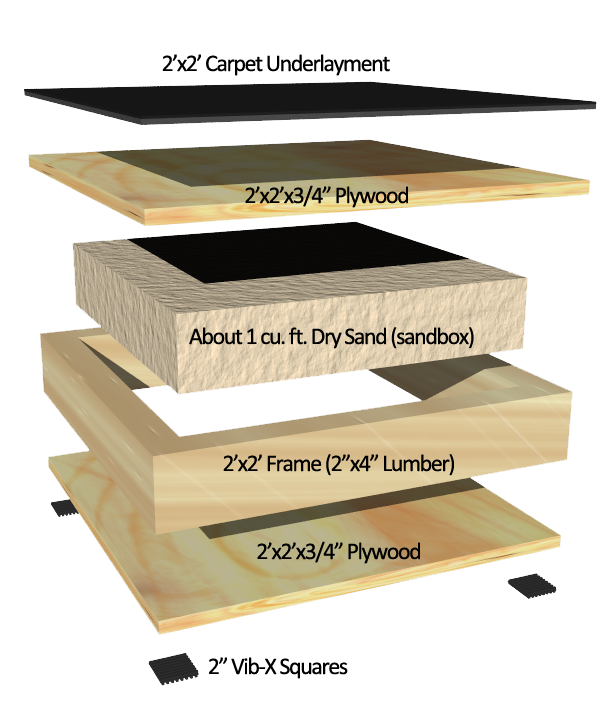
Stuff you will need:
- 2 – 2’x2’x3/4” Plywood (whatever size you want)
- 2’x2’ Carpet Underlayment (Same size as Plywood)
- 2”x4”x8’ Lumber for frame (More if scaling larger)
- About 1 cu.ft. Clean Dry Sand (Sandbox Sand)
- 3’x3’ Industrial Carpet (Enough to cover platform)
- Vib-X Pad to cut at least 4 – 2” Squares for feet
- Construction Adhesive
Simple assembly
- Create Frame and attach to bottom Plywood
- Attach Vib-X feet to bottom
- Fill with Sand
- Attach Plywood top
- Adhere Carpet Underlayment to top
- Carpet Box
 This plan is for a 2’x2’ platform. You can scale these or use more than one. Scale with caution – the sand makes these extremely heavy. What you are building is a floating platform. Keeping the sound from being transmitted into the floor below effectively decouples the speaker, making it “float”. In essence, the vibrations are being absorbed before getting to a solid surface, allowing for a more transparent listening experience and keeping the vibrations from interfering with other instruments in the area.

This simple DIY project is provided as a way for our customers to learn better ways to use our products and get more value out of the products they buy. If you are looking for more ways to use the products you have, look to Acoustics First for Ideas. http://www.acousticsfirst.com
————————————————————————————————————————————————————————————
Acoustics First Corporation supplies acoustical panels and soundproofing materials to control sound and eliminate noise in commercial, residential, government, and institutional applications worldwide. Products include the patented Art Diffusor®, sound absorbers, noise barriers, acoustical fabrics and accessories. Acoustics First® products are sold for O.E.M applications, direct, and through dealers. For more information on acoustical materials and their application, please visit www.AcousticsFirst.com or call Toll Free 1-888-765-2900 (US & Canada).
 Acoustics First BLOG
You must be logged in to post a comment.