Archive for category Articles
DIY – Back Wall Diffuser Array/Bass Trap: Revisited
Posted by Acoustics First in Absorption, Articles, Broadcast Facilities, Customer Feedback, Diffusion, DIY, Home Entertainment, Home Theater, HOW TO, Media Room, Music Rehearsal Spaces, Music Tracking Room, Product Applications, Recording Facilities, Recording Studio, Studio Control Room, Teleconferencing, Theater, Vocal Booth, Voice Over on July 14, 2016

DIY – Diffuser Array/Bass Trap
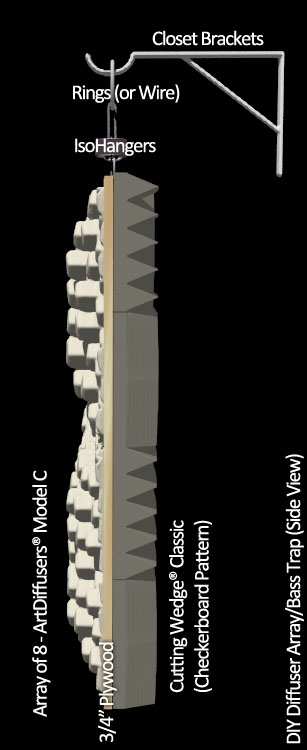 This month we thought we’d share a few Real-Life pictures of an idea we first introduced back in summer of 2013: The “Back Wall Diffuser Array/Bass Trap”.
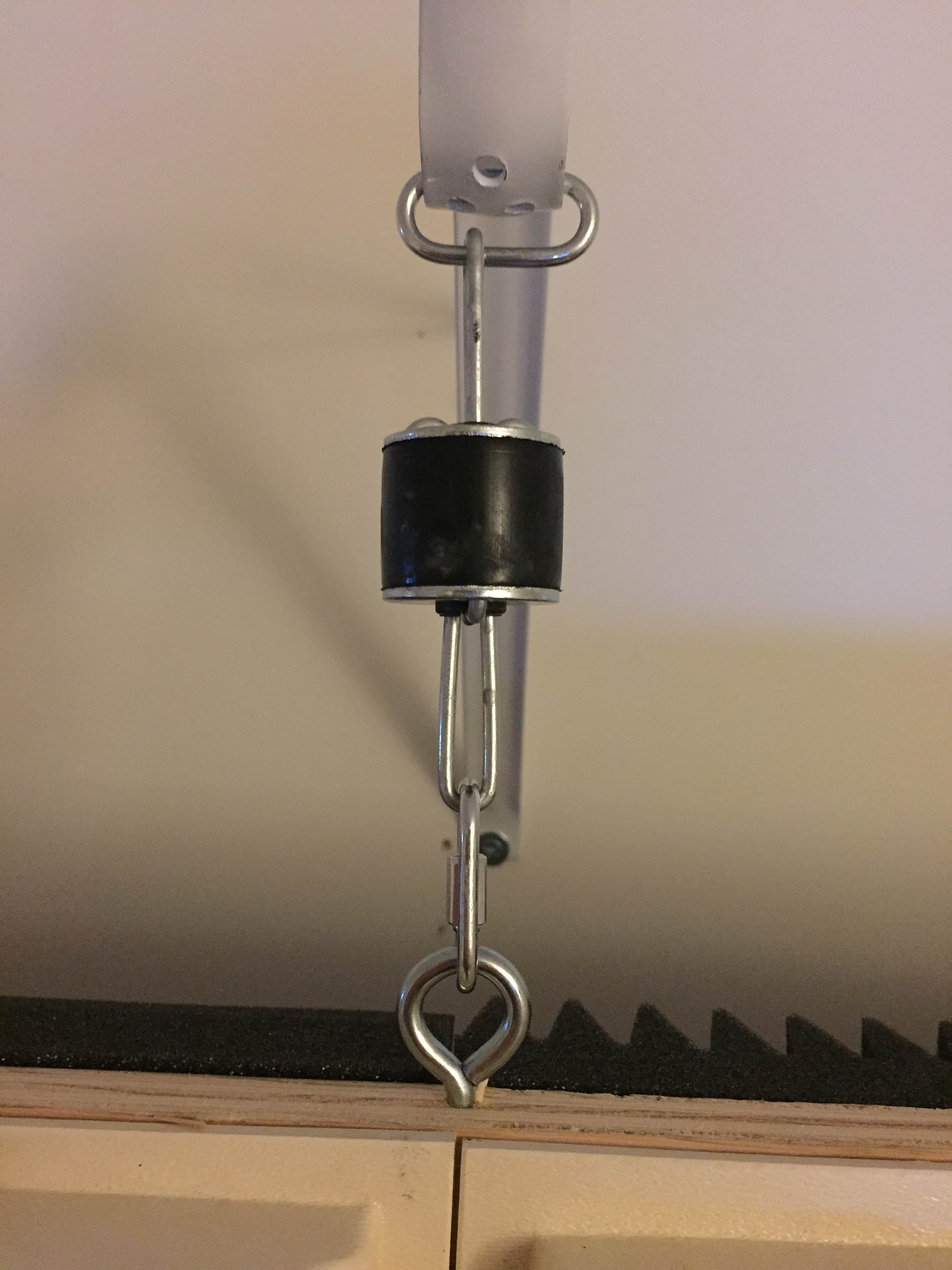
Isolation Hanger
This is the DIY project which incorporates our Art Diffusors®, Cutting Wedge® foam and a couple of isolation hangers into one large free-floating unit, which is acoustically decoupled from the wall.
This particular array was put together by a music producer/bass player for his home. As you can tell from the pics, the construction of this unit was executed beautifully and it’s very close to the original concept drawings.
It’s never too late to get started on your own DIY project.
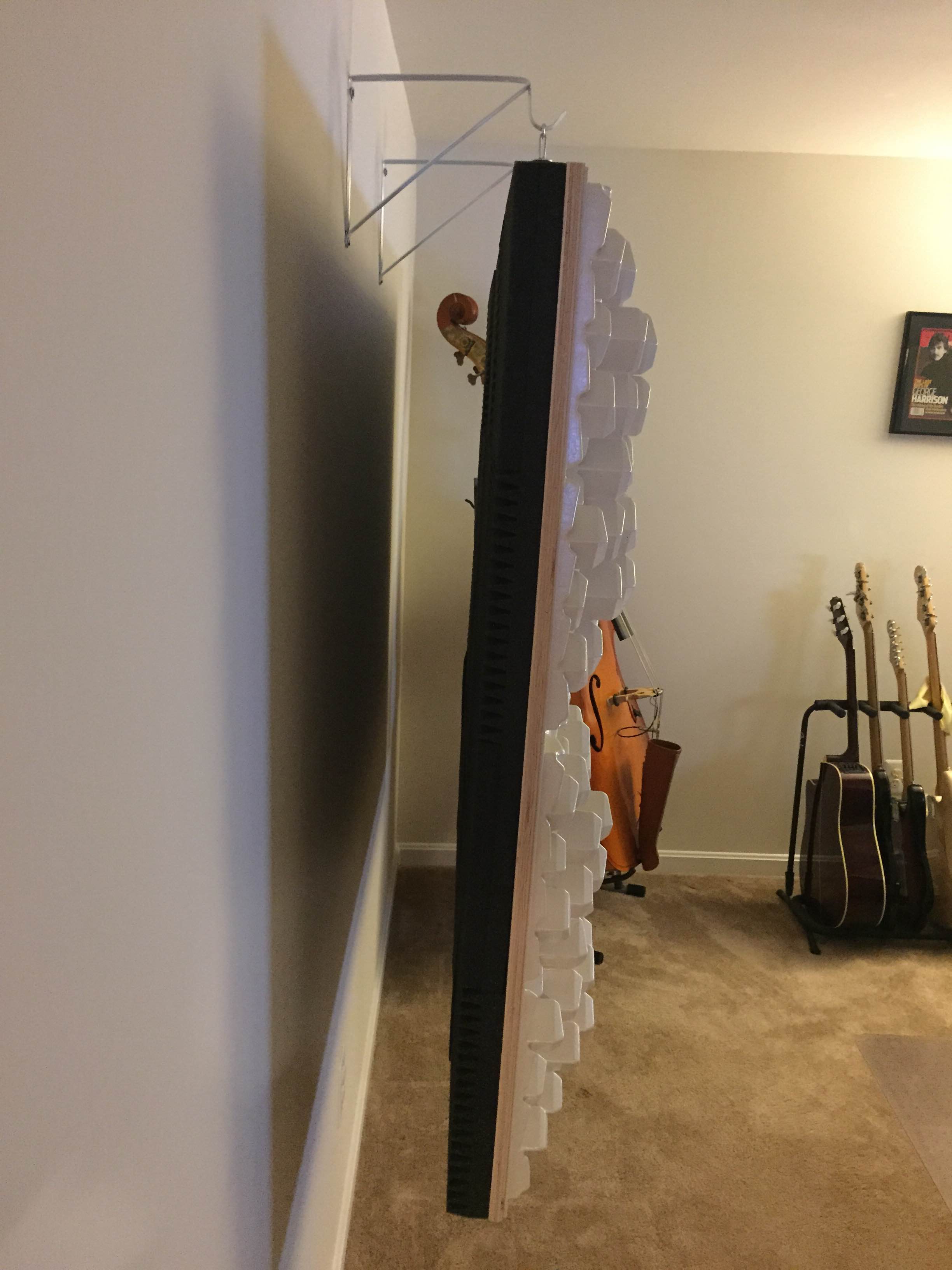 Real World – DIY |

Visit the Original DIY page to find out how to make your own.
Reverberation, the Invisible Architecture
Posted by Acoustics First in Absorption, Articles, Sound proofing on June 13, 2016
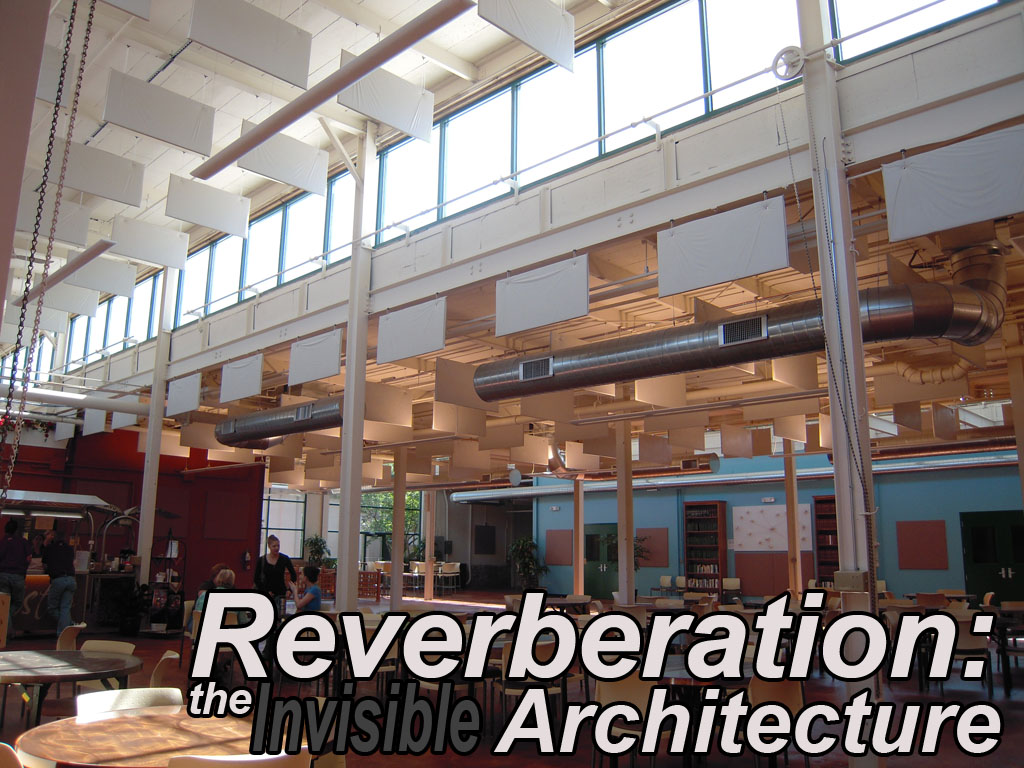
Cloudscape® Baffles and Sonora® Panels change the sonic architecture – making the space sound smaller and more intimate.
Ever wonder what gives us a sense of space? Obviously, our eyes visually tell us what’s going on, but there are other senses that contribute. Peak your head into a dark front hall closet, and even without seeing much, you can “feel” the close proximity of the walls and perhaps even the presence of the coats. Walk in to New York’s Grand Central Station, and you are confronted by a completely different sensation. Close your eyes, and the raucous environment tells you are in a large room with a lofty ceiling. Often times we take for granted the relationship that sound has to our spatial perception.
This sonic “sense of space” can be generally attributed to the room’s reverberation qualities. In simple terms, reverberation is the sound energy that remains in the listening environment as a result of lingering reflections. Reverberation time (RT or RT60) quantifies how quickly an impulse sound decays in a space. RT60 is how quickly the amplitude (volume) of short exciting signal decreases by 60dB in a large room. Reverberation time is dependent upon the volume and surface materials of a given room. Large spaces with hard materials (tile, drywall, etc.) like Grand Central Station have longer reverberation times, while small rooms furnished with “softer” materials, like the coat closet, sound much more “dead”.
Excessive reverberation is one of the most common acoustic issues that we encounter on a daily basis. As you may have experienced at some point, it’s difficult to understand what is being said when reflections from old information cover up what is newly spoken. In spaces where speech intelligibility is paramount, like classrooms or conference rooms, a short reverberation time (under 1 second) should be targeted.
That said, sometimes a long reverberation time is desirable. In spaces like cathedrals and orchestral halls, reverberation helps create ambience for the audience by sustaining musical notes, while allowing choirs and orchestras to blend more easily. These spaces may lack a sound system, and instead utilize the room to propagate sound. Rock venues, on the other hand, have amplified instruments, so a medium-short reverb time is needed to ensure that the music won’t become “muddy” and difficult to perform and enjoy.
There are a number of questions that an acoustician must ask when recommending appropriate treatment. These questions include, but are not limited to: Is there live music in this room? What kind of music is being performed? Is speech intelligibly important? What’s the audience size and where are they in relation to the sound source? So, the ideal amount of reverberation in a space is wholly dependent on the use of the space.
Listed below are the ranges of “ideal” reverberation times at mid-frequency (average of 500 and 1000 Hz) for a variety of rooms. The numbers are derived from David Eagan’s Architectural Acoustics (New York: McGraw-Hill, 1988), in which he breaks down rooms into Speech, Music and Speech/Music spaces. We hope you find this helpful.
Optimum Reverberation Times (T60)
“Speech” Rooms
Recording and Broadcasting Studio – .3 to .7 seconds
Classroom (elementary size) – .6 to .8 seconds
Conference/Lecture Room – .6 to 1.1 seconds
Intimate Drama – .9 to 1.1s“Speech & Music” Rooms
Cinema – .8 to 1.2 seconds
Small Theaters – 1.2 to 1.4 seconds
Multi-Purpose Auditoriums – 1.5 to 1.8 seconds
Worship Spaces – 1.4 (Churches) to 2+ seconds (Cathedrals)“Music” Rooms
Dance Clubs and Rock Venues (w/ Sound System) – 1 to 1.2 seconds
Semi classical Concerts/Chorus (w/ Sound System) – 1.2 to 1.6 seconds
Symphonic Concerts (Classical) – 1.6 to 2.3 seconds
Liturgical (Organ/Chorus) – 2+ seconds
Contact Acoustics First to have our acousticians help you find the ideal reverb time for your space.
ArtDiffusor® – MicroModel D – Big Sound, Small Package
Posted by Acoustics First in Articles, Press Release, Uncategorized on April 1, 2016
With current trends leaning toward improving the quality of life for all creatures living on our great planet, we at Acoustics First® feel that we can contribute to this in our own small way.
So we proudly introduce, the ArtDiffusor® – Micro Model D!

Beaker says, “It really helps to control unwanted specular reflections and flutter echos!”
Birds are very musical creatures, in the past, while Beaker was listening to the Bee Gees, he was bombarded with harsh specular reflections and flutter echos, it was a tragedy – but no longer.
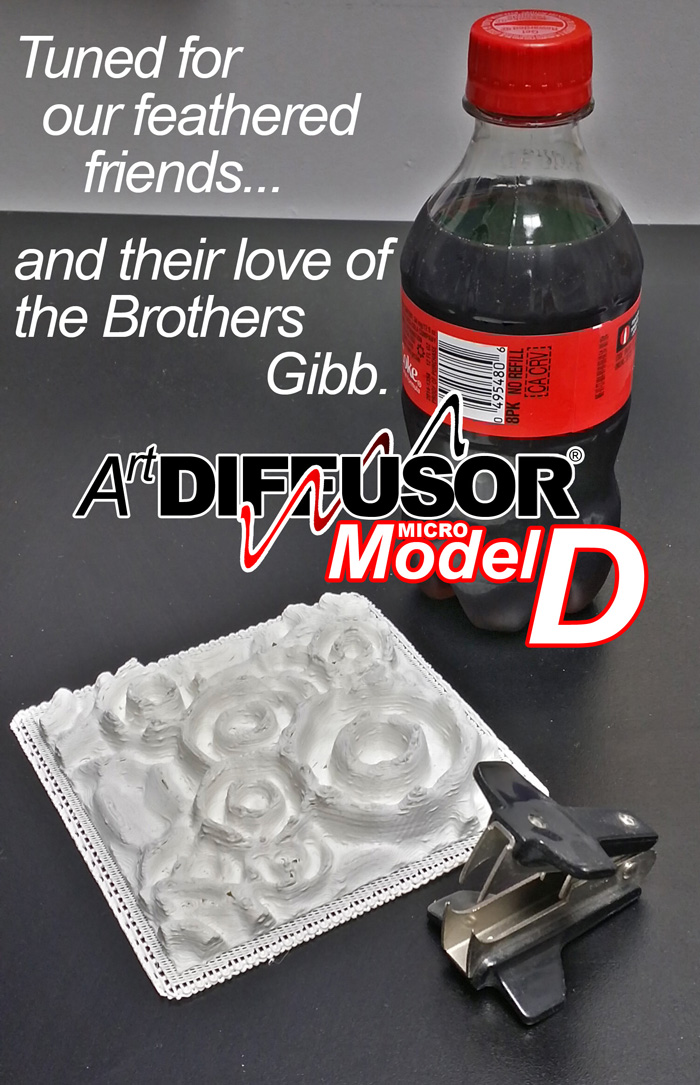
Beaker tweets, “After installing my Micro Model D, Barry’s falsetto is so much clearer – It’s Amazing!”
Harsh acoustic environments are not for the birds… The ArtDiffusor®- Micro Model D… is.
You don’t always hear what you see…
Posted by Acoustics First in Articles, Mentions, Product Applications, Uncategorized on April 14, 2015
 Recent Acoustics First article on PUPN!
Sometimes you enter a space that sounds amazing and wonder what treatments are being used. Many times the treatments are behind the curtain… both figuratively and in reality.
Learn about some of the ways acoustic treatments are hidden in plain sight, obscured from view, camouflaged, or just displayed proudly – Nick Colleran points out the not so obvious.
You just might find – you get what you need.
Click Here
http://www.pupnmag.com/article/detail/6404/acoustics-you-dont-always-hear-what-you-see
(Special thanks to the Great Philosopher Jagger)
– Acoustics First
DIY: StratiQuilt™ Room Treatment
Posted by Acoustics First in Absorption, Animal Shelters, Articles, Broadcast Facilities, Construction Sites, DIY, Home Entertainment, Home Theater, HOW TO, Music Rehearsal Spaces, Music Tracking Room, Product Applications, Products, Recording Facilities, Recording Studio, Sound proofing, Studio Control Room, Vocal Booth, Voice Over on June 6, 2013
There are some situations where people are looking for a more temporary (yet still durable and effective) room treatment. Maybe you have a garage, or a practice space, or a place where you are looking for a usable solution that isn’t a permanent installation. Here is a great (not to mention tax deductible) treatment that can address many of the isolation and absorption issues of a space, while remaining durable (Washable), and easy to remove and reuse.

Stuff you need:
- Enough StratiQuilt™ Double-Faced Barrier Blanket to cover all of the wall and ceiling surfaces of the room you need to treat.
- 2”x4” lumber for the edges (Used to attach the barrier to the walls and maintaining an air gap.)
- Short Lag bolts and Washers
- Misc. hardware to attach 2”x4” lumber to walls.
Here’s what you do.
Attach the 2”x4” lumber to the walls with enough spacing to line up the grommets on two overlapped edges of the StratiQuilt™ blankets – if you have purchased the roll, the finished edges are 4 feet wide. Leave enough room to overlap the edges and bolt the quilts to the 2”x4” lumber as shown in the diagram above. Continue around the room, overlapping the edges of the StratiQuilt™ blankets to seal off the room. The blankets can be left loose over doors to allow for entry and egress while maintaining a good acoustic seal.
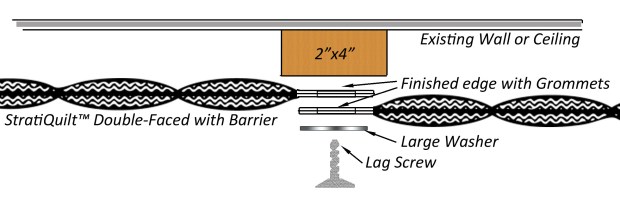
If desired, continue the process across the ceiling to “lock in” the room acoustics. This treatment may be considered by some to be a little on the “dead” side (High Absorption); however, The benefits of the treatment far outweigh this issue, which can be compensated for by adding a few acoustically reflective surfaces to the room (Drum Kit, Amplifiers, Racks, Diffusers, etc.)
Why use this system?
Other than it being very simple to install, take down and move with minor modifications to the structure, it performs a few vital acoustic tasks – all with one product. The StratiQuilt™ design is two layers of quilted acoustic fiberglass with a layer of BlockAid® barrier in the middle. The BlockAid® help the soundproofing of the room by it’s STC of 29, which will add significant isolation to the room. Mounting on the 2”x4” lumber is not just done for ease – adding the air gap behind the barrier increases both its STC and NRC allowing it to work as a limp mass barrier/absorber. The material absorbs on both sides (being double-faced), forcing in-room reflections to be attenuated immensely through the many layers of material it must pass through.
And on a final note, this economical start-up solution has the benefit of not being a “Building Material” for tax purposes, allowing for its immediate deduction as an expense.
Record your garage band without sounding like you’re in a garage, Try StratiQuilt™.
This simple DIY project is provided as a way for our customers to learn better ways to use our products and get more value out of the products they buy. If you are looking for more ways to use the products you have, look to Acoustics First for Ideas. http://www.acousticsfirst.com
————————————————————————————————————————————————————————————
Acoustics First Corporation supplies acoustical panels and soundproofing materials to control sound and eliminate noise in commercial, residential, government, and institutional applications worldwide. Products include the patented Art Diffusor®, sound absorbers, noise barriers, acoustical fabrics and accessories. Acoustics First® products are sold for O.E.M applications, direct, and through dealers. For more information on acoustical materials and their application, please visit www.AcousticsFirst.com or call Toll Free 1-888-765-2900 (US & Canada).
 Acoustics First BLOG
You must be logged in to post a comment.