Posts Tagged sonora
Sabins, SAC, & NRC — a practical guide.
Posted by Acoustics First in Absorption, Articles, HOW TO on September 18, 2025
When optimizing a room’s acoustics, you’re often balancing how much sound is absorbed (loss) against how much bounces around (reverberation). Some common ways to describe absorption — sabins, SAC, and NRC — look different, but they’re closely related.
Sabins
A sabin is a direct measure of absorption: One sabin equals the sound-absorbing effect of one square foot of a perfectly absorbing surface (like an open window – sound goes out, but doesn’t come back.) In practice, manufacturers or labs will report a component’s equivalent absorption area in sabins at various frequencies. Sabins are additive: add the sabins of all items in a space to get the room’s total absorption for use in reverberation calculations.

SAC
Sound absorption coefficients (SAC) are used to simplify large square footage calculations. Each SAC itself is derived from the measured equivalent sabins of a test sample divided by the sample’s area. This allows you to multiply the square footage of a certain material by the SAC and it will tell you how many sabins it will absorb at a certain frequency. You may also see an average of all the SACs, or a subset of those values… a specific, often-used subset is the Noise Reduction Coefficient (NRC).
NRC and how it’s calculated
NRC (Noise Reduction Coefficient) is a number that represents a material’s average absorption performance at mid-to-high frequencies. It’s calculated by taking the arithmetic average of the material’s sound absorption coefficients (SACs) at 250 Hz, 500 Hz, 1000 Hz and 2000 Hz (per ASTM C423 or other standard test procedures). NRC is typically reported to the nearest 0.05 and runs from 0.00 (reflective) to 1.00 (very absorbent). Being an average, it isn’t the most accurate method, but it can give you a quick estimate which can be useful in the planning stages.

Practical Mathematic Relationship
- From measured data: SAC = measured sabins ÷ sample area.
- NRC is the average of SACs across four bands (250 Hz, 500 Hz, 1000 Hz and 2000 Hz).
- To convert NRC into a working absorption number for a planar surface:
sabins = NRC × area (ft²). - For discrete units (baffles, clouds): manufacturers often give sabins per unit, so total absorption is sabins per unit × number of units.
Why sabins for baffles and NRC for wall/ceiling panels?
Hanging devices like baffles are three-dimensional, exposed on multiple faces, and their effective absorption depends on orientation, spacing, and edge behavior. It’s more accurate and user-friendly to report their absorption as “# sabins per unit.” Flat-mounted wall or ceiling panels cover a known area and behave predictably per square foot, so SAC or an NRC (per ft²) is a convenient, normalized way to estimate absorption across a room.
Putting it into RT60 calculations
RT60 calculations depict the amount of time it takes for a sound to decay 60dB in a particular space with specific treatments. (60dB is roughly a 1000-fold reduction in sound pressure.) Reverberation-time formulas (like Sabine’s) use the room’s total absorption in sabins in the function. A basic average will use NRC × area for planar coverage and add sabins-per-unit for baffles. Sum everything up to get total sabins, then plug that into your RT calculation to estimate RT60.
If using feet your calculation is…
RT60 = 0.049 x Room Volume ÷ Total Sabins
If using metric your calculation is…
RT60 = 0.161 x Room Volume ÷ Total (Metric) Sabins
In summary:
NRC is an area-based average (for flat-coverage estimates); SAC is a sabins per square foot coefficient (for efficient absorption calculations using area); sabins per unit are direct, measured absorption values (better for discrete, hung, multi-faced items).
Why use a mix of objective and subjective goals to make a great sounding space?
Posted by Acoustics First in Articles, Media Room, Music Tracking Room, Recording Facilities, Recording Studio, Studio Control Room on July 30, 2024
With the ability to measure and analyze every detail of an acoustic environment, sometimes we forget about the basic fact that it should sound the way we want it to sound. There are scenarios where objective measurement is important, desired, and even required. If there is a physical safety concern that may damage hearing ( loud noises, machinery, etc.), a need to have safety information understood (evacuation/safety notices or alarms, etc.), absolute sound privacy is required (HIPAA regulations, government security, or legal need…), or the need for speech clarity for education… often we require some guidelines be met to insure the acoustics meet a decided standard for performance. These standards use objective measurement and data to make these determinations. There isn’t a governing body that regulates how your home theater should perform, or how an office needs to sound (beyond the safety and privacy concerns mentioned above.)

Entertainment venues, theaters, churches, commercial spaces, restaurants, offices, and residential spaces have very little regulation, and while there are many occasions that testing is used to improve the performance of these spaces, there are some environments where the effort to measure and quantify everything can get in the way of the goal of making a great acoustic space. If you wanted to compare different small “critical listening environments” (mixing and mastering studios are examples of these), there would be some general commonalities in their construction and treatment. Many are built to minimize parallel reflections, have short reverb times, symmetric placement of source speakers, control first reflections, and balance the frequency performance of the space.
A “ruler-flat” frequency response shouldn’t be the acoustic goal.
“Balancing the frequency performance of a space” doesn’t mean “attain ruler-flat frequency response across the entire human hearing range.” There are several reasons that the “ruler-flat” interpretation is counterproductive – the first being that it is nearly impossible to attain in any room. Second, is that everyone perceives sound differently. As humans age, almost all people will experience some degree of “presbycusis,” which is slow decline in high-frequency sensitivity that comes with age. If you are lucky enough to reach a ripe old age, there is a 60% – 80% chance (depending on the study you read) that your high-frequency hearing won’t be what it was when you were young. But even with that factor removed, when your hearing was at its best, your personal perception of sound is different from every other person – making sound, by definition, subjective.

The closest you can get to ruler-flat performance is to remove the room entirely and get some high quality headphones – but you may still find yourself tweaking the equalization curve to your preference. There are many people who feel that headphones sound unnatural, or that they are uncomfortable to listen to for long periods of time. Even the best mixing studios are not completely flat. Also, you will see many different sets of speakers in these spaces… or even headphones. These different sources are to compare how a mix will sound in different environments… and that the mix will “translate” in different listening scenarios. These environments which people will listen to music in vary to include outdoors, bathroom, kitchen, movie theater, grocery store, car, truck, SUV, convertible, living room, and more… coming from sources like phone speakers, headphones, assistants like echo and Google, bookshelf speakers, sound bars, audiophile equipment, movie theater sound systems, and an array of automotive audio systems.

Start with the basics.
If you are making a space for critical listening, there are some objective guides that will help you. If building from scratch, build with a geometry that will reduce room modes and parallel surfaces. Reduce reflections that will interfere with the source. Reduce reverb time. Control the bass response to reduce build up. These can all be readily calculated, measured, and controlled with bass traps, absorption, and diffusion. Most of the time, just following these objective guides will get you a room that will sound subjectively “good.”
After you get that far, you could continue trying to measure the room and tweak the performance to try and attain the unattainable ruler-flat response… or you could listen to music in your room and decide with you ears what should to be done to make it sound how you want. There are many subjective arguments people make about why they think something sounds better. There are philosophical arguments about listening to it “as the engineer/artist intended.” There are debates about if you should equalize music at all – even if you are in the majority of the aging population who may need to give the high-frequencies a nudge to experience the sizzle of Stevie Wonder’s glorious high-hat mastery.
When it comes to your own space… if it sounds good to you… it’s right. By following a few objective guidelines to get you in the arena, you can tweak the last bit with your ears until you are experiencing the material the way you prefer it to sound.
St. Mary Magdalen Worship Center – Kerfed panels to fit curved walls!
Posted by Acoustics First in Absorption, Product Applications, Products, Worship Facilities on June 28, 2024
The Mary Magdalen Mission Center has an oval-shaped sanctuary that was experiencing extremely poor speech and music clarity. Their Worship services are traditional leaning (spoken word, piano and congregational singing) with the occasional contemporary music service.
Parabolic Focusing – A primary feature of the sanctuary are 4 large curved walls (two at the front and two at the rear). Concave, uniform, curved surfaces are very problematic in room acoustics. Curved surfaces “focus” sound reflections to a point, akin to a magnifying glass focusing light passing through the curved lens.
If you’ve ever stood in the center of dome, you’ve probably experienced a few interesting acoustic anomalies. First is the “whisper” effect, where sound produced near the foci of the dome/curve, is amplified, allowing a faint whisper to be heard throughout the room (and conversely, all the sound produced in the room focused to this point, causing a cacophony of reflections at the center foci) . Another is the “creep” effect, where sound produced at the edge of arc, travels along the curved surface, losing little energy until it reaches the opposite end of the arc.
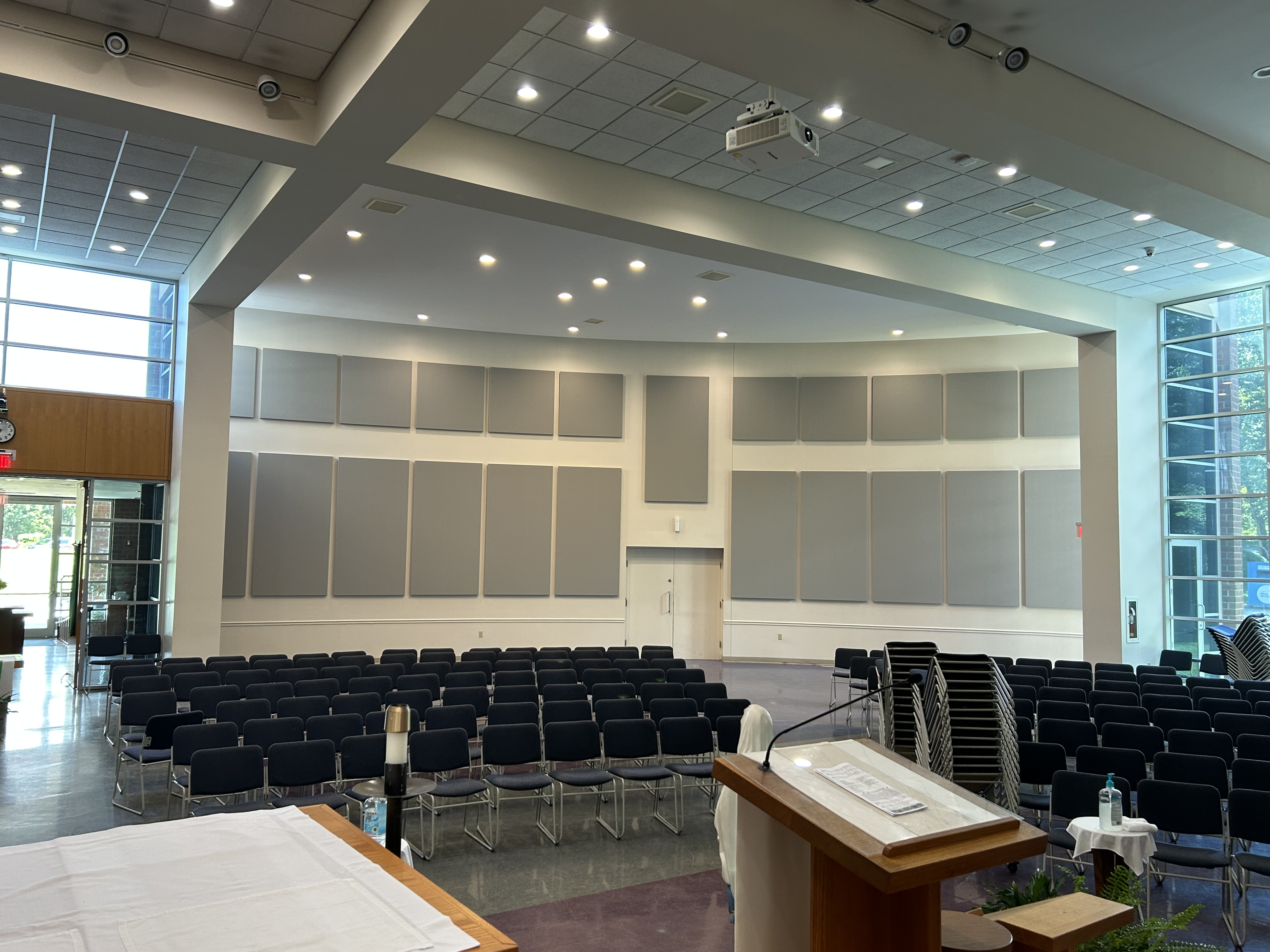
Not only do the hard wall and floor surfaces of the Mary Magdalen Mission Center contribute to excessive sound buildup, but the parabolic focusing from the curved wall surfaces caused extreme comb filtering (pockets of destructive and constructive interference as a result of overlapping waves), exacerbating intelligibility issues. These conditions contribute to an acoustically uncomfortable environment in which music is hard to perform and enjoy while speech is also difficult to understand.
To significantly reduce excessive reverberation and destructive reflections, we recommended installing approx. 1200 SQFT of 2” back-scored Hi Impact Sonora Wall Panels across the rear wall surfaces. We specified kerfed/back-scored Hi Impact Sonora Wall Panels that can “bend” to fit curved surfaces and come with a high-density adder that improves acoustic performance and durability. View Sonora Panel information on our website.
https://www.acousticsfirst.com/sonora-wall-panels.htm
Reverb Predictions – Worship spaces of this size with a blend of traditional and contemporary music should have a reverb time below 1.6s. We entered the room’s dimensions and construction materials and made a prediction of reverb times before and after treatment. In addition to controlling distracting echoes and comb filtering, installing approx. 1248 SQFT of 2” Hi Impact Sonora wall panels across the rear wall reduced reverberation by approx. 35%, significantly improving speech intelligibility and music clarity.
Sonora® Wave Clouds
Posted by Acoustics First in Absorption, Auditorium, Product Applications, Products on May 20, 2024
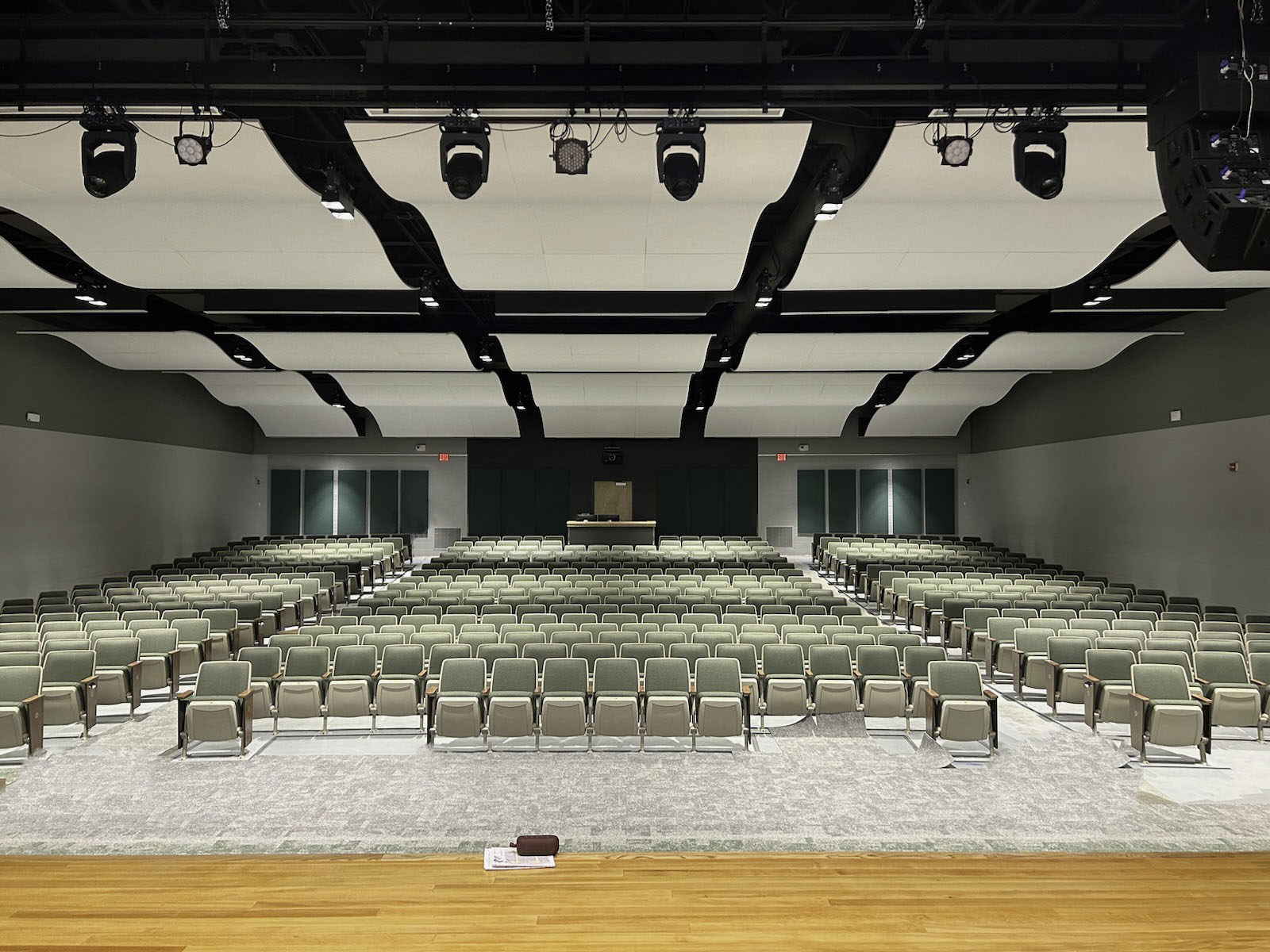
One of the more recent additions to our line of sound absorbing ceiling treatments is the Sonora Wave Cloud. This product can be an ideal choice for architects and specifiers who may be exploring options for large spaces which may require more expansive acoustic treatment while maintaining a certain design aesthetic. The curved shape of the Sonora® Wave Clouds allow for an impressive and unique look, while also providing optimal sound control. Sonora® Wave Clouds are available fabric wrapped or custom painted, with a 132″ radius bend in either a convex or concave profile. This allows for the creation of long waves – hence the name.

For this Job, Acoustics First® worked with Ferrari & Sons to provide the acoustic treatment for an auditorium in the Webutuck Central School District in Amenia, NY. As you can see, the end results turned out great!
Before & After: Video Conference Room
Posted by Acoustics First in Absorption, Customer Feedback, Media Room, Multipurpose Rooms, Offices, Product Applications, Products, Teleconferencing, Video on March 6, 2024
AMC Technology is located in a 5,400 square-foot suite that features a large open office area, a break room as well as several conference rooms.
When Acoustics First® initially met with the AMC team, they had recently moved into the space and were experiencing a number of acoustic problems in the open office area. Although Acoustics First® originally provided recommendations to improve workstation isolation in the open office, once the employees settled into the space, call-clarity issues in the conference rooms had become the much larger concern.
Three of the conference rooms were rudimentarily treated with 1” sound absorbing panels. The other four conference rooms were not treated acoustically and had hard/reflective walls, floors and ceilings. These hard surfaces were most at fault for excessive reverberation, noise buildup and distracting flutter-echoes (“ringing” caused by parallel reflective surfaces). These conditions contributed to an acoustically uncomfortable environment in which speech was hard to understand and conference call clarity suffered.

AMC Technology’s CTO, Anthony Uliano, identified a few goals for potential acoustic remediation. Anthony often works remotely and will call into the conference rooms to talk with team members. The sound of these calls on his side was frequently distorted and individual team members were difficult to understand. Anthony was concerned that clients were experiencing the same intelligibility issues. The primary goal for acoustic treatment was to improve the clarity of conference calls by reducing echoes and excessive reverberation within each conference room. Anthony also mentioned that they were experiencing some isolation problems. Though not a high priority, steps to reduce sound transmission were detailed for future consideration.
Acoustics First® specified Sonora® wall and ceiling treatment within each conference room to control flutter echoes and reduce reverberation down to suitable levels for conference calls. The video below provides a great snapshot of how the room sounded before and after treatment. Each recording is done in the same room, with the same employee and sitting the same distance from the microphone. The end result is a much clearer and intelligible conversation.
 Acoustics First BLOG
You must be logged in to post a comment.