Posts Tagged bass traps
Why use a mix of objective and subjective goals to make a great sounding space?
Posted by Acoustics First in Articles, Media Room, Music Tracking Room, Recording Facilities, Recording Studio, Studio Control Room on July 30, 2024
With the ability to measure and analyze every detail of an acoustic environment, sometimes we forget about the basic fact that it should sound the way we want it to sound. There are scenarios where objective measurement is important, desired, and even required. If there is a physical safety concern that may damage hearing ( loud noises, machinery, etc.), a need to have safety information understood (evacuation/safety notices or alarms, etc.), absolute sound privacy is required (HIPAA regulations, government security, or legal need…), or the need for speech clarity for education… often we require some guidelines be met to insure the acoustics meet a decided standard for performance. These standards use objective measurement and data to make these determinations. There isn’t a governing body that regulates how your home theater should perform, or how an office needs to sound (beyond the safety and privacy concerns mentioned above.)

Entertainment venues, theaters, churches, commercial spaces, restaurants, offices, and residential spaces have very little regulation, and while there are many occasions that testing is used to improve the performance of these spaces, there are some environments where the effort to measure and quantify everything can get in the way of the goal of making a great acoustic space. If you wanted to compare different small “critical listening environments” (mixing and mastering studios are examples of these), there would be some general commonalities in their construction and treatment. Many are built to minimize parallel reflections, have short reverb times, symmetric placement of source speakers, control first reflections, and balance the frequency performance of the space.
A “ruler-flat” frequency response shouldn’t be the acoustic goal.
“Balancing the frequency performance of a space” doesn’t mean “attain ruler-flat frequency response across the entire human hearing range.” There are several reasons that the “ruler-flat” interpretation is counterproductive – the first being that it is nearly impossible to attain in any room. Second, is that everyone perceives sound differently. As humans age, almost all people will experience some degree of “presbycusis,” which is slow decline in high-frequency sensitivity that comes with age. If you are lucky enough to reach a ripe old age, there is a 60% – 80% chance (depending on the study you read) that your high-frequency hearing won’t be what it was when you were young. But even with that factor removed, when your hearing was at its best, your personal perception of sound is different from every other person – making sound, by definition, subjective.

The closest you can get to ruler-flat performance is to remove the room entirely and get some high quality headphones – but you may still find yourself tweaking the equalization curve to your preference. There are many people who feel that headphones sound unnatural, or that they are uncomfortable to listen to for long periods of time. Even the best mixing studios are not completely flat. Also, you will see many different sets of speakers in these spaces… or even headphones. These different sources are to compare how a mix will sound in different environments… and that the mix will “translate” in different listening scenarios. These environments which people will listen to music in vary to include outdoors, bathroom, kitchen, movie theater, grocery store, car, truck, SUV, convertible, living room, and more… coming from sources like phone speakers, headphones, assistants like echo and Google, bookshelf speakers, sound bars, audiophile equipment, movie theater sound systems, and an array of automotive audio systems.

Start with the basics.
If you are making a space for critical listening, there are some objective guides that will help you. If building from scratch, build with a geometry that will reduce room modes and parallel surfaces. Reduce reflections that will interfere with the source. Reduce reverb time. Control the bass response to reduce build up. These can all be readily calculated, measured, and controlled with bass traps, absorption, and diffusion. Most of the time, just following these objective guides will get you a room that will sound subjectively “good.”
After you get that far, you could continue trying to measure the room and tweak the performance to try and attain the unattainable ruler-flat response… or you could listen to music in your room and decide with you ears what should to be done to make it sound how you want. There are many subjective arguments people make about why they think something sounds better. There are philosophical arguments about listening to it “as the engineer/artist intended.” There are debates about if you should equalize music at all – even if you are in the majority of the aging population who may need to give the high-frequencies a nudge to experience the sizzle of Stevie Wonder’s glorious high-hat mastery.
When it comes to your own space… if it sounds good to you… it’s right. By following a few objective guidelines to get you in the arena, you can tweak the last bit with your ears until you are experiencing the material the way you prefer it to sound.
Sonora® LFC – Low-Frequency Control Panel
Posted by Acoustics First in Absorption, Auditorium, Home Entertainment, Home Theater, Multipurpose Rooms, Music Rehearsal Spaces, Music Tracking Room, Press Release, Product Applications, Products, Recording Facilities, Recording Studio, Studio Control Room, Theater, Uncategorized, Vocal Booth, Voice Over, Worship Facilities on May 24, 2021
Bass frequencies are difficult to control… and there is sometimes a tendency to overuse standard, broadband panels to try to absorb everything in order to get rid of that bass. However, this method is unbalanced and has the side-effect of leaving a room sounding muffled and boomy.
Why?
Physics! High frequencies are easier to absorb than low frequencies. So, when you ONLY use broadband absorbers, they easily remove the high frequencies and leave more of the lows. Overusing broadband absorption in a large performance space can be a disaster – leaving an environment lacking energy and feel – many describe this condition as a room sounding “dead.” (Not good!)
So how can you treat the boomy bass without killing your rooms with too much broadband absorption? Can you just take out the bass? Unfortunately, it is impossible to ONLY absorb the bass, but we can LIMIT the amount of high frequency energy that we absorb to balance out the response.
Acoustics First® presents… the Sonora® LFC – Low-Frequency control panel.
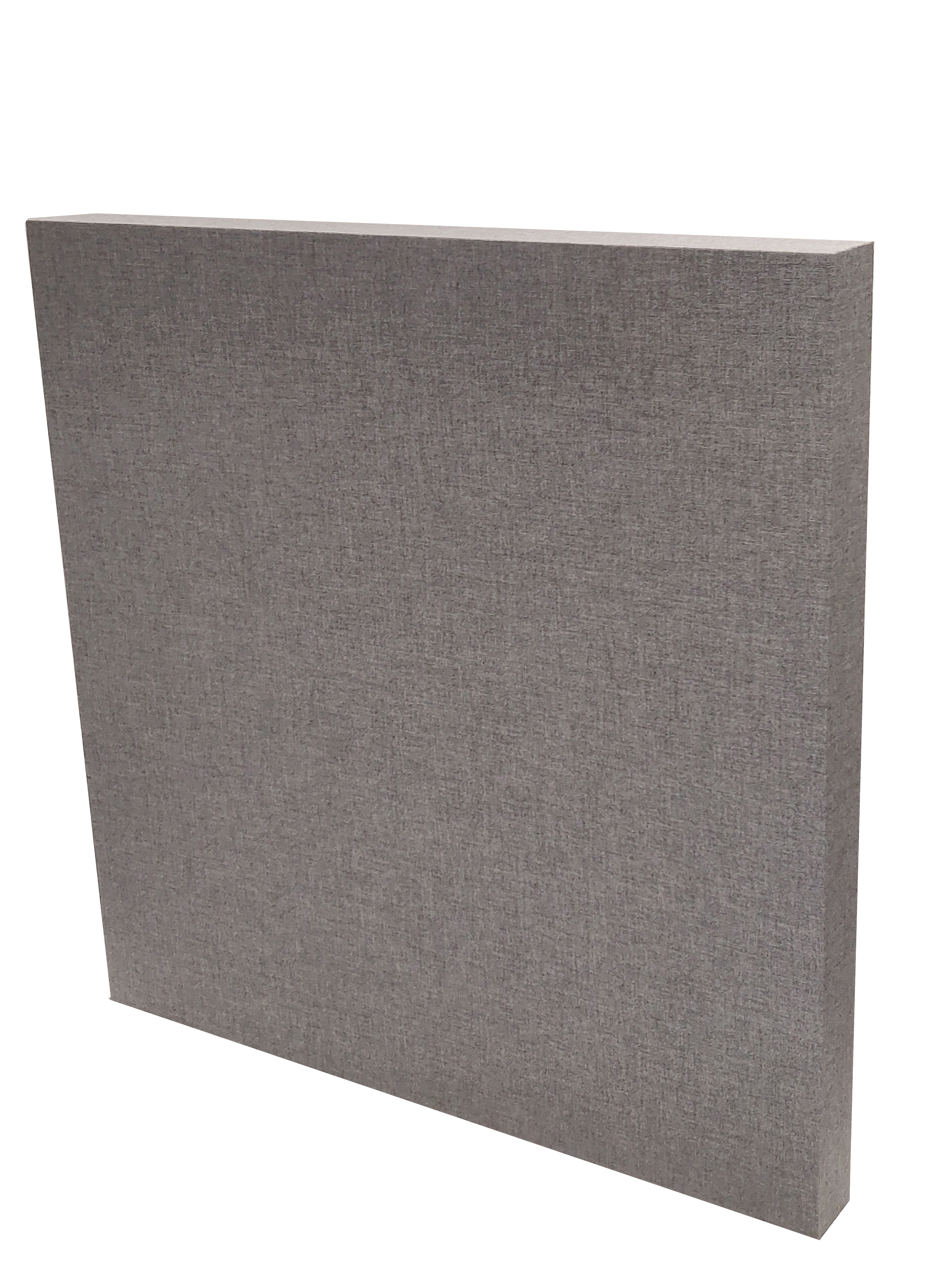
The Sonora® LFC looks like a standard Sonora® Wall panel, but looks can be deceiving! At 4-1/8″ thick, it is virtually indistinguishable from a High-Impact Sonora® panel – however the interior structure of the LFC is optimized to attack the bass frequencies and smoothly roll off the high frequencies. Let’s take a closer look at the performance difference between the Sonora® LFC and the standard Sonora® panel.

When you look at the performance charts, you will notice that the standard 4″ Sonora® panel starts to “roll-off” in the lower frequencies below 125 Hz – it still absorbs them, just to a lesser degree. We designed the Sonora® LFC panel to focus on those frequencies below 125 Hz – while allowing the other treatments to handle the rest! This allows you to use fewer broadband panels, and still have some high-frequency energy for diffusers to spread around – thus creating a more balanced acoustic environment.
The Sonora® LFC is an engineered solution using the same high-performance materials as our other products, but combining them in a way that optimizes them for Low-Frequency Control – hence Sonora® LFC! The magic is in the way those materials are used.
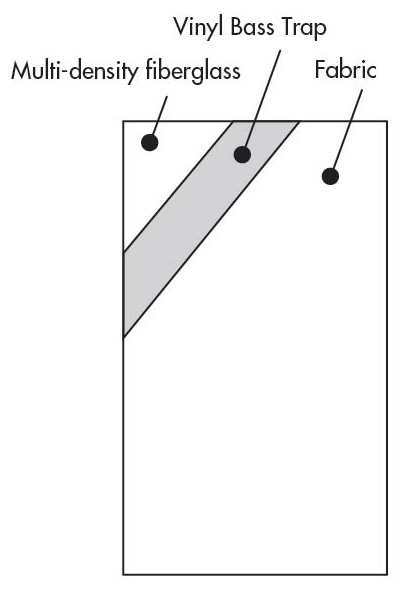
All of the materials used in an acoustic environment have a function – “Diffusers,” “Absorbers,” and “Bass Traps” are all general descriptors of product functions. Some diffusers are also Bass Traps. Some bass traps are also broadband absorbers. Some diffusers use absorption for amplitude grating. By combining a dampened, resonant trap with multi-density fiberglass, the Sonora® LFC focuses on making acoustic spaces more balanced. For controlling the bass without sucking the life out of a room, the LFC Panel is an outstanding tool for refined Low-Frequency Control!
DIY: Super Bass Trap
Posted by Acoustics First in Absorption, Art Galleries, Articles, Classrooms, DIY, Home Entertainment, Home Theater, HOW TO, Music Tracking Room, Product Applications, Products, Recording Facilities, Recording Studio, School & Educational Facilities, Studio Control Room, Teaching Rooms, Teleconferencing, Theater, Universities, Vocal Booth, Voice Over, Worship Facilities on May 16, 2013
Take a couple of products and make your corner into a super trap!

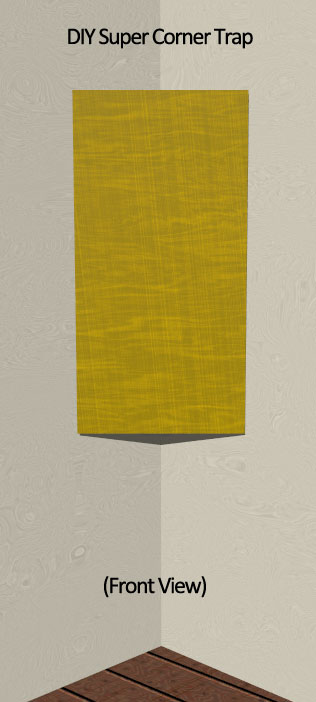
One of the most pervasive problems in recording and listening environments is the problem of bass build up in the corners. If you want to get the most out of your room, try making your corner into a DIY super trap!
Stuff you’ll need:
- 2’x4’x4” (or 2”)Back-Beveled Sonora® Wall Panel (beveled on the rear to fit corners or a standard panel with angle brackets)
- 48” Bermuda Triangle Trap® or 2 PhaseFOAM™ Bass traps (or a 1’x4’x1” raw fiberglass panel hung across the corner.)
- Foam Adhesive
- Sonora® Mounting brackets
Simple installation instructions:
- Use the adhesive to attach the Foam Bass trap to the wall
- Use the brackets to attach the Sonora® Panel across the corner over the trap
Super simple. Super effective.
As simple as it seems, this method of installing these products is an ideal way to get extra trapping in your corners. This solution changes the corner density multiple times as the sound waves pass through it –as well as introduces a layer of air space. This installation method takes the strengths of the two products and has them working together to eliminate that build-up of energy in the corners – it literally sucks it up like a sponge!

This simple DIY project is provided as a way for our customers to learn better ways to use our products and get more value out of the products they buy. If you are looking for more ways to use the products you have, look to Acoustics First for Ideas. http://www.acousticsfirst.com
————————————————————————————————————————————————————————————
Acoustics First Corporation supplies acoustical panels and soundproofing materials to control sound and eliminate noise in commercial, residential, government, and institutional applications worldwide. Products include the patented Art Diffusor®, sound absorbers, noise barriers, acoustical fabrics and accessories. Acoustics First® products are sold for O.E.M applications, direct, and through dealers. For more information on acoustical materials and their application, please visit www.AcousticsFirst.com or call Toll Free 1-888-765-2900 (US & Canada).
Setting the Soundstage: How to treat your home theater like a real theater
Posted by Acoustics First in Articles, Home Entertainment, Home Theater on March 14, 2013
 Modern AVR’s include all kinds of wizardry for speaker setup, positioning and room equalization. Anyone in the know will tell you that room EQ hardware and software should be a last resort. Correct acoustical treatments will pay much bigger dividends.
If you are like many people, you have recently upgraded your home theater, or you’re getting ready to do so. During this process you’ve likely learned that the speakers in the TV are sub-par and you should upgrade your audio experience to include an external sound system. This has become common practice and common knowledge. What you haven’t learned, and which is probably even more important, is how to upgrade the room itself.
One of the things people overlook when trying to make a home theater, is that a real theater pays a lot of attention to the design and treatment of the theater environment. They have good left-right design symmetry (see the diagram for a sample home theater layout). A good theater also has acoustically treated the space so that people can hear everything that is happening, from anywhere in the theater. This article will teach you some of the tricks of getting that great big theater soundstage into your home theater.

Bass Traps – the low-down solution.
Low frequency problems are common to almost any room, regardless of size. The good news is that, most of the time, the solution is simple: put bass traps in the corners of the room. This is one place where it pays to put a little extra in the budget. Corners are defined as the intersection of two or more surfaces. There are not just corners at the end of each wall, but also along the floor and ceiling where the walls intersect them. The more corner you cover with a good trap, the better bass response you get – it’s that simple. Bass loves the corners, and by putting bass traps there, you keep the bass crisp and natural. If bass frequencies are allowed to build in the corners, it causes the bass frequencies to become muddy and undefined – trap them.
Some bass traps work double duty as broadband absorbers as well, which can keep your costs down when considering covering a bunch of square footage with absorbers. Bass traps alone can solve many problems in your room, and due to the simplicity of the implementation, I recommend you start with these first – at least fill the four main corners.
Foam works. But this is a theater, not a studio. Fabric wrapped absorbers look as good as they sound, and Geometrix™ by Acoustics First, fit the corners like a glove. Pick a fabric and get some quarter rounds to fill your corners – that’s it.
Broadband Absorption – tame the ring.
Another common problem in home environments can be easily verified with a clap test. Go into your room and clap your hands. Most likely you will hear more than just the initial clap. Depending on the severity of the problem, you will hear a flutter, ring, or echo after the initial *pop*. This is caused by the sound waves bouncing around off the hard surfaces of the room and returning to your ears after a delay – the more times they bounce without losing energy, the longer the delay. The best way to remove energy from these waves is to use broadband absorption, but where do you put them?
More than likely, your TV and sound system are going to be in a fixed position, and your listening position will also be fixed – so the early reflection surfaces should be easy to locate. You will need a friend for this activity, a mirror, and a pencil. Have your friend place the mirror flat against the side wall and move it around until you can see the speakers in the reflection from your seat – then mark the wall. This is where you are going to place the absorber. The diagram shows a good place to start looking for these reflection paths. Repeat this for all the walls from all the seats.
What you are looking to create is a reflection free zone, which basically means, wherever the sound could bounce off a surface and get to your ears, we are going to absorb energy from it. You can spend a good deal of time on this, but this is the only step that requires this time and effort, so make it count. Sound travels in all directions from the speaker, including behind it, so put absorbers behind it on the wall. Don’t forget the floors, ceiling, and the wall behind you – sound will bounce off those as well.
This simple process will show you where you need to treat. Hang broadband absorbers over all the early reflection points – left, right, front and back. Absorber clouds should be hung on the ceiling, and place a nice thick carpet on the floor. Placement is the first key to getting this reflection free zone. The second is the right choice of absorber.
To match your fabric wrapped bass traps, the simple choice is get some more panels wrapped in fabric. The Sonora® line of broadband absorbing panels coordinate with the bass traps, and come in a plethora of sizes and mounting options to work in your space. Need 2’x4’ behind the speakers, 4’x4’ on the sidewalls, 2’x6’ on the back wall, and a 2’x6’ ceiling cloud – all in material that match those bass traps? Done.
Finally, use broadband absorption with caution, specifically using too much. If you plan on covering more than 50% of your walls with this stuff, you’re going to notice a muffled almost claustrophobia inducing deadness. We are not trying to suck the life out of the room. We are just trying to take enough energy away from those early reflections to keep the focus on the initial sound produced by the speakers.
Diffusers – put life back into your space.
The steps we have taken up to this point have been using absorption to control excess energy that can have an adverse effect on the listening environment. We have removed the unwanted direct reflections and we have tamed the bass, but there is something more we can do to give life to this room – diffusion.
Diffusion will give us something we couldn’t attain through absorption – a sense of open space. Even after treating with absorbers, there are still areas of the room where sound waves will sit, because your room is a fixed box with fixed speakers. Diffusers scatter the energy, creating ambiance with residual energy, like sitting quietly in a forest – the energy around you being directionless, omni-present, and spacious. This simple step does not remove energy from your room, but redistributes it into a soundscape that can make you forget you are in a room at all.
There are many ways to diffuse the sound and coordinate with your room, from the fabric covered HiPer™ Panel and Double Duty Diffusers™, to the striking line of Art Diffusors® like the Model C, which can be painted to match your décor.
Advances in acoustic treatments are being made all the time, bridging form with function, creating products as visually stunning as they sound – and helping your theater, or any theater, be the best that it can be. So use these tips to set up your home theater like a real theater, and experience the difference a soundstage upgrade makes.
————————————————————————————————————————————————————————————
Acoustics First Corporation supplies acoustical panels and soundproofing materials to control sound and eliminate noise in commercial, residential, government, and institutional applications worldwide. Products include the patented Art Diffusor®, sound absorbers, noise barriers, acoustical fabrics and accessories. Acoustics First® products are sold for O.E.M applications, direct, and through dealers. For more information on acoustical materials and their application, please visit www.AcousticsFirst.com or call Toll Free 1-888-765-2900 (US & Canada).
The complete article is posted at the following link: http://acousticsfirst.com/article-setting-the-sound-stage-how-to-treat-your-home-theater-like-a-real-theater.htm
 Acoustics First BLOG
You must be logged in to post a comment.