Posts Tagged Absorption
St. Mary Magdalen Worship Center – Kerfed panels to fit curved walls!
Posted by Acoustics First in Absorption, Product Applications, Products, Worship Facilities on June 28, 2024
The Mary Magdalen Mission Center has an oval-shaped sanctuary that was experiencing extremely poor speech and music clarity. Their Worship services are traditional leaning (spoken word, piano and congregational singing) with the occasional contemporary music service.

Parabolic Focusing – A primary feature of the sanctuary are 4 large curved walls (two at the front and two at the rear). Concave, uniform, curved surfaces are very problematic in room acoustics. Curved surfaces “focus” sound reflections to a point, akin to a magnifying glass focusing light passing through the curved lens.
If you’ve ever stood in the center of dome, you’ve probably experienced a few interesting acoustic anomalies. First is the “whisper” effect, where sound produced near the foci of the dome/curve, is amplified, allowing a faint whisper to be heard throughout the room (and conversely, all the sound produced in the room focused to this point, causing a cacophony of reflections at the center foci) . Another is the “creep” effect, where sound produced at the edge of arc, travels along the curved surface, losing little energy until it reaches the opposite end of the arc.
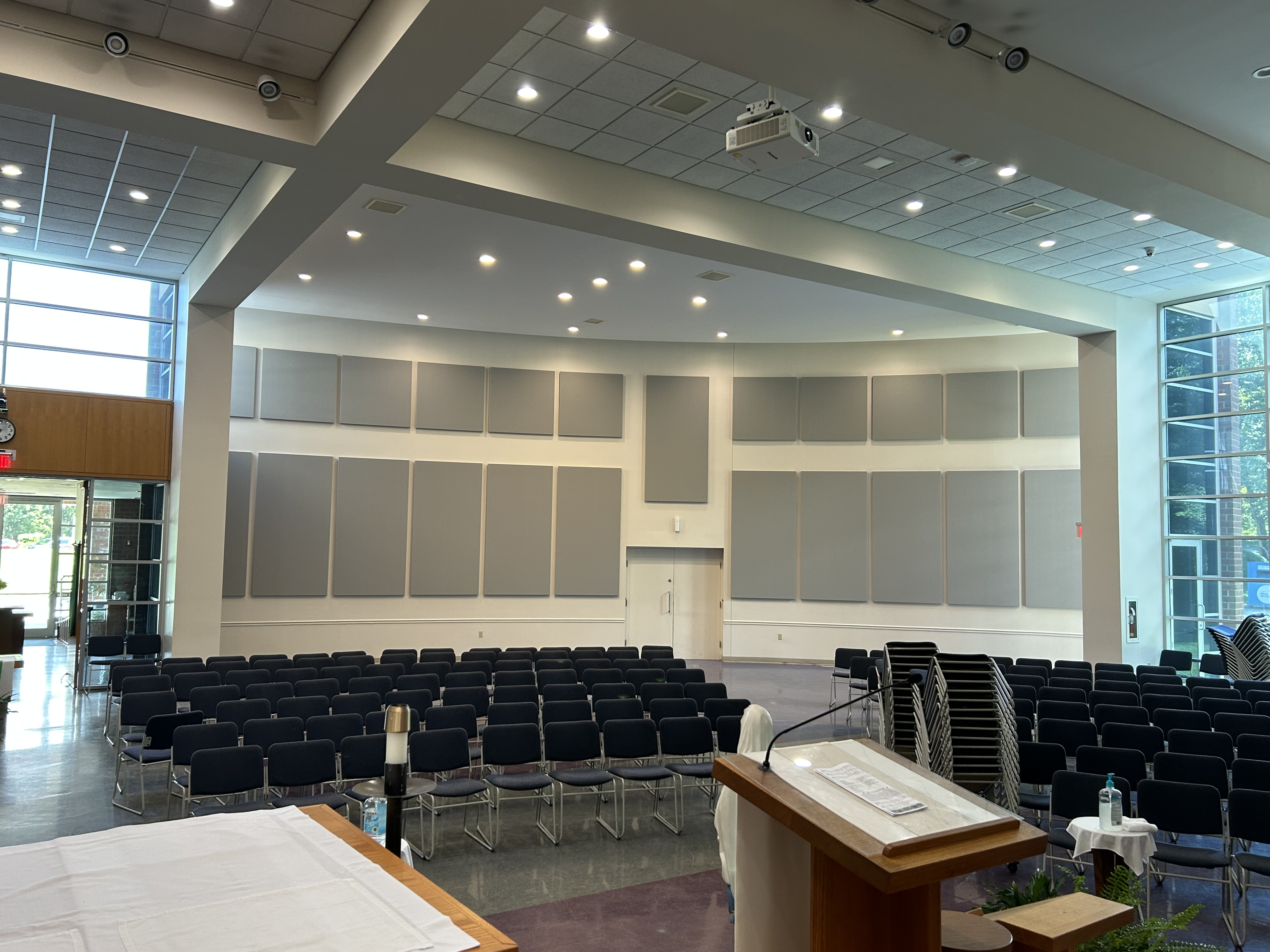
Not only do the hard wall and floor surfaces of the Mary Magdalen Mission Center contribute to excessive sound buildup, but the parabolic focusing from the curved wall surfaces caused extreme comb filtering (pockets of destructive and constructive interference as a result of overlapping waves), exacerbating intelligibility issues. These conditions contribute to an acoustically uncomfortable environment in which music is hard to perform and enjoy while speech is also difficult to understand.
To significantly reduce excessive reverberation and destructive reflections, we recommended installing approx. 1200 SQFT of 2” back-scored Hi Impact Sonora Wall Panels across the rear wall surfaces. We specified kerfed/back-scored Hi Impact Sonora Wall Panels that can “bend” to fit curved surfaces and come with a high-density adder that improves acoustic performance and durability. View Sonora Panel information on our website.
https://www.acousticsfirst.com/sonora-wall-panels.htm
Reverb Predictions – Worship spaces of this size with a blend of traditional and contemporary music should have a reverb time below 1.6s. We entered the room’s dimensions and construction materials and made a prediction of reverb times before and after treatment. In addition to controlling distracting echoes and comb filtering, installing approx. 1248 SQFT of 2” Hi Impact Sonora wall panels across the rear wall reduced reverberation by approx. 35%, significantly improving speech intelligibility and music clarity.
Sonora® Wave Clouds
Posted by Acoustics First in Absorption, Auditorium, Product Applications, Products on May 20, 2024
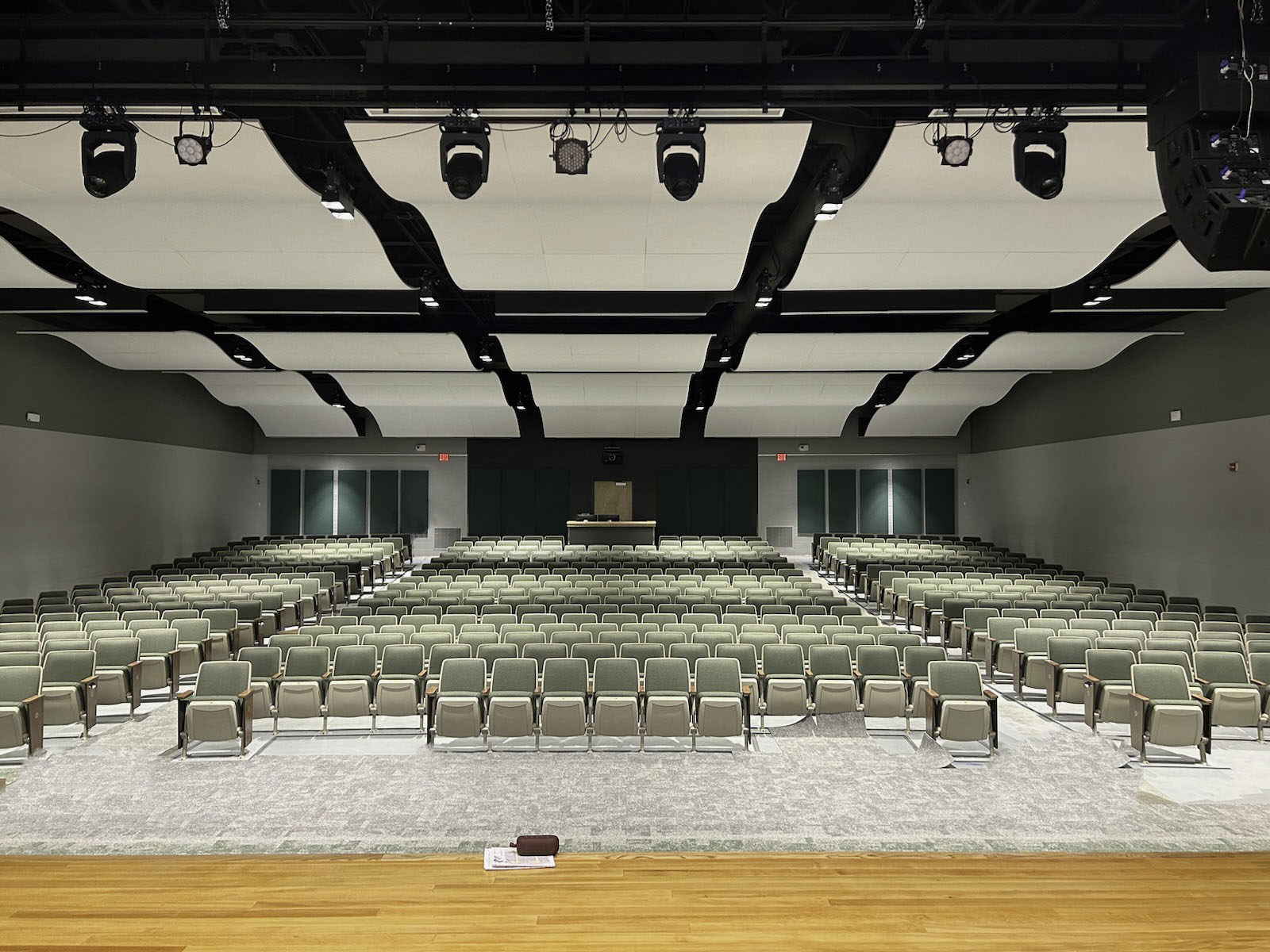
One of the more recent additions to our line of sound absorbing ceiling treatments is the Sonora Wave Cloud. This product can be an ideal choice for architects and specifiers who may be exploring options for large spaces which may require more expansive acoustic treatment while maintaining a certain design aesthetic. The curved shape of the Sonora® Wave Clouds allow for an impressive and unique look, while also providing optimal sound control. Sonora® Wave Clouds are available fabric wrapped or custom painted, with a 132″ radius bend in either a convex or concave profile. This allows for the creation of long waves – hence the name.

For this Job, Acoustics First® worked with Ferrari & Sons to provide the acoustic treatment for an auditorium in the Webutuck Central School District in Amenia, NY. As you can see, the end results turned out great!
St. Andrew by the Bay – Custom HiPer® Impact Panels to absorb and diffuse sound!
Posted by Acoustics First in Absorption, Diffusion, Product Applications, Worship Facilities on April 10, 2024
St. Andrew by the Bay is a traditional worship facility with a focus on spoken word worship and congregational singing. The large volume and hard surfaces in this space are the physical features most at fault for excessive reverberation, comb filtering and distracting “slap” echoes (discrete sound reflections usually caused by a distant, reflective back-wall).
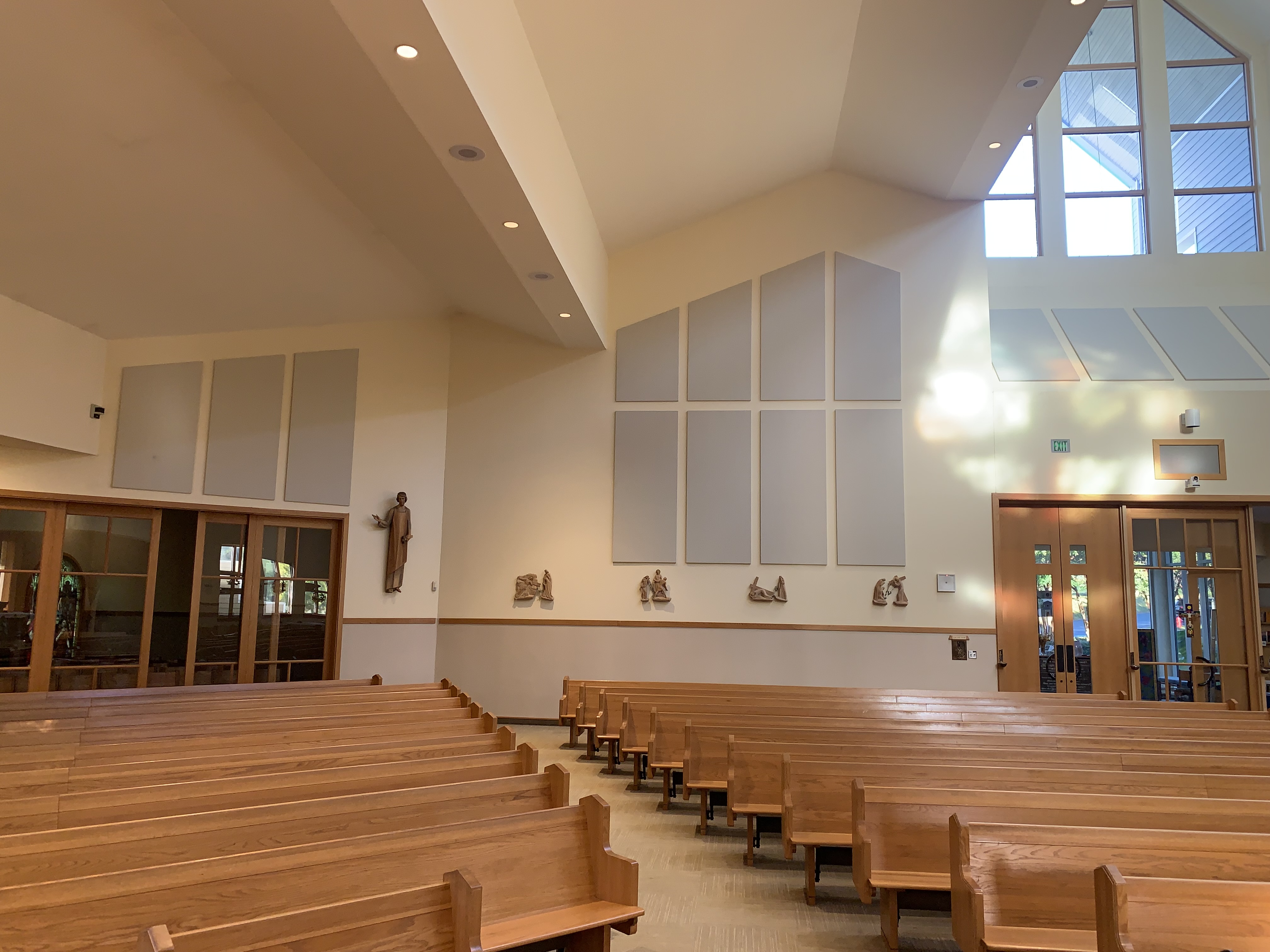
To correct the slap-back and curb excessive reverb without “over deadening” the space, we recommend distributing approx. 550 SQFT 1” HiPer® Impact absorber/diffuser panels throughout the rear wall areas (see attached layout). HiPer® Impact panels absorb low frequencies and diffuse high-frequencies, yielding a much more even room response. In addition to controlling bass buildup, the high-frequency scattering will help retain some “life” in the room for acoustic and choral performances.
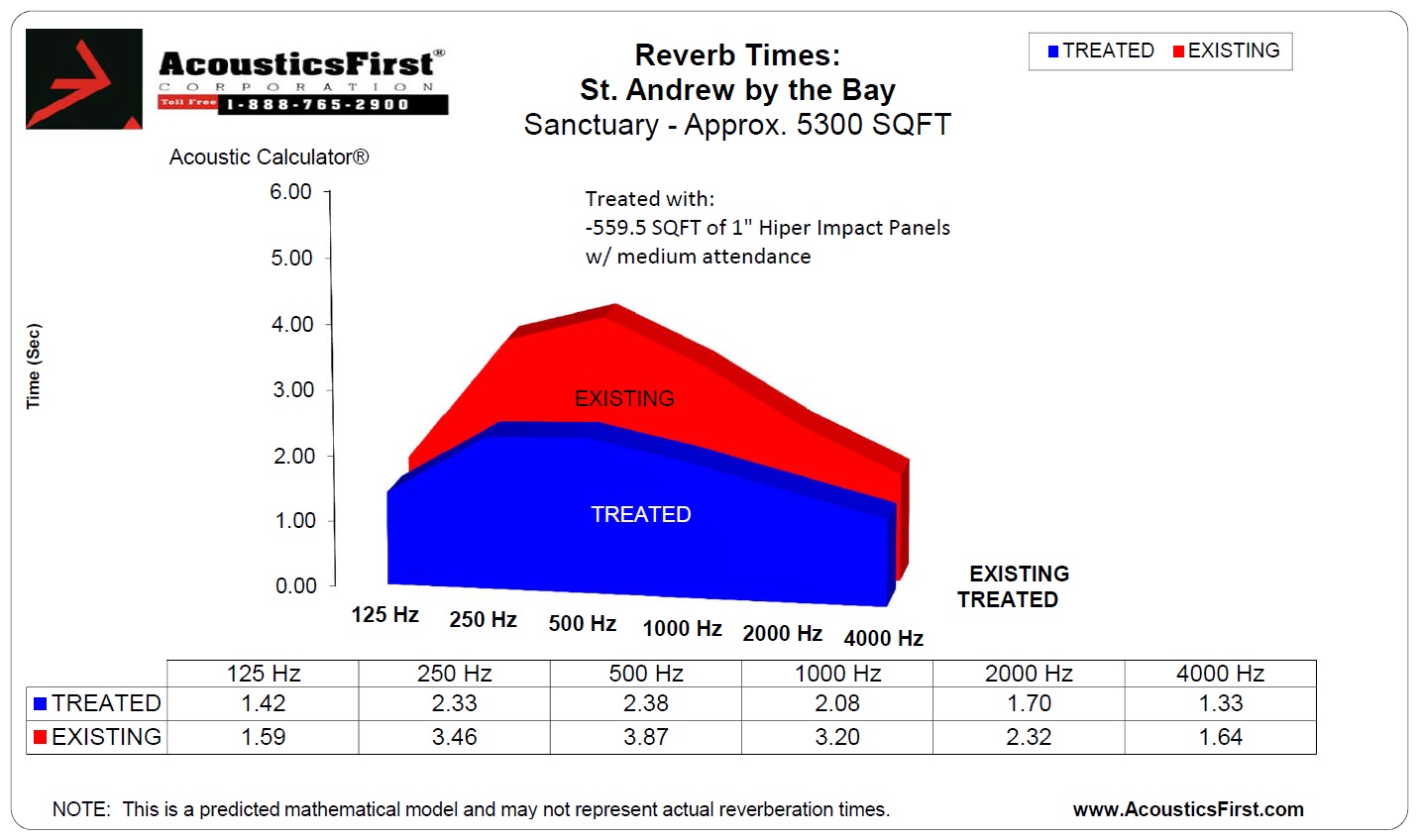
Reverb Prediction – Historically, churches relied on an abundance of hard surfaces to propagate sound to the rear of the nave, so they benefited from very long reverb times (upwards of 4-5s). Modern sound systems allow for a much more focused sound and equitable listening environment , so these extreme reverb tails are no longer necessary and can actually degrade the experience of the congregation. Churches of this size with a sound system and traditional worship services should have a reverb time somewhere in the 1.5-2.25s range. We entered the sanctuary’s dimensions and construction materials into our acoustic calculator and made a prediction of reverb times before and after treatment.
From Lee Hartman & Sons who performed the install “Here are some photos of the finished panels at St. Andrew by the Bay. It turned out great and client is very happy. Many thanks to Cameron for the detailed layout.”

Before & After: Video Conference Room
Posted by Acoustics First in Absorption, Customer Feedback, Media Room, Multipurpose Rooms, Offices, Product Applications, Products, Teleconferencing, Video on March 6, 2024
AMC Technology is located in a 5,400 square-foot suite that features a large open office area, a break room as well as several conference rooms.
When Acoustics First® initially met with the AMC team, they had recently moved into the space and were experiencing a number of acoustic problems in the open office area. Although Acoustics First® originally provided recommendations to improve workstation isolation in the open office, once the employees settled into the space, call-clarity issues in the conference rooms had become the much larger concern.
Three of the conference rooms were rudimentarily treated with 1” sound absorbing panels. The other four conference rooms were not treated acoustically and had hard/reflective walls, floors and ceilings. These hard surfaces were most at fault for excessive reverberation, noise buildup and distracting flutter-echoes (“ringing” caused by parallel reflective surfaces). These conditions contributed to an acoustically uncomfortable environment in which speech was hard to understand and conference call clarity suffered.

AMC Technology’s CTO, Anthony Uliano, identified a few goals for potential acoustic remediation. Anthony often works remotely and will call into the conference rooms to talk with team members. The sound of these calls on his side was frequently distorted and individual team members were difficult to understand. Anthony was concerned that clients were experiencing the same intelligibility issues. The primary goal for acoustic treatment was to improve the clarity of conference calls by reducing echoes and excessive reverberation within each conference room. Anthony also mentioned that they were experiencing some isolation problems. Though not a high priority, steps to reduce sound transmission were detailed for future consideration.
Acoustics First® specified Sonora® wall and ceiling treatment within each conference room to control flutter echoes and reduce reverberation down to suitable levels for conference calls. The video below provides a great snapshot of how the room sounded before and after treatment. Each recording is done in the same room, with the same employee and sitting the same distance from the microphone. The end result is a much clearer and intelligible conversation.
John Bullard Live Room – Tuning a Live Room for Classical Banjo
Posted by Acoustics First in Absorption, Customer Feedback, Diffusion, HOW TO, Music Tracking Room, Product Applications, Products, Recording Facilities on May 3, 2023
When you think of classical music; what instruments come to mind? Piano? Violin? Cello? …What about Banjo?
In the summer of 2022, classical banjoist John Bullard reached out to Acoustics First for assistance with his newly renovated home-studio. John is one of a select group of classical musicians aiming to showcase the versatility of this uniquely American instrument. The banjo, with John’s expertise, lends a very distinct, melancholy sound to contemporary and traditional compositions.

Having recorded a number of albums already, John knew he wanted his live room to be catered specifically to tracking solo, classical banjo as well as small acoustic ensembles. Acoustics First analyzed John’s live room and came up with a treatment design that would achieve an “ideal-as-possible” acoustic environment for recording classical instruments.
The largely reflective live room had walls comprised of unfinished, reclaimed wood planks over plywood, a drywall ceiling, stone fireplace and a polished concrete floor. The parallel, hard surfaces contributed to a poor tracking environment; with standing waves and “flutter” echoes adding unwanted coloration to recordings, inhibiting music definition.
Spaces used for rehearsing and recording classical music often benefit from elevated levels of reverberation, which add a sense of warmth and ambience to acoustic music. Although the reverb in John’s untreated room was only slightly excessive when measured, it was far from “diffuse”, with the majority of energy coming from early reflections.
The primary challenge in the live room was to address the early specular reflections and standing waves without taking too much “life” out of the room. To achieve this delicate balance, wide band diffusion was recommended as the primary ceiling and wall treatment with selective sound absorptive treatment with fabric-wrapped Sonora® panels.

Double Duty Diffusers™ and Aeolian® sound diffusers were recommended as they would also provide some much needed low-frequency absorption in addition to broadband diffusion.
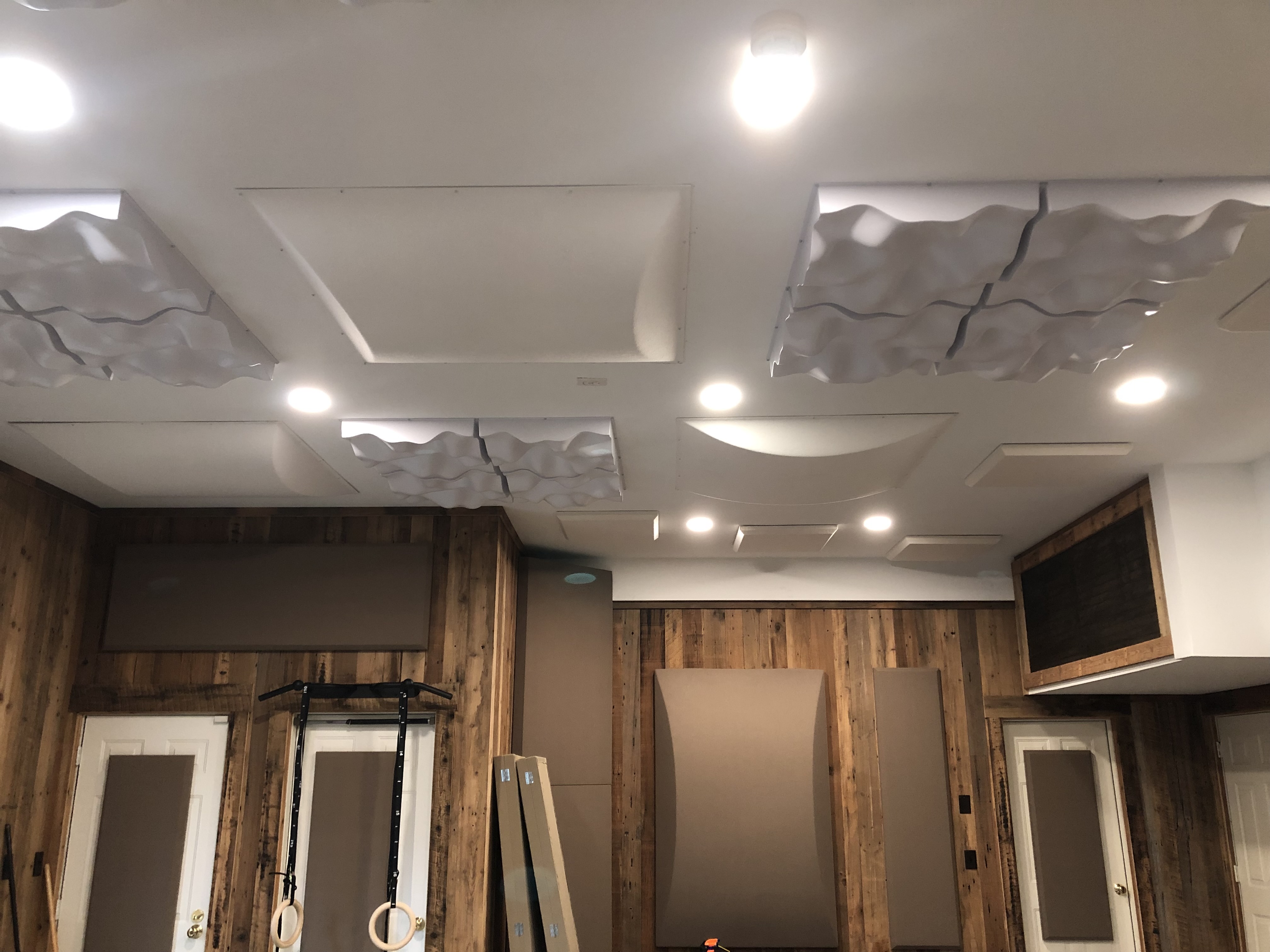
After the treatments were installed, John got right to work on experimenting…
“…ready to start doing extensive test recordings to locate the best spot and rug configuration for solo banjo… It sounds really good to my ear – now to see how the microphones hear it!”
John Bullard

Please check out John Bullard’s music!! – https://www.johnbullard.com/
 Acoustics First BLOG
You must be logged in to post a comment.