Archive for category Articles
Why use a mix of objective and subjective goals to make a great sounding space?
Posted by Acoustics First in Articles, Media Room, Music Tracking Room, Recording Facilities, Recording Studio, Studio Control Room on July 30, 2024
With the ability to measure and analyze every detail of an acoustic environment, sometimes we forget about the basic fact that it should sound the way we want it to sound. There are scenarios where objective measurement is important, desired, and even required. If there is a physical safety concern that may damage hearing ( loud noises, machinery, etc.), a need to have safety information understood (evacuation/safety notices or alarms, etc.), absolute sound privacy is required (HIPAA regulations, government security, or legal need…), or the need for speech clarity for education… often we require some guidelines be met to insure the acoustics meet a decided standard for performance. These standards use objective measurement and data to make these determinations. There isn’t a governing body that regulates how your home theater should perform, or how an office needs to sound (beyond the safety and privacy concerns mentioned above.)

Entertainment venues, theaters, churches, commercial spaces, restaurants, offices, and residential spaces have very little regulation, and while there are many occasions that testing is used to improve the performance of these spaces, there are some environments where the effort to measure and quantify everything can get in the way of the goal of making a great acoustic space. If you wanted to compare different small “critical listening environments” (mixing and mastering studios are examples of these), there would be some general commonalities in their construction and treatment. Many are built to minimize parallel reflections, have short reverb times, symmetric placement of source speakers, control first reflections, and balance the frequency performance of the space.
A “ruler-flat” frequency response shouldn’t be the acoustic goal.
“Balancing the frequency performance of a space” doesn’t mean “attain ruler-flat frequency response across the entire human hearing range.” There are several reasons that the “ruler-flat” interpretation is counterproductive – the first being that it is nearly impossible to attain in any room. Second, is that everyone perceives sound differently. As humans age, almost all people will experience some degree of “presbycusis,” which is slow decline in high-frequency sensitivity that comes with age. If you are lucky enough to reach a ripe old age, there is a 60% – 80% chance (depending on the study you read) that your high-frequency hearing won’t be what it was when you were young. But even with that factor removed, when your hearing was at its best, your personal perception of sound is different from every other person – making sound, by definition, subjective.

The closest you can get to ruler-flat performance is to remove the room entirely and get some high quality headphones – but you may still find yourself tweaking the equalization curve to your preference. There are many people who feel that headphones sound unnatural, or that they are uncomfortable to listen to for long periods of time. Even the best mixing studios are not completely flat. Also, you will see many different sets of speakers in these spaces… or even headphones. These different sources are to compare how a mix will sound in different environments… and that the mix will “translate” in different listening scenarios. These environments which people will listen to music in vary to include outdoors, bathroom, kitchen, movie theater, grocery store, car, truck, SUV, convertible, living room, and more… coming from sources like phone speakers, headphones, assistants like echo and Google, bookshelf speakers, sound bars, audiophile equipment, movie theater sound systems, and an array of automotive audio systems.

Start with the basics.
If you are making a space for critical listening, there are some objective guides that will help you. If building from scratch, build with a geometry that will reduce room modes and parallel surfaces. Reduce reflections that will interfere with the source. Reduce reverb time. Control the bass response to reduce build up. These can all be readily calculated, measured, and controlled with bass traps, absorption, and diffusion. Most of the time, just following these objective guides will get you a room that will sound subjectively “good.”
After you get that far, you could continue trying to measure the room and tweak the performance to try and attain the unattainable ruler-flat response… or you could listen to music in your room and decide with you ears what should to be done to make it sound how you want. There are many subjective arguments people make about why they think something sounds better. There are philosophical arguments about listening to it “as the engineer/artist intended.” There are debates about if you should equalize music at all – even if you are in the majority of the aging population who may need to give the high-frequencies a nudge to experience the sizzle of Stevie Wonder’s glorious high-hat mastery.
When it comes to your own space… if it sounds good to you… it’s right. By following a few objective guidelines to get you in the arena, you can tweak the last bit with your ears until you are experiencing the material the way you prefer it to sound.
NWAA Labs goes nuclear in Stereophile
Posted by Acoustics First in Articles, Company Information, Diffusion, Mentions on July 29, 2022
Ron Sauro of NWAA Labs talks about his massive test facility, speaker measurement, sound diffusion, and more in this article in the August 2022 edition of Stereophile Magazine.

In the article, there is mention of the advances that Jim DeGrandis and Acoustics First® have made in the understanding of diffusion, the developing standards for testing in the ASTM, and their published research into modelling/simulations for refining new acoustic materials.
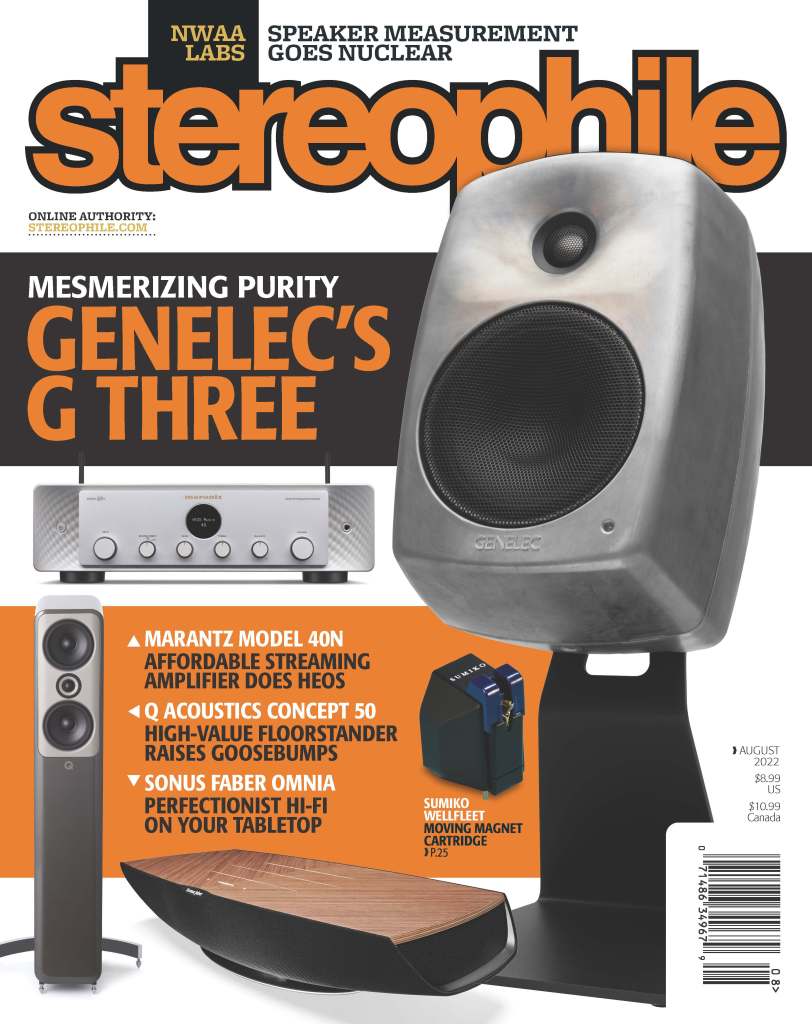
For more information about this edition, and other editions of Stereophile, visit them at https://www.stereophile.com/
Absorption & Diffusion – The Construction Specifier
Posted by Acoustics First in Absorption, Art Galleries, Articles, Auditorium, Broadcast Facilities, Diffusion, Home Entertainment, Home Theater, HOW TO, Industrial Facilities, Media Room, Multipurpose Rooms, Music Rehearsal Spaces, Offices, Product Applications, Recording Facilities, Studio Control Room, Teleconferencing, Theater on April 29, 2022
For the May 2022 edition of “The Construction Specifier,” Acoustics First was asked to illustrate the use of absorption and diffusion in creating optimal acoustic spaces. The article is a great reference for understanding the types of acoustic absorbers and diffusers, as well as some use scenarios like offices, critical listening spaces, and larger communal spaces.
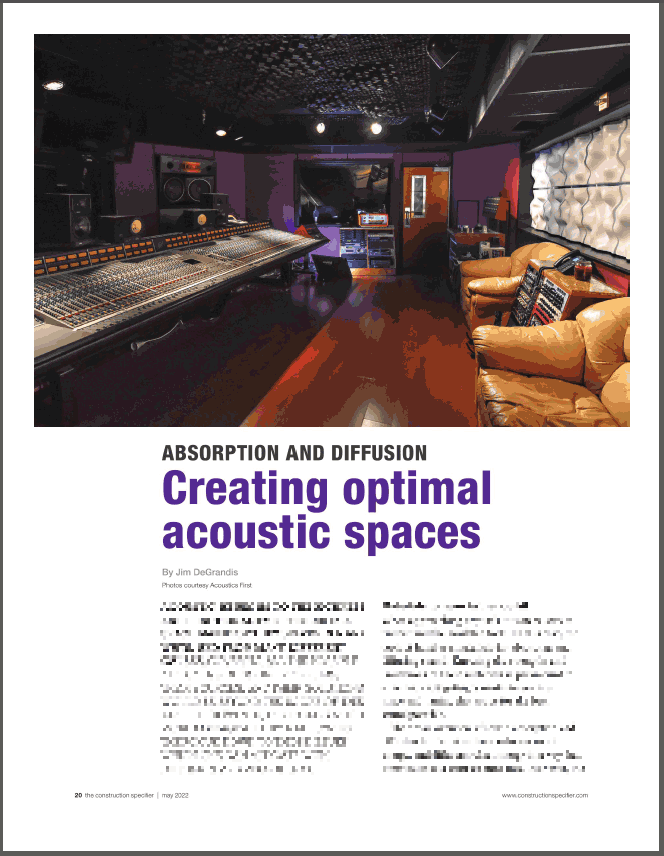
Note: This version has been edited and the advertisements are removed. The full published version of the May 2022 digital edition can be found on The Construction Specifier’s website here.
“If a tree were to fall … and there was no one to hear it, would there be any sound?”
Posted by Acoustics First in Articles, Press Release on April 1, 2022
The philosophical thought experiment of “does something need to be perceived to exist,” has been around since the beginning of time. This allows for human extrapolation into concepts such as quantum mechanics (Schrödinger’s cat) and advanced Artificial Intelligence principals. Albert Einstein was effectively “unfriended” for asking the question of his colleague, Abraham Pais,
“Do you really believe that the moon only exists if you look at it?”
Albert Einstein to Abraham Pais
Pais prescribing to “the majority view of the quantum mechanics community then (and arguably to this day) that existence in the absence of an observer is at best a conjecture, a conclusion that can neither be proven nor disproven.”
But the question still exists. “If a tree falls in a forest and there is no one to hear it, does it make a sound?”

The eminently interesting, Dr. Irving Lirpa asked the burning question…
“If observation is proof, can we calculate the Amplification Coefficient of Human Perception upon something that is ‘likely’ into ‘truth’ versus the amplification of ‘hogwash’ – which will always remain ‘hogwash?’ Because if something is able to be perceived, it must exist in some degree, as amplifying the perception of the non-existent is akin to multiplying by zero.”
Dr. I. Lirpa further posited that: “while the observation of sound proves its existence, the lack of observation does not disprove it… it merely has not been amplified by the scrutiny of human perception.”
He further affirmed that the tree would indeed create sound, but with a much lower intensity due to the Human Perception Amplification Coefficient… henceforth, there would still be sound because it exists – but it would fail to be amplified by human perception.

This seminal work calculated a Maximum Reverb Time of only 0.04 @ 1000 Hz “Without Audience” in a full-leafed, deciduous biome common to the vernal mid-temperate zone. Further calculations found that the Human Perception Amplification Coefficient is equivalent to the reverb time being amplified by 42 TIMES per frequency band upon being observed – which coincides exactly with the calculation made by the supercomputer DEEP THOUGHT on the “Ultimate Question.”
Coincidence? We think not.
TL:DR
“If a tree was to fall in the forest and there was no one there to hear it, would there be any sound?”
“Yes, but there would be 42 Times more sound if there was someone there to hear it.”
Sound Diffusion vs. Absorption in Worship Environments
Posted by Acoustics First in Absorption, Articles, Diffusion, Product Applications, Uncategorized, Worship Facilities on January 25, 2022

Cathedrals, mosques, synagogues and temples are often decorated with an abundance of architectural details (deep coffers, arches, columns, sculptures, intricate engravings etc.). These features are not only beautiful to look at, but also serve the vital acoustic purpose of sound diffusion. Large, uninterrupted spans of hard, flat surfaces reflect sound in a singular, specular wave, which creates discrete echoes and comb filtering (In acoustics, comb filtering is when a delayed reflection interferes with, and distorts the original sound wave). These conditions can contribute to an acoustically uncomfortable environment, in which speech is difficult to understand, and music can be hard to perform and enjoy. Irregular surfaces, on the other hand, scatter these reflections, minimizing comb filtering and distracting echoes. In a “diffused” worship environment, speech is intelligible, music is clear and warm, and there is a sense of envelopment which greatly enhances the congregants’ worship experience.
Absorptive treatment can also be used to control echoes and harmful reflections. Instead of redistributing reflections, these “fluffy” materials (drapery, padded pews, acoustic panels etc.) reduce the overall sound energy from the reflections in the room. However, using to too much sound absorption in a room can often make a space sound ‘dry’ or ‘dead’. Determining whether your space needs absorption, diffusion, or a combination of both is dependent upon the acoustic properties of the space, as well as the type of worship service being conducted.
Acoustic Properties of the Worship Space: Reverberation, a principle acoustic factor, is the sound energy that remains in a listening environment as a result of lingering reflections. The dimensions, construction materials, and furnishings of a given worship space determine its reverberation time (RT or RT60). Large halls with reflective materials (glass, wood, concrete) have longer reverb times, while small rooms with absorptive materials (drop acoustic ceiling, carpet, curtains etc.) will have shorter reverb times. Incorporating sound absorptive materials, Such as fabric wrapped acoustic wall panels, is often the best way to reduce the overall reverberation in a room to a suitable level. However, the target reverb time also depends on the nature of the worship service being conducted in a particular space.
Type of Worship Service: Ideal reverb times for worship environments vary widely. Non-musical, spoken-word worship requires a very short reverb time (.5-.8s range), ensuring that speech is intelligible. At the other end of the spectrum, cathedrals can tolerate an extremely long reverb time (2s and above) due to the traditional nature of their liturgy. Choir, organ and plainchant worship will actually benefit from longer reverb times that create a sense of ambience and spaciousness by sustaining musical notes. These spaces will often lack a sound system, and instead utilize the hard surfaces to propagate sound throughout the room.
Traditional worship may be enhanced by long reverb times, but contemporary worship requires a significantly shorter reverb time. In these environments, drums, guitars, bass and other amplified instruments are critical to the high intensity worship experience, but have far different acoustical needs compared to the choir and organ in a more traditional service. Contemporary “high impact” churches require a reverb time in the .8-1.3s range to ensure that the music won’t become too “muddy” and indistinct. Contemporary churches must also be more cognizant of late specular reflections (slap echoes) which can inhibit the timing of musicians and contribute to poor music clarity.
Let’s take a look a few common scenarios when it comes to treating traditional and contemporary worship spaces.
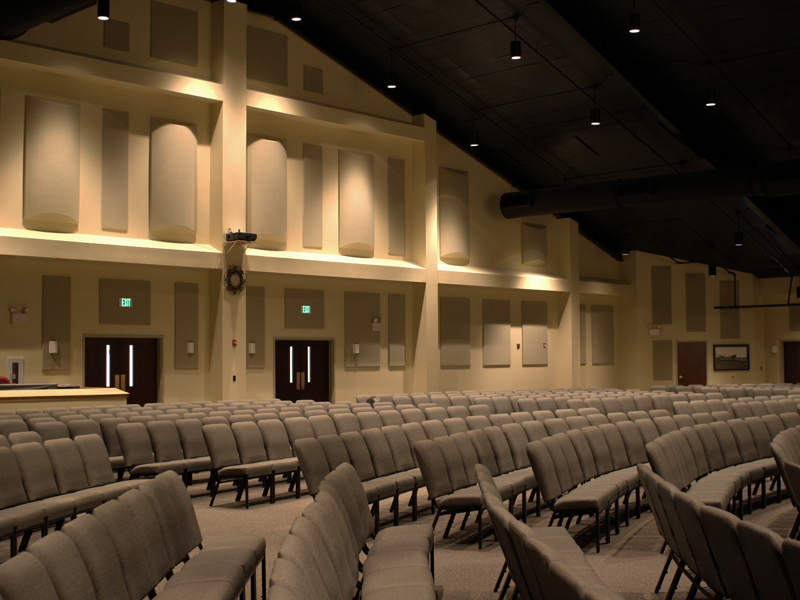
Scenario 1: Conversion from Traditional to Contemporary worship
A growing contemporary church moves into a larger, traditional sanctuary and is confronted by a raucous acoustic environment during their first rehearsal… This “live” space was perfect for traditional music, but is not conducive to a “high impact” contemporary worship service. To reduce the excessive reverberation and distracting echoes, sound absorption should be added to the rear wall (opposite stage) and side walls. Also, if using on-stage monitors, the stage walls should be treated to manage stage volume. Spot diffusive treatment that provides low-frequency absorption would also be beneficial. A good choice for this would be traditional ‘barrel’ diffusers. These are one of the oldest tried and true solutions for controlling bass issues in a performance space. Also, since these units function as both absorbers and diffusers, you get the benefits of both.
Scenario 2: Mix of Traditional and Contemporary worship services.
A worship facility decides to offer a contemporary service in addition to their traditional services… As more absorption is introduced to cut down on distracting reflections, we want to retain the envelopment and spaciousness which benefits congregational singing and traditional worship music. Sound diffusive treatment would be a great way to control echoes and specular reflections, while keeping the energy in the space. A mix of absorption and diffusion is usually best. Multipurpose spaces can also benefit from variable acoustic treatment which allows the room to “adapt” to each service, but that is a subject for another article.
Scenario 3: Poor Music Clarity in Traditional Worship space
A traditional worship space renovates their facility by adding thicker carpet, padded pews and a drop acoustic ceiling… All of a sudden, their once lively space feels “flat” and dull. Acoustic instruments are more anemic, less distinguishable and choirs have a difficult time blending and tuning. To “liven up” the space, replace sound absorptive materials with diffusers. For example, replace 1/3rd of the acoustic ceiling tiles with a combination of gypsum tiles and lay-in diffusers. These days, there are wide variety mid-range quadratic sound diffusers available for drop tile ceiling grids, as well as the more traditional barrel and pyramidal diffusers.
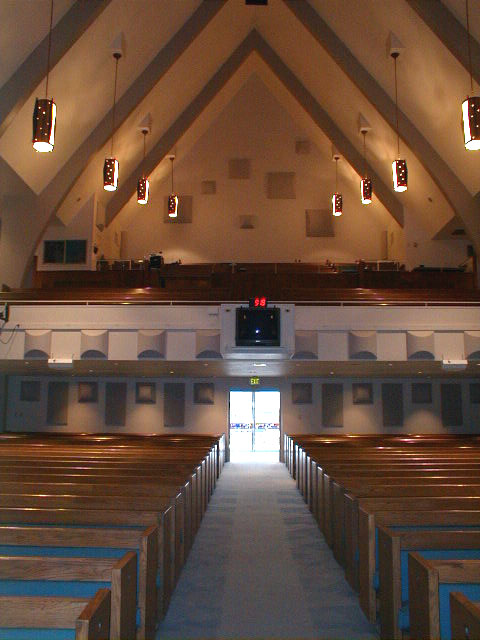
Sound diffusion can often seem a little mysterious compared to sound absorption. This is at least partly because sound diffusion is a more complex and multi-dimensional phenomenon compared to the more easily quantifiable sound absorption. However, sound diffusion is often times the missing piece of an acoustic puzzle: its benefits can help a bad room to sound good, or a good room to sound great!
 Acoustics First BLOG
You must be logged in to post a comment.