Archive for category Absorption
DIY – Back Wall Diffuser Array/Bass Trap: Revisited
Posted by Acoustics First in Absorption, Articles, Broadcast Facilities, Customer Feedback, Diffusion, DIY, Home Entertainment, Home Theater, HOW TO, Media Room, Music Rehearsal Spaces, Music Tracking Room, Product Applications, Recording Facilities, Recording Studio, Studio Control Room, Teleconferencing, Theater, Vocal Booth, Voice Over on July 14, 2016

DIY – Diffuser Array/Bass Trap
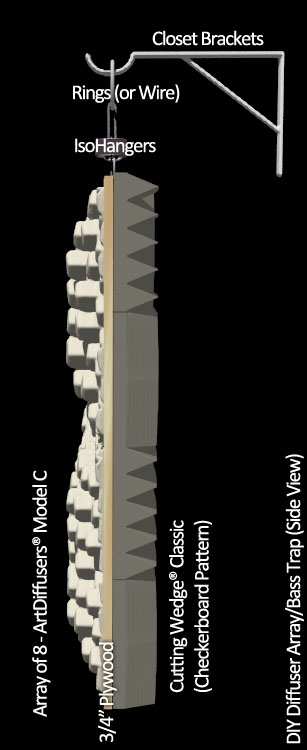 This month we thought we’d share a few Real-Life pictures of an idea we first introduced back in summer of 2013: The “Back Wall Diffuser Array/Bass Trap”.
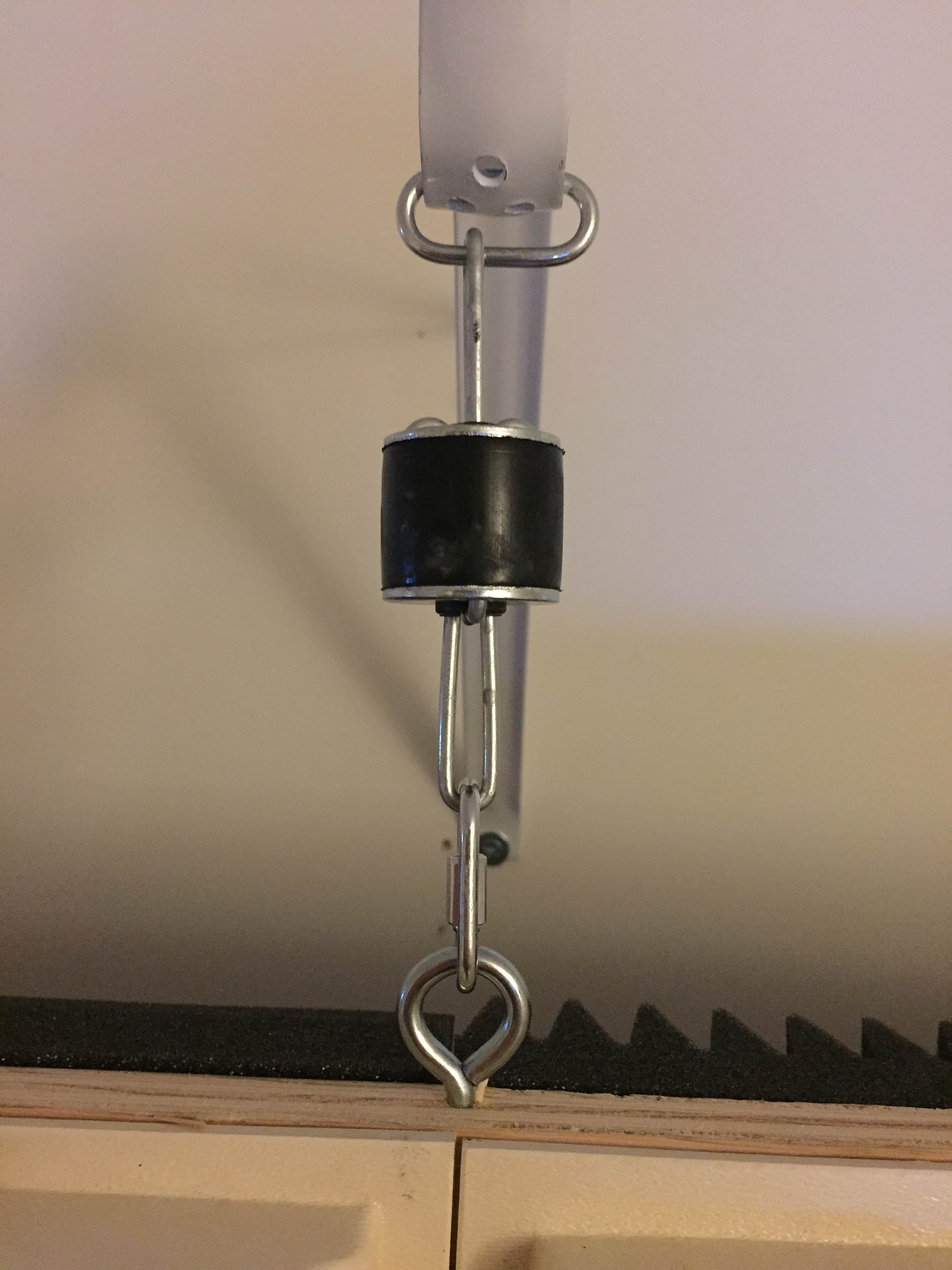
Isolation Hanger
This is the DIY project which incorporates our Art Diffusors®, Cutting Wedge® foam and a couple of isolation hangers into one large free-floating unit, which is acoustically decoupled from the wall.
This particular array was put together by a music producer/bass player for his home. As you can tell from the pics, the construction of this unit was executed beautifully and it’s very close to the original concept drawings.
It’s never too late to get started on your own DIY project.
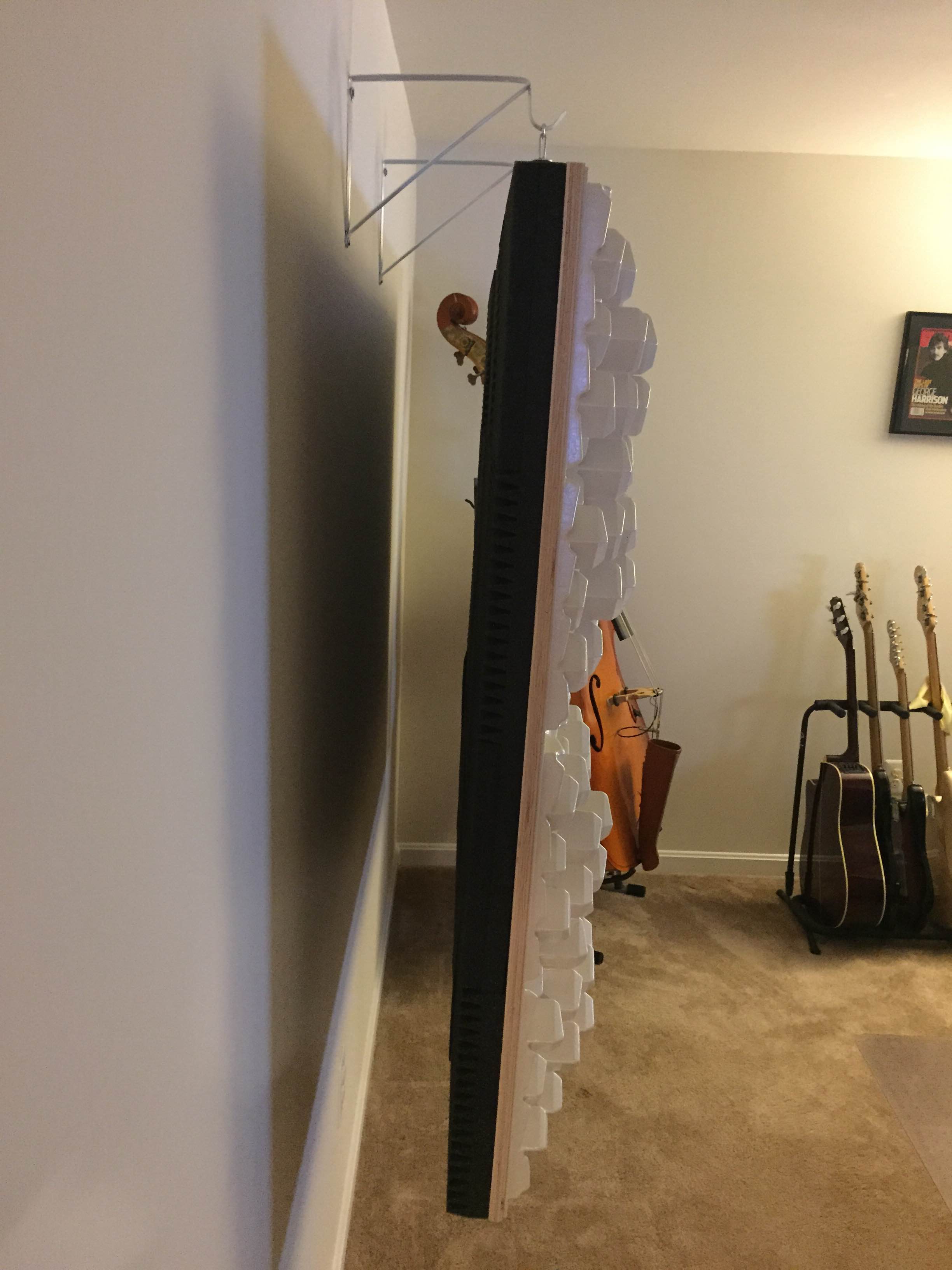 Real World – DIY |

Visit the Original DIY page to find out how to make your own.
Reverberation, the Invisible Architecture
Posted by Acoustics First in Absorption, Articles, Sound proofing on June 13, 2016
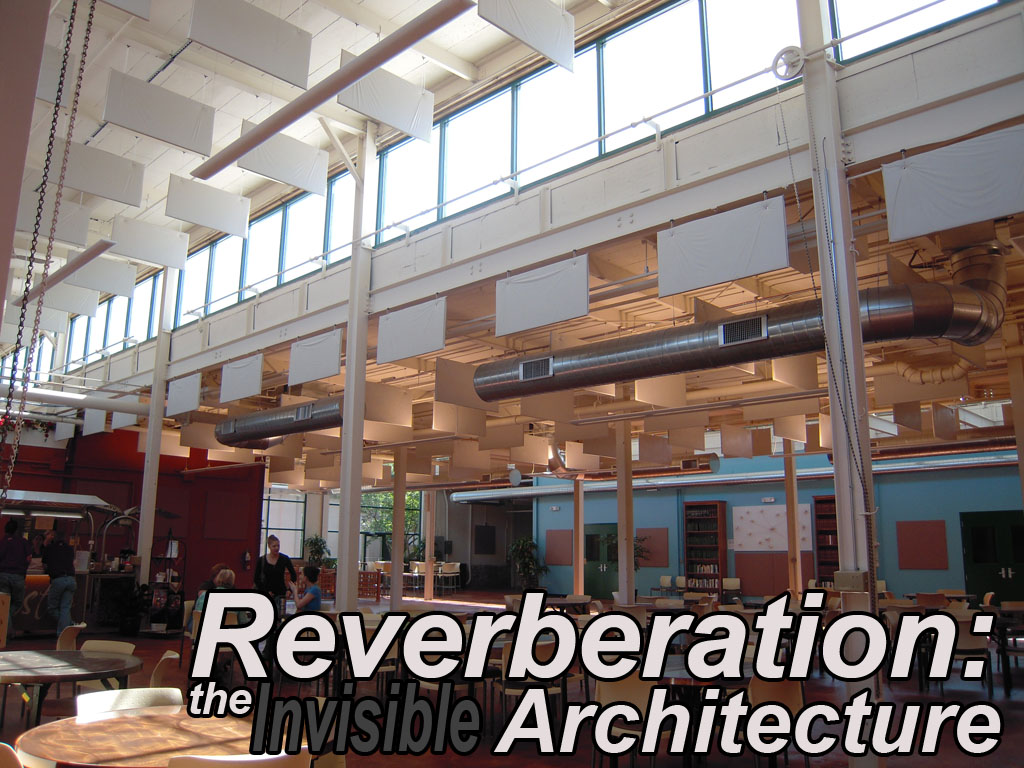
Cloudscape® Baffles and Sonora® Panels change the sonic architecture – making the space sound smaller and more intimate.
Ever wonder what gives us a sense of space? Obviously, our eyes visually tell us what’s going on, but there are other senses that contribute. Peak your head into a dark front hall closet, and even without seeing much, you can “feel” the close proximity of the walls and perhaps even the presence of the coats. Walk in to New York’s Grand Central Station, and you are confronted by a completely different sensation. Close your eyes, and the raucous environment tells you are in a large room with a lofty ceiling. Often times we take for granted the relationship that sound has to our spatial perception.
This sonic “sense of space” can be generally attributed to the room’s reverberation qualities. In simple terms, reverberation is the sound energy that remains in the listening environment as a result of lingering reflections. Reverberation time (RT or RT60) quantifies how quickly an impulse sound decays in a space. RT60 is how quickly the amplitude (volume) of short exciting signal decreases by 60dB in a large room. Reverberation time is dependent upon the volume and surface materials of a given room. Large spaces with hard materials (tile, drywall, etc.) like Grand Central Station have longer reverberation times, while small rooms furnished with “softer” materials, like the coat closet, sound much more “dead”.
Excessive reverberation is one of the most common acoustic issues that we encounter on a daily basis. As you may have experienced at some point, it’s difficult to understand what is being said when reflections from old information cover up what is newly spoken. In spaces where speech intelligibility is paramount, like classrooms or conference rooms, a short reverberation time (under 1 second) should be targeted.
That said, sometimes a long reverberation time is desirable. In spaces like cathedrals and orchestral halls, reverberation helps create ambience for the audience by sustaining musical notes, while allowing choirs and orchestras to blend more easily. These spaces may lack a sound system, and instead utilize the room to propagate sound. Rock venues, on the other hand, have amplified instruments, so a medium-short reverb time is needed to ensure that the music won’t become “muddy” and difficult to perform and enjoy.
There are a number of questions that an acoustician must ask when recommending appropriate treatment. These questions include, but are not limited to: Is there live music in this room? What kind of music is being performed? Is speech intelligibly important? What’s the audience size and where are they in relation to the sound source? So, the ideal amount of reverberation in a space is wholly dependent on the use of the space.
Listed below are the ranges of “ideal” reverberation times at mid-frequency (average of 500 and 1000 Hz) for a variety of rooms. The numbers are derived from David Eagan’s Architectural Acoustics (New York: McGraw-Hill, 1988), in which he breaks down rooms into Speech, Music and Speech/Music spaces. We hope you find this helpful.
Optimum Reverberation Times (T60)
“Speech” Rooms
Recording and Broadcasting Studio – .3 to .7 seconds
Classroom (elementary size) – .6 to .8 seconds
Conference/Lecture Room – .6 to 1.1 seconds
Intimate Drama – .9 to 1.1s“Speech & Music” Rooms
Cinema – .8 to 1.2 seconds
Small Theaters – 1.2 to 1.4 seconds
Multi-Purpose Auditoriums – 1.5 to 1.8 seconds
Worship Spaces – 1.4 (Churches) to 2+ seconds (Cathedrals)“Music” Rooms
Dance Clubs and Rock Venues (w/ Sound System) – 1 to 1.2 seconds
Semi classical Concerts/Chorus (w/ Sound System) – 1.2 to 1.6 seconds
Symphonic Concerts (Classical) – 1.6 to 2.3 seconds
Liturgical (Organ/Chorus) – 2+ seconds
Contact Acoustics First to have our acousticians help you find the ideal reverb time for your space.
Exploring Green Acoustic Treatment: Sound Channels® Acoustical Wall Fabric
Posted by Acoustics First in Absorption, Press Release, Products, Sound proofing on March 15, 2016
Sound Channels® Acoustical Wall Treatment – Made from Plastic Bottles?
Buzz words like “renewable”, “100% recycled” and “eco-friendly” seem to be everywhere we look, from coffee cups to building codes. This preoccupation with all things “green” has long passed the point of being just another fad. The desire for environmentally responsible products has shifted from being simply in vogue to being firmly requisite.
Leadership in Energy and Environmental Design (LEED) certification has become a standard benchmark for most modern buildings. To achieve the most points towards a LEED certified building, many architects are looking for “green” materials that show a commitment to the environment and responsible, eco-friendly practices. This includes the focus on materials that go beyond how much is used; to get a better understanding of what’s in the materials they specify for buildings and the effect those components have on human health and the environment. LEED certification also requires a more performance-based approach to indoor environmental quality to ensure improved occupant comfort. Specifying Sound Channels® acoustic wall fabric can help designers realize the above goals.
Obviously, specifying acoustic materials that use recycled content gets big points towards LEED certification. That said, the use of recycled content for acoustical products is not necessarily unique. For example, the fiberglass substrate for our Sonora Panels are made of 52 percent pre-consumer and 5 percent post-consumer recycled content. What is truly unique is the extent that Sound Channels® utilizes the waste product of one of our most widespread habits: the use of plastic water bottles.
Sound Channels – Recycled Textiles by the Numbers:
One yard of Sound Channels® acoustic wall fabric utilizes 15 post consumer plastic bottles. Recycling one ton of plastic from bottles saves approximately 7.4 cubic yards of landfill space. This means that 36.5 million pounds of Sound Channels® fiber saves 365 million bottles from landfills, 91,250 barrels of oil and over 64,000 tons of emissions!
How does a discarded plastic bottle become wall fabric? Let’s take a look at the process…
First, bottles are picked up at recycling centers then sorted by type and color. Then labels and caps are removed; the bottles are washed, crushed and chopped into very small pieces called “flakes”. These flakes are melted down and color is added. Lastly, anti-microbial technology is added before the product is made into Sound Channels® acoustical wall fabric. Sound Channels® then can be recycled back into fiber at the end of its life cycle.
Besides the “green” benefits, there are performance advantages with Sound Channels® acoustic wall fabric. The anti-microbial technology incorporates silver and copper ions into the root fiber which naturally attack microbes. This technology works against the types of airborne bacteria that we are most concerned about, making this product ideal for hospitals and classrooms.
Recently, an improved design has increased its sound absorption by 25% (NRC of .25). The uniform coverage you get with treating the walls with Sound Channels® eliminates the flutter/slap from reflective parallel walls, while helping to control excessive reverberation and noise buildup.
Whatever your application, Sound Channels® acoustical wall fabric and Acoustics First can help you towards your “green” goals!
Acoustic Treatment for your Home Theater or Listening Room
Posted by Acoustics First in Absorption, Diffusion, DIY, Home Entertainment, Home Theater, HOW TO, Media Room, Products on January 19, 2016
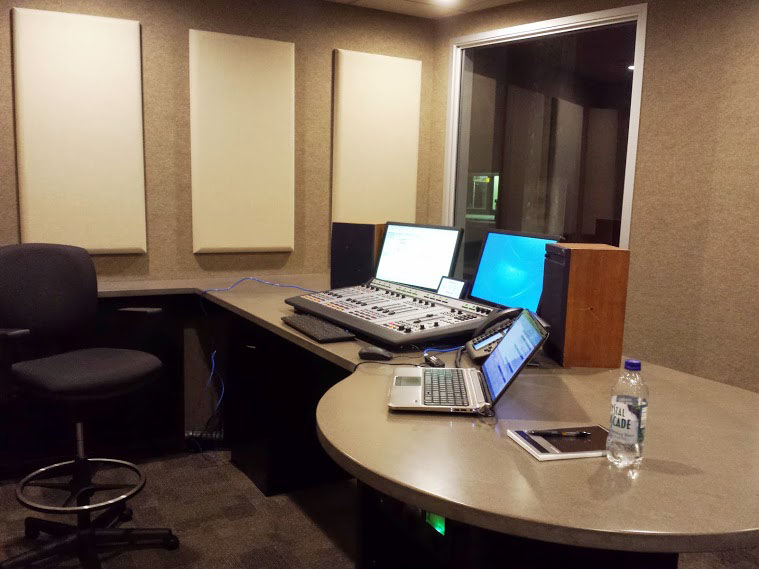
Any good theater or listening is acoustically treated to ensure the sound coming from the speakers is what arrives at the listener’s ears. Conditions common in small/medium rooms, such as flutter echo and comb filtering, degrade the clarity of music and speech. Here are some tricks to get a full and accurate sound out of your home theater or listening room. For those visually inclined individuals, the accompanying video shows how a critical listening space would ideally be treated.
Bass Traps – low-end control
Low frequency problems are common to almost any room, regardless of size. The good news is that most of the time the solution is simple. By installing bass traps in the corners of the room you can prevent the excessive bass build-up. If bass frequencies are allowed to build in the corners, it causes the bass frequencies to become muddy and undefined. The more corners you cover with a good trap, the better bass response you get from the room.
Having bass traps in all corners is best. That said, if you only have budget for two, having bass traps in the front corners of the room should be the highest priority. Fabric wrapped absorbers look as good as they sound, and Geometrix™ by Acoustics First, fit the corners like a glove.
Broadband Absorption – tame the ring.
To control the flutter echo caused by reflective parallel walls, it’s vital that the first refection points are treated with broadband absorption (wall panels). More than likely, your TV and/or sound system is in a fixed position, and your listening position will be relatively fixed as well. This should make the early reflection surfaces easy to locate. Sound travels in all directions from the speaker, including behind it, so put absorbers behind it on the wall. Don’t forget the floors, ceiling, and the wall behind you – sound will bounce off those as well.
Hang broadband absorbers over all the early reflection points – left, right, front and back so they are centered at ear height. Placement is the first key to getting this reflection free zone. The second is the right choice of absorber. To match your fabric wrapped bass traps, the simple choice is get some more panels wrapped in fabric. The Sonora® line of broadband absorbing panels coordinate with the bass traps, and come in a plethora of sizes and mounting options to work in your space.
Diffusers – put life back into your space.
Diffusion will give us something we couldn’t attain through absorption – a sense of open space. Even after treating with absorbers, there are still areas of the room where sound waves will sit, because your room is a fixed box with fixed speakers. Diffusers scatter the energy, creating ambiance with residual energy. This simple step does not remove energy from your room, but redistributes it into a soundscape that can make you forget you are in a room at all. In order of priority, the rear walls, front wall and ceiling are the most important surfaces to install diffusers.
There are many ways to diffuse the sound and coordinate with your room, from the fabric covered HiPer™ Panel and Double Duty Diffusers™, to the striking line of Art Diffusors® like the Model C, which can be painted to match your décor.
Sound Channels® – Top Product!
Posted by Acoustics First in Absorption, Classrooms, Customer Feedback, Mentions, Press Release, School & Educational Facilities on December 22, 2015
Acoustics First® Sound Channels® wall fabric has been named a ‘2015 Top Product’ by Christian School Products magazine!
http://www.cspmagdigital.com/publication/?i=284531&p=18

Christian School Products – 2015 Top Products
This article from their November issue explains why:
Merry Christmas and Happy New Year from all of us at Acoustics First!
 Acoustics First BLOG
You must be logged in to post a comment.