Archive for category Absorption
End-of-Year Warehouse SALE 2025!
Posted by Acoustics First in Absorption, Diffusion, Press Release, Products on December 23, 2025
It’s that time again! Time to do The End-of-Year cleanout of overstock, B-Stock, etc! Help us clean house!
Free Ground Shipping to the lower 48 states included on warehouse sale items – Available until January 31st… or while supplies last!
Aeolian™ Sound Diffusers – B-Stock

These Aeolian™ Diffusers have minor imperfections due to the batch of plastic having small orange specs in it. Barely noticeable, and easily paintable.
Quantity at time of writing – 102
Original Price $175 per unit – Sale price $87.50 per unit!
ArtDiffusor® Model D Sound Diffusers – Overstock
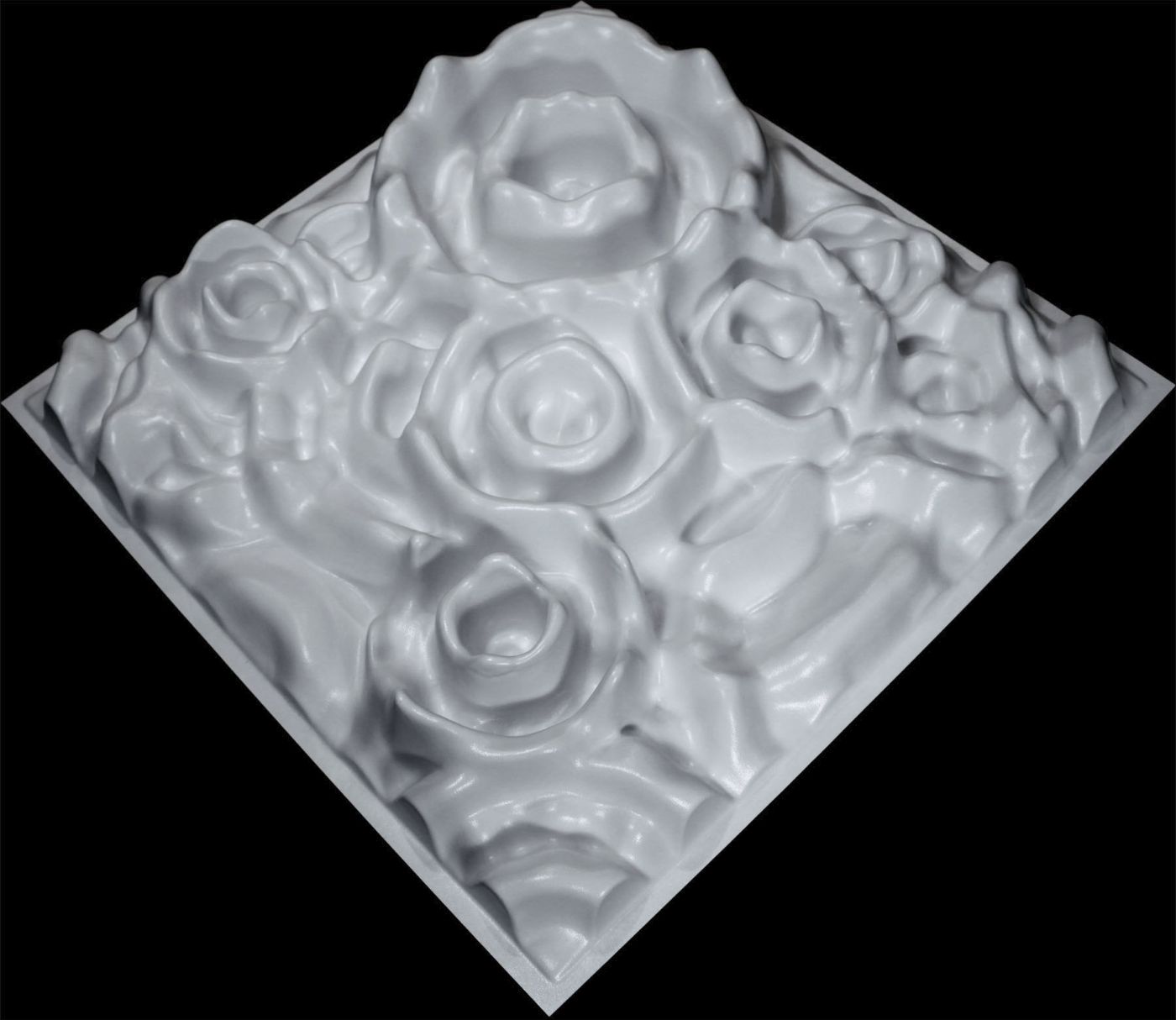
These ArtDiffusor® Model D Diffusers are A-Grade Stock – they are simply overstock items!
Quantity at time of writing – 96
Original Price $175 per unit – Sale price $87.50 per unit!
2’x2’x1″ Tone Tiles – Overstock

These 2’x2’x1″ ToneTiles are A-Grade Stock – they are simply overstock items!
Quantity at time of writing – 60
Original Price $70 per unit – Sale price $35.00 per unit!
2’x2′ Cloudscape Ceiling Tiles – Tile Backed – Customer Return

These Cloudscape Ceiling Tiles with Fog Pattern are a customer return – Listed as B-Stock. They are mounted to a ceiling tile backer for use in a drop ceiling grid.
Quantity at time of writing – 66
Original Price $60 per unit – Sale price $30.00 per unit!
Contact Acoustics First today at 888-765-2900 or reach out to info@acousticsfirst.com to inquire about these deals – but don’t wait… once they are gone, that’s it!
Sabins, SAC, & NRC — a practical guide.
Posted by Acoustics First in Absorption, Articles, HOW TO on September 18, 2025
When optimizing a room’s acoustics, you’re often balancing how much sound is absorbed (loss) against how much bounces around (reverberation). Some common ways to describe absorption — sabins, SAC, and NRC — look different, but they’re closely related.
Sabins
A sabin is a direct measure of absorption: One sabin equals the sound-absorbing effect of one square foot of a perfectly absorbing surface (like an open window – sound goes out, but doesn’t come back.) In practice, manufacturers or labs will report a component’s equivalent absorption area in sabins at various frequencies. Sabins are additive: add the sabins of all items in a space to get the room’s total absorption for use in reverberation calculations.

SAC
Sound absorption coefficients (SAC) are used to simplify large square footage calculations. Each SAC itself is derived from the measured equivalent sabins of a test sample divided by the sample’s area. This allows you to multiply the square footage of a certain material by the SAC and it will tell you how many sabins it will absorb at a certain frequency. You may also see an average of all the SACs, or a subset of those values… a specific, often-used subset is the Noise Reduction Coefficient (NRC).
NRC and how it’s calculated
NRC (Noise Reduction Coefficient) is a number that represents a material’s average absorption performance at mid-to-high frequencies. It’s calculated by taking the arithmetic average of the material’s sound absorption coefficients (SACs) at 250 Hz, 500 Hz, 1000 Hz and 2000 Hz (per ASTM C423 or other standard test procedures). NRC is typically reported to the nearest 0.05 and runs from 0.00 (reflective) to 1.00 (very absorbent). Being an average, it isn’t the most accurate method, but it can give you a quick estimate which can be useful in the planning stages.

Practical Mathematic Relationship
- From measured data: SAC = measured sabins ÷ sample area.
- NRC is the average of SACs across four bands (250 Hz, 500 Hz, 1000 Hz and 2000 Hz).
- To convert NRC into a working absorption number for a planar surface:
sabins = NRC × area (ft²). - For discrete units (baffles, clouds): manufacturers often give sabins per unit, so total absorption is sabins per unit × number of units.
Why sabins for baffles and NRC for wall/ceiling panels?
Hanging devices like baffles are three-dimensional, exposed on multiple faces, and their effective absorption depends on orientation, spacing, and edge behavior. It’s more accurate and user-friendly to report their absorption as “# sabins per unit.” Flat-mounted wall or ceiling panels cover a known area and behave predictably per square foot, so SAC or an NRC (per ft²) is a convenient, normalized way to estimate absorption across a room.
Putting it into RT60 calculations
RT60 calculations depict the amount of time it takes for a sound to decay 60dB in a particular space with specific treatments. (60dB is roughly a 1000-fold reduction in sound pressure.) Reverberation-time formulas (like Sabine’s) use the room’s total absorption in sabins in the function. A basic average will use NRC × area for planar coverage and add sabins-per-unit for baffles. Sum everything up to get total sabins, then plug that into your RT calculation to estimate RT60.
If using feet your calculation is…
RT60 = 0.049 x Room Volume ÷ Total Sabins
If using metric your calculation is…
RT60 = 0.161 x Room Volume ÷ Total (Metric) Sabins
In summary:
NRC is an area-based average (for flat-coverage estimates); SAC is a sabins per square foot coefficient (for efficient absorption calculations using area); sabins per unit are direct, measured absorption values (better for discrete, hung, multi-faced items).
Throwback Thursday: Diffusion Vs. Absorption
Posted by Acoustics First in Absorption, Diffusion, Product Applications on May 22, 2025
On this Throwback Thursday, we look back at a popular Sound and Communications article about why sound diffusion is so much more complex a phenomenon than sound absorption. In this article, we discuss some of the different variables associated with the quantification of diffusion – magnitude, phase, frequency, direction, etc. When comparing its properties against absorption, which is simply the reduction of energy at specific frequencies, the argument is cemented as to why a single-parameter coefficient is insufficient to fully express the phenomenon of acoustic diffusion.
Read the article here:
PDF Version of Sound and Communications Article.

Revisit the original post here:
https://acousticsfirst.info/2020/03/24/acoustics-first-talks-diffusion-in-sound-communications/
Eat with your Eyes (and Ears): Acoustic Treatment for Restaurants
Posted by Acoustics First in Absorption, Products, Restaurants on March 21, 2025

When evaluating a restaurant, guests will often look at four factors: food quality, service, price point and atmosphere. The first three are fairly obvious in terms of how they influence the customers satisfaction, but the link between atmosphere and guest satisfaction is a bit murky.
Atmosphere is a sort of “catch-all” term for the various room and design elements that contribute to the overall experience of the patrons. “Atmosphere” is usually associated with visual elements, like lighting, table setting and decorations, but “atmosphere” can literally refer to the air in the room (is the restaurant properly ventilated, are there distracting smells from the kitchen?) or more functional/operating elements like the layout of the tables and, our focus in this article, sound management.
Sound Management – How many times have you been to a busy restaurant that is so loud you can’t hold a conversation with those at your table? It’s difficult to understand speech when background noise and reflections from other sources cover up new information. This causes patrons to elevate their voices to be heard, further exacerbating noise level issues.
Studies show that patrons spend more time and money at restaurants that properly address sound management, ensuring their guest don’t feel overwhelmed at peak hours. Key considerations include:
- Background music: Choose music that complements your restaurant’s concept. Adjust the playlist and volume based on the time of day and desired energy level—soft jazz for a relaxed dinner or upbeat tracks for a lively lunch.
- Comfortable conversation levels: Keep music and ambient noise at a volume that allows guests to speak without straining to hear each other. The right balance creates a welcoming buzz without becoming disruptive.
- Consider layout impacts: Open kitchens, high ceilings, or closely packed tables can amplify noise. Think about incorporating design features like partitions and high booths to help “break up” sound that is traveling from table to table.
- Acoustic design elements: Sound will build up most in spaces that have a lot of hard/reflective surfaces. Use sound-absorbing materials like acoustic panels to reduce reverberation/echoes and create a more intimate atmosphere.

Tone Tile Panels – In restaurants, it’s especially important to minimize visually obtrusive acoustic treatment so it does detract or conflict with the carefully constructed aesthetic of the dining room. Tone Tiles are a perfect solution for restaurants that require “invisible” sound absorption as they can be field or factory painted to match the wall or ceiling color precisely. They also have a white, lightly textured surface that resembles drywall (Tone Tiles can be used as projector screens). Keep in mind, the more you paint an acoustic panel, the less sound reaches the absorptive substrate. We recommend light passes with water based paint to ensure the surface of the panel remains as acoustically “transparent” as possible
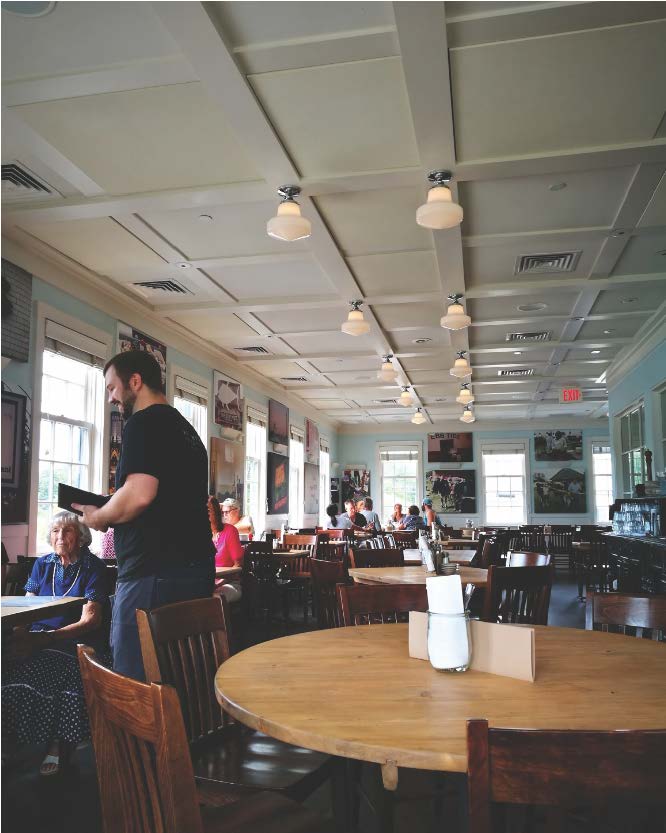
Silent Picture Panels – Another popular treatment option is our Silent Picture panels. Silent Picture panels can be wrapped with customer supplied artwork, images or branding. Restaurants love the double utility of full-color images and premium sound absorption.
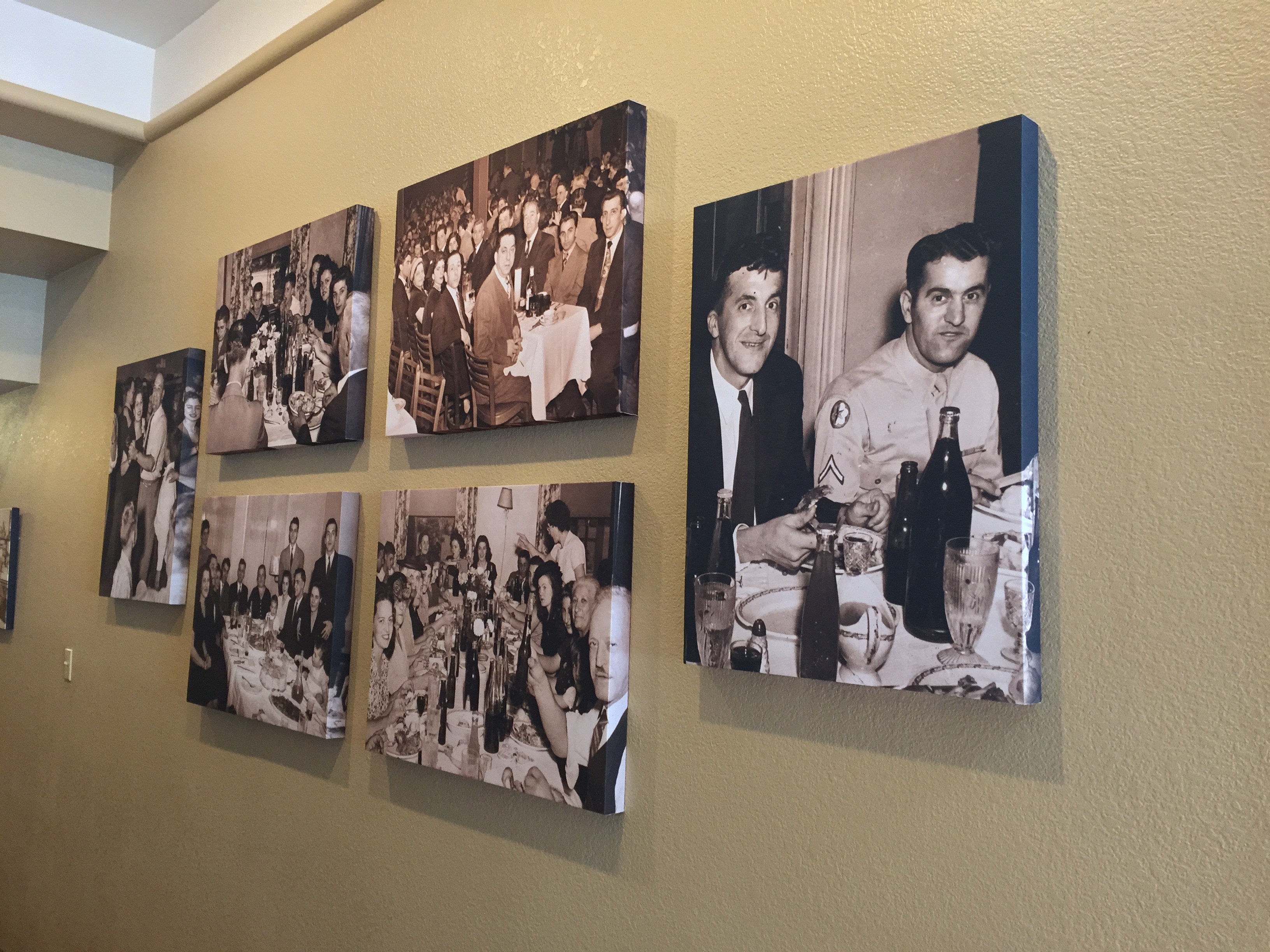
Can’t I just put foam under the tables? We do not typically recommend acoustic material underneath restaurant tables. Treating the underside of tables will only “take the edge” off overall sound buildup, primarily attenuating sounds produced below the table (shuffling feet, chair slides, etc.). Sound absorptive treatment is much more effective when in the direct “line of sight” of primary sound sources. Also, installing acoustic foam or felt under tables, where it is likely to be picked at or possibly soiled, present durability and sanitary concerns.
We’ve all heard the expression that we “eat with our eyes”; if the meal is not appealing to look at… it is less pleasing to eat. However, we also “eat with our ears”; if the environment is not conducive to comfortable conversation, then the customer will leave with a bad taste in their mouth, even if the food quality and service is exceptional.
Acoustic Treatment in the 1920’s – A look at the Guardian Building
Posted by Acoustics First in Absorption, Offices, Uncategorized on January 14, 2025
The bank wanted the building be a “show-piece” and communicate its principles of “security” and “fidelity” (remember, this was at a time before the FDIC), to impress customers and convince them to store their valuables at their bank. Incredibly, the building was completed in just one year; construction began in 1928 and finished just before the Stock Market Crash of 1929 (so much for fidelity).
Head designer Wirt C. Rowland had far from a subdued vision for the building. Blending Native American, Aztec, and Arts & Crafts designs, Rowland wanted to make an indelible impression on anyone who walked in. He said “We no longer live in a leisurely age…the impression must be immediate, strong and complete. Color has this vital power.”
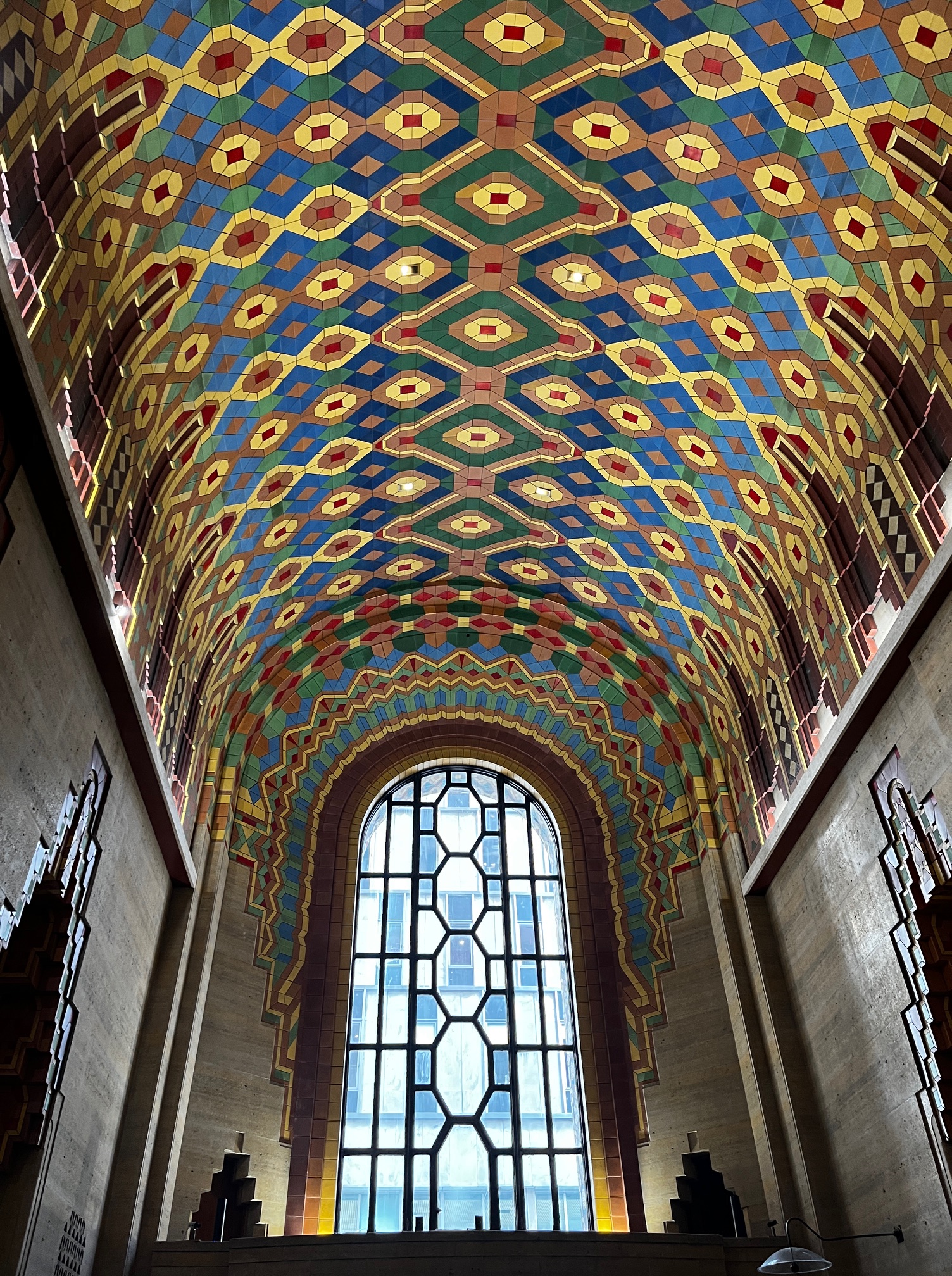
Colorful, luxury materials grace every surface of this building. Italian Travertine marble was used for steps and wall surfaces, contrasting with deep-red Numidian marble imported from Africa. Brilliantly colored tiles fill the lobby’s vaulted ceiling, and a massive multi-colored mosaic adorns the vestibule wall. Monel metal was used in the large ornamental gate dividing the banking hall and main lobby, supporting a pair of Tiffany & Co. Glass clocks. Even the office corridors and restrooms are lined in a Tavernelle marble from Tennessee.
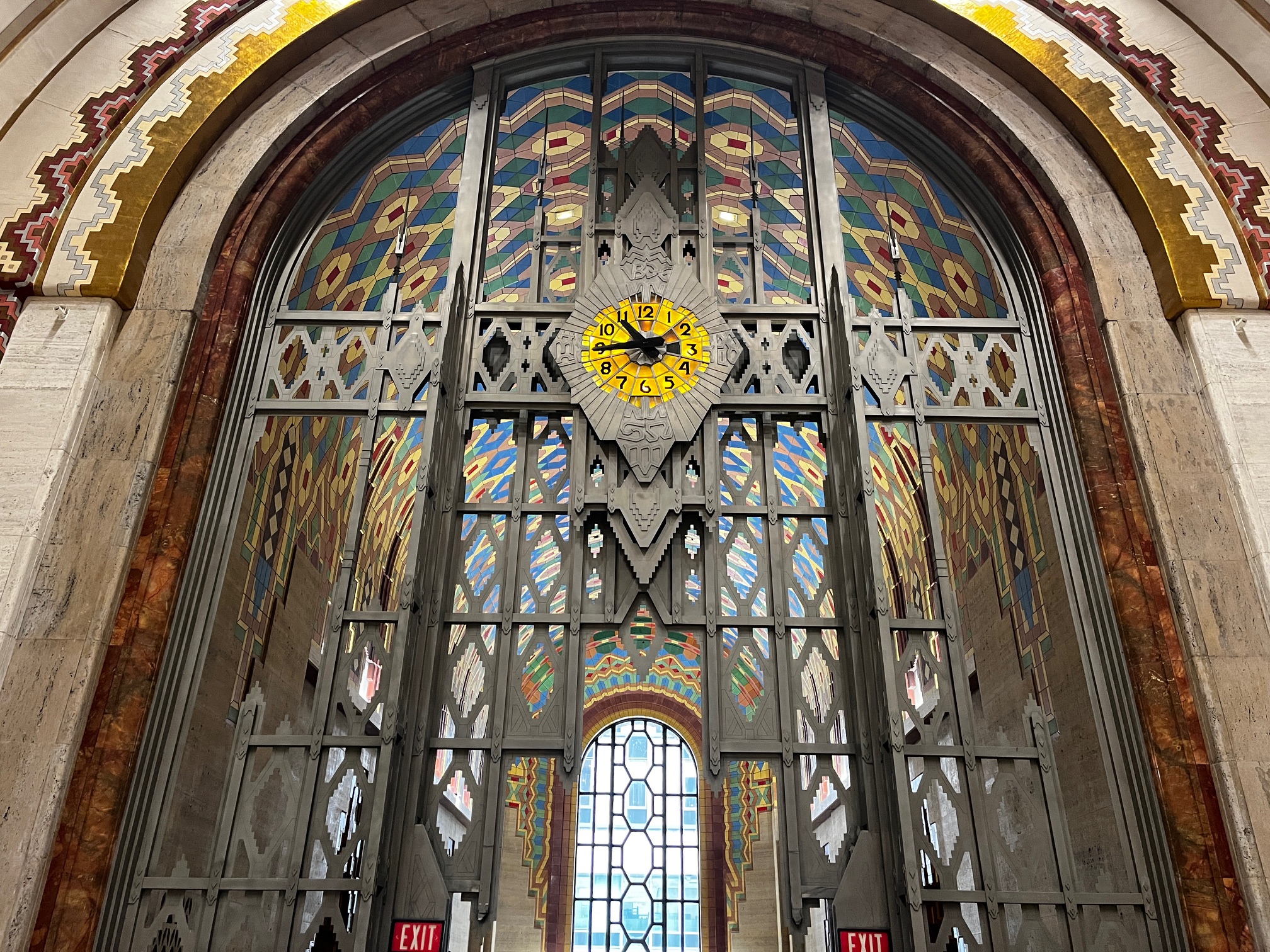
Obviously, these beautiful materials are also extremely sound reflective. Having worked on similar buildings, Rowland understood the need for acoustic treatment in the banking hall as there would be hundreds of customers, tellers and their managers trying to conduct important business in this large, cathedral-like space. If they used the same ceramic tiles they used on the ceiling of the lobby, conversations would be drowned out by a cacophony of typewriters. In lieu of the tiles, the banking hall has an incredibly appointed, intricate system of stretched canvas over wood frames backed with sound-absorbing horse hair. The canvas was hand painted with real gold and silver and requires regular maintenance. In fact, the same Italian family that made the ceiling nearly 100 years ago has been caring for it ever since!

I recently had the pleasure of touring the Guardian building, and walking through the Monel gate from the lobby to the banking hall, you can hear the difference. Though the banking hall is much larger, it feels much more intimate and comfortable, in large part because of the ceiling. Although the horse hair and canvas materials may not meet fire code today, modern stretched-fabric acoustic assemblies owe a lot to this sort of early innovation.

The Guardian Building is a symbol of creativity and achievement. Designed for the future, it is no surprise that Rowland’s masterpiece still dazzles and inspires visitors to this day.
For more information on the Guardian Building’s long history, visit https://www.guardianbuilding.com/history
 Acoustics First BLOG
You must be logged in to post a comment.