Posts Tagged sound absorbers
Eat with your Eyes (and Ears): Acoustic Treatment for Restaurants
Posted by Acoustics First in Absorption, Products, Restaurants on March 21, 2025

When evaluating a restaurant, guests will often look at four factors: food quality, service, price point and atmosphere. The first three are fairly obvious in terms of how they influence the customers satisfaction, but the link between atmosphere and guest satisfaction is a bit murky.
Atmosphere is a sort of “catch-all” term for the various room and design elements that contribute to the overall experience of the patrons. “Atmosphere” is usually associated with visual elements, like lighting, table setting and decorations, but “atmosphere” can literally refer to the air in the room (is the restaurant properly ventilated, are there distracting smells from the kitchen?) or more functional/operating elements like the layout of the tables and, our focus in this article, sound management.
Sound Management – How many times have you been to a busy restaurant that is so loud you can’t hold a conversation with those at your table? It’s difficult to understand speech when background noise and reflections from other sources cover up new information. This causes patrons to elevate their voices to be heard, further exacerbating noise level issues.
Studies show that patrons spend more time and money at restaurants that properly address sound management, ensuring their guest don’t feel overwhelmed at peak hours. Key considerations include:
- Background music: Choose music that complements your restaurant’s concept. Adjust the playlist and volume based on the time of day and desired energy level—soft jazz for a relaxed dinner or upbeat tracks for a lively lunch.
- Comfortable conversation levels: Keep music and ambient noise at a volume that allows guests to speak without straining to hear each other. The right balance creates a welcoming buzz without becoming disruptive.
- Consider layout impacts: Open kitchens, high ceilings, or closely packed tables can amplify noise. Think about incorporating design features like partitions and high booths to help “break up” sound that is traveling from table to table.
- Acoustic design elements: Sound will build up most in spaces that have a lot of hard/reflective surfaces. Use sound-absorbing materials like acoustic panels to reduce reverberation/echoes and create a more intimate atmosphere.

Tone Tile Panels – In restaurants, it’s especially important to minimize visually obtrusive acoustic treatment so it does detract or conflict with the carefully constructed aesthetic of the dining room. Tone Tiles are a perfect solution for restaurants that require “invisible” sound absorption as they can be field or factory painted to match the wall or ceiling color precisely. They also have a white, lightly textured surface that resembles drywall (Tone Tiles can be used as projector screens). Keep in mind, the more you paint an acoustic panel, the less sound reaches the absorptive substrate. We recommend light passes with water based paint to ensure the surface of the panel remains as acoustically “transparent” as possible
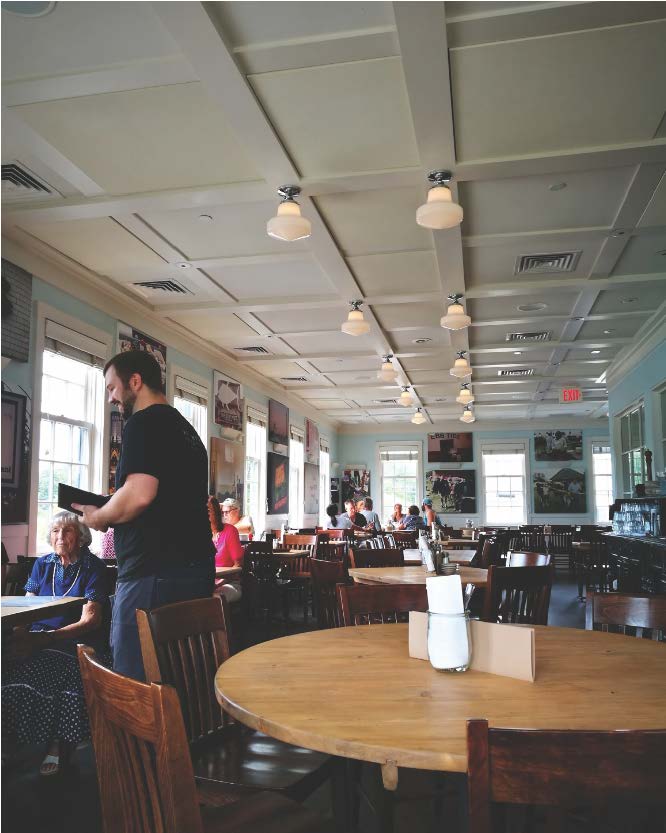
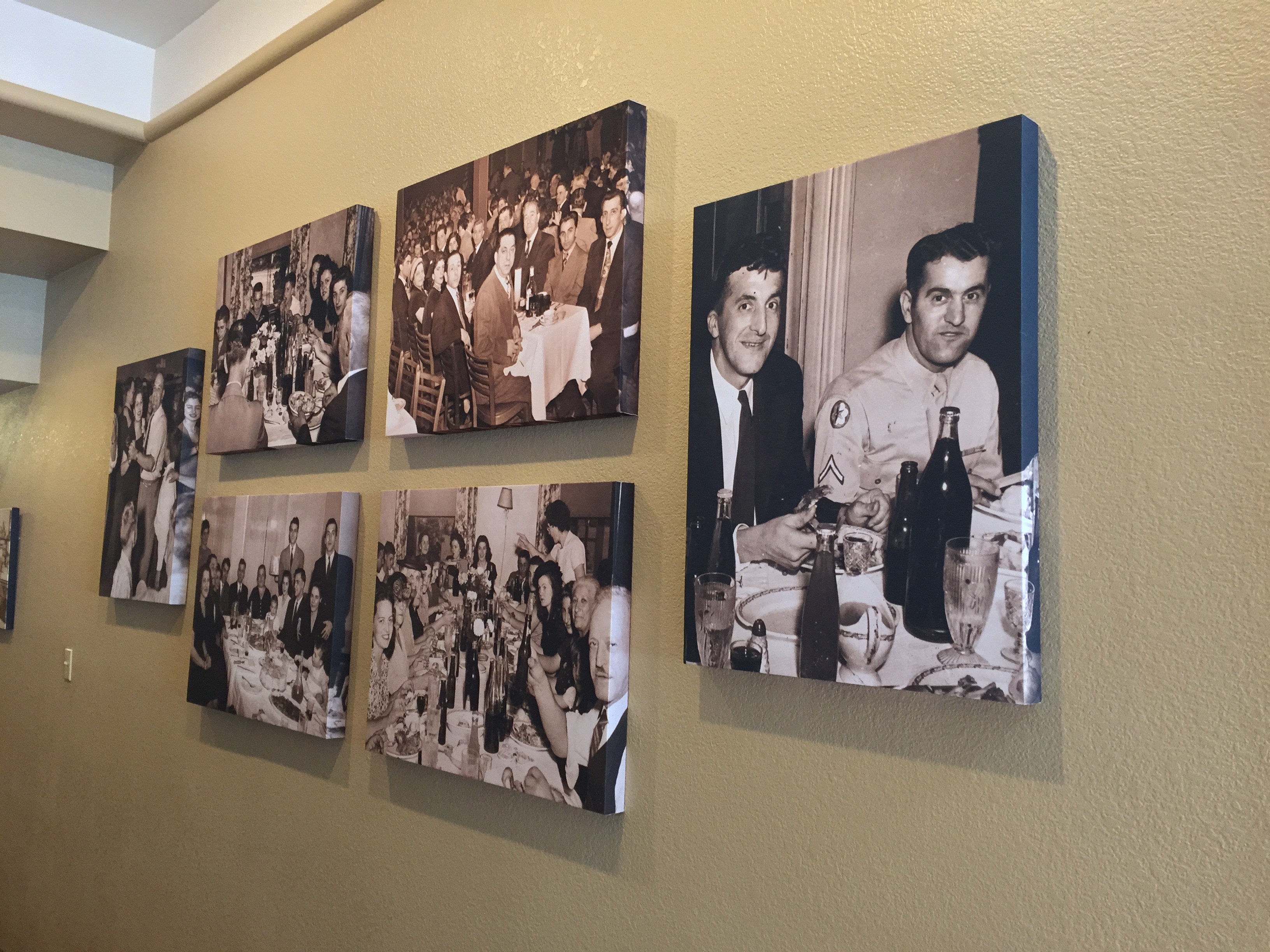
Silent Picture Panels – Another popular treatment option is our Silent Picture panels. Silent Picture panels can be wrapped with customer supplied artwork, images or branding. Restaurants love the double utility of full-color images and premium sound absorption.
Can’t I just put foam under the tables? We do not typically recommend acoustic material underneath restaurant tables. Treating the underside of tables will only “take the edge” off overall sound buildup, primarily attenuating sounds produced below the table (shuffling feet, chair slides, etc.). Sound absorptive treatment is much more effective when in the direct “line of sight” of primary sound sources. Also, installing acoustic foam or felt under tables, where it is likely to be picked at or possibly soiled, present durability and sanitary concerns.
We’ve all heard the expression that we “eat with our eyes”; if the meal is not appealing to look at… it is less pleasing to eat. However, we also “eat with our ears”; if the environment is not conducive to comfortable conversation, then the customer will leave with a bad taste in their mouth, even if the food quality and service is exceptional.
Acoustical Considerations for Classrooms
Posted by Acoustics First in Absorption, Articles, Classrooms, Product Applications, Products, School & Educational Facilities, Teaching Rooms on September 19, 2024
Poor classroom acoustics has long been the invisible problem that has the farthest reaching implications for learning. Excessive noise and reverberation degrade speech intelligibility, resulting in reduced understanding and therefore reduced learning. In many classrooms in the United States, the speech intelligibility rating is 75% or less. That means, in speech intelligibility tests, listeners with normal hearing can only understand 75% of the words read from a list. Imagine reading a textbook with every fourth word missing. Wouldn’t that make comprehension near impossible? Fortunately, poor classroom acoustics can usually be remedied with some basic knowledge and commercially available treatment. But before getting into specific treatment, let’s go over some basic acoustic principles.
Noise
Obviously, it’s difficult to understand what the instructor is saying when there is a lot of naturally occurring noise in the room. A glut of factors can be considered noise sources, including HVAC “rumble”, traffic outside the building and students moving in their chairs. These sources contribute to a “noise floor” that makes understanding speech very difficult. Since there is no one “cure-all” for an excessive noise floor, it is often best to seek the assistance of a professional acoustical consultant to properly diagnose and find a solution to these issues.
Reverberation: Undesirable vs Useful Reflections
When not attributed to a noise issue, the culprit of poor classroom acoustics is often excessive reverberation. In simple terms, reverberation is the sound energy that remains in the listening environment as a result of lingering reflections. As mentioned before, these reflections can easily interfere with speech intelligibility. As you may have experienced at some point, it can be difficult to understand what is being said when reflections from old information cover up what is newly spoken.
The reverberation time (RT or RT60) is used to determine how quickly sound decays. The RT is dependent upon the volume and surface materials of a given room. Large spaces with hard materials (tile, drywall, etc.) have longer reverberation times, while small rooms built with “softer” materials sound more “dead”. Ideally, classrooms should have relatively short RT’s, somewhere in the .6-.8 second range.
A long reverberation time is not the only factor that should be considered when treating a classroom with poor acoustics. Flutter echo is a particularly significant problem when it occurs between the side walls at the front of the classroom where the teacher is speaking. This condition can be heard as a “ringing” sound (when one claps) as the sound rapidly bounces back and forth between two parallel walls. Flutter and other discrete echoes are considered “undesirable reflections” and should be controlled with absorptive or diffusive materials.
Not all reflections are bad though. There are “useful reflections” that reinforce spoken word, rather than cover it up. The teacher’s voice can be propagated throughout the room by shaping a sound reflecting gypsum board ceiling over the front of the room or by making the center of the ceiling a hard, reflecting surface (see figure 1). This will help project the speaker, so they don’t have to strain their voice to be heard over the students.

Reducing Reverberation
Often reducing the dimensions of a classroom to attain a more suitable reverberation time is not feasible, but one can improve the acoustics by introducing sound absorptive materials. Typical classrooms usually have a dropped “acoustical” ceiling that has some absorptive qualities. In classrooms that don’t have this ceiling, reverberation can be reduced by installing an acoustical ceiling or a number of fabric faced fiberglass panels, like Sonora® Ceiling Clouds. Likewise, if there isn’t carpeting in the room, you can marginally reduce the reverberation time by installing sound absorptive flooring.
Wall treatment: Acoustic Panels
If the ceiling and floor are at least rudimentarily treated, then hard walls are usually at fault for poor speech intelligibility. Absorptive wall panels, like Acoustics First Sonora® panels, are a common treatment to control lateral reflections and reverberation.
These panels are popular because they can be customized with a variety of colors, edge designs and fabric facings. They also can come with a high-density fiberglass adder that improves durability. In classrooms, these “Hi-impact” panels are particularly useful because the adder allows for the panels to be used as tack boards. This brings an extra level of functionality to the panels outside of their absorptive properties.
Though wall panels are a perfectly suitable treatment, uncovered areas between the panels can sometimes allow a few hard reflections and/or flutter echo to still occur (although full treatment of the walls would likely result in a room sounding too “dead”). For these situations, Acoustics First often recommends Sound Channels® acoustic wall fabric.

Acoustical Wall Fabric
In many instances, acoustic wall fabric is actually a viable alternative to traditional wall panels. Unlike a typical “wall carpet”, Sound Channels® is made of 100% recycled content and has ridges to increase surface area and absorption. Perhaps most importantly, the uniform coverage you get by treating the walls with acoustic wall fabric eliminates the flutter/slap from reflective parallel walls (without making the space too “dead”). Acoustic wall fabrics are generally light weight and most can be put up just like any other wallcovering.
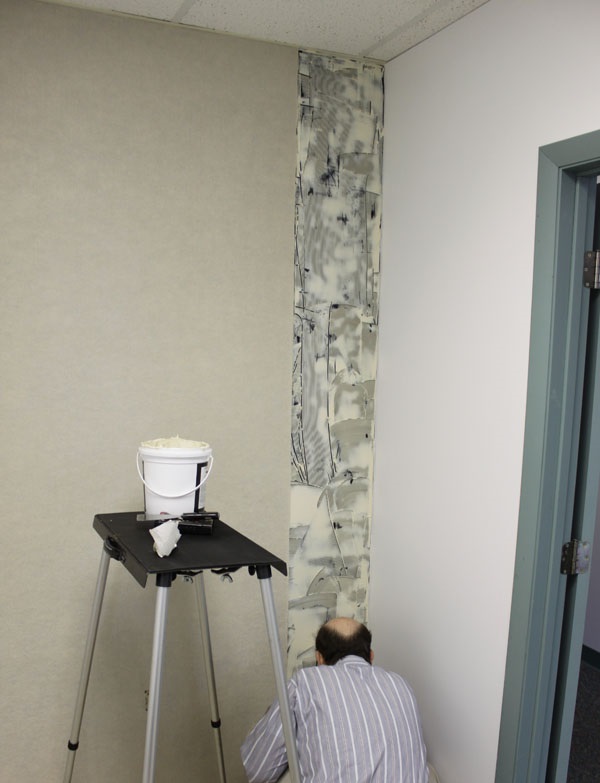
Also of note are the additional benefits when using Sound Channels® in early education classrooms. The effective range that this wall fabric controls is the higher speech frequencies, which is the ideal range for classrooms with younger children (there are not many bass/baritone kindergarteners). Another advantage is in keeping the treatment clean. Wall panels may suck up sound, but they can also absorb fluids (like the occasional juice box). Sound Channels®, on the other hand, is resistant to moisture, mildew and rot. It is also is non-allergenic, easy to clean, and is highly resilient to common wear.
Acoustical Considerations for Classrooms
Although this knowledge has been around for decades, classrooms across the country continue to be plagued by a lack of acoustical forethought. Perhaps as this information becomes more readily available to architects, contractors, administrators and teachers we will begin to see (and hear) better sounding classrooms. School is challenging enough on students and teachers as it is, let’s not compound their daily obstacles by continuing to overlook classroom acoustics.
(Originally published in Christian School Products Magazine – November, 2015)
Sonora® Wave Clouds
Posted by Acoustics First in Absorption, Auditorium, Product Applications, Products on May 20, 2024
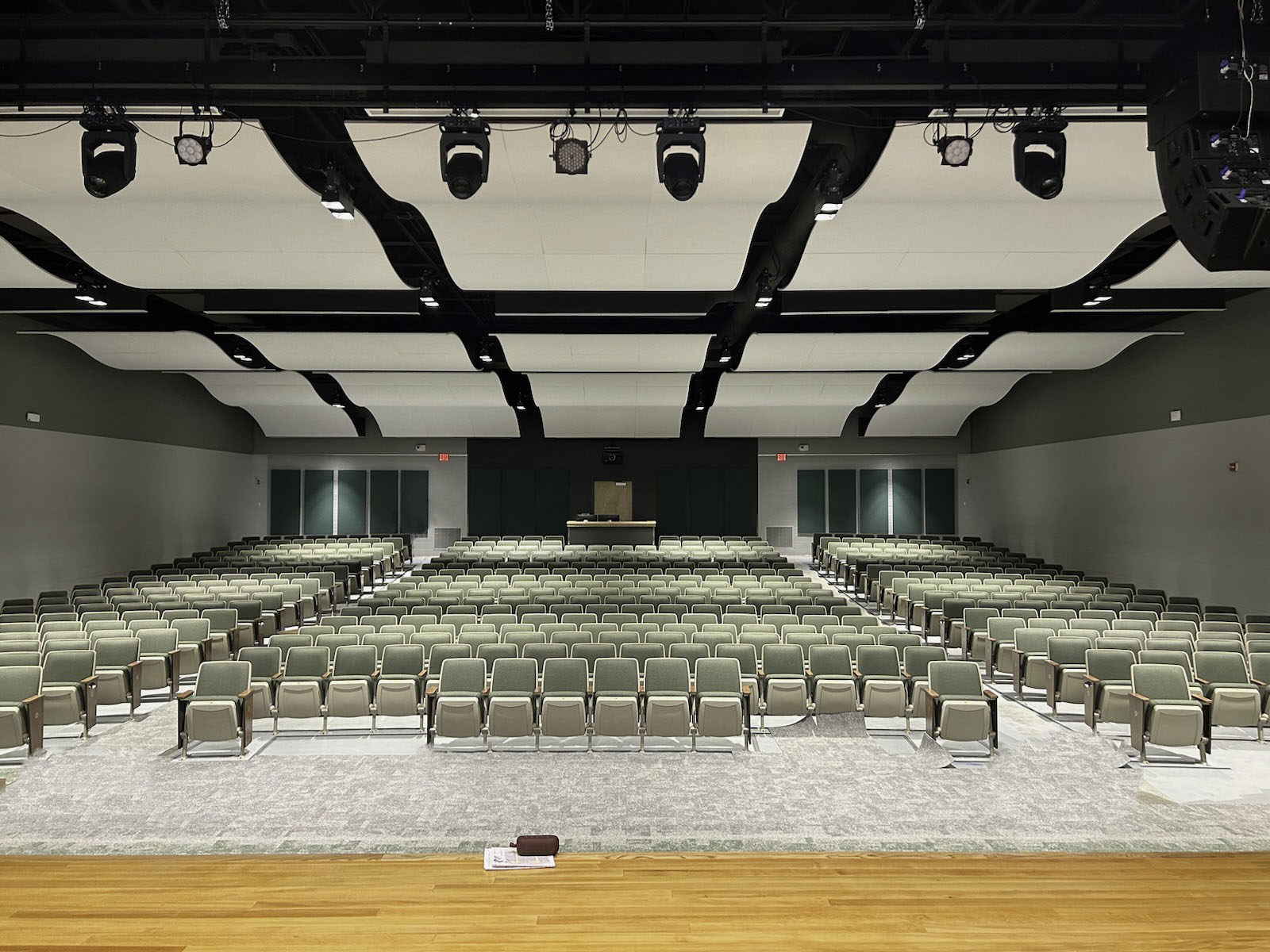
One of the more recent additions to our line of sound absorbing ceiling treatments is the Sonora Wave Cloud. This product can be an ideal choice for architects and specifiers who may be exploring options for large spaces which may require more expansive acoustic treatment while maintaining a certain design aesthetic. The curved shape of the Sonora® Wave Clouds allow for an impressive and unique look, while also providing optimal sound control. Sonora® Wave Clouds are available fabric wrapped or custom painted, with a 132″ radius bend in either a convex or concave profile. This allows for the creation of long waves – hence the name.

For this Job, Acoustics First® worked with Ferrari & Sons to provide the acoustic treatment for an auditorium in the Webutuck Central School District in Amenia, NY. As you can see, the end results turned out great!
Chickahominy Multipurpose Room – Sonora® Wall and Ceiling Panels
Posted by Acoustics First in Absorption, Multipurpose Rooms, Product Applications on January 31, 2023

With multi-function rooms, there are usually a wide range of events being held in the same space. It could be full of kids playing games, dancing and music, or large important meetings. A balance can often be struck, making the room lively enough for the music and games, but tame enough for the speech intelligibility needed for the important meetings.

This particular space took advantage of the expansive ceiling with the use of direct mounted Sonora® Panels – which helped reduce the low-frequency buildup between the ceiling and the floor. Then some carefully-placed, wall-mounted Sonora® Panels were used to reduce the reflections bouncing off the walls. These panels were spread out in clusters along the walls to help reduce troublesome reflections, and tame the flutter from the long parallel walls.
The end result turned out great and all were pleased.
FireFlex™ Wave – Cloud or Baffle
Posted by Acoustics First in Absorption, Product Applications, Products on June 21, 2022
It’s good to have options in ceiling treatments. Some environments have high ceilings that benefit from vertically-hanging baffles, while other environments have lower ceilings in which clouds are more appropriate. In some cases the aesthetic will dictate which product would be best – but what if there was one product that could do both?
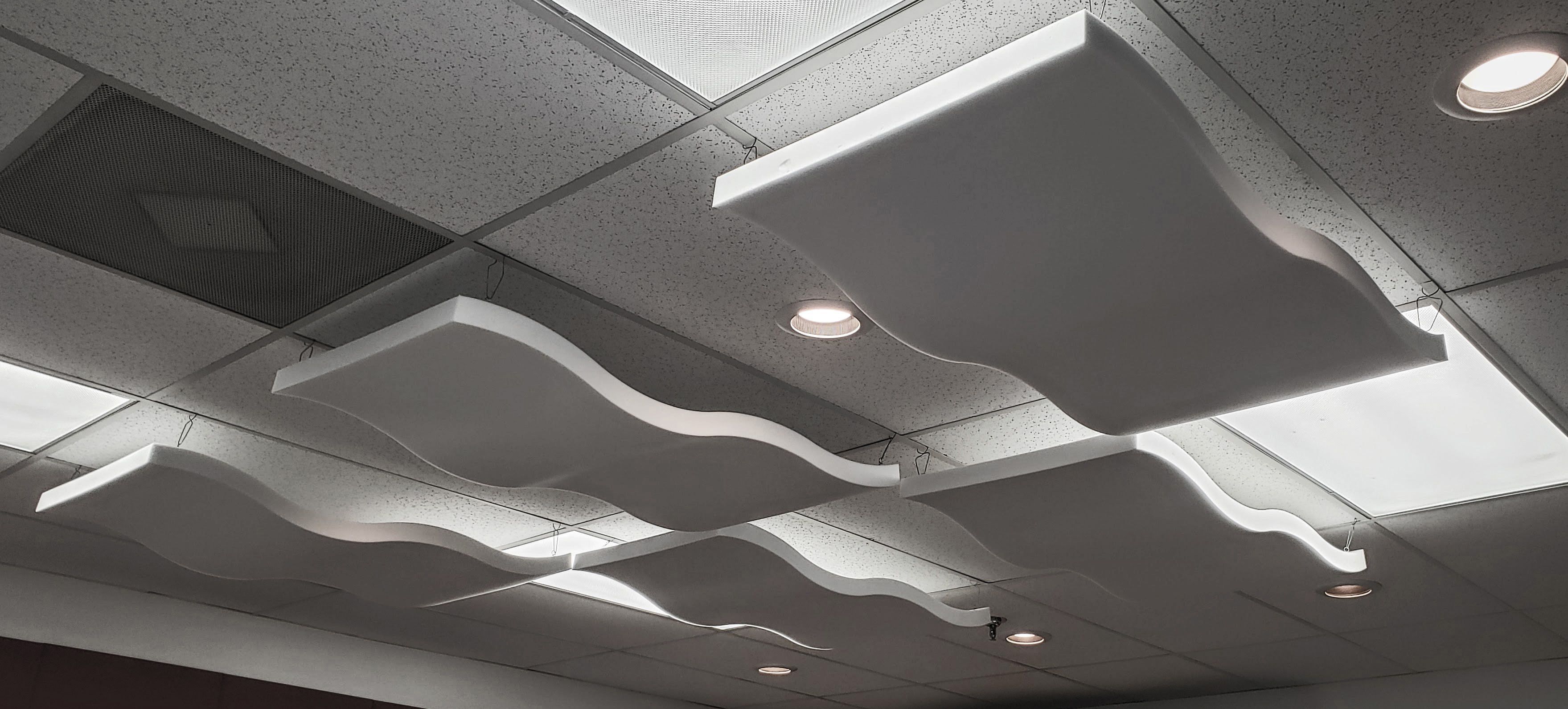
The Fireflex™ Wave has a unique, undulating shape that adds visual interest along with acoustic absorption – but it has another feature which few materials can boast. Due to the Class 1(A) melamine foam construction, the corkscrew mounting hardware can be installed wherever it is needed – including on the edges.

By installing the hardware on the edges instead of the face, you are given the option to also hang the Waves in a vertical orientation as baffles. The wave shape works well aesthetically in either orientation – horizontal or vertical.
In rooms with a lower ceiling, the horizontal orientation of clouds provides more headroom while the undulating shape optimizes the Wave’s surface area for absorption. In larger spaces with high ceilings, you can add more absorptive surface area by hanging the Waves as baffles, and provide a more organic look than you get with flat baffles.
When overhead acoustic absorption is required, turn to Acoustics First®.
 Acoustics First BLOG
You must be logged in to post a comment.