Posts Tagged cloudscape
End-of-Year Warehouse SALE 2025!
Posted by Acoustics First in Absorption, Diffusion, Press Release, Products on December 23, 2025
It’s that time again! Time to do The End-of-Year cleanout of overstock, B-Stock, etc! Help us clean house!
Free Ground Shipping to the lower 48 states included on warehouse sale items – Available until January 31st… or while supplies last!
Aeolian™ Sound Diffusers – B-Stock

These Aeolian™ Diffusers have minor imperfections due to the batch of plastic having small orange specs in it. Barely noticeable, and easily paintable.
Quantity at time of writing – 102
Original Price $175 per unit – Sale price $87.50 per unit!
ArtDiffusor® Model D Sound Diffusers – Overstock
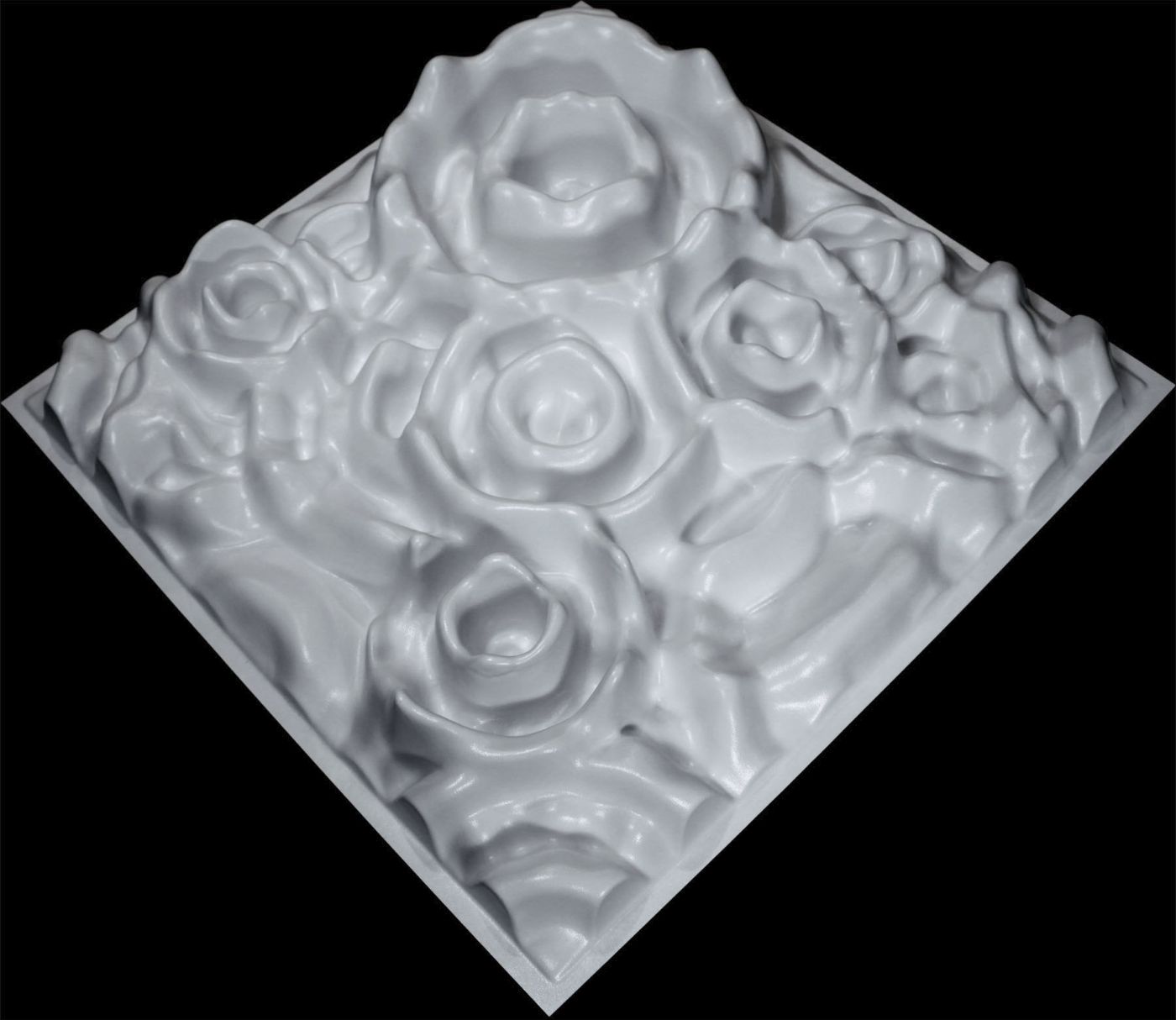
These ArtDiffusor® Model D Diffusers are A-Grade Stock – they are simply overstock items!
Quantity at time of writing – 96
Original Price $175 per unit – Sale price $87.50 per unit!
2’x2’x1″ Tone Tiles – Overstock

These 2’x2’x1″ ToneTiles are A-Grade Stock – they are simply overstock items!
Quantity at time of writing – 60
Original Price $70 per unit – Sale price $35.00 per unit!
2’x2′ Cloudscape Ceiling Tiles – Tile Backed – Customer Return

These Cloudscape Ceiling Tiles with Fog Pattern are a customer return – Listed as B-Stock. They are mounted to a ceiling tile backer for use in a drop ceiling grid.
Quantity at time of writing – 66
Original Price $60 per unit – Sale price $30.00 per unit!
Contact Acoustics First today at 888-765-2900 or reach out to info@acousticsfirst.com to inquire about these deals – but don’t wait… once they are gone, that’s it!
Sabins, SAC, & NRC — a practical guide.
Posted by Acoustics First in Absorption, Articles, HOW TO on September 18, 2025
When optimizing a room’s acoustics, you’re often balancing how much sound is absorbed (loss) against how much bounces around (reverberation). Some common ways to describe absorption — sabins, SAC, and NRC — look different, but they’re closely related.
Sabins
A sabin is a direct measure of absorption: One sabin equals the sound-absorbing effect of one square foot of a perfectly absorbing surface (like an open window – sound goes out, but doesn’t come back.) In practice, manufacturers or labs will report a component’s equivalent absorption area in sabins at various frequencies. Sabins are additive: add the sabins of all items in a space to get the room’s total absorption for use in reverberation calculations.

SAC
Sound absorption coefficients (SAC) are used to simplify large square footage calculations. Each SAC itself is derived from the measured equivalent sabins of a test sample divided by the sample’s area. This allows you to multiply the square footage of a certain material by the SAC and it will tell you how many sabins it will absorb at a certain frequency. You may also see an average of all the SACs, or a subset of those values… a specific, often-used subset is the Noise Reduction Coefficient (NRC).
NRC and how it’s calculated
NRC (Noise Reduction Coefficient) is a number that represents a material’s average absorption performance at mid-to-high frequencies. It’s calculated by taking the arithmetic average of the material’s sound absorption coefficients (SACs) at 250 Hz, 500 Hz, 1000 Hz and 2000 Hz (per ASTM C423 or other standard test procedures). NRC is typically reported to the nearest 0.05 and runs from 0.00 (reflective) to 1.00 (very absorbent). Being an average, it isn’t the most accurate method, but it can give you a quick estimate which can be useful in the planning stages.

Practical Mathematic Relationship
- From measured data: SAC = measured sabins ÷ sample area.
- NRC is the average of SACs across four bands (250 Hz, 500 Hz, 1000 Hz and 2000 Hz).
- To convert NRC into a working absorption number for a planar surface:
sabins = NRC × area (ft²). - For discrete units (baffles, clouds): manufacturers often give sabins per unit, so total absorption is sabins per unit × number of units.
Why sabins for baffles and NRC for wall/ceiling panels?
Hanging devices like baffles are three-dimensional, exposed on multiple faces, and their effective absorption depends on orientation, spacing, and edge behavior. It’s more accurate and user-friendly to report their absorption as “# sabins per unit.” Flat-mounted wall or ceiling panels cover a known area and behave predictably per square foot, so SAC or an NRC (per ft²) is a convenient, normalized way to estimate absorption across a room.
Putting it into RT60 calculations
RT60 calculations depict the amount of time it takes for a sound to decay 60dB in a particular space with specific treatments. (60dB is roughly a 1000-fold reduction in sound pressure.) Reverberation-time formulas (like Sabine’s) use the room’s total absorption in sabins in the function. A basic average will use NRC × area for planar coverage and add sabins-per-unit for baffles. Sum everything up to get total sabins, then plug that into your RT calculation to estimate RT60.
If using feet your calculation is…
RT60 = 0.049 x Room Volume ÷ Total Sabins
If using metric your calculation is…
RT60 = 0.161 x Room Volume ÷ Total (Metric) Sabins
In summary:
NRC is an area-based average (for flat-coverage estimates); SAC is a sabins per square foot coefficient (for efficient absorption calculations using area); sabins per unit are direct, measured absorption values (better for discrete, hung, multi-faced items).
Sonora® & Sonora® Lite – together in Michigan
Posted by Acoustics First in Absorption, Customer Feedback, Product Applications, Products, Worship Facilities on November 30, 2022
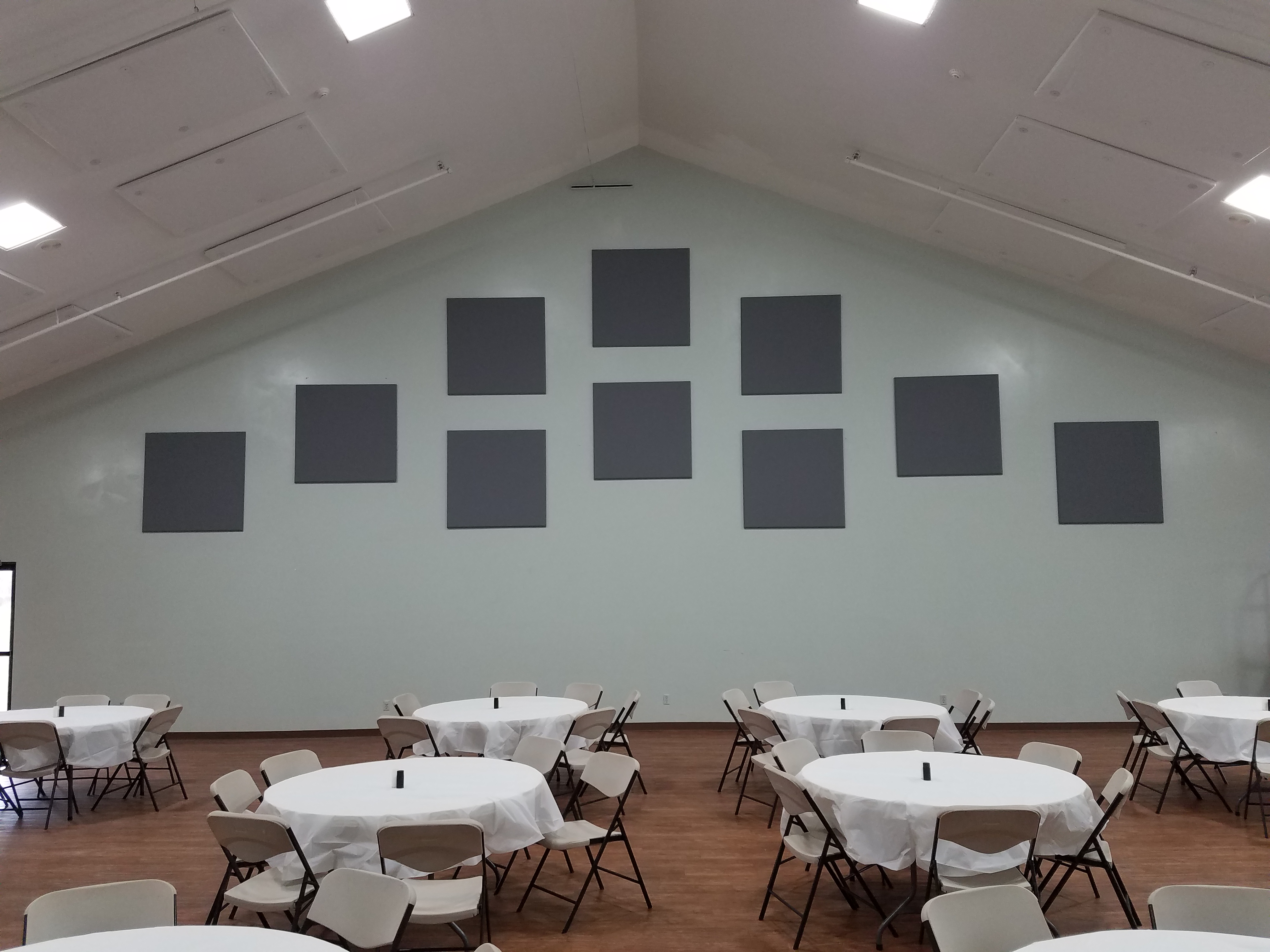
Here are a couple of fresh install photos – courtesy of SLS Productions in Michigan. For this fellowship hall at Kalamazoo Missionary Church, a mix of standard Sonora® Panels and Sonora® Lite PVC encapsulated panels were used. The Steel Grey Sonora® Panels, installed on the wall, are the standard 6-7# density panels that have become ubiquitous in so many churches and schools throughout the country for improving speech clarity and taming harsh reverb times.
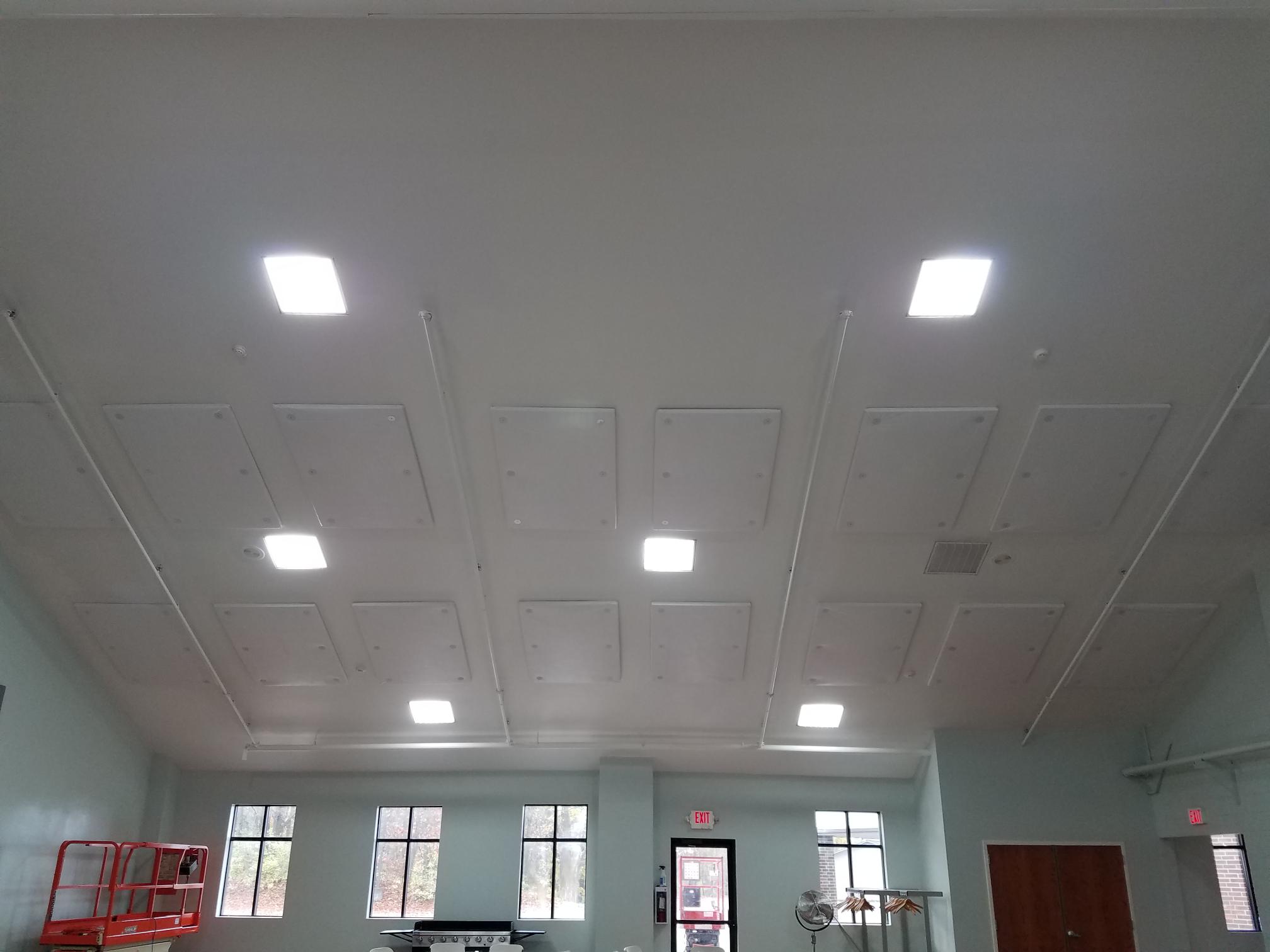
For the ceiling of the room, Sonora® Lite Panels were used. Notice how the white PVC covering and clear washer plates help the panels blend aesthetically into the ceiling. These lower density (1.65#) PVC encapsulated panels could be thought of as a ‘direct mount’ cousin of our Cloudscape® baffles and are an excellent budget friendly choice when treating ceilings. The final results turned out great and all were pleased.
Taming the Cube with Cloudscape®
Posted by Acoustics First in Absorption, Classrooms, Customer Feedback, Manufacturing, Media Room, Product Applications, School & Educational Facilities, Teaching Rooms, Universities on October 21, 2022
When the University of the Pacific reached out to help tame the acoustics of their makerspace called “The Cube”, many different concerns were underlined about the space, its uses, and the problems they faced.
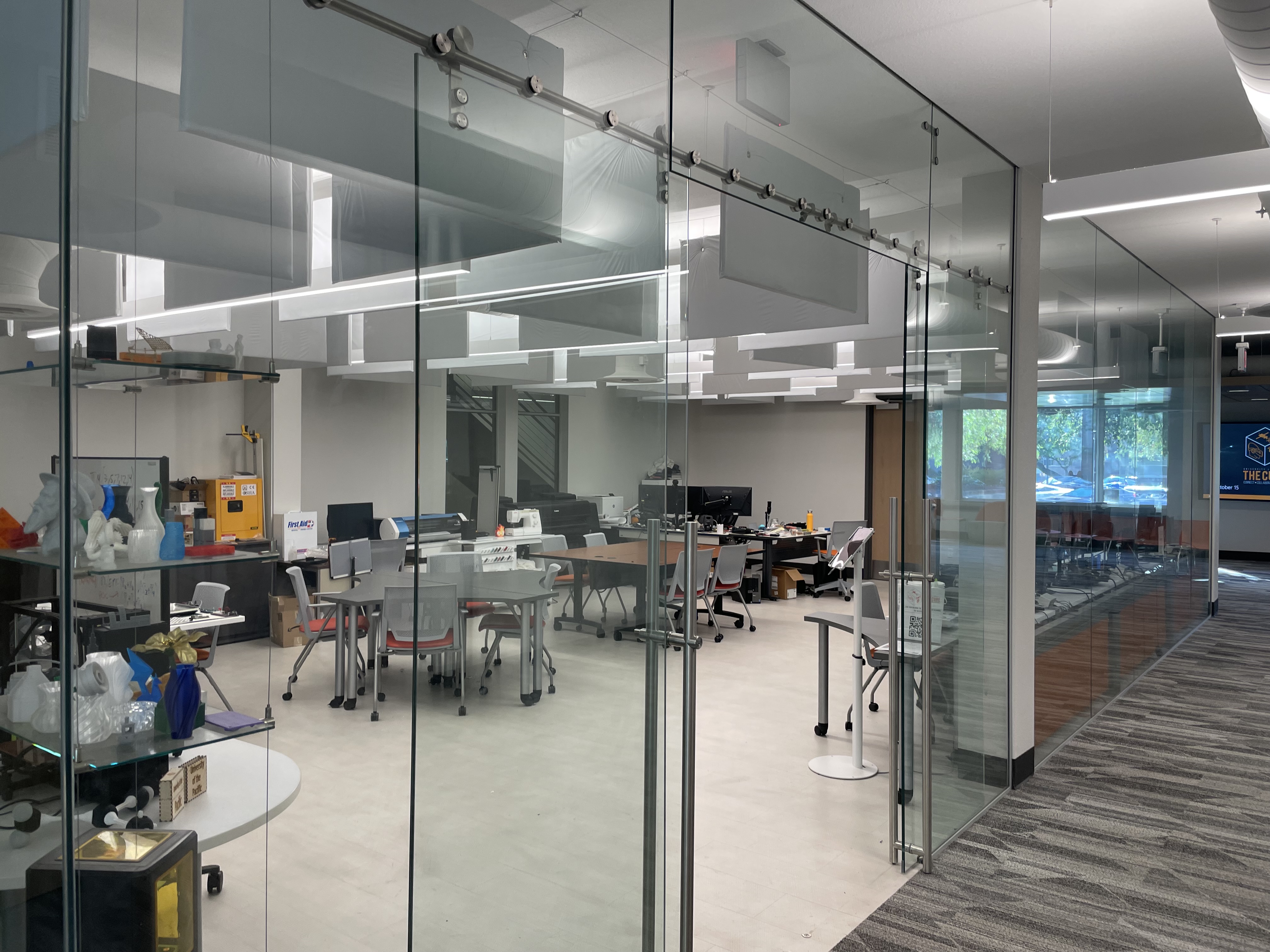
These concerns covered more than just the room dimensions – size, height, HVAC, glass walls, etc…. there were functional requirements for collaboration, classes, and workshops. The overwhelming acoustic problems involved the near constant noises generated by the vast array of equipment in this space – sewing machines, large format printers, plotting cutters, 3D printers, scanners, and every other modern tool for allowing the creative minds at their school to create. It was a cacophony of stepper motors, fans, and moving parts – which made collaboration very difficult.
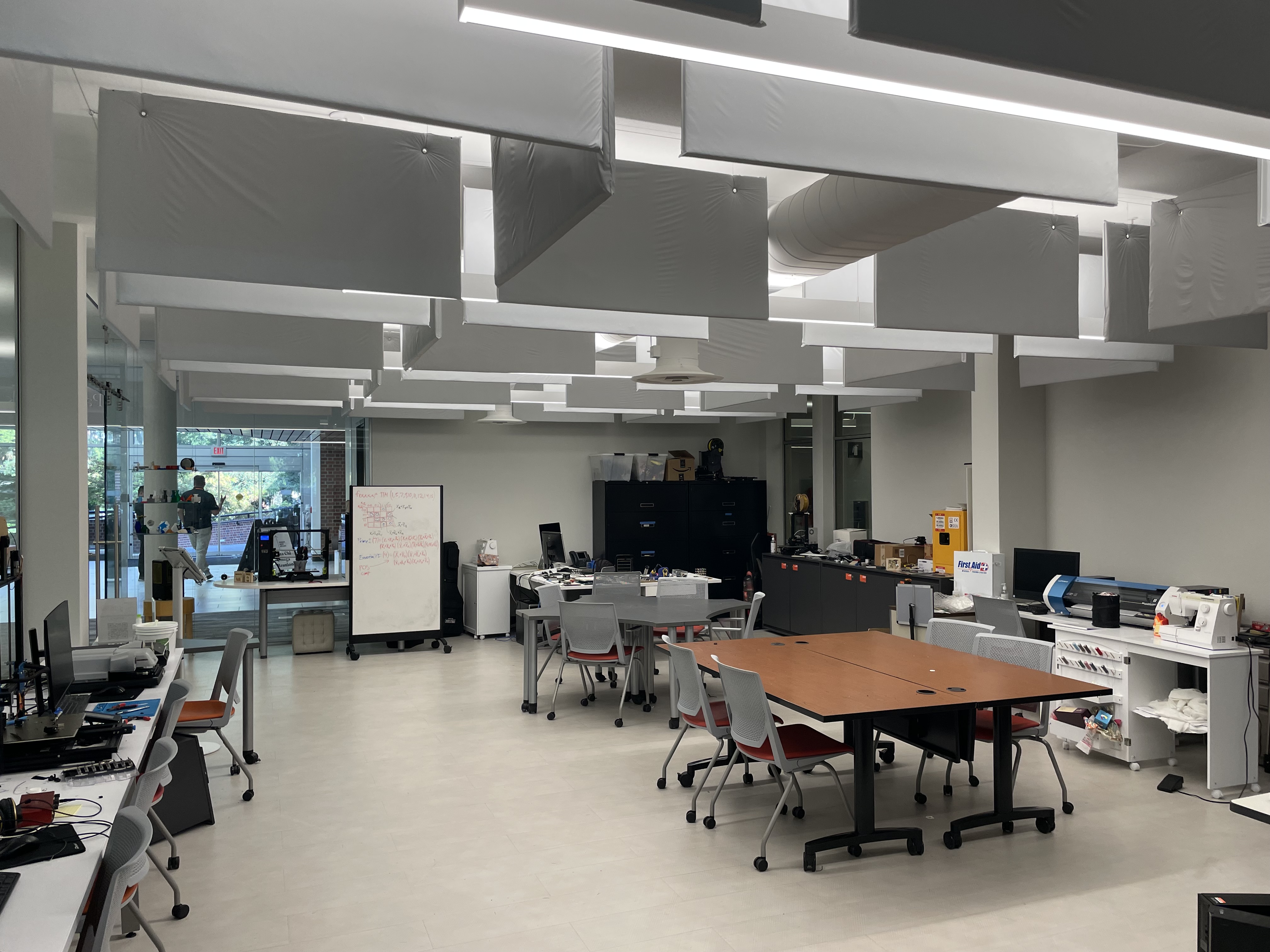
The other parameter that needed to be maintained was the ability to reconfigure the layout of the equipment without affecting the acoustic treatment in the space. This removed almost all of the walls in the space as possible locations for treatment. This left the ceiling as the only viable space left for treatment, but with an array of lights and exposed HVAC systems, there were few treatments that would be easy to implement and still be effective.

The decision was made to creatively weave Cloudscape® Baffles into all the spaces available in the ceiling. Dodging duct-work and suspended lighting rails was made possible with careful planning and execution – and the results were immediately notable. (Also noticeable was that the baffles had very little impact on the lighting which is vital in any makerspace.)
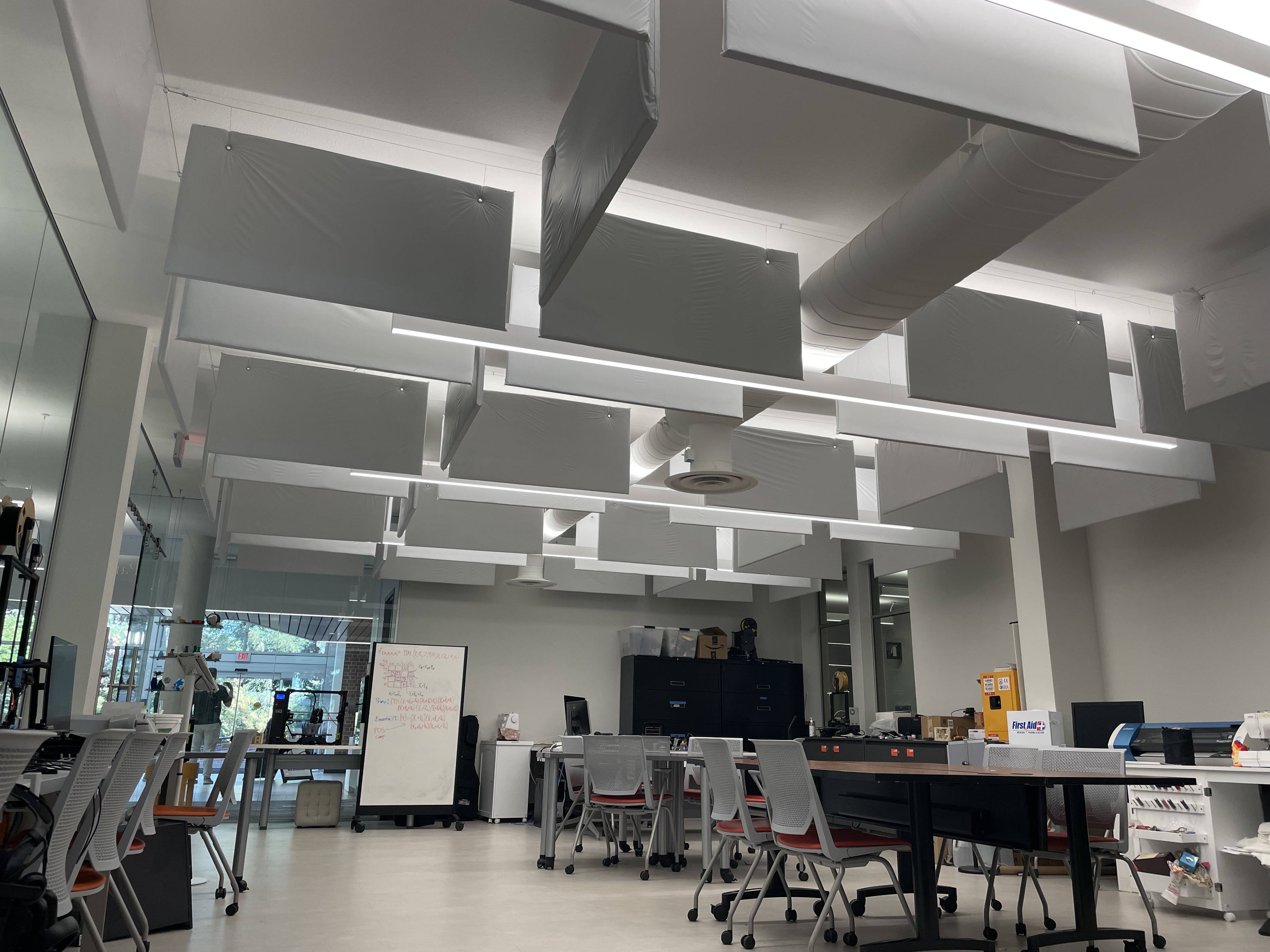
“…The sound baffles you recommended finally got installed in my makerspace about two weeks ago and I wanted to send a quick thank you since they’ve made a very noticeable acoustic difference to the room, and it’s a lot more pleasant in here now. “
Chris Crawford – Innovation Spaces Manager (University of the Pacific)
Case Study: Swim RVA! Competition Natatorium (POOL!)
Posted by Acoustics First in Absorption, Fitness, Gymnasium, Product Applications, Products, Uncategorized on May 12, 2021

Athletic facilities, including indoor pools, can often tolerate longer reverberation times when compared to other large spaces, like event halls and theaters. However, sound absorptive treatment is often needed to improve PA announcer intelligibility, reduce ambient noise levels and facilitate clear communication between coaches and participants.
Swim RVA enlisted the help of RTW Media and Acoustics First® to improve the listening conditions of their large Natatorium which contains an Olympic sized pool. The massive volume (approx. 800,000 cubic feet) and abundant hard surfaces contribute to excessive reverberation and noise buildup. Water is an extremely sound-reflective surface, akin to polished concrete; which exacerbates these issues.
To address these problems, over 200 4’x10’ Cloudscape® Banners were installed throughout the ceiling. Cloudscape® Banners provide the most “bang for the buck” in reducing excessive reverberation and noise buildup. When festooned, they provide additional low-frequency absorption, which is needed in these mostly concrete-block facilities.
In the end, the client was extremely satisfied with the end results, both acoustically and aesthetically!
Is your indoor athletics facility too noisy? Contact Acoustics First® today for a consultation!
 Acoustics First BLOG
You must be logged in to post a comment.