Posts Tagged acoustical materials
Why use a mix of objective and subjective goals to make a great sounding space?
Posted by Acoustics First in Articles, Media Room, Music Tracking Room, Recording Facilities, Recording Studio, Studio Control Room on July 30, 2024
With the ability to measure and analyze every detail of an acoustic environment, sometimes we forget about the basic fact that it should sound the way we want it to sound. There are scenarios where objective measurement is important, desired, and even required. If there is a physical safety concern that may damage hearing ( loud noises, machinery, etc.), a need to have safety information understood (evacuation/safety notices or alarms, etc.), absolute sound privacy is required (HIPAA regulations, government security, or legal need…), or the need for speech clarity for education… often we require some guidelines be met to insure the acoustics meet a decided standard for performance. These standards use objective measurement and data to make these determinations. There isn’t a governing body that regulates how your home theater should perform, or how an office needs to sound (beyond the safety and privacy concerns mentioned above.)

Entertainment venues, theaters, churches, commercial spaces, restaurants, offices, and residential spaces have very little regulation, and while there are many occasions that testing is used to improve the performance of these spaces, there are some environments where the effort to measure and quantify everything can get in the way of the goal of making a great acoustic space. If you wanted to compare different small “critical listening environments” (mixing and mastering studios are examples of these), there would be some general commonalities in their construction and treatment. Many are built to minimize parallel reflections, have short reverb times, symmetric placement of source speakers, control first reflections, and balance the frequency performance of the space.
A “ruler-flat” frequency response shouldn’t be the acoustic goal.
“Balancing the frequency performance of a space” doesn’t mean “attain ruler-flat frequency response across the entire human hearing range.” There are several reasons that the “ruler-flat” interpretation is counterproductive – the first being that it is nearly impossible to attain in any room. Second, is that everyone perceives sound differently. As humans age, almost all people will experience some degree of “presbycusis,” which is slow decline in high-frequency sensitivity that comes with age. If you are lucky enough to reach a ripe old age, there is a 60% – 80% chance (depending on the study you read) that your high-frequency hearing won’t be what it was when you were young. But even with that factor removed, when your hearing was at its best, your personal perception of sound is different from every other person – making sound, by definition, subjective.

The closest you can get to ruler-flat performance is to remove the room entirely and get some high quality headphones – but you may still find yourself tweaking the equalization curve to your preference. There are many people who feel that headphones sound unnatural, or that they are uncomfortable to listen to for long periods of time. Even the best mixing studios are not completely flat. Also, you will see many different sets of speakers in these spaces… or even headphones. These different sources are to compare how a mix will sound in different environments… and that the mix will “translate” in different listening scenarios. These environments which people will listen to music in vary to include outdoors, bathroom, kitchen, movie theater, grocery store, car, truck, SUV, convertible, living room, and more… coming from sources like phone speakers, headphones, assistants like echo and Google, bookshelf speakers, sound bars, audiophile equipment, movie theater sound systems, and an array of automotive audio systems.

Start with the basics.
If you are making a space for critical listening, there are some objective guides that will help you. If building from scratch, build with a geometry that will reduce room modes and parallel surfaces. Reduce reflections that will interfere with the source. Reduce reverb time. Control the bass response to reduce build up. These can all be readily calculated, measured, and controlled with bass traps, absorption, and diffusion. Most of the time, just following these objective guides will get you a room that will sound subjectively “good.”
After you get that far, you could continue trying to measure the room and tweak the performance to try and attain the unattainable ruler-flat response… or you could listen to music in your room and decide with you ears what should to be done to make it sound how you want. There are many subjective arguments people make about why they think something sounds better. There are philosophical arguments about listening to it “as the engineer/artist intended.” There are debates about if you should equalize music at all – even if you are in the majority of the aging population who may need to give the high-frequencies a nudge to experience the sizzle of Stevie Wonder’s glorious high-hat mastery.
When it comes to your own space… if it sounds good to you… it’s right. By following a few objective guidelines to get you in the arena, you can tweak the last bit with your ears until you are experiencing the material the way you prefer it to sound.
Sonora® Wave Clouds
Posted by Acoustics First in Absorption, Auditorium, Product Applications, Products on May 20, 2024
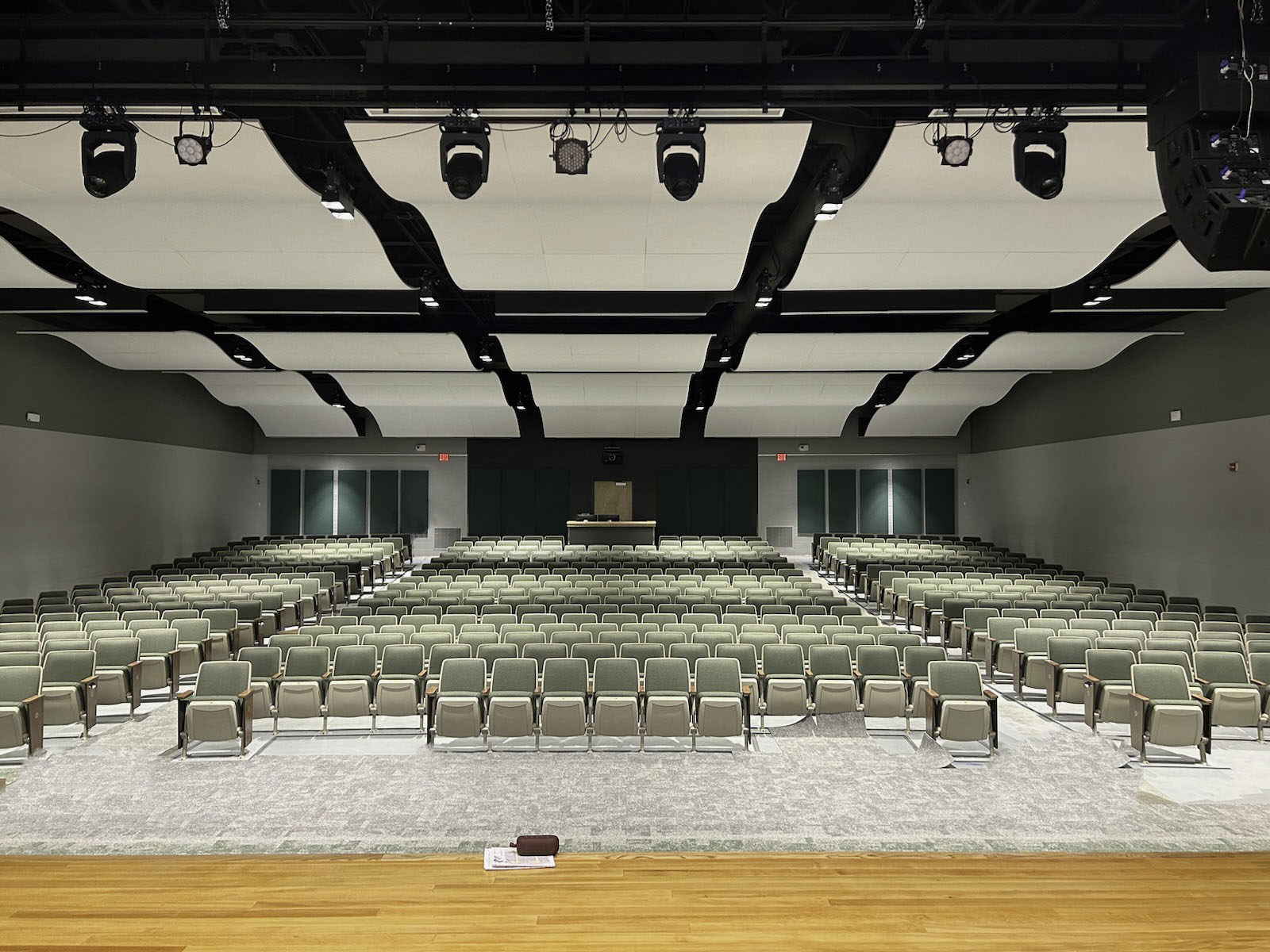
One of the more recent additions to our line of sound absorbing ceiling treatments is the Sonora Wave Cloud. This product can be an ideal choice for architects and specifiers who may be exploring options for large spaces which may require more expansive acoustic treatment while maintaining a certain design aesthetic. The curved shape of the Sonora® Wave Clouds allow for an impressive and unique look, while also providing optimal sound control. Sonora® Wave Clouds are available fabric wrapped or custom painted, with a 132″ radius bend in either a convex or concave profile. This allows for the creation of long waves – hence the name.

For this Job, Acoustics First® worked with Ferrari & Sons to provide the acoustic treatment for an auditorium in the Webutuck Central School District in Amenia, NY. As you can see, the end results turned out great!
Project: Beginning to End – Biltmore Park Clubhouse
Posted by Acoustics First in Absorption, Customer Feedback, HOW TO, Multipurpose Rooms, Product Applications, Products, Video on August 16, 2023
Occasionally, we get the opportunity to show the entire process that goes into a project, and today we have one which we will run through – beginning to end.
Biltmore Park clubhouse was getting a full aesthetic and acoustic makeover. Acoustics First® was asked to collaborate with Harmony Interiors on the acoustic panel recommendations for this project. After an initial consultation, a layout was developed that would attain the desired effect.
Along with this layout, a pre and post treatment acoustic performance was predicted and supplied.

After the treatment was approved and ordered, the panels were manufactured and supplied to the customer for install. This installation included several Sonora® panels for the ceiling, and others for the walls. After the customer received the order, Harmony Interiors began the installation.


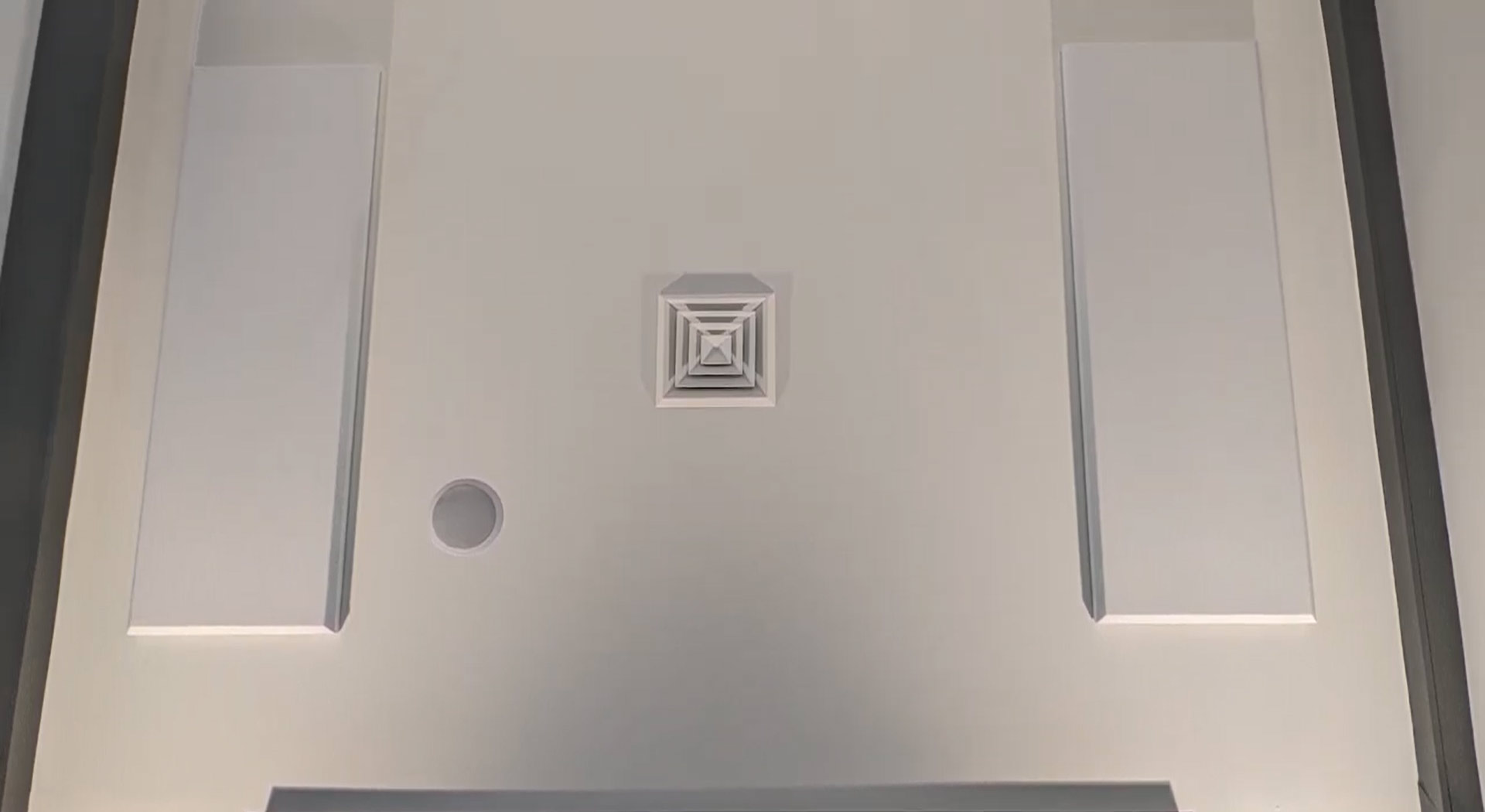


BONUS! This is often all the information we receive… along with some comments about how great the room sounds. But on this occasion, we were able to obtain a full before and after comparison of the effects of the treatment!
Video of the room – pre and post treatment!
The second benefit of getting this before-and-after comparison video is that we were able to critique our initial predictions of the pre- and post-treatment reverb times.
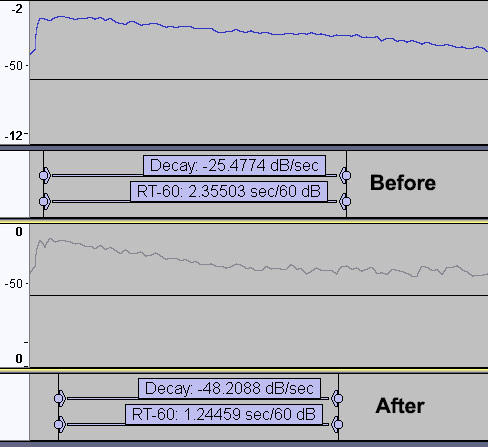
We hope you enjoyed seeing this acoustic project from the initial consultation and layout phase, through the installation, and to completion.
John Bullard Live Room – Tuning a Live Room for Classical Banjo
Posted by Acoustics First in Absorption, Customer Feedback, Diffusion, HOW TO, Music Tracking Room, Product Applications, Products, Recording Facilities on May 3, 2023
When you think of classical music; what instruments come to mind? Piano? Violin? Cello? …What about Banjo?
In the summer of 2022, classical banjoist John Bullard reached out to Acoustics First for assistance with his newly renovated home-studio. John is one of a select group of classical musicians aiming to showcase the versatility of this uniquely American instrument. The banjo, with John’s expertise, lends a very distinct, melancholy sound to contemporary and traditional compositions.
Having recorded a number of albums already, John knew he wanted his live room to be catered specifically to tracking solo, classical banjo as well as small acoustic ensembles. Acoustics First analyzed John’s live room and came up with a treatment design that would achieve an “ideal-as-possible” acoustic environment for recording classical instruments.
The largely reflective live room had walls comprised of unfinished, reclaimed wood planks over plywood, a drywall ceiling, stone fireplace and a polished concrete floor. The parallel, hard surfaces contributed to a poor tracking environment; with standing waves and “flutter” echoes adding unwanted coloration to recordings, inhibiting music definition.
Spaces used for rehearsing and recording classical music often benefit from elevated levels of reverberation, which add a sense of warmth and ambience to acoustic music. Although the reverb in John’s untreated room was only slightly excessive when measured, it was far from “diffuse”, with the majority of energy coming from early reflections.
The primary challenge in the live room was to address the early specular reflections and standing waves without taking too much “life” out of the room. To achieve this delicate balance, wide band diffusion was recommended as the primary ceiling and wall treatment with selective sound absorptive treatment with fabric-wrapped Sonora® panels.

Double Duty Diffusers™ and Aeolian® sound diffusers were recommended as they would also provide some much needed low-frequency absorption in addition to broadband diffusion.
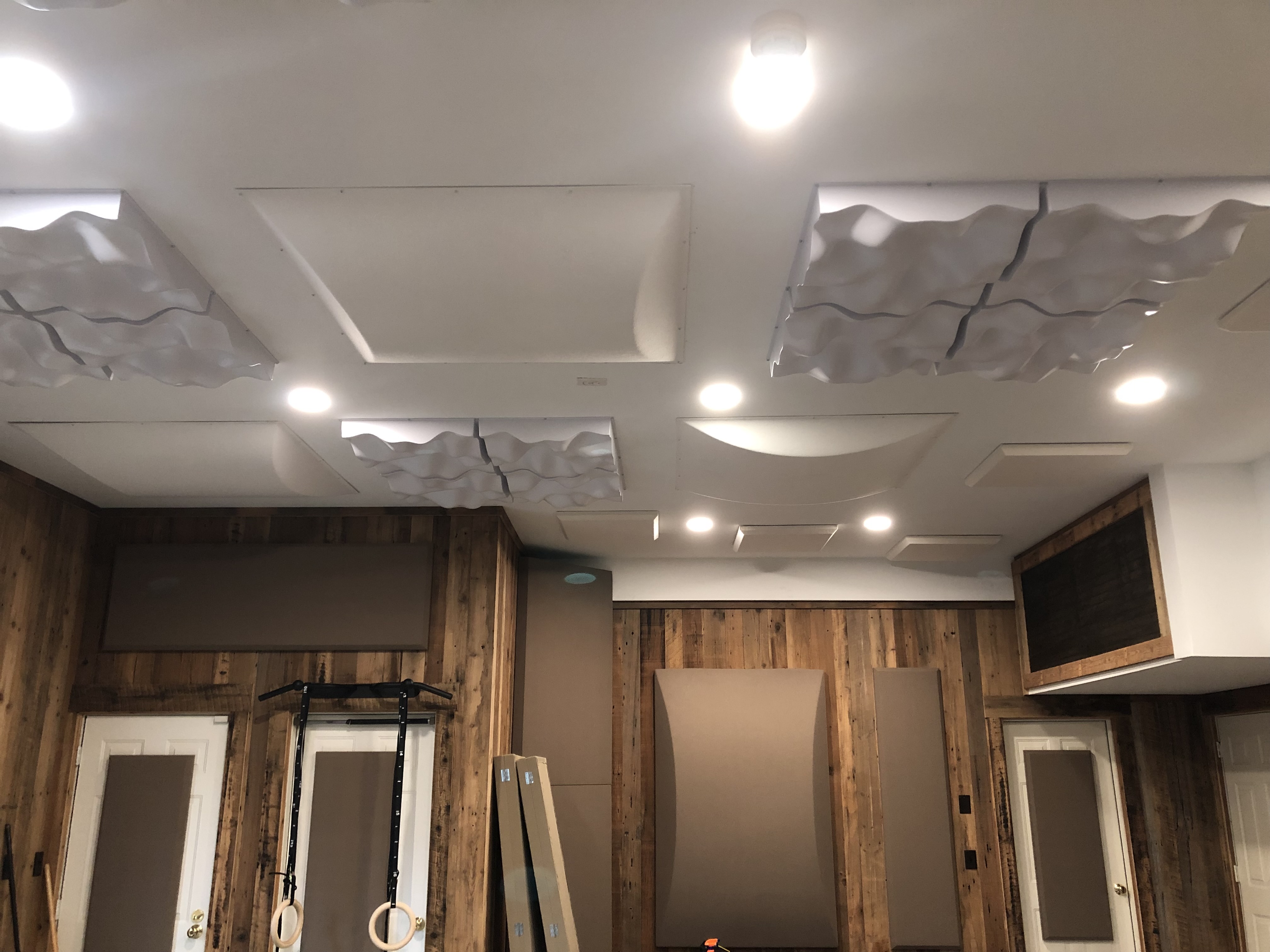
After the treatments were installed, John got right to work on experimenting…
“…ready to start doing extensive test recordings to locate the best spot and rug configuration for solo banjo… It sounds really good to my ear – now to see how the microphones hear it!”
John Bullard

Please check out John Bullard’s music!! – https://www.johnbullard.com/
Fabtec™ Panels: A Fully-wrapped option.
Posted by Acoustics First in Absorption, Product Applications, Products on March 7, 2023
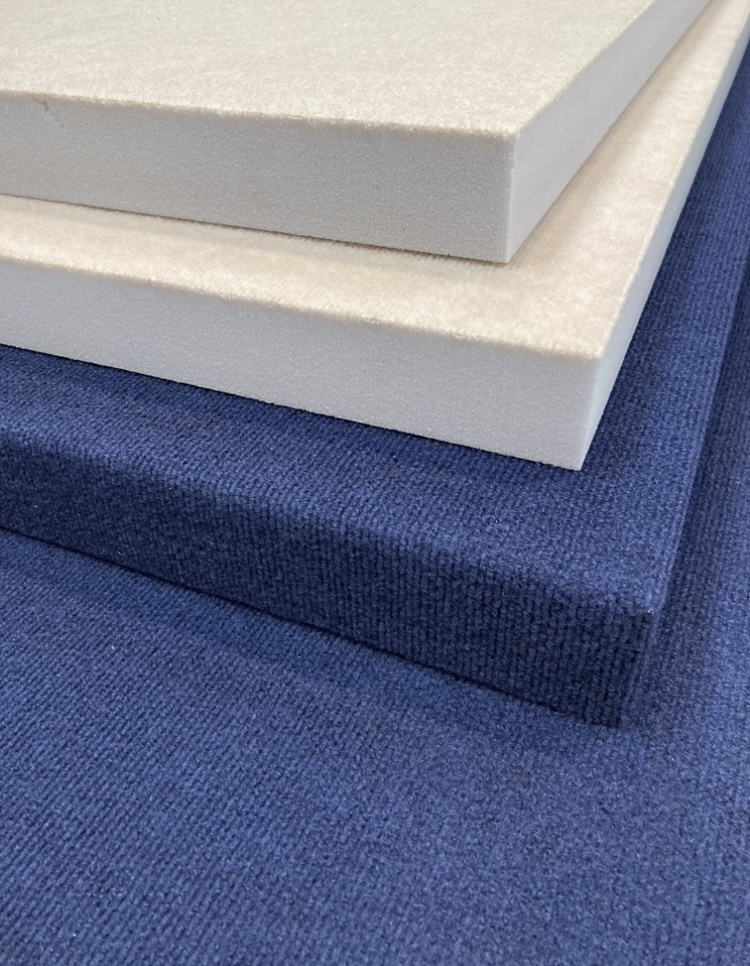
This month we thought we would post a of picture of the seldom seen FabTec™ with fully wrapped edges. Although more commonly produced with unwrapped edges to facilitate abutting panels for seamless installs, FabTec™ can also be produced with a fully wrapped edge, for a look and function very similar to our Sonora® wall panels.

These fully wrapped FabTec™ panels do exhibit a few unique qualities all their own:
1. They are extremely lightweight, roughly ¼ the weight of a standard Sonora® wall panel.
2. They flex. Unlike panels produced with the more commonly used rigid fiberglass boards, the FireFlex™ foam substrate of the FabTec™ panels can flex a bit. This can be particularly helpful when trying to install over a curved surface.
3. The combination of the spongy FireFlex™ substrate coupled with FabTec’s robust fabric covering make for a panel that’s actually pretty tough.
So, there you have it: a solid offering that straddles the line of acoustical foam products and architectural type panels, and encompasses some of the more desirable characteristics of both.
Reach out to Acoustics First® with any questions about which acoustic treatments would work best for your space!
 Acoustics First BLOG
You must be logged in to post a comment.