Throwback Thursday: Diffusion Vs. Absorption
Posted by Acoustics First in Absorption, Diffusion, Product Applications on May 22, 2025
On this Throwback Thursday, we look back at a popular Sound and Communications article about why sound diffusion is so much more complex a phenomenon than sound absorption. In this article, we discuss some of the different variables associated with the quantification of diffusion – magnitude, phase, frequency, direction, etc. When comparing its properties against absorption, which is simply the reduction of energy at specific frequencies, the argument is cemented as to why a single-parameter coefficient is insufficient to fully express the phenomenon of acoustic diffusion.
Read the article here:
PDF Version of Sound and Communications Article.

Revisit the original post here:
https://acousticsfirst.info/2020/03/24/acoustics-first-talks-diffusion-in-sound-communications/
Eat with your Eyes (and Ears): Acoustic Treatment for Restaurants
Posted by Acoustics First in Absorption, Products, Restaurants on March 21, 2025

When evaluating a restaurant, guests will often look at four factors: food quality, service, price point and atmosphere. The first three are fairly obvious in terms of how they influence the customers satisfaction, but the link between atmosphere and guest satisfaction is a bit murky.
Atmosphere is a sort of “catch-all” term for the various room and design elements that contribute to the overall experience of the patrons. “Atmosphere” is usually associated with visual elements, like lighting, table setting and decorations, but “atmosphere” can literally refer to the air in the room (is the restaurant properly ventilated, are there distracting smells from the kitchen?) or more functional/operating elements like the layout of the tables and, our focus in this article, sound management.
Sound Management – How many times have you been to a busy restaurant that is so loud you can’t hold a conversation with those at your table? It’s difficult to understand speech when background noise and reflections from other sources cover up new information. This causes patrons to elevate their voices to be heard, further exacerbating noise level issues.
Studies show that patrons spend more time and money at restaurants that properly address sound management, ensuring their guest don’t feel overwhelmed at peak hours. Key considerations include:
- Background music: Choose music that complements your restaurant’s concept. Adjust the playlist and volume based on the time of day and desired energy level—soft jazz for a relaxed dinner or upbeat tracks for a lively lunch.
- Comfortable conversation levels: Keep music and ambient noise at a volume that allows guests to speak without straining to hear each other. The right balance creates a welcoming buzz without becoming disruptive.
- Consider layout impacts: Open kitchens, high ceilings, or closely packed tables can amplify noise. Think about incorporating design features like partitions and high booths to help “break up” sound that is traveling from table to table.
- Acoustic design elements: Sound will build up most in spaces that have a lot of hard/reflective surfaces. Use sound-absorbing materials like acoustic panels to reduce reverberation/echoes and create a more intimate atmosphere.

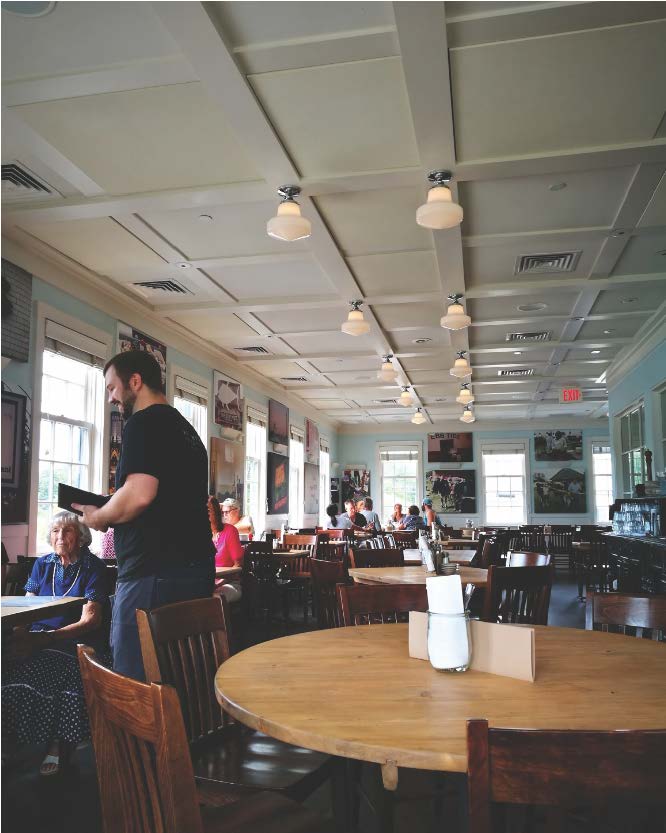
Tone Tile Panels – In restaurants, it’s especially important to minimize visually obtrusive acoustic treatment so it does detract or conflict with the carefully constructed aesthetic of the dining room. Tone Tiles are a perfect solution for restaurants that require “invisible” sound absorption as they can be field or factory painted to match the wall or ceiling color precisely. They also have a white, lightly textured surface that resembles drywall (Tone Tiles can be used as projector screens). Keep in mind, the more you paint an acoustic panel, the less sound reaches the absorptive substrate. We recommend light passes with water based paint to ensure the surface of the panel remains as acoustically “transparent” as possible
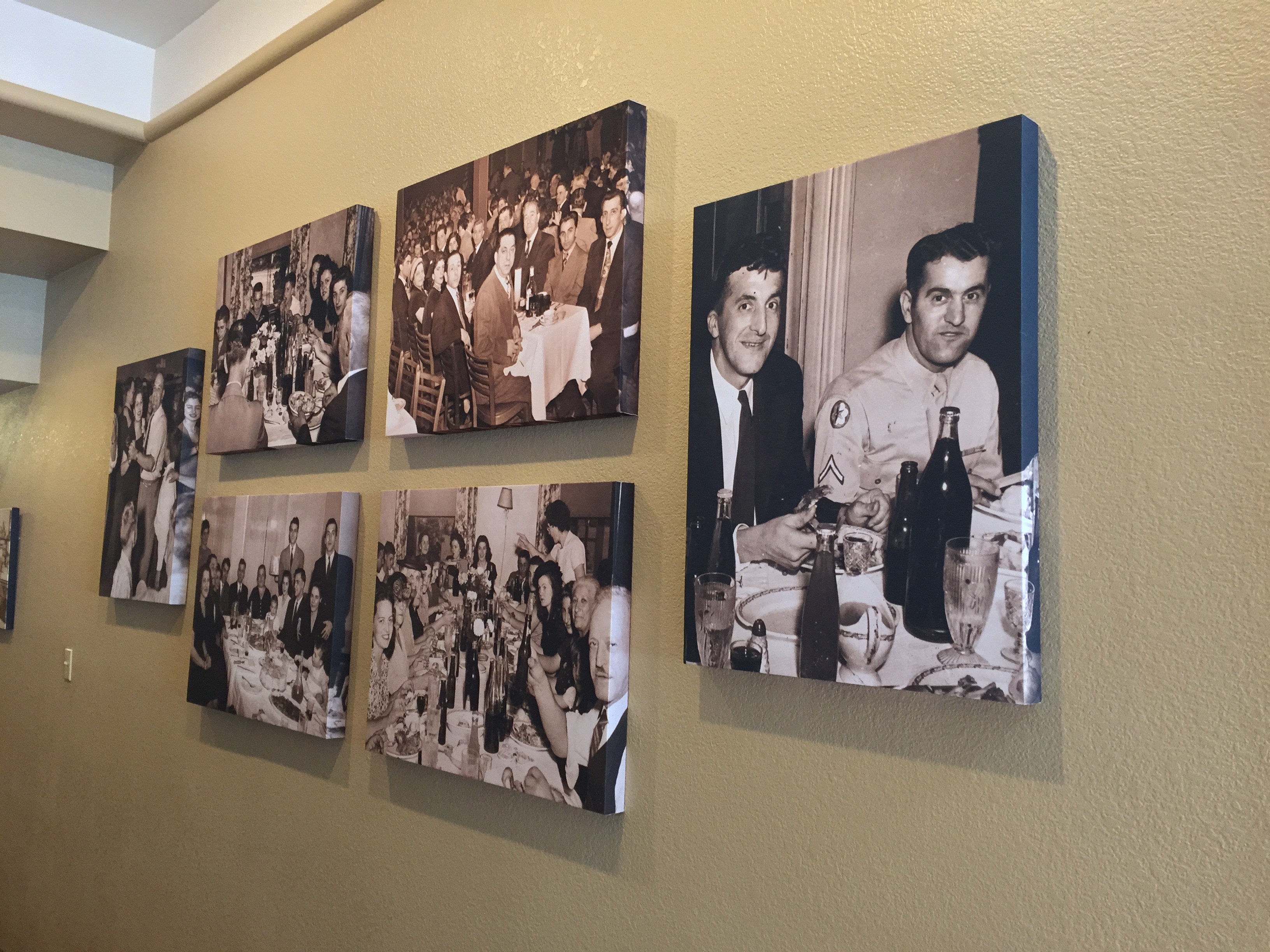
Silent Picture Panels – Another popular treatment option is our Silent Picture panels. Silent Picture panels can be wrapped with customer supplied artwork, images or branding. Restaurants love the double utility of full-color images and premium sound absorption.
Can’t I just put foam under the tables? We do not typically recommend acoustic material underneath restaurant tables. Treating the underside of tables will only “take the edge” off overall sound buildup, primarily attenuating sounds produced below the table (shuffling feet, chair slides, etc.). Sound absorptive treatment is much more effective when in the direct “line of sight” of primary sound sources. Also, installing acoustic foam or felt under tables, where it is likely to be picked at or possibly soiled, present durability and sanitary concerns.
We’ve all heard the expression that we “eat with our eyes”; if the meal is not appealing to look at… it is less pleasing to eat. However, we also “eat with our ears”; if the environment is not conducive to comfortable conversation, then the customer will leave with a bad taste in their mouth, even if the food quality and service is exceptional.
Throwback Thursday – Diffusion and Binaural Bob from 10 years ago!
Posted by Acoustics First in Diffusion, Offices, Product Applications, Products, Uncategorized, Video on February 27, 2025
In June of 2015, Acoustics First® posted about our experiment which allowed people to hear the effects of sound diffusers in a small space. The experiment consisted of treating a small office with varying numbers of our new (at the time) Art Diffusor® Model D sound diffusers, then providing various sonic stimuli and capturing and measuring the results with a custom binaural head (called “Binaural Bob.”) This experiment received great feedback and with that input, future experiments were conducted using a similar method, mixing absorbers and diffusers, and having a wider range of stimuli.

But here we look back to the first… This is the video we produced during that experiment way back in 2015 with Binaural Bob, a bunch of Model D’s, a small office, some balloons, bang snaps, and one very heavy book.
If you would like to revisit the original post in it’s entirety, here is the link!
https://acousticsfirst.info/2015/06/09/want-to-hear-acoustic-diffusion-audio-demo/
Acoustic Treatment in the 1920’s – A look at the Guardian Building
Posted by Acoustics First in Absorption, Offices, Uncategorized on January 14, 2025
The bank wanted the building be a “show-piece” and communicate its principles of “security” and “fidelity” (remember, this was at a time before the FDIC), to impress customers and convince them to store their valuables at their bank. Incredibly, the building was completed in just one year; construction began in 1928 and finished just before the Stock Market Crash of 1929 (so much for fidelity).
Head designer Wirt C. Rowland had far from a subdued vision for the building. Blending Native American, Aztec, and Arts & Crafts designs, Rowland wanted to make an indelible impression on anyone who walked in. He said “We no longer live in a leisurely age…the impression must be immediate, strong and complete. Color has this vital power.”
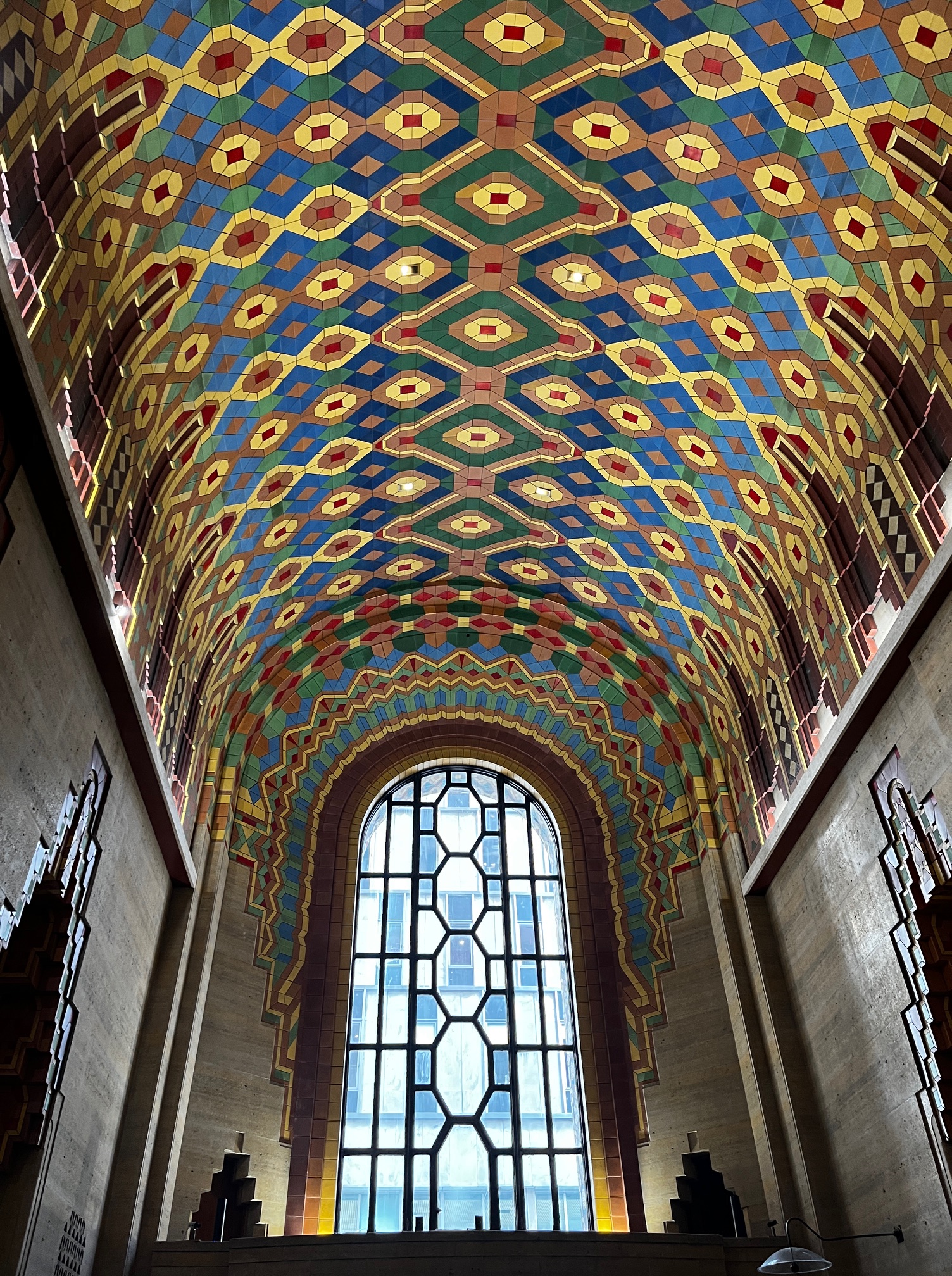
Colorful, luxury materials grace every surface of this building. Italian Travertine marble was used for steps and wall surfaces, contrasting with deep-red Numidian marble imported from Africa. Brilliantly colored tiles fill the lobby’s vaulted ceiling, and a massive multi-colored mosaic adorns the vestibule wall. Monel metal was used in the large ornamental gate dividing the banking hall and main lobby, supporting a pair of Tiffany & Co. Glass clocks. Even the office corridors and restrooms are lined in a Tavernelle marble from Tennessee.
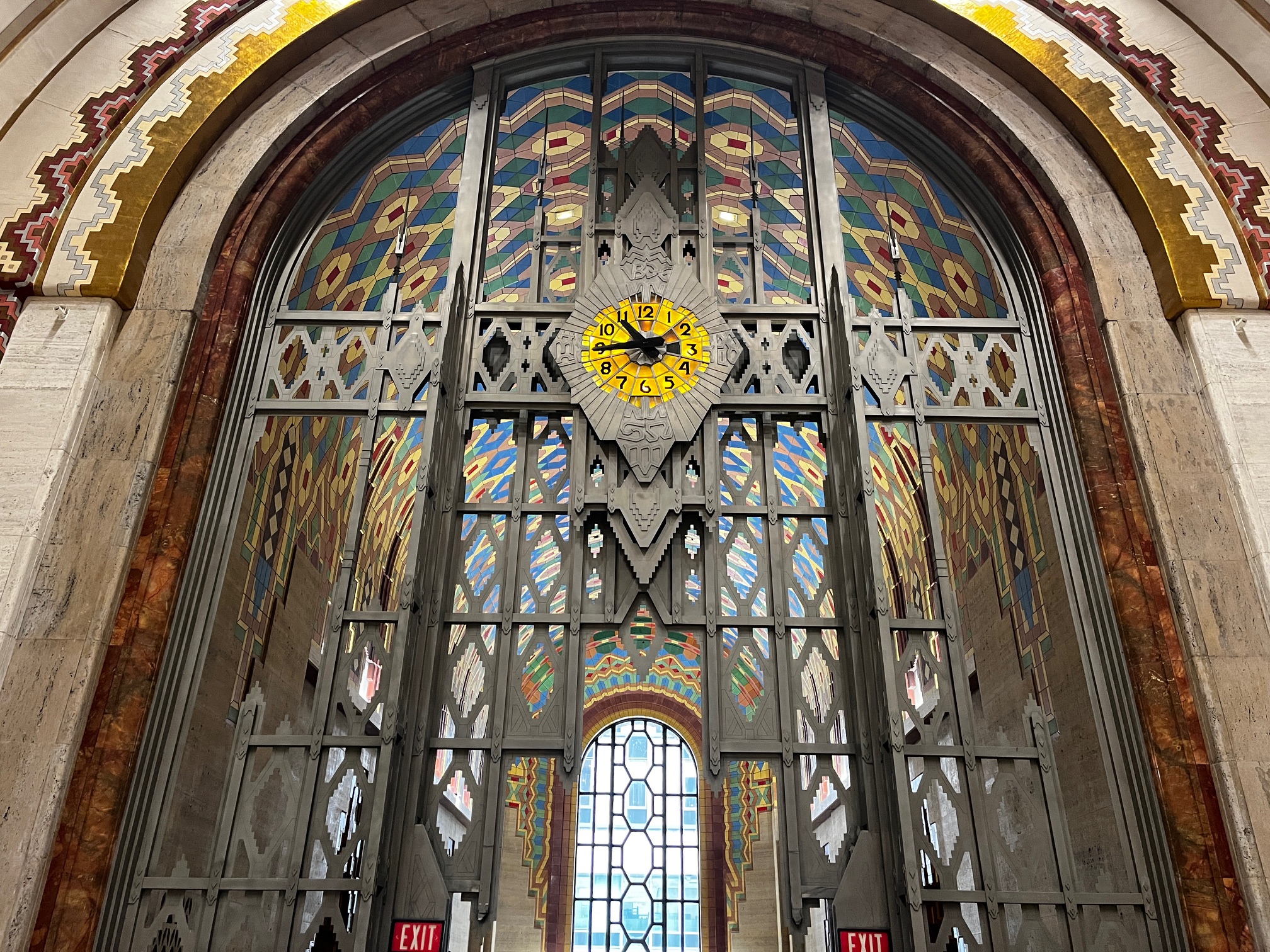
Obviously, these beautiful materials are also extremely sound reflective. Having worked on similar buildings, Rowland understood the need for acoustic treatment in the banking hall as there would be hundreds of customers, tellers and their managers trying to conduct important business in this large, cathedral-like space. If they used the same ceramic tiles they used on the ceiling of the lobby, conversations would be drowned out by a cacophony of typewriters. In lieu of the tiles, the banking hall has an incredibly appointed, intricate system of stretched canvas over wood frames backed with sound-absorbing horse hair. The canvas was hand painted with real gold and silver and requires regular maintenance. In fact, the same Italian family that made the ceiling nearly 100 years ago has been caring for it ever since!

I recently had the pleasure of touring the Guardian building, and walking through the Monel gate from the lobby to the banking hall, you can hear the difference. Though the banking hall is much larger, it feels much more intimate and comfortable, in large part because of the ceiling. Although the horse hair and canvas materials may not meet fire code today, modern stretched-fabric acoustic assemblies owe a lot to this sort of early innovation.

The Guardian Building is a symbol of creativity and achievement. Designed for the future, it is no surprise that Rowland’s masterpiece still dazzles and inspires visitors to this day.
For more information on the Guardian Building’s long history, visit https://www.guardianbuilding.com/history
Similar, yet different: HiPer Panel® vs. HiPer Panel® Impact
Posted by Acoustics First in Absorption, Diffusion, Product Applications, Products on December 11, 2024
While the HiPer Panel® and the HiPer Panel® Impact may appear to be identical on the surface, there are some key differences that may change which one you would use, and why you would use it. They are both layered, flat-panel diffuser products, with perforations, and they are both covered in fabric. However, their construction, below the surface, is drastically different. One is a broadband absorber with a modified frequency response which focuses on reduction of specular energy, and cancellation of noise – where the other is a high frequency diffuser and reflector with a tuned bass absorption which is constructed to maintain acoustic energy in the space.

Construction
The HiPer Panel® was originally designed to optimize the capabilities of a standard broadband absorber. Its internal membrane and perforations create a material that works to modify the range of absorption, and create high frequency diffraction… but that isn’t all. The cavities are backed up to the membrane, which changes the reflection characteristics, where high frequencies can be reflected, and higher energy waves are absorbed more than if it was just fiberglass. This extended range is random, as the perforation density is gaussian in nature, but the membrane is also randomly backed by more cavities.
This design creates 4 different physical conditions that acoustic energy has to contend with… in a gaussian distribution.
- areas of the panel with 2 layers of fiberglass and a membrane in the middle.
- one layer of fiberglass with a rear membrane over a cavity.
- a cavity with a membrane back… sitting on fiberglass.
- a cavity with a membrane back… stretched over another cavity.
The random distribution of multiple acoustic obstacles is what gives this device its unique characteristics. It’s an absorber that changes its performance depending on where sound hits it, and at which frequency. Some frequencies pass into the cavities and reflect off the membrane, while others are dampened by the membrane… while longer wavelengths see the membrane as a stretched diaphragm or limp mass.
The HiPer Panel® Impact has a very different construction and may be used for a very different reason. The HiPer Panel® Impact uses the same pattern of holes, but the holes aren’t cut into an absorber… they are cut out of a reflective face, which is attached to an absober. Unlike the first HiPer Panel®, the “Impact” can be used to maintain more of the energy in the space, break up some of the higher frequencies with that gaussian hole pattern, and be a low frequency bass trap. The design is simple and effective, but is not necessarily used in the same places where you would use the first HiPer Panel®.
Use cases.
The first Hiper Panel® is often used in theaters, and listening spaces where focusing on the source is of primary importance. Its broadband absorption, gentle high frequency diffusion, and smooth mid frequency control are ideal for critical listening environments such as mixing rooms, media rooms, theaters, or even voice over spaces. The performance is about removing the acoustic elements that could interfere with the focus on the source speakers.
The HiPer Panel® Impact is often used in performance spaces, where you want to maintain energy, break up high frequency flutter, and remove low bass. The reflective face doesn’t remove as much energy from the space, however it does change the characteristics of the space. This helps break up some frequencies, reduce bass, and keep the energy moving around the room. Music halls, churches, auditoriums, and any space that relies on the room helping to reinforce the sound will benefit from these taking the edge off the highs and dampening the lows – which is how the HiPer Panel® Impact controls the sound… while helping it maintain its “impact.”
In summary, while these two products are in the same family, they have a different core construction, which changes their performance. There are scenarios where you may use them both, however since they address different problems in a space, they are not always interchangeable. Contact Acoustics First® if you have questions about any of our products.
 Acoustics First BLOG
You must be logged in to post a comment.