Archive for category Products
Sonora® Corner Bass Trap – Low Frequency Control
Posted by Acoustics First in Absorption, Product Applications, Products, Uncategorized on April 21, 2020

Sometimes a simple solution is the best solution. That is the guiding philosophy behind our new Sonora® Corner Bass Trap. Take one 4” thick, 6-7pcf sound absorbing fiberglass panel, back bevel to fit in a corner, front bevel for a nice finished look, throw in a few corner clips for mounting, and done!
The Sonora® Corner Bass Trap was born.
This bass trap lives up to the design aesthetic and functionality of the Geometrix® Quarter Round unit, but at a lower price point with reduced weight for an easy installation. Available in widths of 24” or 18”, standard length is 4’ with custom lengths available.
The Sonora® Corner Bass Trap is a great option for studios, theaters, or any critical listening environment where broadband absorption with enhanced low frequency control is desired.

Bevelled front & rear for a clean, finished look when installed.
Custom Sonora® Ceiling Clouds in NY!
Posted by Acoustics First in Absorption, Offices, Product Applications, Products on December 23, 2019
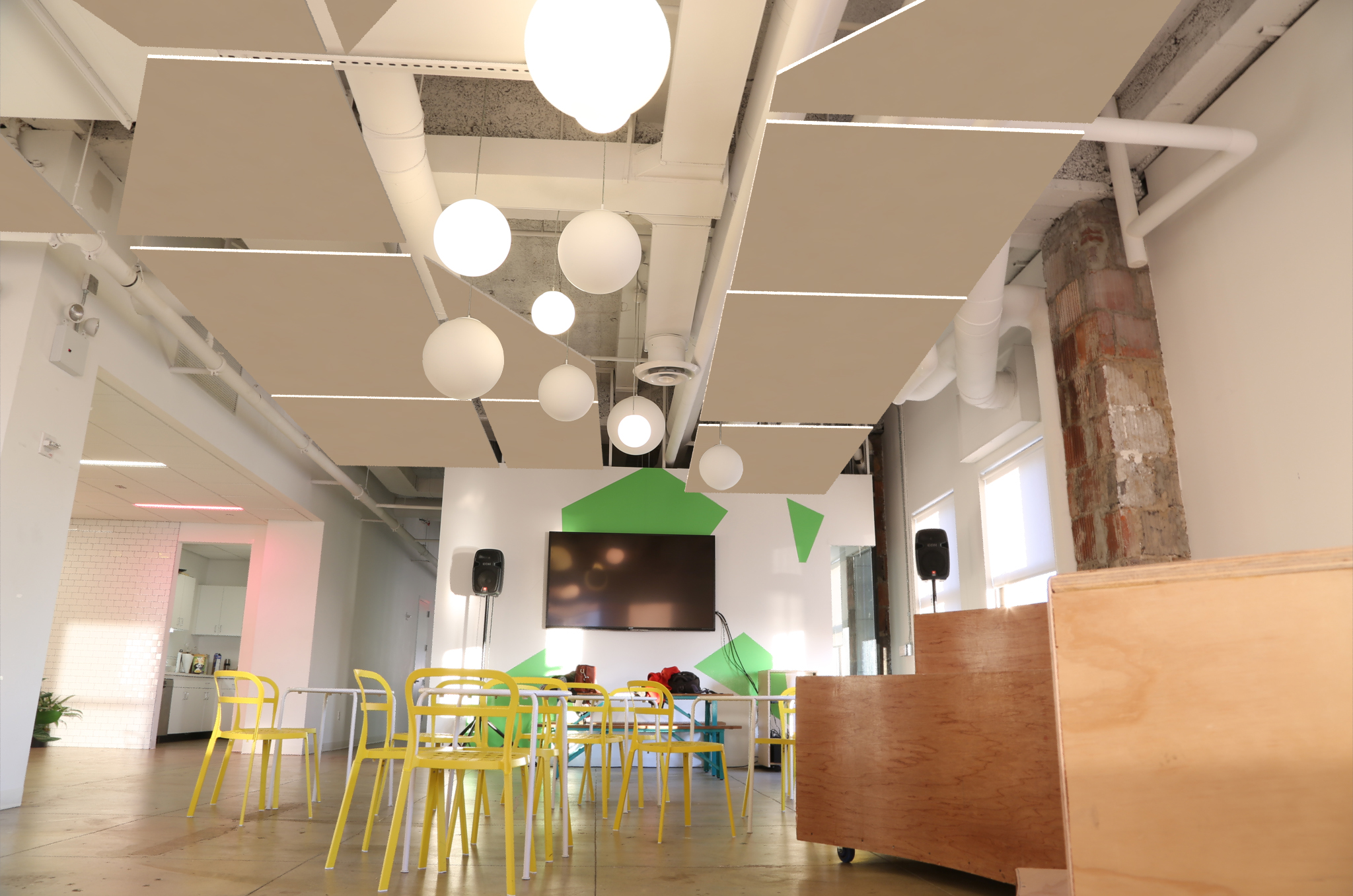
Custom Sonora® Ceiling Clouds
Here are a few new pics, courtesy of one of our longtime associates in New York. For this facility, they installed several arrays of our Sonora Ceiling Clouds, some of them in custom trapezoidal shapes! Sonora Ceiling clouds are often a great option in facilities with high ceilings, but limited wall space.


WKNC 88.1 completes renovation with Sonora® – and then does another!
Posted by Acoustics First in Absorption, Broadcast Facilities, Customer Feedback, Product Applications, Products, School & Educational Facilities, Uncategorized, Universities on September 25, 2019

Sonora® Panels complete the HD-2 studio renovation. (Photo- J. Gilbert)
Renovating a broadcast studio is a daunting task – technically, financially, and logistically. Amidst the chaos, it is possible for certain things to fall through the cracks – even important things. As the student run station at NC State University began their renovation, they were focused on doing it right, and not letting important elements go unaddressed.
When Jamie Lynn Gilbert, the Associate Director of Student Media and Adviser to WKNC 88.1, contacted Acoustics First they were finishing up an extensive renovation of the HD-2 studio and were looking for some Sonora® Acoustic Panels as the “final touch.” The end result was the frosting on the cake of this renovation, and the impact, both acoustically and aesthetically, was quite evident – even to their consulting engineer on the project.

Sonora® panels in WKNC HD-2 studio – reverse angle (Photo – J. Gilbert)
So evident, in fact, that just a month later, Jamie was back in contact with Acoustics First® to get nearly identical treatment for their production studio as they completed its renovation as well…
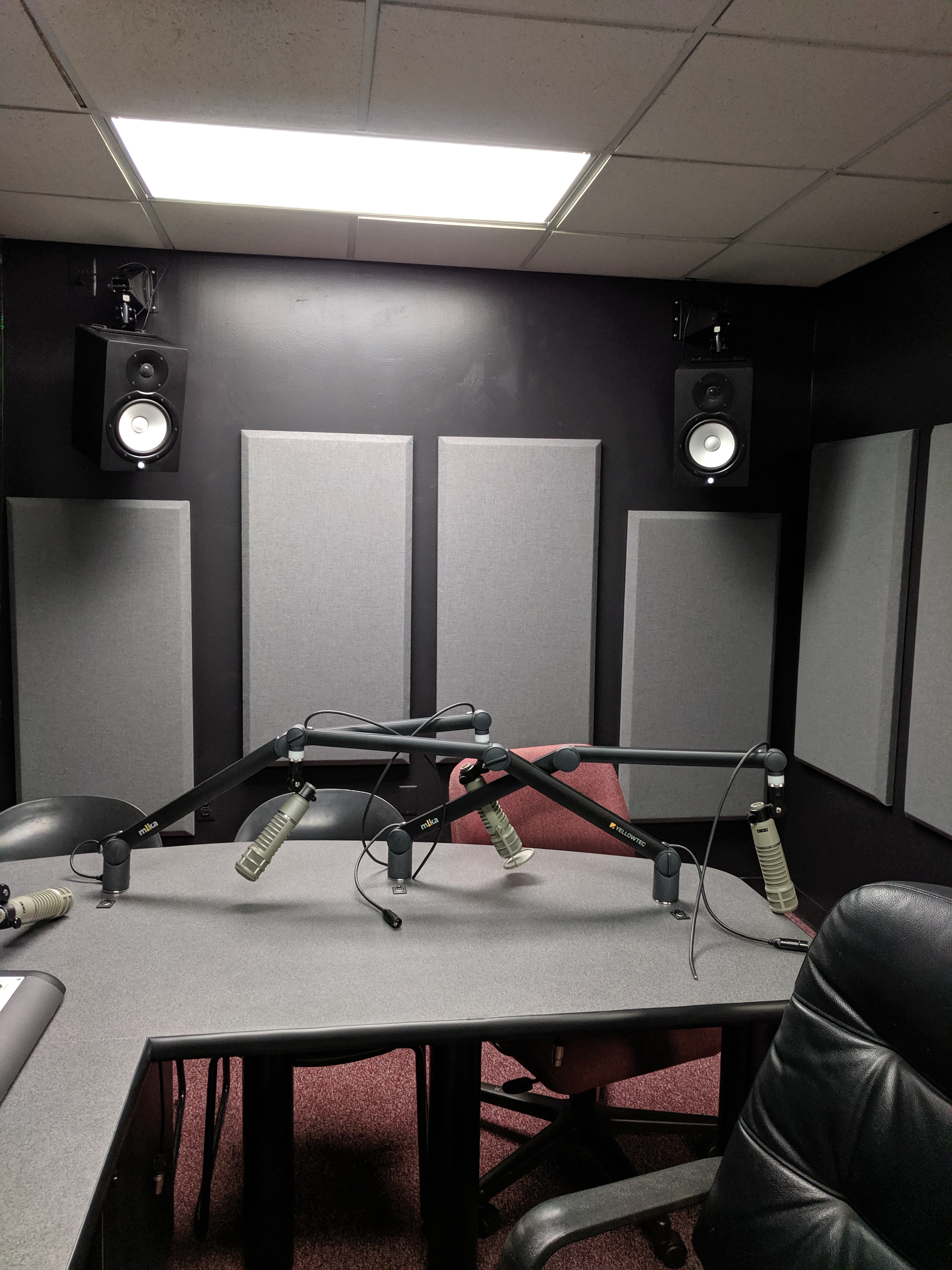
Nearly identical Sonora® Panel treatment for the production studio. (Photo – J.Gilbert)
Sonora® Ceiling Baffle vs. Sonora® Ceiling Cloud
Posted by Acoustics First in Absorption, Product Applications, Products, Uncategorized on August 23, 2019
There are many situations in which it is valuable to use ceiling treatments to control sound in a space, and after ceiling tiles, two other popular options are either Sonora® ceiling clouds or Sonora® ceiling baffles. What is the difference between these two, and when is it desirable to use one over the other?
It may help if we first define the physical characteristics of the two treatments. The similarities are in materials, and the differences are in implementation. Both are fiberglass core substrates covered in an acoustically transparent fabric; however, a baffle is completely wrapped in the fabric, while the ceiling cloud is often left uncovered on the back – to assist with mounting.
The main difference between the Sonora® baffle and the Sonora® ceiling cloud is the hanging orientation. A baffle is hung from its edge in a vertical orientation, while the cloud is hung horizontally, often parallel to the ceiling. The major benefit of both of these products is that neither is directly mounted to the surface, allowing all of the surfaces of the absorptive material to be exposed to sound – this makes them extremely effective at mediating airborne sound.
If they are both so similar, why do some situations benefit from one over the other?
Due to the horizontal orientation of the cloud, they are great at removing hard reflections off of the ceiling – say over a mixing position, in a listening room, or between the ceiling and a large conference table. They can be used to make a false ceiling by hanging them below a high ceiling – creating some intimacy in the space, both aesthetically and acoustically. By leaving space between the clouds, sound can travel up and around them, losing energy as it travels up to the hard ceiling, bounces off, and passes back through the absorbent substrate. This makes them very effective at deadening the hard first reflections and helping to reduce reverb times by removing the energy early. They require some skill in hanging, as they have multiple mounting points on the rear, and can be difficult to level – but the aesthetics are worth the extra effort.

Sonora® Ceiling Clouds – Note the horizontal Orientation.
The ceiling baffles hang vertically, which generally changes their implementation. First, they require higher ceilings, but this also means that they are very effective in larger spaces, because they hang down lower. Also, hanging a large array of baffles is a quick and easy process, with many only having 2 mounting points. They are great for controlling reverb in large spaces where sound could be coming from many different locations in the room – like a gymnasium, multi-purpose space, or cafeteria. Due to their vertical orientation, it is not likely that objects (volleyballs, basketballs, kickballs, etc.) will get stuck on top of them, which is more plausible with the clouds. Sonora® Baffles lower the reverb time by addressing the sound pressures up in the ceiling area, and create labyrinth for sound to run through. A large grid of baffles will increase speech intelligibility substantially in larger spaces by trapping the sound that usually bounces around in the rafters – an ideal use for the humble baffle.

Sonora® Ceiling Baffles – Note the Vertical Orientation.
So, those are some of the similarities and differences between the Sonora® ceiling baffle and the Sonora® ceiling cloud, and while they are very similar in their construction, they do have different scenarios where their strengths shine.
If you have questions about which treatments would work best in your space, contact us today for a free assessment and consultation.
A “Stand off” (clip) is a good thing.
Posted by Acoustics First in Absorption, Product Applications, Products, Uncategorized on July 19, 2019
When people order acoustic panels, whether it be Sonora Panels®, Tone Tiles®, or Silent Pictures®, the mounting method is sometimes overlooked.
“A panel mounted to the wall is a panel mounted to the wall… right?”
This isn’t entirely accurate, and we are going to focus this installment on the often misunderstood Stand off clip.

2″ Stand off Clips
What makes the Stand off clip different is that it doesn’t hold the panel flush to the wall, but it leaves a gap between the wall and the panel.
Why would you want this?
There are a few very important reasons, both acoustic and aesthetic.
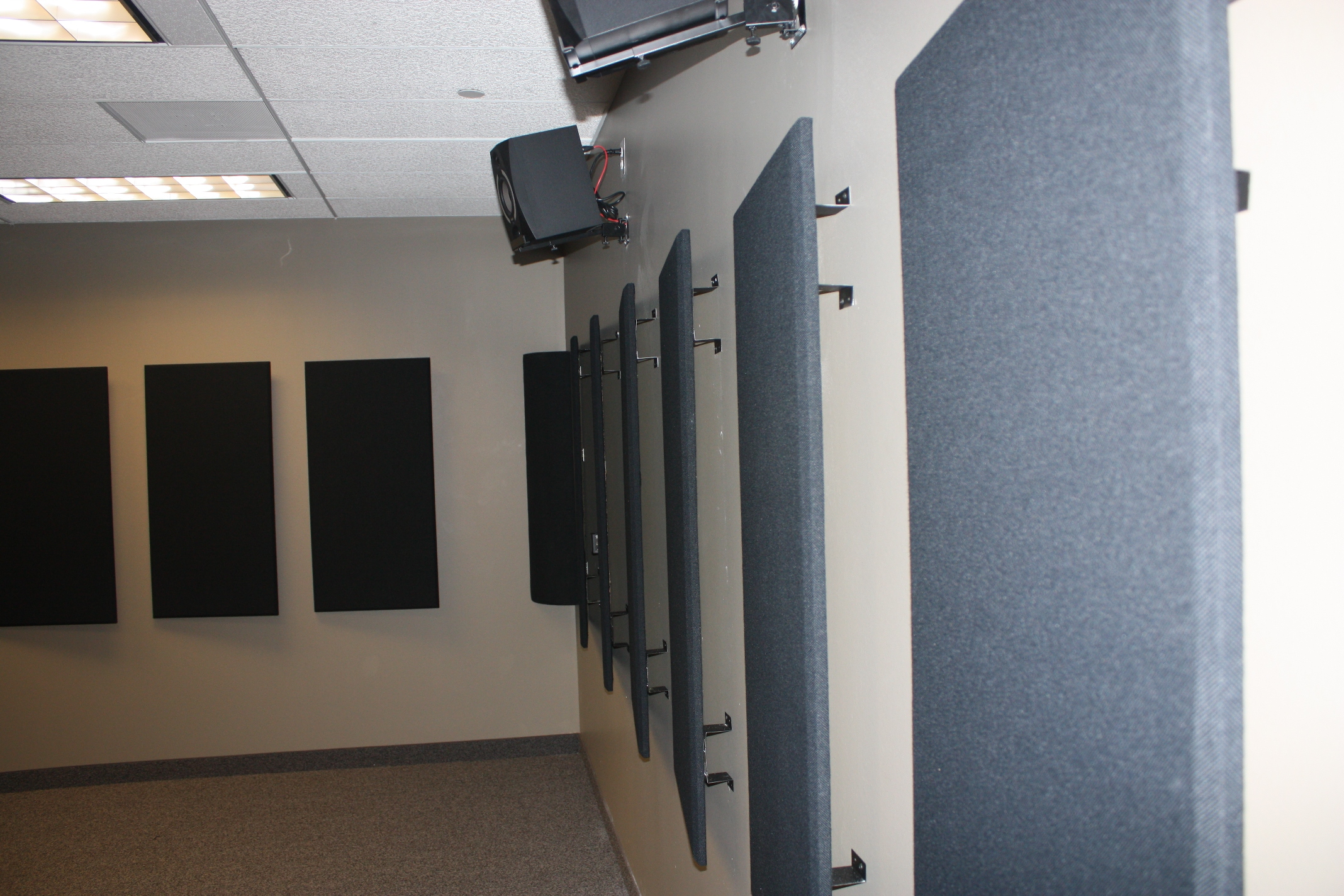
Sonora® Panels with 2″ Stand off clips.
Acoustically.
Sound travels around all exposed surfaces, and by raising the panel off the wall, you expose the back surface to sound, more like a baffle, which is a great absorber. Also, sound will pass through a panel into the space behind, bounce off the wall, and then have to pass through the panel again. This transition from panel to air and back changes the medium sound must travel through – this effectively changes impedance, which strips energy from sound. These are just a couple of the acoustic benefits of using a standoff clip – there are others.

Tone Tiles® and Silent Pictures® can be mounted with Stand off Clips.

Sonora® Panel back-lit on Stand off Clips
Aesthetically.
Wall mounted Sonora® panels take on a whole new dimension when using Stand off clips – they appear to float in mid air a couple of inches off the wall. This alone adds visual interest to a standard panel, but it can then be further accented by back-lighting the panel – changing the simple panel into a focal point in the lighting scheme.
Stand off clips can also be used with Tone Tiles® or Silent Pictures® – allowing your artwork to literally jump off the wall and float in the space in front of it.
So, a stand off is a good thing, with Sonora® Panels, Tone Tiles® and Silent Pictures® – acoustically and aesthetically.
 Acoustics First BLOG
You must be logged in to post a comment.