Archive for category Product Applications
Case Study: Swim RVA! Competition Natatorium (POOL!)
Posted by Acoustics First in Absorption, Fitness, Gymnasium, Product Applications, Products, Uncategorized on May 12, 2021

Athletic facilities, including indoor pools, can often tolerate longer reverberation times when compared to other large spaces, like event halls and theaters. However, sound absorptive treatment is often needed to improve PA announcer intelligibility, reduce ambient noise levels and facilitate clear communication between coaches and participants.
Swim RVA enlisted the help of RTW Media and Acoustics First® to improve the listening conditions of their large Natatorium which contains an Olympic sized pool. The massive volume (approx. 800,000 cubic feet) and abundant hard surfaces contribute to excessive reverberation and noise buildup. Water is an extremely sound-reflective surface, akin to polished concrete; which exacerbates these issues.
To address these problems, over 200 4’x10’ Cloudscape® Banners were installed throughout the ceiling. Cloudscape® Banners provide the most “bang for the buck” in reducing excessive reverberation and noise buildup. When festooned, they provide additional low-frequency absorption, which is needed in these mostly concrete-block facilities.
In the end, the client was extremely satisfied with the end results, both acoustically and aesthetically!
Is your indoor athletics facility too noisy? Contact Acoustics First® today for a consultation!
The HiPer® Panel and Ken Fritz’s Dream
Posted by Acoustics First in Absorption, Diffusion, DIY, Home Entertainment, Home Theater, Media Room, Mentions, Press Release, Products on April 13, 2021

There are many home theaters of note, but rarely is one created (at this scale) by the singular dream and dedication of one man. Ken Fritz involved Acoustics First® early in the project to perform acoustic measurements of the space, and his theater became the first large-scale installation of our newly developed HiPer® Panel. From beginning to end, Ken says that he spent more than 25 years on the realization of his dream – and others have taken notice.

There have been numerous write-ups of Ken’s theater, which was constructed (from the ground up) specifically for this purpose. The walls are hurricane grade block construction, the roof-line is constructed to improve the acoustics, the walls are clad in HiPer® Panels, the bass emanates effortlessly from in-wall enclosures – and just look at those custom built arrays that Ken designed and constructed by hand! This project is more than just a labor of love, it is an obsession with excellence.

This obsession covers every aspect of the room and the system, with everything being either built by hand, customized to his specifications, or simply the best you can get! If there is a “home theater mountain,” Ken built a skyscraper at the summit – but don’t take our word for it…
You can watch the one-hour documentary telling the story behind the dream – in Ken’s own words.
Quick Case Study: The Bank of NH Stage.
Posted by Acoustics First in Absorption, Multipurpose Rooms, Product Applications, Products, Theater on March 12, 2021
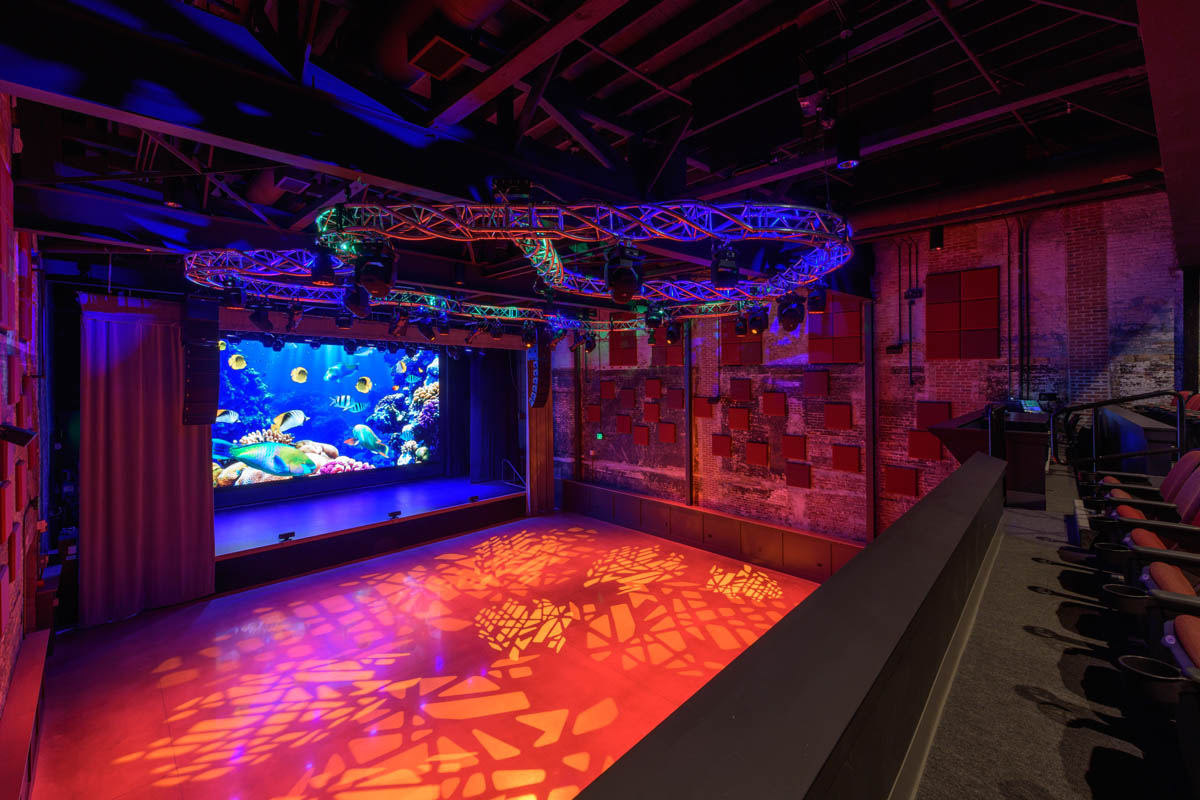
The Bank of New Hampshire Stage is multipurpose venue that hosts live performances, corporate events, movies as well as weddings. The venue’s designers aimed for an acoustical environment that achieves a balanced and intimate atmosphere for their audience and performers.

The multipurpose space is convertible with different seating configurations for different types of events.
Sonora® Wall Panels and Sonora® Baffles were used to control specular reflections (echoes) and reduce overall reverberation down to a suitable level for the wide variety of BONH Stage shows and events. The results are absolutely stunning!

Boys & Girls Club is (Cloudscape®) Baffled!
Posted by Acoustics First in Absorption, Customer Feedback, Fitness, Gymnasium, Multipurpose Rooms, Product Applications, Products on February 3, 2021

The Boys & Girls Club is enjoying their improved acoustics! (Photo by: Rennie Fish)
A large gymnasium/basketball court made of concrete blocks and metal is not an acoustically tame place. Add dozens of active boys and girls and the cacophony of sound can be a little overwhelming. This is exactly the reason why the Boys & Girls club reached out to Acoustics First®.
After a quick consultation, it was decided that the most efficient and cost effective option was installing Cloudscape® baffles to tame the overall reverb and sound pressure levels in the gym. Because the baffles are hanging with all of the sides are exposed, this increases their effective surface area and, in turn, improves their ability to absorb noise. This efficiency, ease of installation, and their relatively low cost is why they were the perfect option for this space.
ArtDiffusor® Model D vs. Aeolian®: Similar, yet different.
Posted by Acoustics First in Diffusion, Product Applications, Products, Uncategorized on November 12, 2020

Today on, “Similar, yet different…” we are going to analyze two more of our acoustic diffusers and compare/contrast their designs and functionality… and this one is a doozy; The Model D vs. The Aeolian®. These two diffusers have some very interesting similarities and some surprising differences – so lets get started!
We have discussed the Aeolian® construction before, so we will start here with a quick recap as a reference point. The Aeolian® started life as a blocky-looking diffuser – just like the Model C, but the implementation is different. While the Model C retains its “blocky” appearance, the Aeolian® has run through a mathematical process called “bicubic interpolation.” This smooths the transition from one block to the next, creating the wavy appearance of the Aeolian® diffuser.
So, keep that in mind: The diffuser was tuned with different height blocks and then the transitions were smoothed.

Look at the smooth curves of the Aeolian®.
The Art Diffusor® Model D has multiple layers of math below its curved surface. While the Aeolian® started life as “Blocks” of different heights… the Model D started life as “Rings” of different sizes and heights. The calculation for the heights is identical to the mathematics used in tuning the Aeolian®, but why different sized rings?
There is an older diffuser design known as a Maximum Length Sequence (MLS) diffuser. These were tuned to different frequencies using a specific depth, and different spacings of “lands and valleys.”
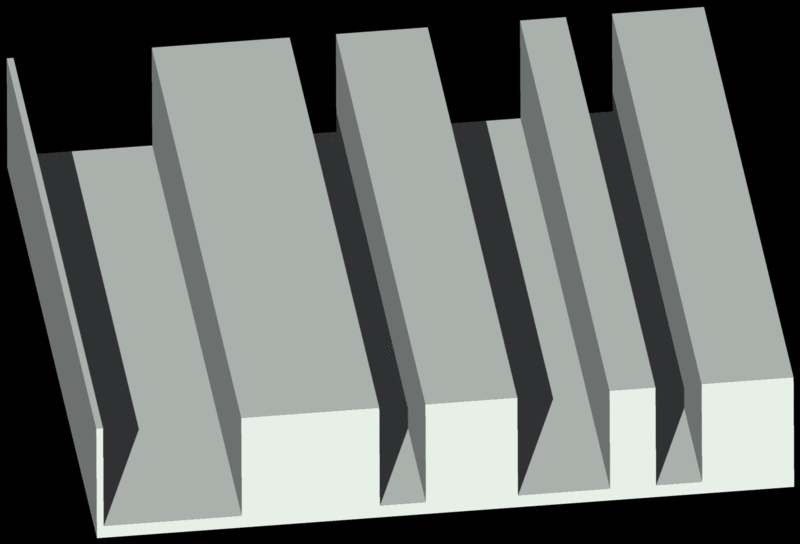
MLS Diffusers had same depth wells of different sizes and spacings…
The Model D started with the concept of twisting the MLS spacings into rings, and changing the size of the rings. Then to break the “MLS mold” of having the same depth, this MLS ring structure is raised to different heights using Quadratic Residue calculations… effectively combining the rings of MLS spacings with different QRD heights. While this could have been where this stopped, we wanted to interject more randomness into the equation.
Wherever the rings of different heights intersected, we decided to change the heights by values relative to the difference between the two rings. This height variation is what is responsible for the “random” waviness. This was accomplished with different Boolean Functions, to either add or subtract height where the rings intersected.
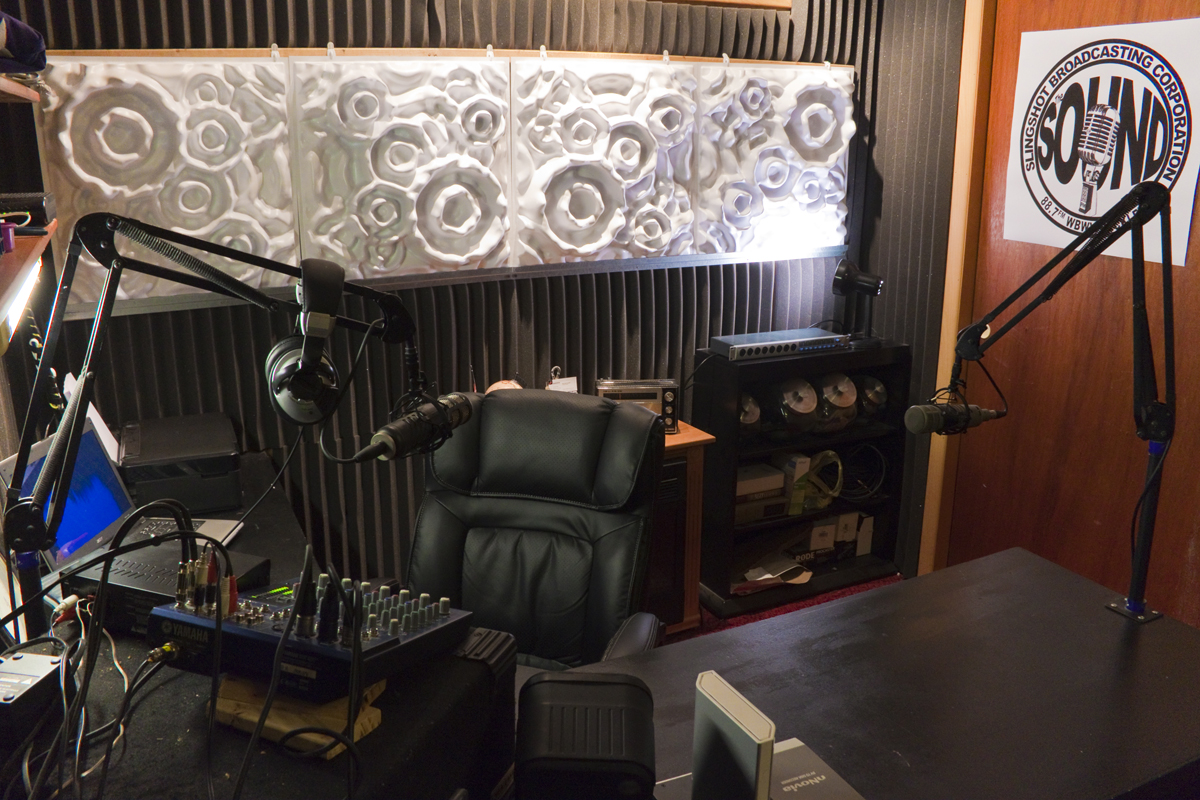
You can really see the variation in the geometry of the Model D… look at the ripples in the rings.
This method of using Boolean Functions inserts a known-height randomization into a hybrid MLS/Quadratic system. (That’s a mouthful.) The final step, after refining the ring size, height, position and intersection parameters… was to smooth the whole geometry with “Bicubic Interpolation.” That’s right. This final step smooths all the transitions from the heights, just like the blocks of the Aeolian®.
So onto the Simple Similarities!
Both diffusers use a quadratic residue calculations to get the main heights of the diffusive elements. Both diffusers are finished off with a helping of “Bicubic Interpolation” to smooth it all out. This gives them both a very organic look… The Aeolian® looks a bit like rolling waves, and the Model D resembles droplets of rain in a puddle…
They do perform quite a bit differently though.
The Aeolian® has great lower mid-band performance… while the Model D is a beast in the upper mid-bands starting about 2.5K. The difference is in the severity of the geometry. The Aeolian® is a gently rolling surface which redirects the waveforms uniformly through a wide range of frequencies. The Model D has a very irregular surface. With the different ring sizes, heights, locations and boolean functions… it’s meant to target and shred mid to high frequencies. Both diffusers are asymmetric – and affect different frequencies in different ways.
The Aeolian® is also deeper than the Model D – and this depth is a single resonant cavity… allowing it to be a great bass absorber as well. The Model D is useful in environments where you have bass control in place, but really need to diffuse the upper mid range and bring those frequencies to life… or maybe shred some flutter echos or comb filtering. There are scenarios where both are used in the same environment – but for different reasons.
In Conclusion...
While both the ArtDiffusor® Model D and the Aeolian® both look like liquids frozen in time, they have some other similarities in the math behind them… Yet they are still as different as rolling waves versus droplets of rain in a puddle.
 Acoustics First BLOG
You must be logged in to post a comment.