Archive for category Offices
Throwback Thursday – Diffusion and Binaural Bob from 10 years ago!
Posted by Acoustics First in Diffusion, Offices, Product Applications, Products, Uncategorized, Video on February 27, 2025
In June of 2015, Acoustics First® posted about our experiment which allowed people to hear the effects of sound diffusers in a small space. The experiment consisted of treating a small office with varying numbers of our new (at the time) Art Diffusor® Model D sound diffusers, then providing various sonic stimuli and capturing and measuring the results with a custom binaural head (called “Binaural Bob.”) This experiment received great feedback and with that input, future experiments were conducted using a similar method, mixing absorbers and diffusers, and having a wider range of stimuli.

But here we look back to the first… This is the video we produced during that experiment way back in 2015 with Binaural Bob, a bunch of Model D’s, a small office, some balloons, bang snaps, and one very heavy book.
If you would like to revisit the original post in it’s entirety, here is the link!
https://acousticsfirst.info/2015/06/09/want-to-hear-acoustic-diffusion-audio-demo/
Acoustic Treatment in the 1920’s – A look at the Guardian Building
Posted by Acoustics First in Absorption, Offices, Uncategorized on January 14, 2025
The bank wanted the building be a “show-piece” and communicate its principles of “security” and “fidelity” (remember, this was at a time before the FDIC), to impress customers and convince them to store their valuables at their bank. Incredibly, the building was completed in just one year; construction began in 1928 and finished just before the Stock Market Crash of 1929 (so much for fidelity).
Head designer Wirt C. Rowland had far from a subdued vision for the building. Blending Native American, Aztec, and Arts & Crafts designs, Rowland wanted to make an indelible impression on anyone who walked in. He said “We no longer live in a leisurely age…the impression must be immediate, strong and complete. Color has this vital power.”
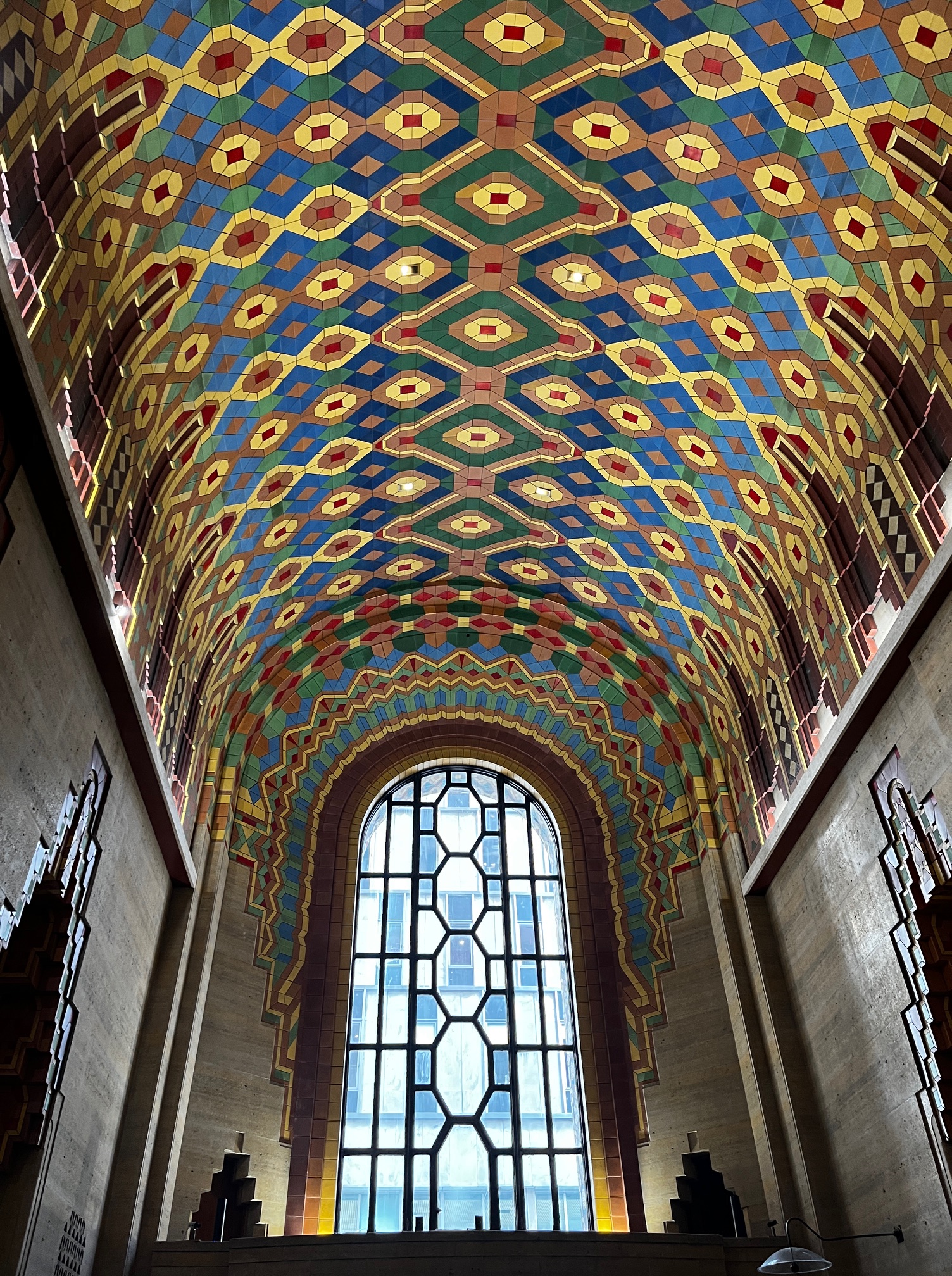
Colorful, luxury materials grace every surface of this building. Italian Travertine marble was used for steps and wall surfaces, contrasting with deep-red Numidian marble imported from Africa. Brilliantly colored tiles fill the lobby’s vaulted ceiling, and a massive multi-colored mosaic adorns the vestibule wall. Monel metal was used in the large ornamental gate dividing the banking hall and main lobby, supporting a pair of Tiffany & Co. Glass clocks. Even the office corridors and restrooms are lined in a Tavernelle marble from Tennessee.
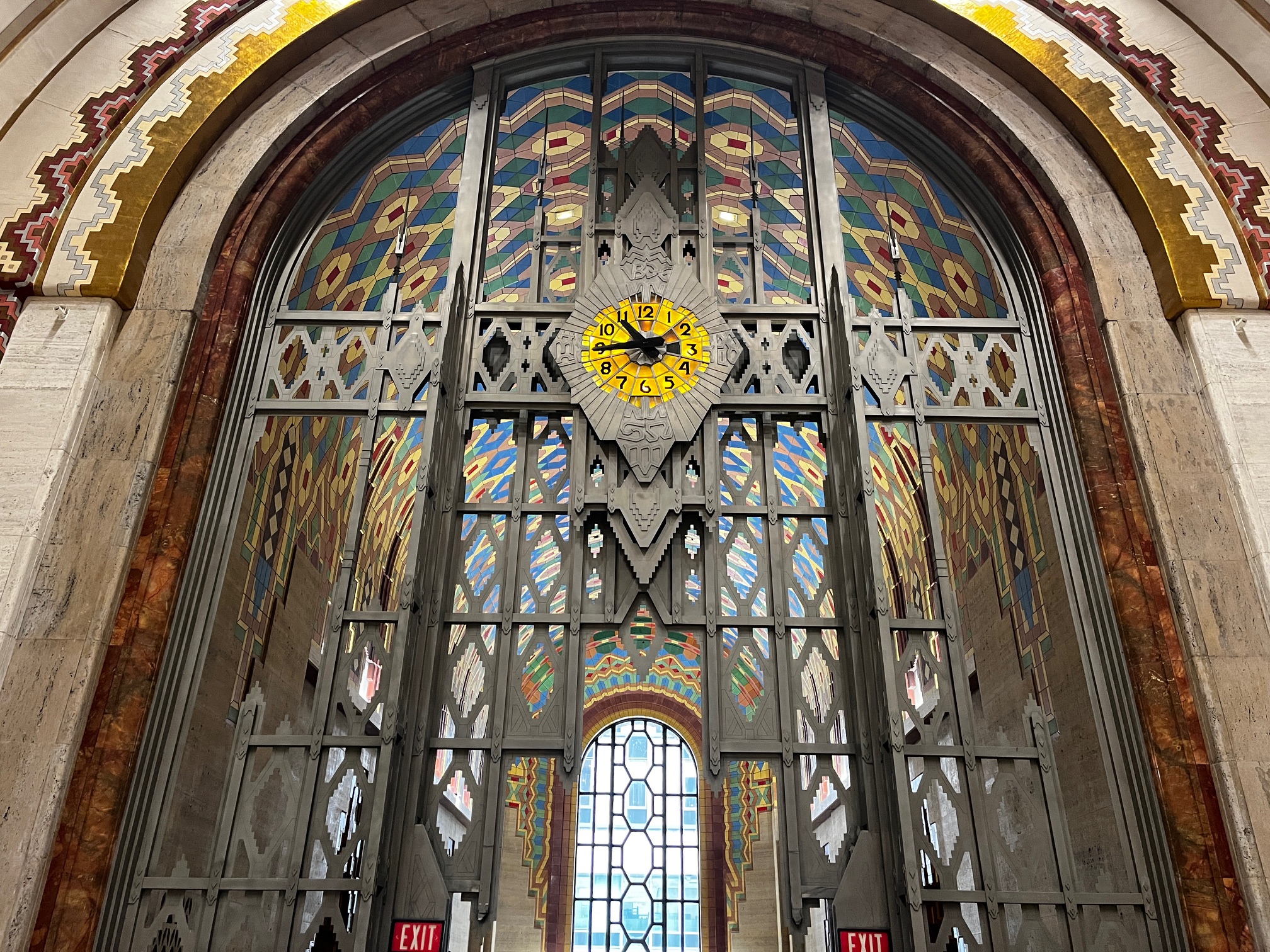
Obviously, these beautiful materials are also extremely sound reflective. Having worked on similar buildings, Rowland understood the need for acoustic treatment in the banking hall as there would be hundreds of customers, tellers and their managers trying to conduct important business in this large, cathedral-like space. If they used the same ceramic tiles they used on the ceiling of the lobby, conversations would be drowned out by a cacophony of typewriters. In lieu of the tiles, the banking hall has an incredibly appointed, intricate system of stretched canvas over wood frames backed with sound-absorbing horse hair. The canvas was hand painted with real gold and silver and requires regular maintenance. In fact, the same Italian family that made the ceiling nearly 100 years ago has been caring for it ever since!

I recently had the pleasure of touring the Guardian building, and walking through the Monel gate from the lobby to the banking hall, you can hear the difference. Though the banking hall is much larger, it feels much more intimate and comfortable, in large part because of the ceiling. Although the horse hair and canvas materials may not meet fire code today, modern stretched-fabric acoustic assemblies owe a lot to this sort of early innovation.

The Guardian Building is a symbol of creativity and achievement. Designed for the future, it is no surprise that Rowland’s masterpiece still dazzles and inspires visitors to this day.
For more information on the Guardian Building’s long history, visit https://www.guardianbuilding.com/history
Before & After: Video Conference Room
Posted by Acoustics First in Absorption, Customer Feedback, Media Room, Multipurpose Rooms, Offices, Product Applications, Products, Teleconferencing, Video on March 6, 2024
AMC Technology is located in a 5,400 square-foot suite that features a large open office area, a break room as well as several conference rooms.
When Acoustics First® initially met with the AMC team, they had recently moved into the space and were experiencing a number of acoustic problems in the open office area. Although Acoustics First® originally provided recommendations to improve workstation isolation in the open office, once the employees settled into the space, call-clarity issues in the conference rooms had become the much larger concern.
Three of the conference rooms were rudimentarily treated with 1” sound absorbing panels. The other four conference rooms were not treated acoustically and had hard/reflective walls, floors and ceilings. These hard surfaces were most at fault for excessive reverberation, noise buildup and distracting flutter-echoes (“ringing” caused by parallel reflective surfaces). These conditions contributed to an acoustically uncomfortable environment in which speech was hard to understand and conference call clarity suffered.

AMC Technology’s CTO, Anthony Uliano, identified a few goals for potential acoustic remediation. Anthony often works remotely and will call into the conference rooms to talk with team members. The sound of these calls on his side was frequently distorted and individual team members were difficult to understand. Anthony was concerned that clients were experiencing the same intelligibility issues. The primary goal for acoustic treatment was to improve the clarity of conference calls by reducing echoes and excessive reverberation within each conference room. Anthony also mentioned that they were experiencing some isolation problems. Though not a high priority, steps to reduce sound transmission were detailed for future consideration.
Acoustics First® specified Sonora® wall and ceiling treatment within each conference room to control flutter echoes and reduce reverberation down to suitable levels for conference calls. The video below provides a great snapshot of how the room sounded before and after treatment. Each recording is done in the same room, with the same employee and sitting the same distance from the microphone. The end result is a much clearer and intelligible conversation.
Absorption & Diffusion – The Construction Specifier
Posted by Acoustics First in Absorption, Art Galleries, Articles, Auditorium, Broadcast Facilities, Diffusion, Home Entertainment, Home Theater, HOW TO, Industrial Facilities, Media Room, Multipurpose Rooms, Music Rehearsal Spaces, Offices, Product Applications, Recording Facilities, Studio Control Room, Teleconferencing, Theater on April 29, 2022
For the May 2022 edition of “The Construction Specifier,” Acoustics First was asked to illustrate the use of absorption and diffusion in creating optimal acoustic spaces. The article is a great reference for understanding the types of acoustic absorbers and diffusers, as well as some use scenarios like offices, critical listening spaces, and larger communal spaces.
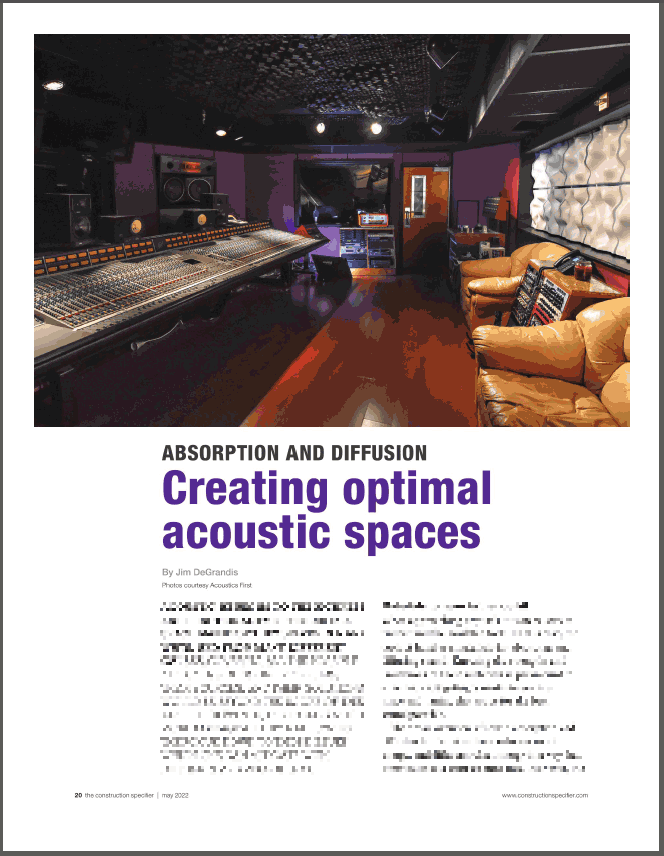
Note: This version has been edited and the advertisements are removed. The full published version of the May 2022 digital edition can be found on The Construction Specifier’s website here.
When it Comes to Glass, Don’t “Glaze-over” Acoustics!
Posted by Acoustics First in Multipurpose Rooms, Offices, Product Applications on March 28, 2022
Glass is a universal building material that is attractive to architects and clients, while posing a variety of challenges to acousticians.
Due to its transparent nature, glass creates an open and pleasing atmosphere. Curtain walls, skylights and windows allow for a view both outward and inward; connecting occupants to the building’s natural or urban setting. The use of natural light can lower electricity bills, brighten the rooms of a building, boosting the mood of the occupants. Glass is also a renewable building material, with 30% of new glass comprised of recycled materials. For all these reasons and more, glass will continue to play a major role in architecture in the future.
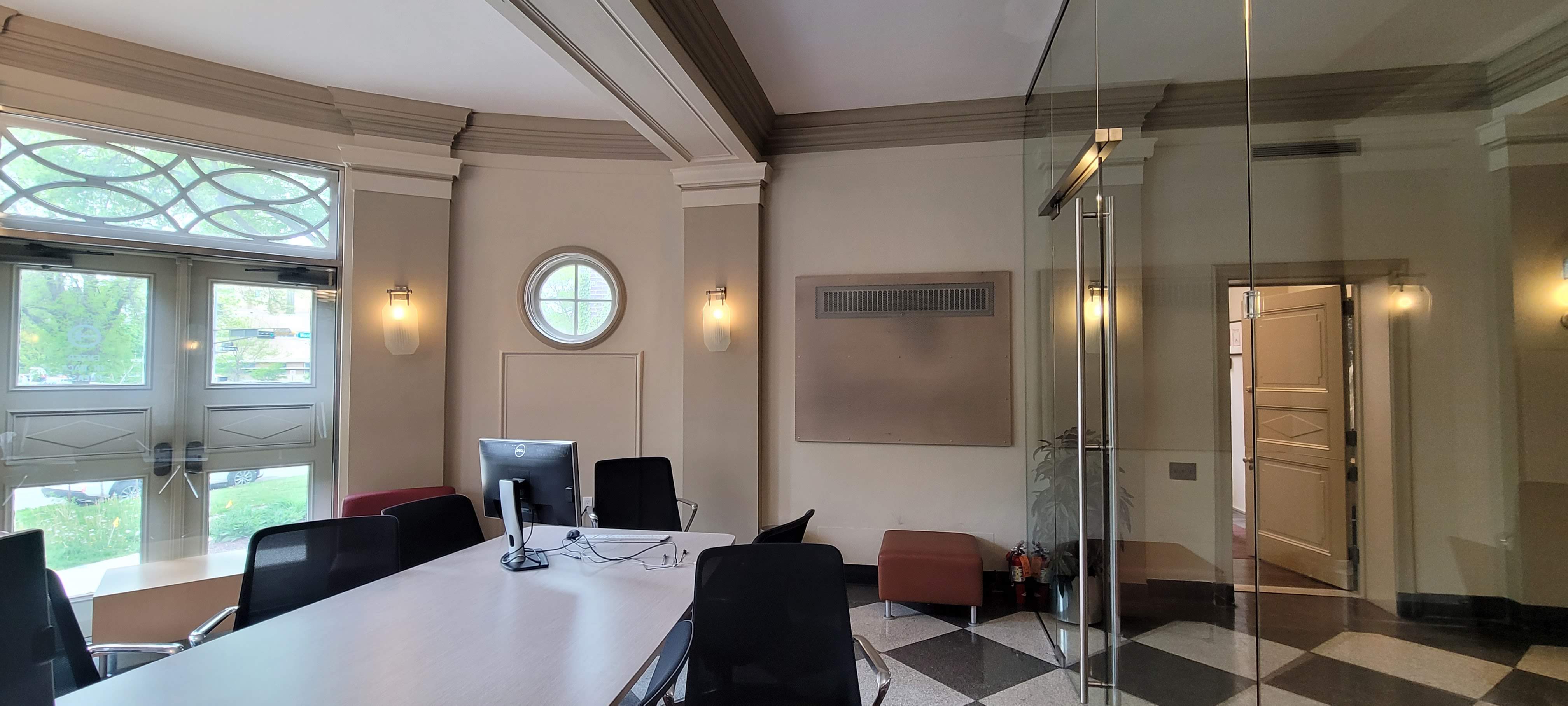
However, glass has a number of acoustical properties that can contribute to a poor occupant experience. To illustrate this, let’s take a closer look at what happens when sound interacts with glass.
When sound encounters a window, the glass converts some energy into thermal and kinetic energy (resonate vibrations), allows some sound to pass through, and reflects the rest back.

Glass only “absorbs” sound near its resonant frequency (and subsequent harmonics). The resonant frequency of glass is dependent on many factors, including density, thickness and panel size. As is the case with many “hard” building materials, the absorbed sound accounts for only a small fraction of sound energy’s interaction; most sound is either reflected or transmitted through the glass. Sound reflection and sound transmission are two separate acoustic issues with separate solutions.
Sound Reflection – Reflected acoustic energy from an internal sound source can cause a number of issues for occupants. Large, uninterrupted spans of hard materials like glass and gypsum cause specular reflections (echoes) and contribute to excessive reverberation and noise levels. These conditions can contribute to a poor acoustic environment in which speech is difficult to understand and music clarity suffers.
Specular reflections are compounded when there are other hard surfaces in the room. Flutter echo, heard as “ringing”, happens when sound bounces back-and-forth between parallel reflective surfaces (between walls or floor-to-ceiling). Flutter echoes greatly degrade speech intelligibility and music definition. This is a big problem in studios, offices, conference rooms and theater/media rooms. If there is an abundance of reflective surfaces, background “noise” from latent energy will cover up or distort the direct sound.

Typically, these issues are corrected with sound absorbing materials. However, we cannot simply “resurface” the glass with sound absorption, like we would with concrete or gypsum, without impacting transparency. Until someone invents invisible acoustic foam or fiberglass, sound reflections off glass will continue to be a challenge that needs accounted for.
Sound absorptive materials like thick curtains or acoustic shades provide adequate sound absorption and coverage flexibility. Other creative solutions include “stand alone” furnishings like tall, leafy plants or translucent perforated plastic sheets mounted over top the window. Essentially, any irregular surface you can introduce in front of the glass will help diffuse sound and break up harmful wall-to-wall reflections.
Sound Transmission – More than 90% of all exterior noise comes in through doors and windows. This can be partially attributed to poor weather stripping. “Leaky” windows will not only cause uncomfortable drafts, but allow sound to more easily work its way into our homes and businesses. Sound is a little like water; it will “pour out” through any gaps in the building assembly. Improving sound-loss across glass often starts with replacing the weather stripping and properly sealing any joints with non-hardening acoustic caulk.
Air-tight, limp, massive materials are the best at blocking sound. Glass is rigid, and its heft is limited by transparency requirements that keep it thin. Glass transmits a lot of sound energy, particularly at low frequencies. Laminated glass and insulated glazing assemblies both reduce sound transmission through glass by reducing resonance and adding air-space.

Including an acoustic consultant early in the design process will allow architects and owners to make well-informed decisions. An acoustical consultant will best identify potential pitfalls of using glass and recommend glazing systems and construction techniques to minimize future headaches. This measured approach will result in more beautiful looking (and sounding) spaces!
 Acoustics First BLOG
You must be logged in to post a comment.