Archive for category HOW TO
Sabins, SAC, & NRC — a practical guide.
Posted by Acoustics First in Absorption, Articles, HOW TO on September 18, 2025
When optimizing a room’s acoustics, you’re often balancing how much sound is absorbed (loss) against how much bounces around (reverberation). Some common ways to describe absorption — sabins, SAC, and NRC — look different, but they’re closely related.
Sabins
A sabin is a direct measure of absorption: One sabin equals the sound-absorbing effect of one square foot of a perfectly absorbing surface (like an open window – sound goes out, but doesn’t come back.) In practice, manufacturers or labs will report a component’s equivalent absorption area in sabins at various frequencies. Sabins are additive: add the sabins of all items in a space to get the room’s total absorption for use in reverberation calculations.

SAC
Sound absorption coefficients (SAC) are used to simplify large square footage calculations. Each SAC itself is derived from the measured equivalent sabins of a test sample divided by the sample’s area. This allows you to multiply the square footage of a certain material by the SAC and it will tell you how many sabins it will absorb at a certain frequency. You may also see an average of all the SACs, or a subset of those values… a specific, often-used subset is the Noise Reduction Coefficient (NRC).
NRC and how it’s calculated
NRC (Noise Reduction Coefficient) is a number that represents a material’s average absorption performance at mid-to-high frequencies. It’s calculated by taking the arithmetic average of the material’s sound absorption coefficients (SACs) at 250 Hz, 500 Hz, 1000 Hz and 2000 Hz (per ASTM C423 or other standard test procedures). NRC is typically reported to the nearest 0.05 and runs from 0.00 (reflective) to 1.00 (very absorbent). Being an average, it isn’t the most accurate method, but it can give you a quick estimate which can be useful in the planning stages.

Practical Mathematic Relationship
- From measured data: SAC = measured sabins ÷ sample area.
- NRC is the average of SACs across four bands (250 Hz, 500 Hz, 1000 Hz and 2000 Hz).
- To convert NRC into a working absorption number for a planar surface:
sabins = NRC × area (ft²). - For discrete units (baffles, clouds): manufacturers often give sabins per unit, so total absorption is sabins per unit × number of units.
Why sabins for baffles and NRC for wall/ceiling panels?
Hanging devices like baffles are three-dimensional, exposed on multiple faces, and their effective absorption depends on orientation, spacing, and edge behavior. It’s more accurate and user-friendly to report their absorption as “# sabins per unit.” Flat-mounted wall or ceiling panels cover a known area and behave predictably per square foot, so SAC or an NRC (per ft²) is a convenient, normalized way to estimate absorption across a room.
Putting it into RT60 calculations
RT60 calculations depict the amount of time it takes for a sound to decay 60dB in a particular space with specific treatments. (60dB is roughly a 1000-fold reduction in sound pressure.) Reverberation-time formulas (like Sabine’s) use the room’s total absorption in sabins in the function. A basic average will use NRC × area for planar coverage and add sabins-per-unit for baffles. Sum everything up to get total sabins, then plug that into your RT calculation to estimate RT60.
If using feet your calculation is…
RT60 = 0.049 x Room Volume ÷ Total Sabins
If using metric your calculation is…
RT60 = 0.161 x Room Volume ÷ Total (Metric) Sabins
In summary:
NRC is an area-based average (for flat-coverage estimates); SAC is a sabins per square foot coefficient (for efficient absorption calculations using area); sabins per unit are direct, measured absorption values (better for discrete, hung, multi-faced items).
Don’t Knock the Knock: Acoustics and the Pursuit of the Perfect Watermelon
Posted by Acoustics First in HOW TO, Uncategorized on July 3, 2025
After being outside on a hot summer’s day, nothing quite hits the spot like a slice of a cool, crisp, sweet watermelon. Unfortunately, not every watermelon is the same, and everyone has different methods for selecting the best ones.
There are number of visual clues that one can rely on to help identify a good watermelon. A large, yellow field spot on the bottom indicates that the watermelon was on the vine longer and is probably sweeter. Also, the coloring of a “ripe” melon will have strong, consistent stripe pattern; dull dark green stripes alternating with light yellow/pale stripes.
However, even when I followed these visual tells, I would often cut into my purchase only to be dismayed by a Styrofoam-like, flavorless inside or an over-ripened, mushy mess.
This melon melancholy haunted me until a few years back when I saw a middle-aged woman kneeling on the concrete floor of the supermarket with 5 watermelons circling her. I watched as she bent over and carefully knocked on each one, listening and nodding her head like she was holding a séance with the “other side” of the produce aisle. She repeated this process, rearranging the melons in front of her, until she picked up “the one” and put it in her cart, returning the other watermelons to the display bin.

I greeted the woman, trying not to startle her, and admitted that I often struggled to pick out watermelons. Clearly, she knew what she was doing and I was curious if she might share her system with me.
She kindly told me that she was listening for a “hollow” sound, that was full, but not too deep in pitch. I told her that I had heard that this “knock” test is a good way to judge the water content, but I never had much luck. She said that people will make the mistake of holding onto the melon when knocking, which quickly dampens the sound, so you can’t hear much of a tonal difference between melons (like palming the string of a guitar will change its sound to a shorter, more percussive, note).

Her strategy is to pick out 4-6 similar sized melons that have a large, yellowish sugar spot and strong striping, then sets each down so the only point of contact is with the hard floor. Without external dampeners, the melon can really “sing” when knocked, telling her how far along the fruit is. Too deep of a sound and the fruit is over-ripe/mushy, too high-pitch (or not hollow at all) and the watermelon is not ripe enough. She organizes the melons from lowest to highest in pitch and she simply selects from the middle melons to find one or two that are “just right”.
She said that this ritual, as ridiculous as it might appear to other shoppers, is the best way to guarantee a good watermelon and it’s worked for me ever since; so, don’t knock the knock!
Project: Beginning to End – Biltmore Park Clubhouse
Posted by Acoustics First in Absorption, Customer Feedback, HOW TO, Multipurpose Rooms, Product Applications, Products, Video on August 16, 2023
Occasionally, we get the opportunity to show the entire process that goes into a project, and today we have one which we will run through – beginning to end.
Biltmore Park clubhouse was getting a full aesthetic and acoustic makeover. Acoustics First® was asked to collaborate with Harmony Interiors on the acoustic panel recommendations for this project. After an initial consultation, a layout was developed that would attain the desired effect.
Along with this layout, a pre and post treatment acoustic performance was predicted and supplied.

After the treatment was approved and ordered, the panels were manufactured and supplied to the customer for install. This installation included several Sonora® panels for the ceiling, and others for the walls. After the customer received the order, Harmony Interiors began the installation.


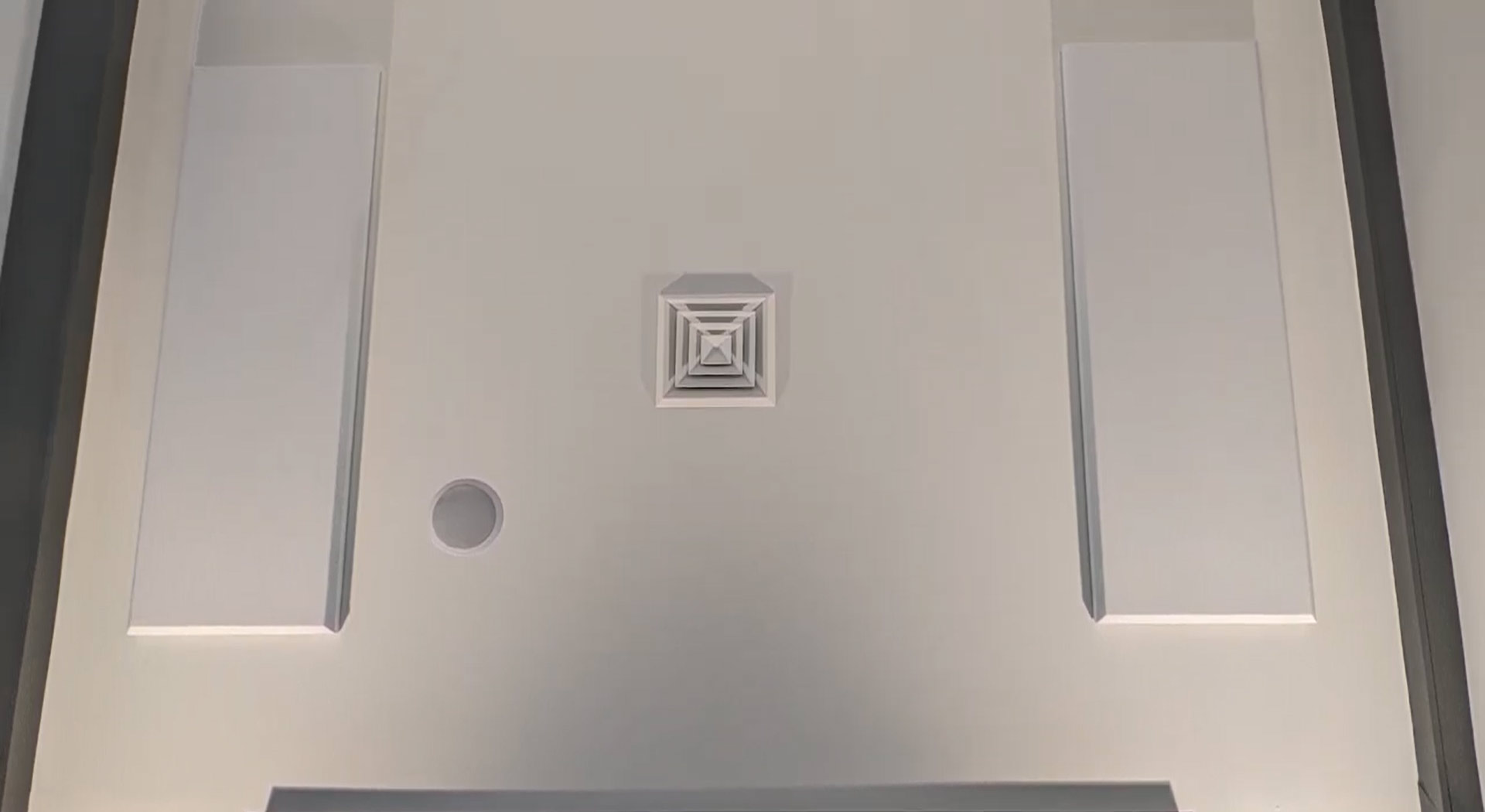


BONUS! This is often all the information we receive… along with some comments about how great the room sounds. But on this occasion, we were able to obtain a full before and after comparison of the effects of the treatment!
Video of the room – pre and post treatment!
The second benefit of getting this before-and-after comparison video is that we were able to critique our initial predictions of the pre- and post-treatment reverb times.
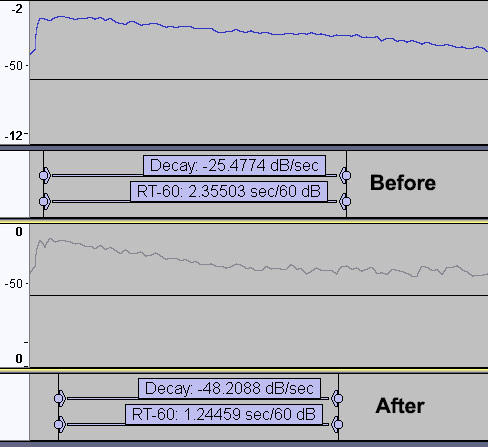
We hope you enjoyed seeing this acoustic project from the initial consultation and layout phase, through the installation, and to completion.
John Bullard Live Room – Tuning a Live Room for Classical Banjo
Posted by Acoustics First in Absorption, Customer Feedback, Diffusion, HOW TO, Music Tracking Room, Product Applications, Products, Recording Facilities on May 3, 2023
When you think of classical music; what instruments come to mind? Piano? Violin? Cello? …What about Banjo?
In the summer of 2022, classical banjoist John Bullard reached out to Acoustics First for assistance with his newly renovated home-studio. John is one of a select group of classical musicians aiming to showcase the versatility of this uniquely American instrument. The banjo, with John’s expertise, lends a very distinct, melancholy sound to contemporary and traditional compositions.

Having recorded a number of albums already, John knew he wanted his live room to be catered specifically to tracking solo, classical banjo as well as small acoustic ensembles. Acoustics First analyzed John’s live room and came up with a treatment design that would achieve an “ideal-as-possible” acoustic environment for recording classical instruments.
The largely reflective live room had walls comprised of unfinished, reclaimed wood planks over plywood, a drywall ceiling, stone fireplace and a polished concrete floor. The parallel, hard surfaces contributed to a poor tracking environment; with standing waves and “flutter” echoes adding unwanted coloration to recordings, inhibiting music definition.
Spaces used for rehearsing and recording classical music often benefit from elevated levels of reverberation, which add a sense of warmth and ambience to acoustic music. Although the reverb in John’s untreated room was only slightly excessive when measured, it was far from “diffuse”, with the majority of energy coming from early reflections.
The primary challenge in the live room was to address the early specular reflections and standing waves without taking too much “life” out of the room. To achieve this delicate balance, wide band diffusion was recommended as the primary ceiling and wall treatment with selective sound absorptive treatment with fabric-wrapped Sonora® panels.

Double Duty Diffusers™ and Aeolian® sound diffusers were recommended as they would also provide some much needed low-frequency absorption in addition to broadband diffusion.
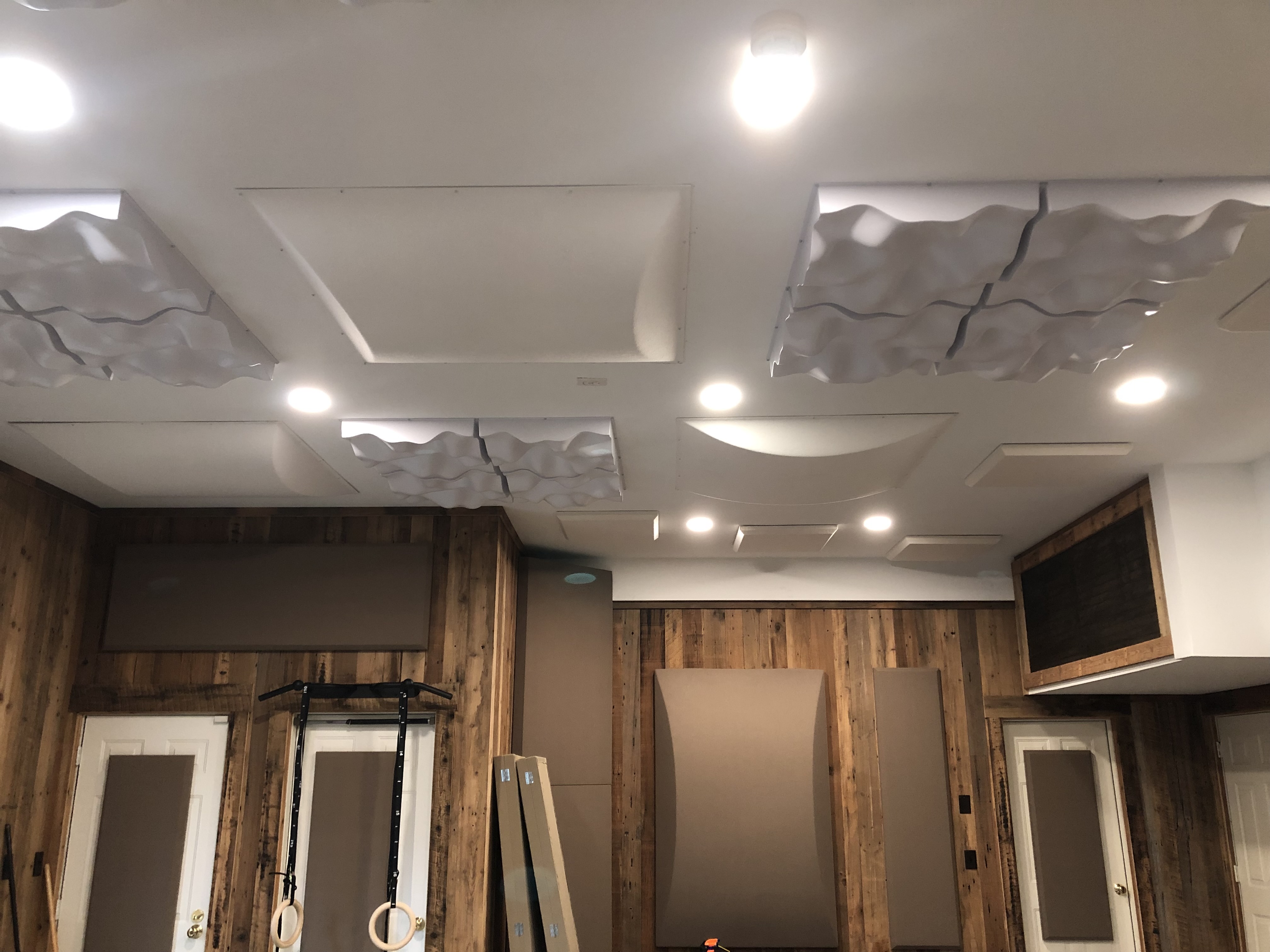
After the treatments were installed, John got right to work on experimenting…
“…ready to start doing extensive test recordings to locate the best spot and rug configuration for solo banjo… It sounds really good to my ear – now to see how the microphones hear it!”
John Bullard

Please check out John Bullard’s music!! – https://www.johnbullard.com/
Ken Fritz – 1942-2022
Posted by Acoustics First in DIY, Home Entertainment, Home Theater, HOW TO, Media Room, Mentions, Uncategorized on August 18, 2022

Back in April 2021, Acoustics First® Posted a blog about a listening room designed and built by Ken Fritz. This is an overly-simplified statement, as he not only designed and built the structure, but also the massive speakers, the high-tech turntable, and many of the other components. The next month, John Gardner, Nick Colleran, and Jim DeGrandis were invited to witness Ken’s masterpiece of a room in person – and now, a year later, Ken is no longer with us.

Let’s back up a little bit. The history of this room goes back decades, and there is a common history between this room and the Acoustics First® HiPer Panel®. While Ken was finishing the structure back in the early 2000’s, he was focused on building a room that would help his speakers reach their ultimate potential. He had researched the geometry of the finest halls and theaters and their construction, but he was looking to take it one step further. When he was shopping for acoustic treatments for the space, he came across Acoustics First® – which was near his home. At the time, Nick Colleran and John Gardner were working on ideas for a new type of multi-layer, perforated composite, which would eventually become the HiPer Panel®. After the product completed development, and its patent was still pending, Ken’s room became the first installation of the new product.

Ken consulted with Nick and John multiple times during the long construction process, his uncompromising attitude toward his space was always looking for the “best way, no matter what it took.” His bass traps were styled after professional mastering facilities, where the entire corner was recessed and filled with low-frequency absorption. His ceiling was modeled to direct the reflections toward the upper rear of the room, above the balcony. The speakers were hand built, as was his turntable – all of which were marvels of engineering and detail.

I will never forget Ken’s enthusiasm when he indulged in listening to his favorite recording of the “1812 Overture”, complete with Howitzer cannons. The magnitude of the sound would have shaken everything in the room, had Ken not meticulously isolated and anchored everything. The sound was pure and clean, even at 105dB (standing at the rear of the room – and balanced perfectly.)
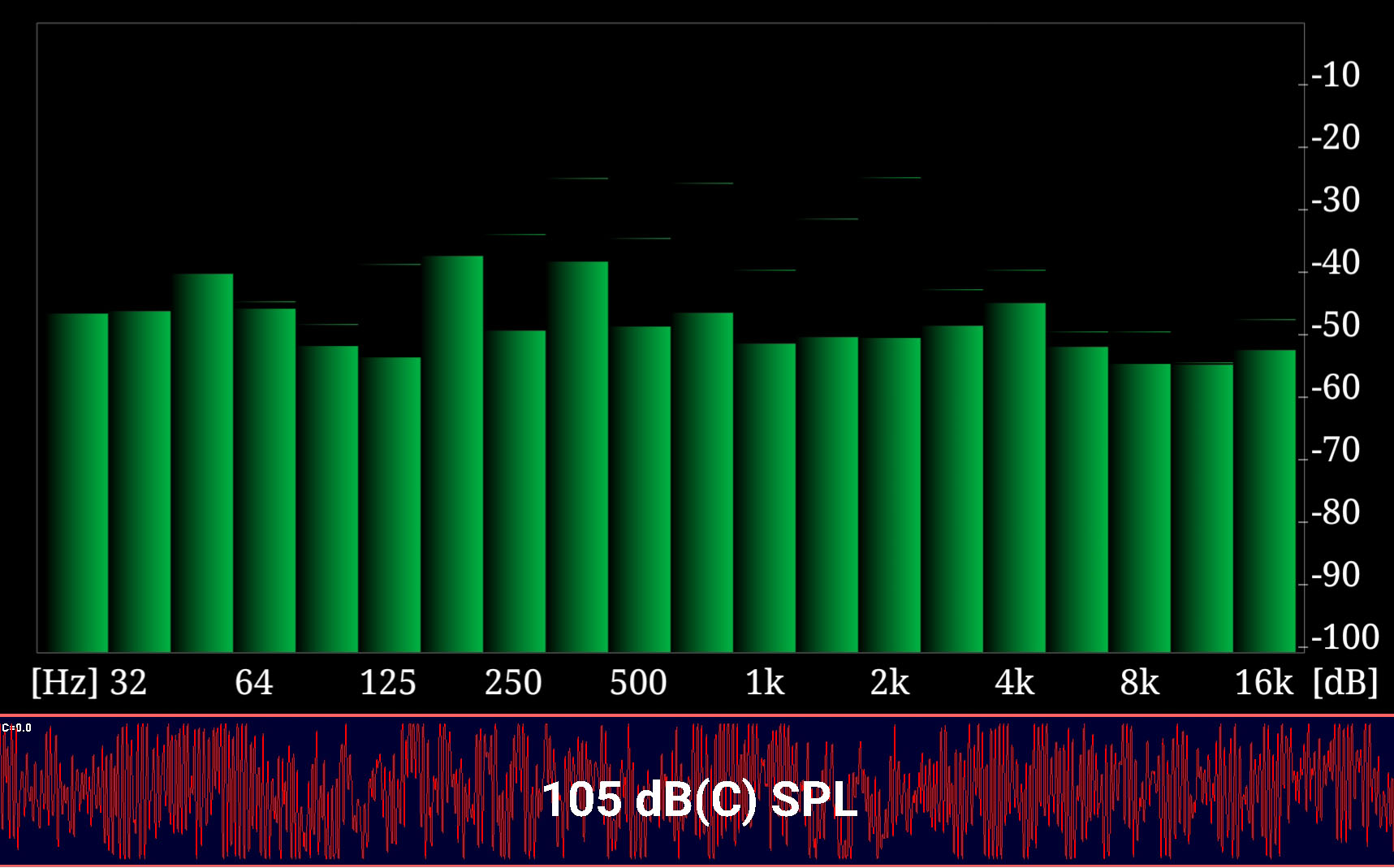
But Ken wasn’t just about the music or the gear, he also liked to educate and learn. After listening to the recording, he went on to discuss how they had recorded the cannon shots, and even had an audio sample of the different “takes” done during the setup. This was Ken… he wasn’t just interested in how it sounded, but the process of how they got there.
We hope that Ken’s enthusiasm continues to inspire those who have an uncompromising love of music and sound, and that he will be remembered as one of the most fervent proponents of “following your dream.”

Thanks, Ken.
 Acoustics First BLOG
You must be logged in to post a comment.