Archive for category Diffusion
Similar, yet different: Quadratic vs. Itself?
Posted by Acoustics First in Diffusion, Product Applications, Products on July 6, 2023
For this installment of “Similar, yet different,” we will take a classic welled-quadratic sound diffuser, The Model Q, and compare its performance to itself – only installed backwards!

Taking “similar” to the extreme in this case, we are testing the difference in performance of a 1-dimensional, welled-quadratic diffuser installed in the standard welled configuration, and then installed reversed – with the sound impeding on the back side of the wells. For a bit of history, the Classic Quadratic Diffuser (or Schroeder diffuser) was designed with a grid separating the reflectors – creating wells of different depths proportional to the remainders of n2 (mod N). This design has some interesting facets.
- They are inherently symmetric if left in the original sequence.
- They are periodic (i.e. they repeat.)
- The discrete Fourier transform of the exponentiated sequence has constant magnitude.
The design principal is simple if you tear apart the math, and it’s simply wells that have a different effect on different frequencies, depending on the geometry of the wells. The Model Q is an advanced 1D-Quadratic with angled well-bottoms, which assist in smoothing out the performance and widening the 1D polar radiation. So if this design is relying on the wells to be effective, why would we reverse it?
An acoustically diffuse environment develops due to many factors, and while the frequency focus of the wells is useful, there are other scenarios where different methods may be preferred. If the geometry of the elements were flipped around, you would get the same (albeit reversed) ratio of distance, but you lose the containment and channeling that the wells provide. This imparts a diffraction on the unrestrained elements. This also allows for a different interaction between the elements, as the face of the unit is no longer planar.
Let’s look at the effect this has on the performance of the device at some different frequencies – starting low and moving up…
First, we will look at the 1150Hz performance of the devices… standard welled-install on the left, reversed on the right.

At 1150Hz, there is a little variation in the performance. Both are front focused, with a strong 1D horizontal polar response, but they are not identical. The welled-design (left) shows a broad frontal response, while the reversed design has a smoother vertical response, sharper front lobes, and stronger side performance. Overall, this difference is relatively small at this frequency.
Now, we will look at 2300Hz.

Again, we have two similar looking balloons, but there seems to be a bit more variation. The welled-design (left) shows a smoother 1D pattern in the front as the wells release sound within the same plane – at the front face of the wells. On the right you will notice sharper and more discreet lobes, but you will also notice that it has wider horizontal performance again, as it isn’t as front focused due to its free standing elements. The vertical performance is also a bit different – the welled design is broad and smoother vertically, while the reversed installation shows sharp lobes again.
Step up to 2800Hz, and we see some more drastic differences.
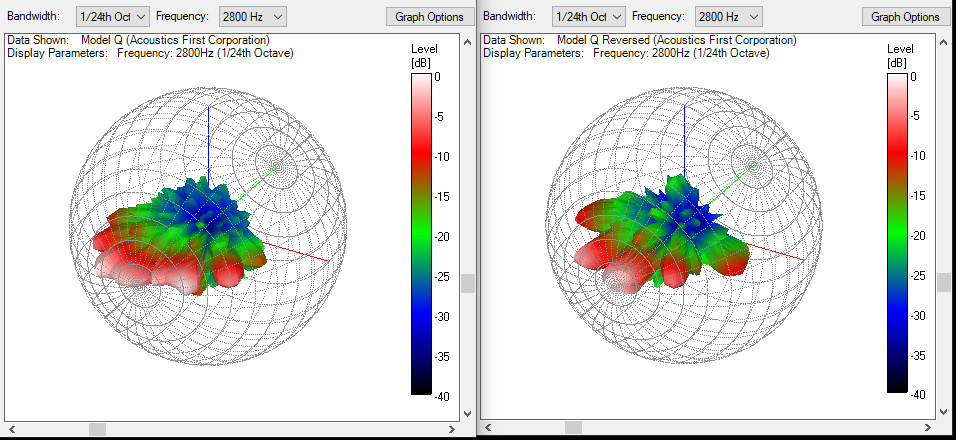
The performance of the standard welled-install (left) stays smooth and front-focused, while the lobes of the reversed install (right) have become even more distinct. Interestingly, the side lobes are even larger, showing an even wider polar pattern than before. These two instances show a marked difference between the smooth front-focused wells and the wide sharp scattering of the unrestrained elements. These two configurations are both very different, but are still both very effective at helping to disperse the incoming energy. Remember that the room develops diffusion through sound travelling in many different directions – these are not simple reflectors sending the specular energy in a single direction.
Now at 3650Hz we see a shift toward the reverse installation.
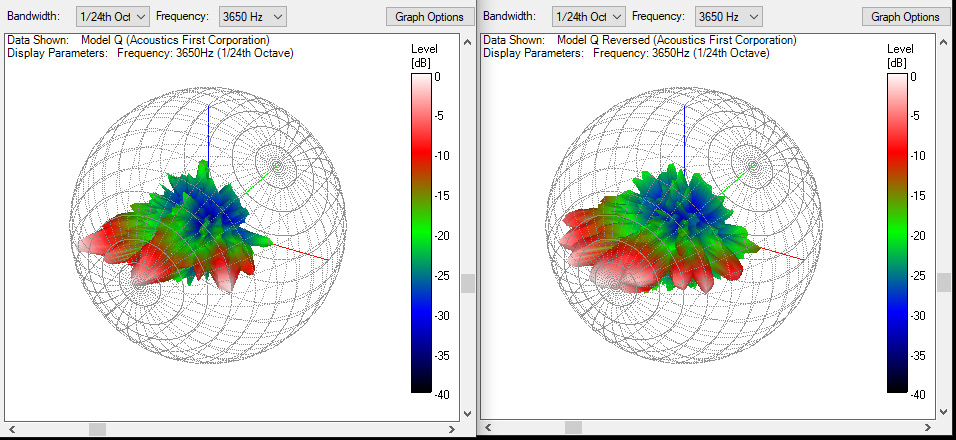
At around 4K the welled-installation (left) begins to move back front and center. It’s primary method of diffusion uses the wells to channel the energy, and at higher frequencies sound becomes much more directional. This directionality is used to create a temporal shift in the sound, as the reflections will occur out of phase from the source, and controlling that reflection is paramount to tuning this method of diffusion. However, as stated before, there are other mechanisms contribute to diffusion. The unrestrained elements on the right balloon, have hit their stride and still maintain a wide 1D polar pattern. The lobes are still sharp, showing the interaction of the elements with sound. This installation is showing the strength of its spatial dispersion, which will send acoustic energy in more directions and use the travel through the space to create a diffuse environment. It loses some of the frequency tuning of the wells, but makes up for it in the wide polar pattern.
Now for the super high frequencies – we jump straight to 10Khz.
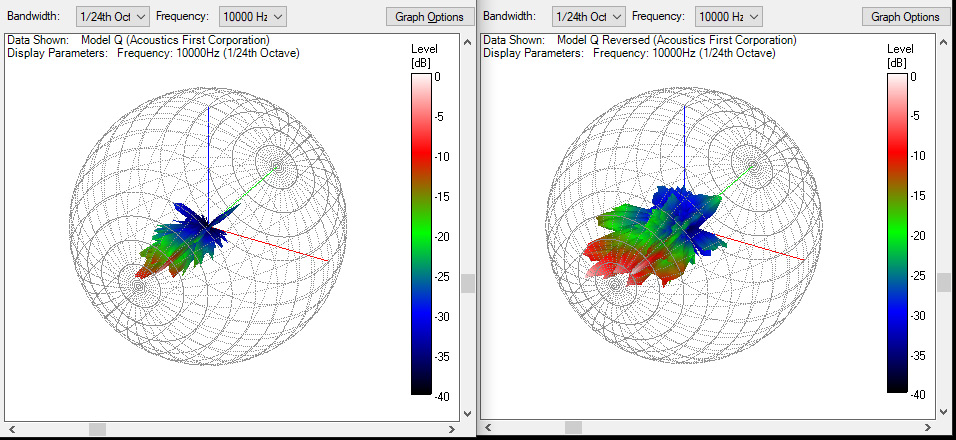
This final set shows two diffusers pushed to the limits. The welled-installation (left) is a very narrow focused beam now. You will note that it has some variance due to the interactions with the walls of the wells but all of its work is done through phase shifting at this point. In contrast, the exposed elements (right) are still allowing for a bit of diffraction to occur, and the angled faces are still allowing for a bit of spatial redirection. Also note that these polar patterns were generated with a sound source directly in front of the device at 0° incidence, and the exposed elements would offer more exposure to its surface area than a welled design at wider angles of incidence.
In summary…
Diffusion develops using many different variables, including the untreated walls of the space. While both of these installations are functioning in nearly identical frequency ranges due to their geometry, the mechanisms which they work are slightly different and have different strengths. The welled-design (in classic temporal Schroeder configuration) uses the wells to channel sound and address the frequencies in a tuned and controlled fashion. By simply flipping the device around, however, you change its performance from a controlled time shift, to an unrestrained spatial redirector, which imparts time shift through dispersion, diffraction, and distance travelled – further reducing intensity by having a wide 1D diffusion polar pattern. Both have scenarios which one configuration would be preferable over the other, making the Model Q diffuser a very versatile device.
Both configurations are literally two sides of the same coin… they work in different ways, over the same frequencies, providing results – no matter how you flip them.
John Bullard Live Room – Tuning a Live Room for Classical Banjo
Posted by Acoustics First in Absorption, Customer Feedback, Diffusion, HOW TO, Music Tracking Room, Product Applications, Products, Recording Facilities on May 3, 2023
When you think of classical music; what instruments come to mind? Piano? Violin? Cello? …What about Banjo?
In the summer of 2022, classical banjoist John Bullard reached out to Acoustics First for assistance with his newly renovated home-studio. John is one of a select group of classical musicians aiming to showcase the versatility of this uniquely American instrument. The banjo, with John’s expertise, lends a very distinct, melancholy sound to contemporary and traditional compositions.

Having recorded a number of albums already, John knew he wanted his live room to be catered specifically to tracking solo, classical banjo as well as small acoustic ensembles. Acoustics First analyzed John’s live room and came up with a treatment design that would achieve an “ideal-as-possible” acoustic environment for recording classical instruments.
The largely reflective live room had walls comprised of unfinished, reclaimed wood planks over plywood, a drywall ceiling, stone fireplace and a polished concrete floor. The parallel, hard surfaces contributed to a poor tracking environment; with standing waves and “flutter” echoes adding unwanted coloration to recordings, inhibiting music definition.
Spaces used for rehearsing and recording classical music often benefit from elevated levels of reverberation, which add a sense of warmth and ambience to acoustic music. Although the reverb in John’s untreated room was only slightly excessive when measured, it was far from “diffuse”, with the majority of energy coming from early reflections.
The primary challenge in the live room was to address the early specular reflections and standing waves without taking too much “life” out of the room. To achieve this delicate balance, wide band diffusion was recommended as the primary ceiling and wall treatment with selective sound absorptive treatment with fabric-wrapped Sonora® panels.

Double Duty Diffusers™ and Aeolian® sound diffusers were recommended as they would also provide some much needed low-frequency absorption in addition to broadband diffusion.
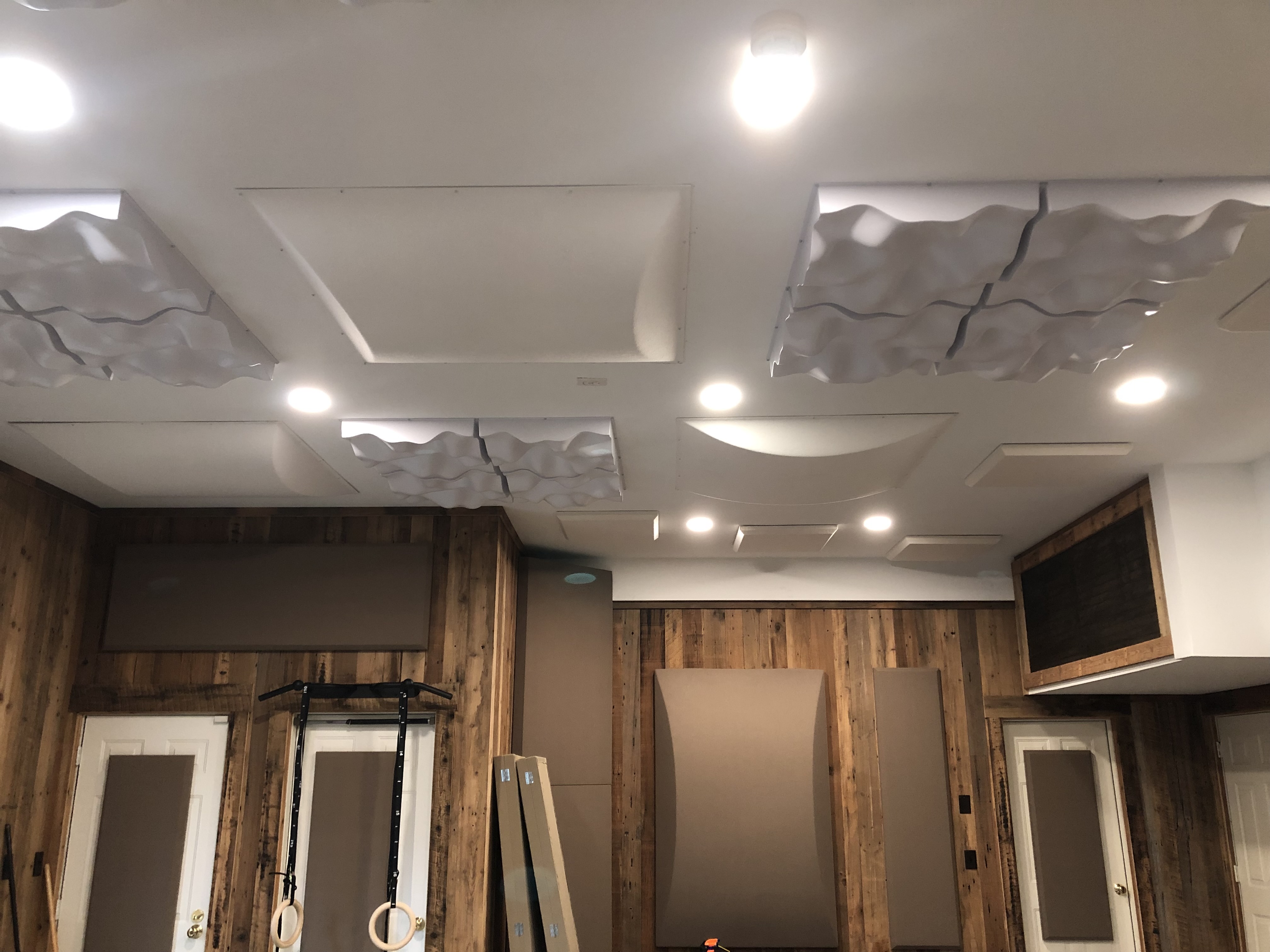
After the treatments were installed, John got right to work on experimenting…
“…ready to start doing extensive test recordings to locate the best spot and rug configuration for solo banjo… It sounds really good to my ear – now to see how the microphones hear it!”
John Bullard

Please check out John Bullard’s music!! – https://www.johnbullard.com/
NWAA Labs goes nuclear in Stereophile
Posted by Acoustics First in Articles, Company Information, Diffusion, Mentions on July 29, 2022
Ron Sauro of NWAA Labs talks about his massive test facility, speaker measurement, sound diffusion, and more in this article in the August 2022 edition of Stereophile Magazine.

In the article, there is mention of the advances that Jim DeGrandis and Acoustics First® have made in the understanding of diffusion, the developing standards for testing in the ASTM, and their published research into modelling/simulations for refining new acoustic materials.
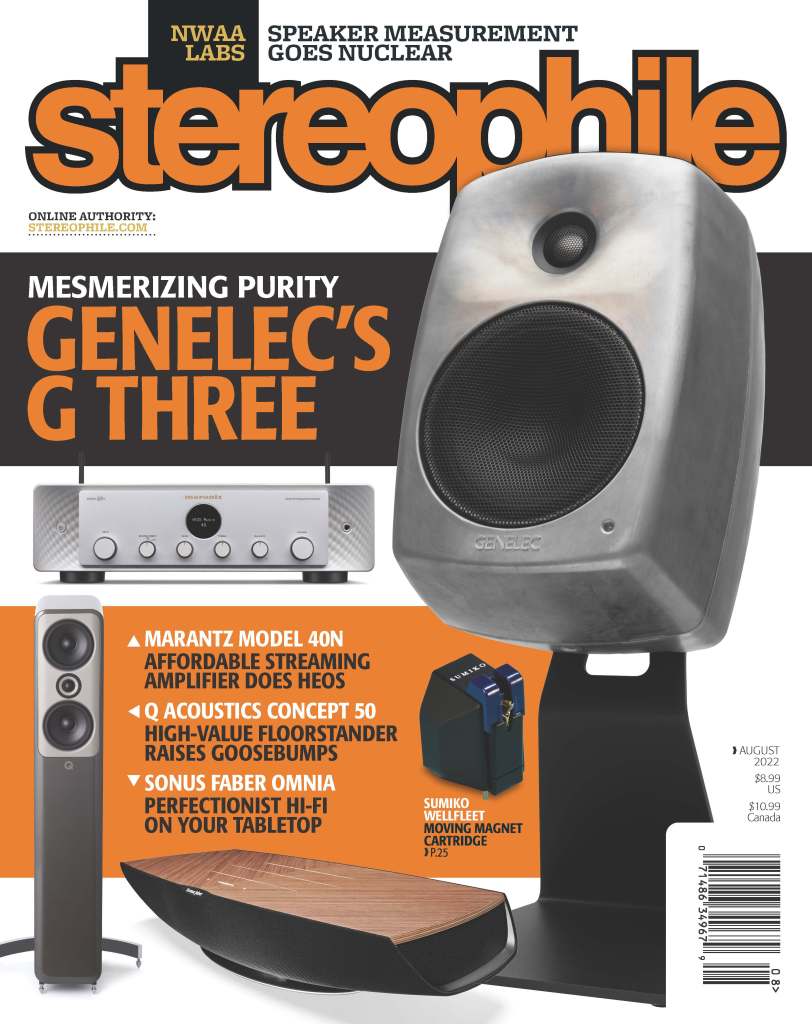
For more information about this edition, and other editions of Stereophile, visit them at https://www.stereophile.com/
Absorption & Diffusion – The Construction Specifier
Posted by Acoustics First in Absorption, Art Galleries, Articles, Auditorium, Broadcast Facilities, Diffusion, Home Entertainment, Home Theater, HOW TO, Industrial Facilities, Media Room, Multipurpose Rooms, Music Rehearsal Spaces, Offices, Product Applications, Recording Facilities, Studio Control Room, Teleconferencing, Theater on April 29, 2022
For the May 2022 edition of “The Construction Specifier,” Acoustics First was asked to illustrate the use of absorption and diffusion in creating optimal acoustic spaces. The article is a great reference for understanding the types of acoustic absorbers and diffusers, as well as some use scenarios like offices, critical listening spaces, and larger communal spaces.
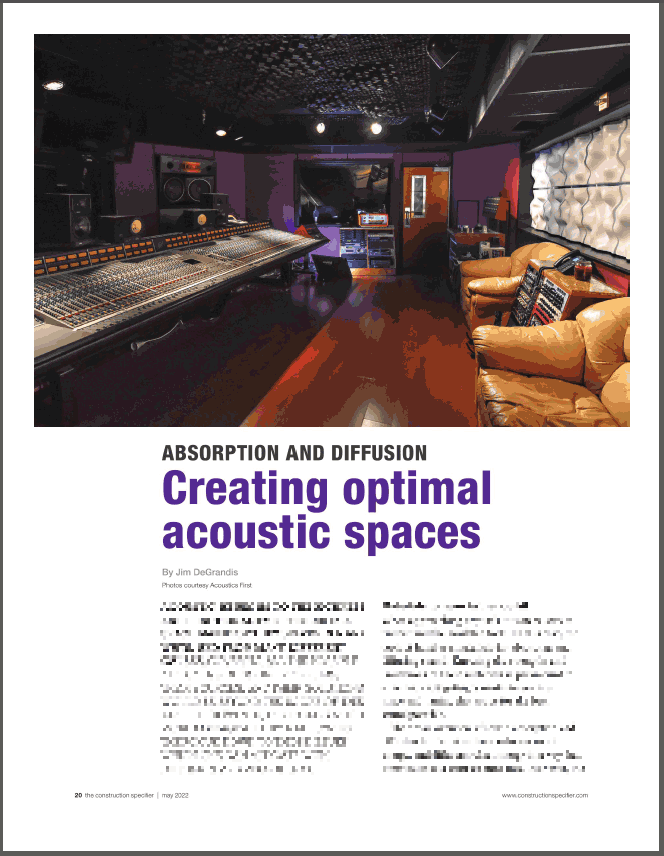
Note: This version has been edited and the advertisements are removed. The full published version of the May 2022 digital edition can be found on The Construction Specifier’s website here.
Sound Diffusion vs. Absorption in Worship Environments
Posted by Acoustics First in Absorption, Articles, Diffusion, Product Applications, Uncategorized, Worship Facilities on January 25, 2022
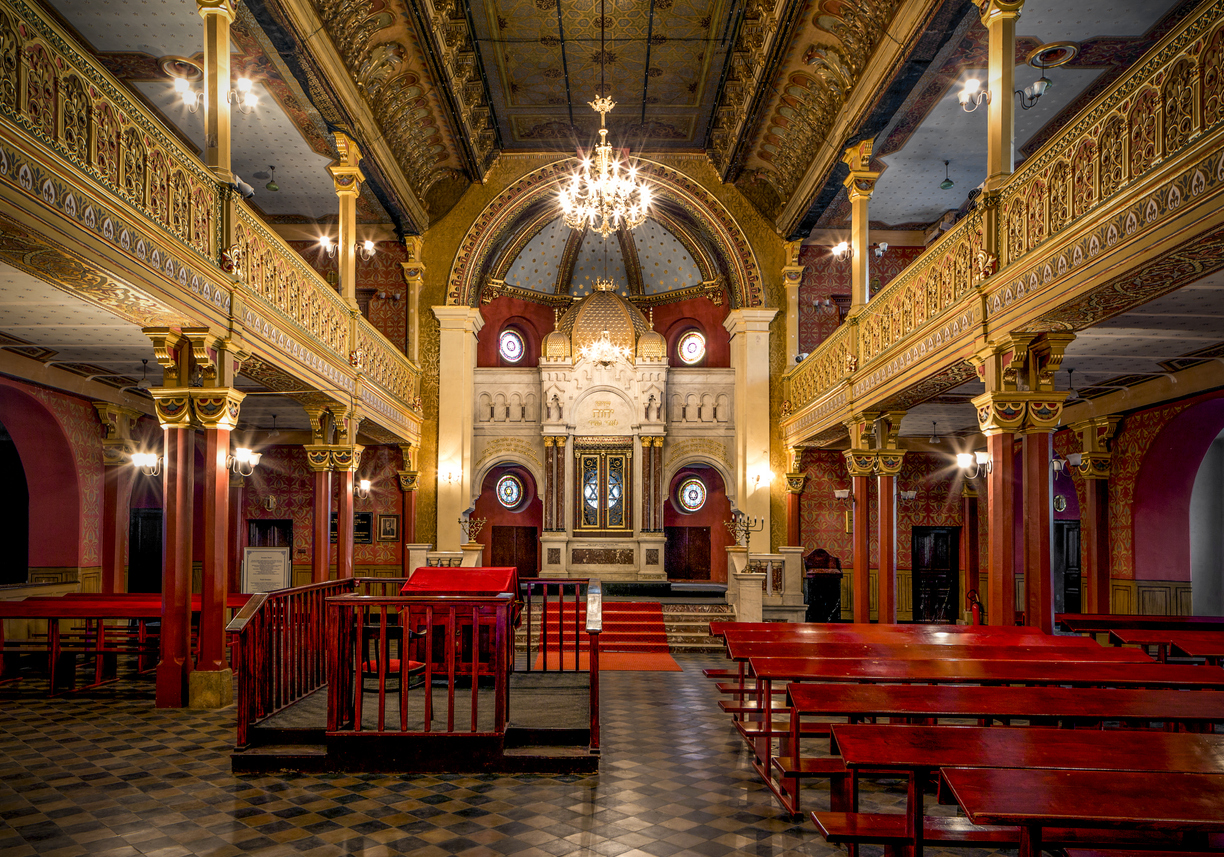
Cathedrals, mosques, synagogues and temples are often decorated with an abundance of architectural details (deep coffers, arches, columns, sculptures, intricate engravings etc.). These features are not only beautiful to look at, but also serve the vital acoustic purpose of sound diffusion. Large, uninterrupted spans of hard, flat surfaces reflect sound in a singular, specular wave, which creates discrete echoes and comb filtering (In acoustics, comb filtering is when a delayed reflection interferes with, and distorts the original sound wave). These conditions can contribute to an acoustically uncomfortable environment, in which speech is difficult to understand, and music can be hard to perform and enjoy. Irregular surfaces, on the other hand, scatter these reflections, minimizing comb filtering and distracting echoes. In a “diffused” worship environment, speech is intelligible, music is clear and warm, and there is a sense of envelopment which greatly enhances the congregants’ worship experience.
Absorptive treatment can also be used to control echoes and harmful reflections. Instead of redistributing reflections, these “fluffy” materials (drapery, padded pews, acoustic panels etc.) reduce the overall sound energy from the reflections in the room. However, using to too much sound absorption in a room can often make a space sound ‘dry’ or ‘dead’. Determining whether your space needs absorption, diffusion, or a combination of both is dependent upon the acoustic properties of the space, as well as the type of worship service being conducted.
Acoustic Properties of the Worship Space: Reverberation, a principle acoustic factor, is the sound energy that remains in a listening environment as a result of lingering reflections. The dimensions, construction materials, and furnishings of a given worship space determine its reverberation time (RT or RT60). Large halls with reflective materials (glass, wood, concrete) have longer reverb times, while small rooms with absorptive materials (drop acoustic ceiling, carpet, curtains etc.) will have shorter reverb times. Incorporating sound absorptive materials, Such as fabric wrapped acoustic wall panels, is often the best way to reduce the overall reverberation in a room to a suitable level. However, the target reverb time also depends on the nature of the worship service being conducted in a particular space.
Type of Worship Service: Ideal reverb times for worship environments vary widely. Non-musical, spoken-word worship requires a very short reverb time (.5-.8s range), ensuring that speech is intelligible. At the other end of the spectrum, cathedrals can tolerate an extremely long reverb time (2s and above) due to the traditional nature of their liturgy. Choir, organ and plainchant worship will actually benefit from longer reverb times that create a sense of ambience and spaciousness by sustaining musical notes. These spaces will often lack a sound system, and instead utilize the hard surfaces to propagate sound throughout the room.
Traditional worship may be enhanced by long reverb times, but contemporary worship requires a significantly shorter reverb time. In these environments, drums, guitars, bass and other amplified instruments are critical to the high intensity worship experience, but have far different acoustical needs compared to the choir and organ in a more traditional service. Contemporary “high impact” churches require a reverb time in the .8-1.3s range to ensure that the music won’t become too “muddy” and indistinct. Contemporary churches must also be more cognizant of late specular reflections (slap echoes) which can inhibit the timing of musicians and contribute to poor music clarity.
Let’s take a look a few common scenarios when it comes to treating traditional and contemporary worship spaces.
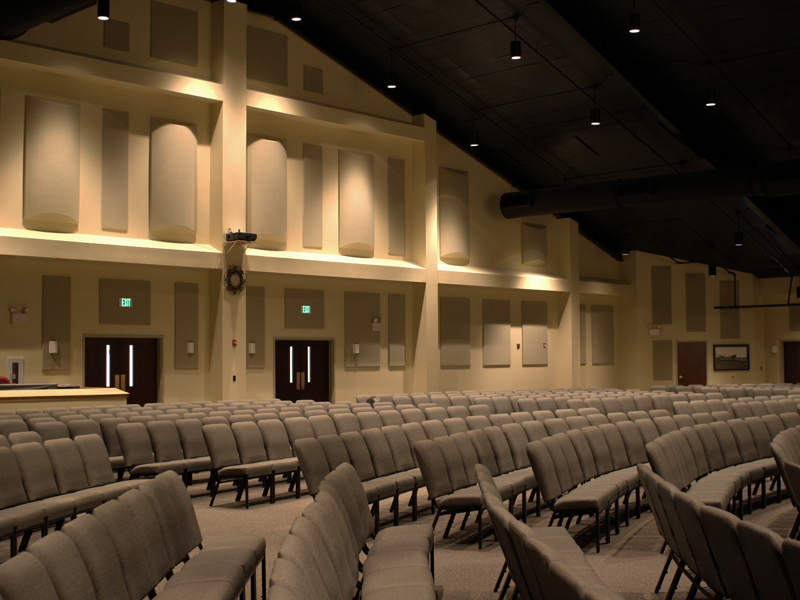
Scenario 1: Conversion from Traditional to Contemporary worship
A growing contemporary church moves into a larger, traditional sanctuary and is confronted by a raucous acoustic environment during their first rehearsal… This “live” space was perfect for traditional music, but is not conducive to a “high impact” contemporary worship service. To reduce the excessive reverberation and distracting echoes, sound absorption should be added to the rear wall (opposite stage) and side walls. Also, if using on-stage monitors, the stage walls should be treated to manage stage volume. Spot diffusive treatment that provides low-frequency absorption would also be beneficial. A good choice for this would be traditional ‘barrel’ diffusers. These are one of the oldest tried and true solutions for controlling bass issues in a performance space. Also, since these units function as both absorbers and diffusers, you get the benefits of both.
Scenario 2: Mix of Traditional and Contemporary worship services.
A worship facility decides to offer a contemporary service in addition to their traditional services… As more absorption is introduced to cut down on distracting reflections, we want to retain the envelopment and spaciousness which benefits congregational singing and traditional worship music. Sound diffusive treatment would be a great way to control echoes and specular reflections, while keeping the energy in the space. A mix of absorption and diffusion is usually best. Multipurpose spaces can also benefit from variable acoustic treatment which allows the room to “adapt” to each service, but that is a subject for another article.
Scenario 3: Poor Music Clarity in Traditional Worship space
A traditional worship space renovates their facility by adding thicker carpet, padded pews and a drop acoustic ceiling… All of a sudden, their once lively space feels “flat” and dull. Acoustic instruments are more anemic, less distinguishable and choirs have a difficult time blending and tuning. To “liven up” the space, replace sound absorptive materials with diffusers. For example, replace 1/3rd of the acoustic ceiling tiles with a combination of gypsum tiles and lay-in diffusers. These days, there are wide variety mid-range quadratic sound diffusers available for drop tile ceiling grids, as well as the more traditional barrel and pyramidal diffusers.
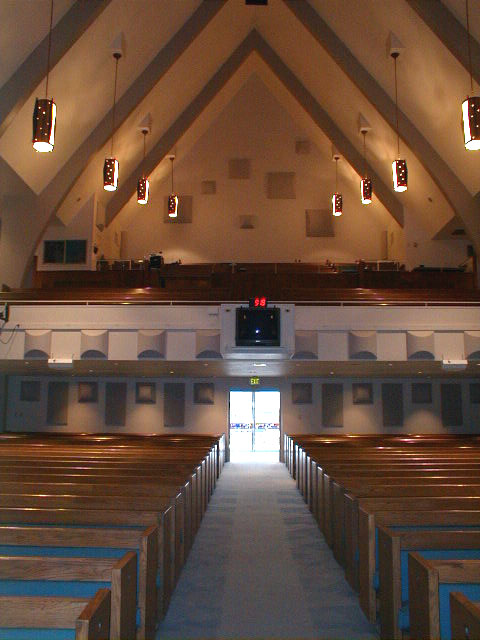
Sound diffusion can often seem a little mysterious compared to sound absorption. This is at least partly because sound diffusion is a more complex and multi-dimensional phenomenon compared to the more easily quantifiable sound absorption. However, sound diffusion is often times the missing piece of an acoustic puzzle: its benefits can help a bad room to sound good, or a good room to sound great!
 Acoustics First BLOG
You must be logged in to post a comment.