Posts Tagged subjective test
Why use a mix of objective and subjective goals to make a great sounding space?
Posted by Acoustics First in Articles, Media Room, Music Tracking Room, Recording Facilities, Recording Studio, Studio Control Room on July 30, 2024
With the ability to measure and analyze every detail of an acoustic environment, sometimes we forget about the basic fact that it should sound the way we want it to sound. There are scenarios where objective measurement is important, desired, and even required. If there is a physical safety concern that may damage hearing ( loud noises, machinery, etc.), a need to have safety information understood (evacuation/safety notices or alarms, etc.), absolute sound privacy is required (HIPAA regulations, government security, or legal need…), or the need for speech clarity for education… often we require some guidelines be met to insure the acoustics meet a decided standard for performance. These standards use objective measurement and data to make these determinations. There isn’t a governing body that regulates how your home theater should perform, or how an office needs to sound (beyond the safety and privacy concerns mentioned above.)

Entertainment venues, theaters, churches, commercial spaces, restaurants, offices, and residential spaces have very little regulation, and while there are many occasions that testing is used to improve the performance of these spaces, there are some environments where the effort to measure and quantify everything can get in the way of the goal of making a great acoustic space. If you wanted to compare different small “critical listening environments” (mixing and mastering studios are examples of these), there would be some general commonalities in their construction and treatment. Many are built to minimize parallel reflections, have short reverb times, symmetric placement of source speakers, control first reflections, and balance the frequency performance of the space.
A “ruler-flat” frequency response shouldn’t be the acoustic goal.
“Balancing the frequency performance of a space” doesn’t mean “attain ruler-flat frequency response across the entire human hearing range.” There are several reasons that the “ruler-flat” interpretation is counterproductive – the first being that it is nearly impossible to attain in any room. Second, is that everyone perceives sound differently. As humans age, almost all people will experience some degree of “presbycusis,” which is slow decline in high-frequency sensitivity that comes with age. If you are lucky enough to reach a ripe old age, there is a 60% – 80% chance (depending on the study you read) that your high-frequency hearing won’t be what it was when you were young. But even with that factor removed, when your hearing was at its best, your personal perception of sound is different from every other person – making sound, by definition, subjective.

The closest you can get to ruler-flat performance is to remove the room entirely and get some high quality headphones – but you may still find yourself tweaking the equalization curve to your preference. There are many people who feel that headphones sound unnatural, or that they are uncomfortable to listen to for long periods of time. Even the best mixing studios are not completely flat. Also, you will see many different sets of speakers in these spaces… or even headphones. These different sources are to compare how a mix will sound in different environments… and that the mix will “translate” in different listening scenarios. These environments which people will listen to music in vary to include outdoors, bathroom, kitchen, movie theater, grocery store, car, truck, SUV, convertible, living room, and more… coming from sources like phone speakers, headphones, assistants like echo and Google, bookshelf speakers, sound bars, audiophile equipment, movie theater sound systems, and an array of automotive audio systems.

Start with the basics.
If you are making a space for critical listening, there are some objective guides that will help you. If building from scratch, build with a geometry that will reduce room modes and parallel surfaces. Reduce reflections that will interfere with the source. Reduce reverb time. Control the bass response to reduce build up. These can all be readily calculated, measured, and controlled with bass traps, absorption, and diffusion. Most of the time, just following these objective guides will get you a room that will sound subjectively “good.”
After you get that far, you could continue trying to measure the room and tweak the performance to try and attain the unattainable ruler-flat response… or you could listen to music in your room and decide with you ears what should to be done to make it sound how you want. There are many subjective arguments people make about why they think something sounds better. There are philosophical arguments about listening to it “as the engineer/artist intended.” There are debates about if you should equalize music at all – even if you are in the majority of the aging population who may need to give the high-frequencies a nudge to experience the sizzle of Stevie Wonder’s glorious high-hat mastery.
When it comes to your own space… if it sounds good to you… it’s right. By following a few objective guidelines to get you in the arena, you can tweak the last bit with your ears until you are experiencing the material the way you prefer it to sound.
Binaural Bob Returns!
Posted by Acoustics First in Absorption, Diffusion, Offices, Product Applications, Products, Uncategorized, Video on April 5, 2018
Back in the summer of 2015 we had a good time stuffing a bunch of our Model D Art Diffusors® into an empty storage closet and making a bunch of racket. The results were recorded, with the help of our friend Binaural Bob and the resulting data provided some interesting insights.

Well, Binaural Bob is back! This time we had a larger room than before (10’x9’x8’), and experimented with wider variety of sounds and treatment options. While this is obviously not the same as a controlled laboratory test, it does have a certain ‘real world’ flavor that’s relatable.
For best results, turn off any compression/effects and listen on headphones.
Reference Sounds played through speaker
Ye Olde Balloon Pop Test! (Calibrated 12″ Shiny Red Latex Party Balloons!)
WARNING! BALLOONS ARE LOUD – TURN IT DOWN!
Want to hear acoustic diffusion? – Audio Demo
Posted by Acoustics First in Diffusion, Products, Uncategorized, Video on June 9, 2015
 Acoustics First® would like to announce our “Binaural Bob meets the ArtDiffusor® Model D – Audio Demo”.
While acoustic diffusion has become a common acoustic treatment, many people still struggle to explain exactly what diffusion does, or what it sounds like – and because how we hear is subjective – we at Acoustics First feel that the best way to explain it, is to let you experience it.
We have created a demo to let you compare what a room sounds like with no treatment, good diffusion treatment, and extensive diffusion treatment.
The setup is as follows:
- A small office with no windows and one solid door (6′ x 8′- 8′ ceiling)
- Standard office carpet over concrete.
- Drop ceiling with standard 2’x4′ tiles and one 2’x4′ flourescent light fixture.
- Drywall over metal studs – no insulation.
- A binaural head in the center to capture the audio
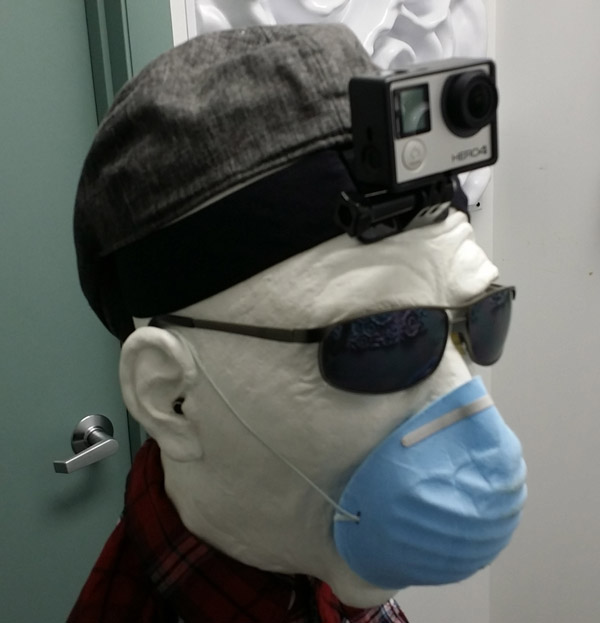
Custom Binaural Head – Binaural Bob
The demo uses different noise makers to help you hear the room:
1. A Balloon Pop
2. Bang-Snaps (Pop-Its)
3. Slamming a Book Shut
The space is configured three different ways:
1. No Treatment (Bare Walls)
2. Good Diffusion Treatment (9 ArtDiffusor® Model D at Ear Level)
3. Extensive Diffusion Treatment (27 ArtDiffusor® Model D Distributed)
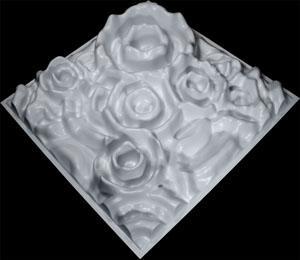
Art Diffusor® Model D –
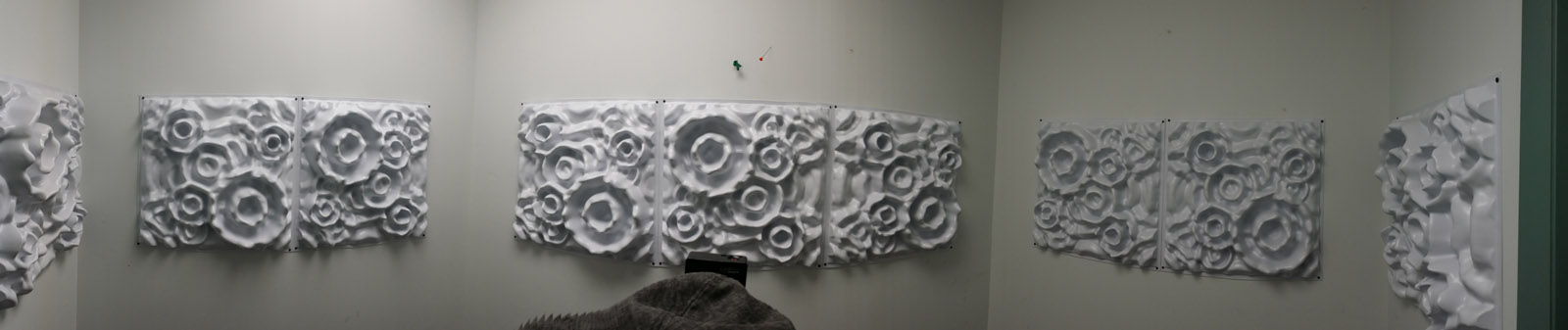
Panoramic – 9 Model D Treatment Demo

Panoramic – 27 Model D Treatment Demo
While the Demo is best experienced with a pair of reference headphones – earbuds or decent speakers should work as well. The headphones allow you the ability to hear the room just like it sounded when the test was run without hearing your own room – Think of it like auditory immersion. This is the best way (we’ve found) to compare the results of adding high-quality diffusers to an inferior space.
The test is run in rounds, you will hear the same noise (a Balloon Pop, for example) in each room configuration (First Untreated, then with Good Treatment, and finally Extensive Treatment) before progressing to the next round. The image will show the room configuration (and the noise producer in the upper corner) while the sound is played.
The Demo is as follows:
1. Balloon Pop (1 Round)- Untreated, Good Treatment, Extensive Treatment
2. Bang-snaps (3 rounds) – Untreated, Good Treatment, Extensive Treatment
3. Book Slam (2 rounds) – Untreated, Good Treatment, Extensive Treatment
Note: ArtDiffuser® Model D units were the only acoustic treatments used in this demo.
While we would rarely treat a room only with diffusers, the results of treating this space with just diffusers was interesting…
The diffusers reduced the SPL from 89 dB down to 87dB according to a pink noise test with the handy-dandy Radio Shack SPL meter…
and
Cut the RT(60) from about .7 seconds down to about .4 seconds…
Sometimes hearing is believing.
Believe it!
– Acoustics First®.
 Acoustics First BLOG
You must be logged in to post a comment.