Posts Tagged Double Duty
Eight very different 2′ x 2′ sound diffusers.
Posted by Acoustics First in Diffusion, Product Applications, Products, Recording Facilities on June 30, 2025
Acoustics First® has maximized the idea of adaptable designs. One of the most common modular architectural elements is the 2′ x 2′ ceiling grid. While standard, fiber ceiling tiles have their uses, specialized acoustic environments require higher-performing materials – for both absorption and diffusion. While Acoustics First® excels with its Sonora® and Cloudscape® Ceiling tiles, today we are going to focus on the wide range of 2’x 2′ diffusers that have been developed over the several decades.
Sound diffusers in a 2′ x 2′ format have several advantages, other than just being placed in a ceiling grid to help diffuse the ceiling. They integrate well on walls and in arrays, where they can help break up large flat surfaces and help minimize flutter and standing waves from parallel surfaces. While they provide many different aesthetic options, there are also many different functional types of diffusers available in this form-factor to address different acoustic issues, from flutter, bass issues, targeted frequency absorption, and geometric scattering. Let’s look at some of these devices and their uses.
Geometric Diffusers.
Geometric diffusers have been around a long time. These devices break up large flat surfaces and redirect or “scatter” those reflections in different directions. They work great in environments where you need to redirect acoustic energy in a predictable way, and redistribute a specular reflection over a wider area. In a 2′ x 2′ size, you can also get a fair amount of bass absorption, due to the large cavity behind the geometric shapes creating a space that can be stuffed with absorbent material to tune it.


Quadratic/Mathematic Diffusers
Mathematic diffusers are devices that use specific calculations to design their size, shape, and structures to effect their performance. A common type is called the Quadratic Residue Diffuser (sometimes called a Schroeder Diffuser, after its pioneering inventor, Manfred Schroeder). This type uses a Quadratic Residue Sequence that optimizes uniform sound diffusion at specific design frequencies. There are different ways to implement these designs, but two common designations are based on their diffusion patters – 1D or 2D. A 1D Quadratic diffuser mostly spreads energy in one plane, and a 2D provides a hemispheric pattern.
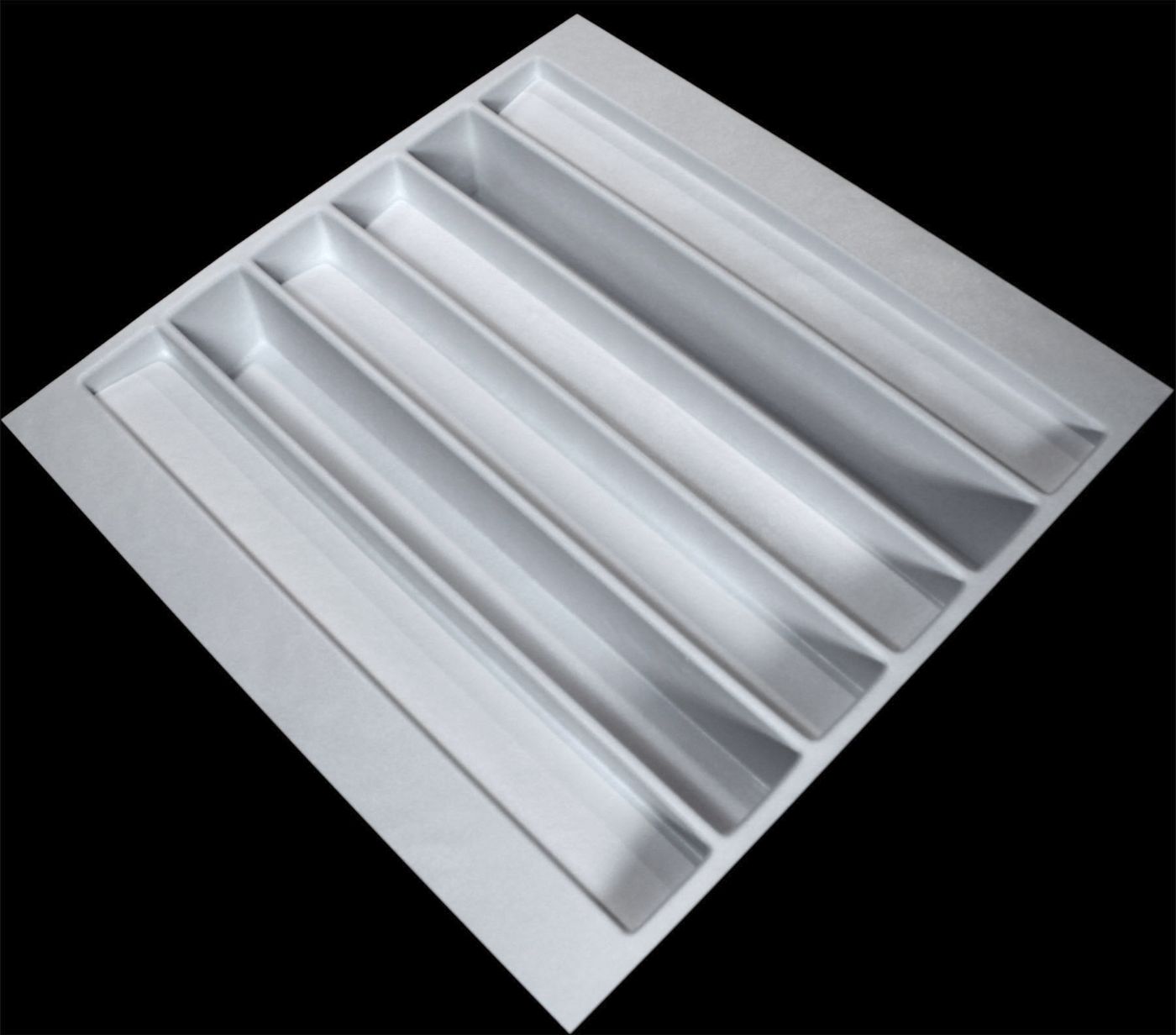


Organic Diffusers.
Organic diffusers are a variation on the classic mathematic diffusers which use different mathematic functions to optimize the diffusion further by creating a smooth transition. Once such method is called Bicubic Interpolation. Instead of having the math restricted to having blocks at certain heights, the interpolation bridges these heights using a function that provides a smooth transition to the next target height. This transition creates unlimited resolution in the frequencies within it’s functional range, providing expanded uniformity throughout its range, and increasing its capabilities. As different frequencies are affected differently depending on their wavelength – the organic diffusers have no hard edges to define their pattern and look differently to different frequencies and energy from varied sources.

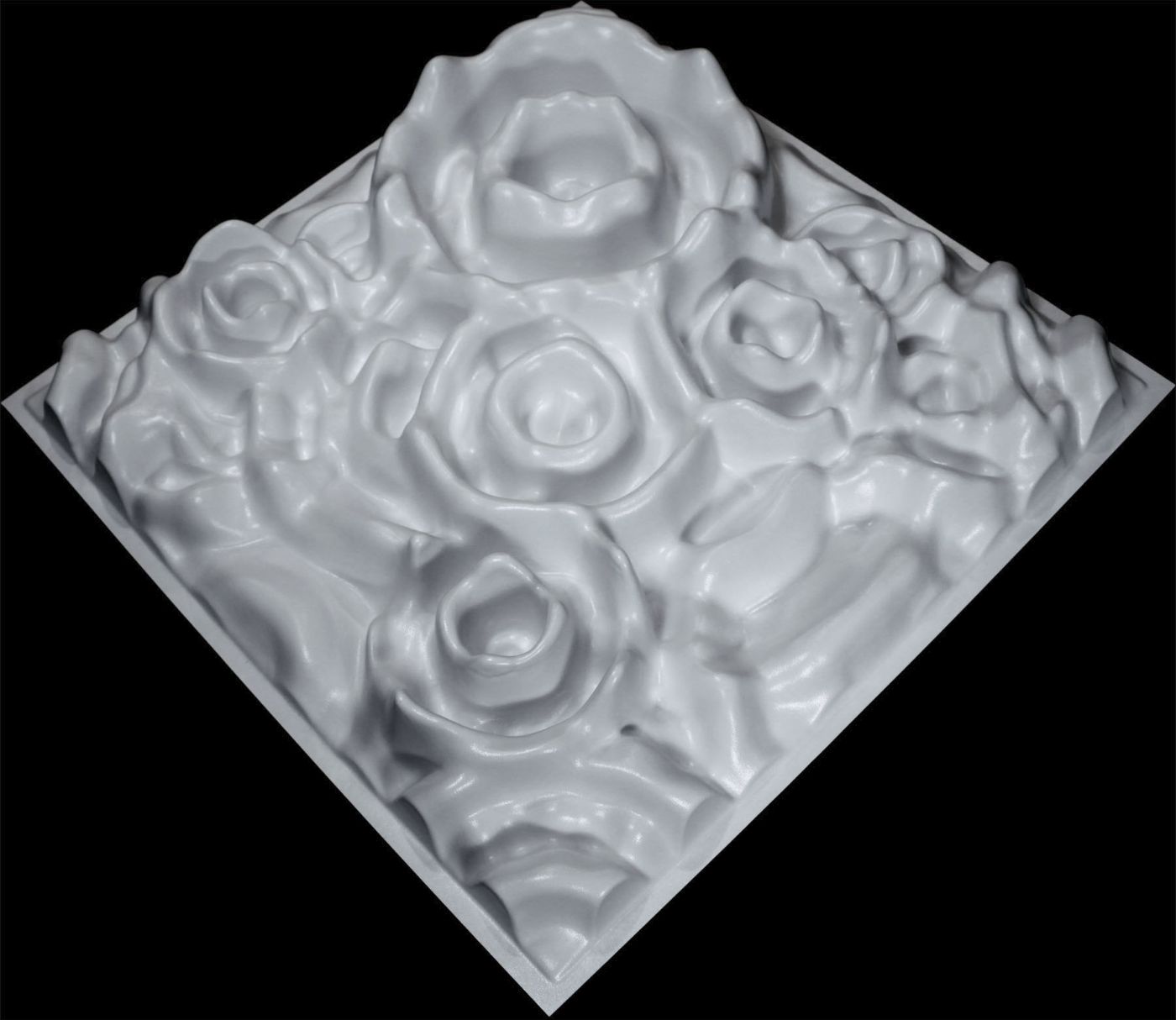
These diffusers all have the ability to be used in different types of installations for different reasons. Many of these diffusers are mixed and matched in the same room. You will see these on the walls or ceiling, and placed in different locations. There are rooms with Double-Duty diffusers for low frequency control, Model C for Mids, and Model F for flutter, while other rooms may have Aeolians™ on the rear wall and Model C’s and Model F’s to control the ceiling.

Keep in mind, these aren’t even all the diffusers we have available, these are just the ones specific to the 2′ x 2′ format. The Aeolian™ has a 1′ x 1′ version called the Aeolian™ Mini. There are flat panel diffusers that are hybrid absorbers and diffuser like the HiPer Panel® and the HiPer Panel® Impact. There are even large format versions of the Double Duty™ diffuser, Pyramidal, and even the Quadratic Diffuser.
For more info about these diffusers, read some of our, “Similar, Yet Different Series,” where we go into more detail about our products… and how some of these are similar, yet different!”
If you have any questions as to which products you need to optimize your space, reach out to Acoustics First® and we can help you find which products will be best for your application. Remember that Acoustics First’s® full line of sound diffusers are all made in the USA, with many available in stock for quick shipping.
John Bullard Live Room – Tuning a Live Room for Classical Banjo
Posted by Acoustics First in Absorption, Customer Feedback, Diffusion, HOW TO, Music Tracking Room, Product Applications, Products, Recording Facilities on May 3, 2023
When you think of classical music; what instruments come to mind? Piano? Violin? Cello? …What about Banjo?
In the summer of 2022, classical banjoist John Bullard reached out to Acoustics First for assistance with his newly renovated home-studio. John is one of a select group of classical musicians aiming to showcase the versatility of this uniquely American instrument. The banjo, with John’s expertise, lends a very distinct, melancholy sound to contemporary and traditional compositions.

Having recorded a number of albums already, John knew he wanted his live room to be catered specifically to tracking solo, classical banjo as well as small acoustic ensembles. Acoustics First analyzed John’s live room and came up with a treatment design that would achieve an “ideal-as-possible” acoustic environment for recording classical instruments.
The largely reflective live room had walls comprised of unfinished, reclaimed wood planks over plywood, a drywall ceiling, stone fireplace and a polished concrete floor. The parallel, hard surfaces contributed to a poor tracking environment; with standing waves and “flutter” echoes adding unwanted coloration to recordings, inhibiting music definition.
Spaces used for rehearsing and recording classical music often benefit from elevated levels of reverberation, which add a sense of warmth and ambience to acoustic music. Although the reverb in John’s untreated room was only slightly excessive when measured, it was far from “diffuse”, with the majority of energy coming from early reflections.
The primary challenge in the live room was to address the early specular reflections and standing waves without taking too much “life” out of the room. To achieve this delicate balance, wide band diffusion was recommended as the primary ceiling and wall treatment with selective sound absorptive treatment with fabric-wrapped Sonora® panels.

Double Duty Diffusers™ and Aeolian® sound diffusers were recommended as they would also provide some much needed low-frequency absorption in addition to broadband diffusion.
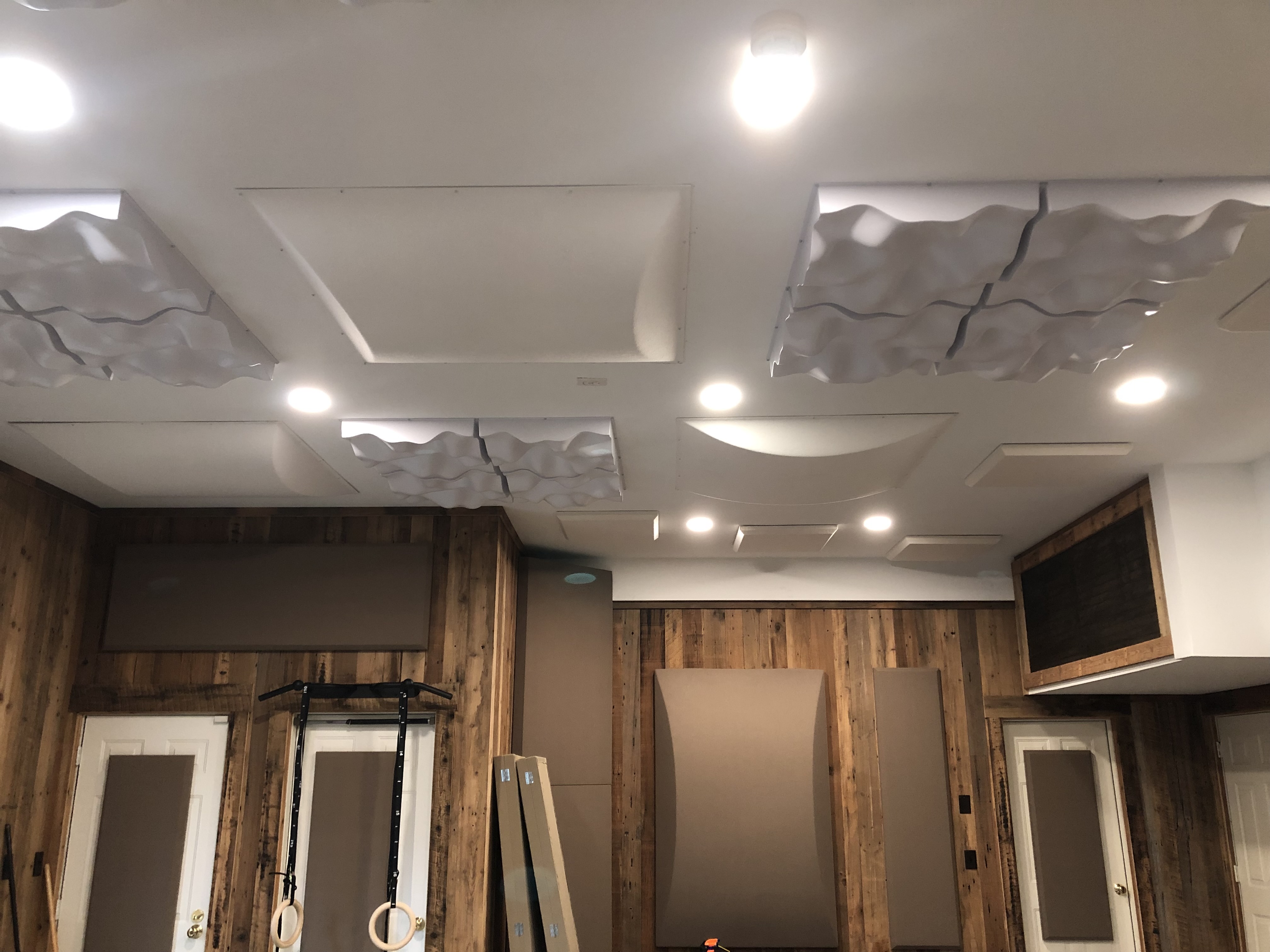
After the treatments were installed, John got right to work on experimenting…
“…ready to start doing extensive test recordings to locate the best spot and rug configuration for solo banjo… It sounds really good to my ear – now to see how the microphones hear it!”
John Bullard

Please check out John Bullard’s music!! – https://www.johnbullard.com/
Similar, Yet Different. Double Duty Diffuser™ Vs. Pyramidal
Posted by Acoustics First in Diffusion, Products, Uncategorized on January 15, 2021
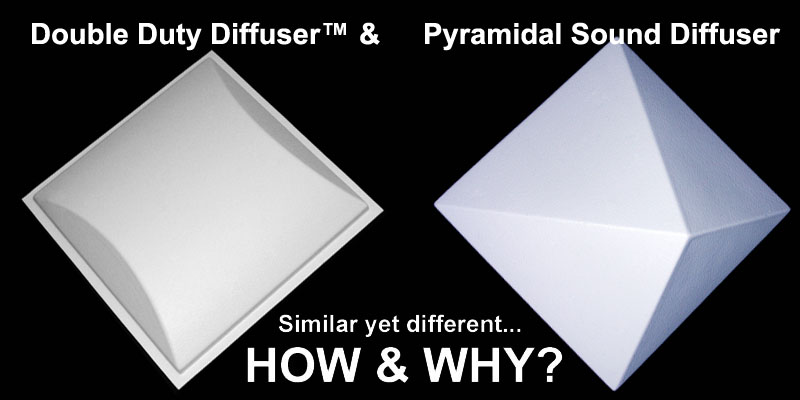
For this installment of “Similar, yet Different”, we will be going retro – The Barrel Vs. The Pyramid! These two shapes are the historic foundations for modern acoustic treatments. How did they come about? Why do they work? How are they different?
These two shapes have origins before written history. The pyramids of Egypt may not have been renowned for their acoustic properties, but they certainly show the historical age of this shape. The barrel is also an ancient shape, born from the pillars of historic temples and gathering places. Both of these shapes have been used in architecture for the expanse of human history, and their acoustic properties have been studied in numerous environments, in many different applications.
These shapes are often referred to as “primitive.” The barrel, in its basic form, is a truncated cylinder – basically a segment of the cylinder. The pyramidal is, in this case, a modified/offset pyramid… a pyramid without equal sides. Their differences begin with this fundamental variable – the pyramid has angled planes and the Double Duty™ is a large curved surface.
Symmetry vs. Asymmetry
Another simple difference is the fact that the Double Duty™ is symmetric and the offset pyramid is asymmetric. The barrel primarily scatters sound across the curve of the face – sending acoustic energy in a wide arc. However, the pyramid’s facets are all angled slightly differently – reflecting in different directions. This allows the pyramid to be installed in complex arrays which create more “random” reflections due to their different facet angles. The Barrel is primarily a one-dimensional diffuser, and installs either horizontally or vertically.

Note that the Double Duty™ (barrel) scatters across the curve of the face while the Pyramid throws energy in different directions.
Diffraction.
There is another phenomenon that helps to contribute to diffusion – and that is diffraction. Diffraction is what happens to sound when it hits a corner or edge. Unlike light, acoustic energy is the physical fluctuation of pressure changes – which gives sound the ability to travel around corners. This bending varies by the wavelength of the sound and the size of the object in encounters. Both barrels and pyramids have facets which introduce diffraction, and while both can be made in different sizes, the offset pyramid has different sized facets on each device – contributing to more randomized diffraction at different frequencies.
Inverse Square Law
Without getting too heavy into math, as sound travels it decreases in intensity. This is due to the fact that sound “spreads out” as it travels. It is produced with a finite amount of energy, so intensity drops as it covers more space. Both the barrel and pyramid increase the rate that sound “spreads out,” which diminishes the intensity of the sound – however, they both do it slightly differently, however..
The Double Duty’s™ curvature leaves the wave primarily intact, but it increases the rate of expansion across the curve. This redirection is very smooth and predictable, where the random facets of the offset pyramid break up the sound into sections which travel in different directions. At the intersection of those facets, diffraction takes the reigns and scatters sound even further.
By increasing the rate of expansion of the wave, you decrease its intensity while also breaking up the wavefront which helps to reduce echoes and flutter. Both the barrel and the pyramid are perfect for larger spaces, as those massive surfaces do a great job of controlling reflections from large wave fronts. Also, due to their simple shapes, they can be made really big, which helps!
Absorption.
There is one more feature which is sometimes overlooked. Because of the material of their construction, and the large volume of air behind them, these diffusers exhibit a certain amount of “bass trapping.” The Double Duty™ diffuser got it’s name due to this characteristic. It’s not just a diffuser, but also a bass trap. The Pyramidal diffuser also exhibits bass absorption, though it is slightly less.
So there it is… the battle of the classics! Sometimes, keeping it simple is the way to go!
Acoustics First® makes sound Visible!
Posted by Acoustics First in Diffusion, Product Applications, Products, Uncategorized, Video on November 18, 2016
 As many of you know, Acoustics First® invests a great deal of energy in the development of the science of acoustics. Here are three ways that we are making advances that help people learn and actually Visualize acoustics!
Those interested in sound diffusers have certainly noticed that Acoustics First® has produced a Diffuser Data book, containing all kinds of test data about how our diffusers contribute to the sound in your space. This information is a great advancement and we have worked closely with the ASTM committee developing this test method. Some people wonder exactly how the test produces the data that we report, and we have developed a simulation to show exactly how the sound energy is sampled during this test.
If you download the Diffuser Data booklet, you can see a picture of the gigantic test arc at NWAA Labs which is used for the real world tests.
Acoustics First – Diffuser Data Test Demo from Acoustics First®.
We have also made leaps and bounds in using simulations to show the different ways that diffusion develops in a space. Depending on the type and placement of the diffusers you install, the diffuse field will develop at different speeds, at different frequencies. We can now show a couple of simulations of the development of a diffuse field to help you visualize how sound moves in room without treatment and with two different sets of diffuser treatments.
Acoustics First – Room Simulations from Acoustics First®.
Bonus video! Imagine being able to see the Untreated room and the Model D room from a different angle – To be able to move around the outside of the room and see how the sound field develops from a different perspective. Imagine no more! Here it is!
Acoustics First – Sound Field Development Simulation – 3D Panning from Acoustics First®.
If you prefer to use YouTube – you will find the videos uploaded at our YouTube channel here.
We hope these helped you to “look” at acoustics in a whole new way, and stay tuned – more advancements are coming soon!
Contact Acoustics First® for a high bitrate, presentation quality version of the videos – as well as permission and terms of use.
Bonus! Simulations! Now in stereo – and with absorption! Click Here!
 Acoustics First BLOG
You must be logged in to post a comment.