Posts Tagged diffusion
Big vs. Bigger: 2′ vs 4′ Acoustic Diffusers
Posted by Acoustics First in Diffusion, Product Applications, Products on December 16, 2025
A couple common form factors in acoustics are based on building material sizes. Ceiling grids are a common place to install acoustic devices, and you will find that many are built to either work in a 2’x2′, 2’x4′, or 4’x4′ ceiling grid installation. This makes sense, but did you know that these devices also perform differently in some cases due to their dimensions? This is especially true with acoustic diffusers.
When you’re tuning a room—whether it’s a studio, theater, rehearsal space, or even a high-end listening room—acoustic diffusers are one of those rare tools that improve clarity without taking the life out of the space. Designs like the Double Duty Diffuser, Pyramidal Diffusers, and Quadratic Diffusers all share that same mission: redistribute sound energy so your room feels open, natural, and honest.
But while they may look similar in concept, their size changes the game. A 2’x2′ panel and a 4’x4′ panel both diffuse sound, but their effect—especially in the low-frequency and low-mid ranges—can be very different.
2’x2′ Diffusers — Compact Control
2’x2′ units are the most modular diffusers in the lineup. Their smaller footprint makes them ideal for:
- Breaking up mid and high-frequency reflections
- Treating small and medium rooms
- Sitting comfortably in grid ceilings or tight wall spaces
Because of their size, 2’x2′ diffusers don’t interact as much with the low-frequency energy in a room. Bass waves—being physically large—tend to wrap around smaller objects. The result? Excellent clarity improvements in the mids and highs, with a very predictable diffusion performance. The Double Duty Diffuser and Pyramidal diffusers have been a standard in breaking up planar surfaces for decades. While their diffusion in low frequencies is limited at this size, the air cavities do help control some upper bass frequencies through absorption.
The tuned mid frequency effects of the 2’x2′ quadratic, and the smooth performance of the Double Duty or Pyramidal diffuser are perfect for control rooms, edit rooms, drum booths, and anywhere you want accuracy without sacrificing sparkle.

4’x4′ Diffusers — Where Diffusion meets Bass Control
Now we get to the big ones.
A 4’x4′ diffuser is similar in concept to its smaller relatives, but the scale moves it into a different acoustic category. At this size, diffusers begin to influence longer wavelengths, which opens the door to something smaller diffusers often struggle with…
Low-frequency interaction
Large diffusers present enough depth, volume, and surface area to affect the bass spectrum. The extra size creates cavities which are tuned to reduce bass, and they have surfaces large enough to redirect those lower frequencies.
- Break up standing waves in the low-mid range
- Reduce modes and nodes common in rectangular rooms
- Add a sense of openness to the bass field
- Prevent buildup behind listening positions
In other words: same diffuser concept, very different low-end behavior.
Wide-area coverage
A single 4’x4′ panel can modify a huge portion of a wall, creating an even, spacious character that feels less like “treatment” and more like a room that’s naturally well-behaved.
These panels shine in larger studios, live rooms, and worship spaces—anywhere you need diffusion that reaches deeper into the frequency spectrum – and can break-up large, flat, specular surface reflections, which are responsible for flutter, echoes, bass buildup, and long reverb times.
Which do you need?
There are two main factors in the decision: space and performance requirements. In certain environments, it’s impractical or impossible to install large 4’x4′ or larger diffusers; It also may not be the best solution – even if it may appear to be on paper. While a single, large barrel diffuser may appear ideal, you may not have enough physical space to allow the diffusion to develop – where several smaller diffusers would be the better solution.
In short, your physical space and acoustic conditions will dictate which size elements will give you the most benefit in your environment.

You say “Diffuser,” I say “Diffusor”
Posted by Acoustics First in Diffusion, Q&A, Uncategorized on November 11, 2025
If you’ve spent any time around acoustic treatment—especially sound diffusion—you’ve probably noticed something odd: sometimes the product is called a “diffuser“, and other times it’s a “diffusor“. For newcomers, this can feel like a secret code or a subtle technical distinction – But the truth is much simpler.

Many trace the dual spelling back to Manfred Schroeder, the German physicist who developed the mathematically designed Quadratic Residue Diffusor (QRD).
In German, the word is spelled “Diffusor.” When Schroeder’s work entered the academic world, the spelling likely came with it.
Because his research became foundational in architectural acoustics, the German spelling spread through physics papers, textbooks, and graduate-level acoustics programs. Over time, “diffusor” became a common spelling when discussing mathematical or Schroeder-style diffusors specifically.
As manufacturers began producing these mathematically derived designs—like the ArtDiffusor® line from Acoustics First® (and many other early products)—they retained the “diffusor” spelling as a nod to the academic and scientific origins.
Before long, the industry ended up with two spellings that referred to the same thing:
- Diffuser – the standard English spelling
- Diffusor – the academically inherited, German-influenced spelling tied to Schroeder’s work
Both spellings appear throughout the professional audio world, and both are correct.
Is There Any Practical Difference?
No. None. Zero.
There is no technical difference between a “diffuser” and a “diffusor.” They both refer to devices used to redistribute sound energy and improve the acoustic quality of a space through accelerating the development of sound field diffusion. The spelling variation is purely linguistic.
Think of it like “colour” vs. “color” or “flavour” vs. “flavor.” British English keeps the “u,” American English drops it. (However, if you ask a Brit, they’ll tell you Americans are obviously spelling it wrong.)
The “diffusor/diffuser” split works the same way—just with a German twist.
So Which Should You Use?
Use whichever feels natural or matches the context you’re writing in. Many engineers and academics use “diffusor” when referring to Schroeder-type or other mathematical designs, simply out of tradition. Others stick with the standard English “diffuser.”
Tomato. Tom-ah-to.
Throwback Thursday – Diffusion and Binaural Bob from 10 years ago!
Posted by Acoustics First in Diffusion, Offices, Product Applications, Products, Uncategorized, Video on February 27, 2025
In June of 2015, Acoustics First® posted about our experiment which allowed people to hear the effects of sound diffusers in a small space. The experiment consisted of treating a small office with varying numbers of our new (at the time) Art Diffusor® Model D sound diffusers, then providing various sonic stimuli and capturing and measuring the results with a custom binaural head (called “Binaural Bob.”) This experiment received great feedback and with that input, future experiments were conducted using a similar method, mixing absorbers and diffusers, and having a wider range of stimuli.

But here we look back to the first… This is the video we produced during that experiment way back in 2015 with Binaural Bob, a bunch of Model D’s, a small office, some balloons, bang snaps, and one very heavy book.
If you would like to revisit the original post in it’s entirety, here is the link!
https://acousticsfirst.info/2015/06/09/want-to-hear-acoustic-diffusion-audio-demo/
St. Andrew by the Bay – Custom HiPer® Impact Panels to absorb and diffuse sound!
Posted by Acoustics First in Absorption, Diffusion, Product Applications, Worship Facilities on April 10, 2024
St. Andrew by the Bay is a traditional worship facility with a focus on spoken word worship and congregational singing. The large volume and hard surfaces in this space are the physical features most at fault for excessive reverberation, comb filtering and distracting “slap” echoes (discrete sound reflections usually caused by a distant, reflective back-wall).
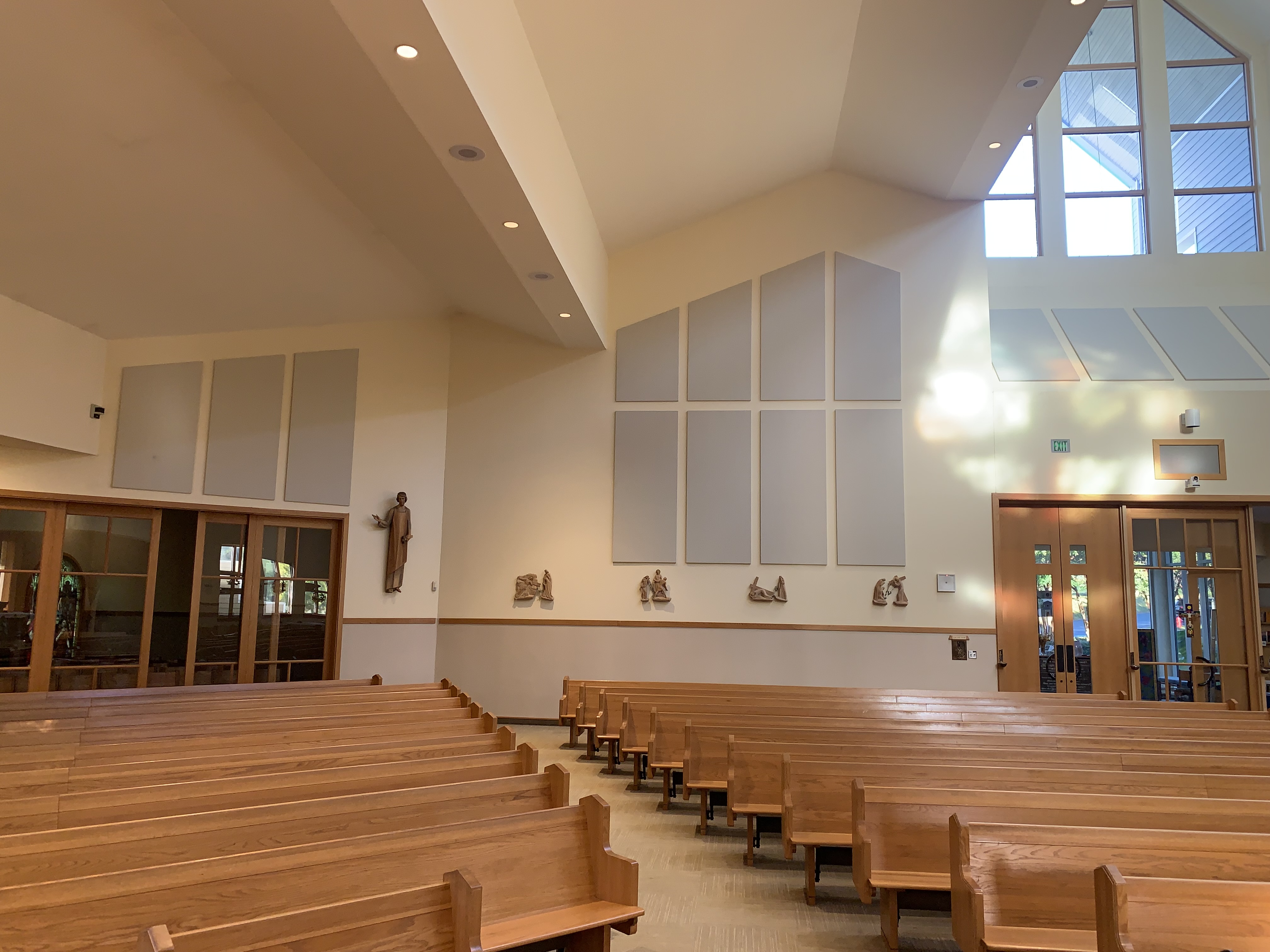
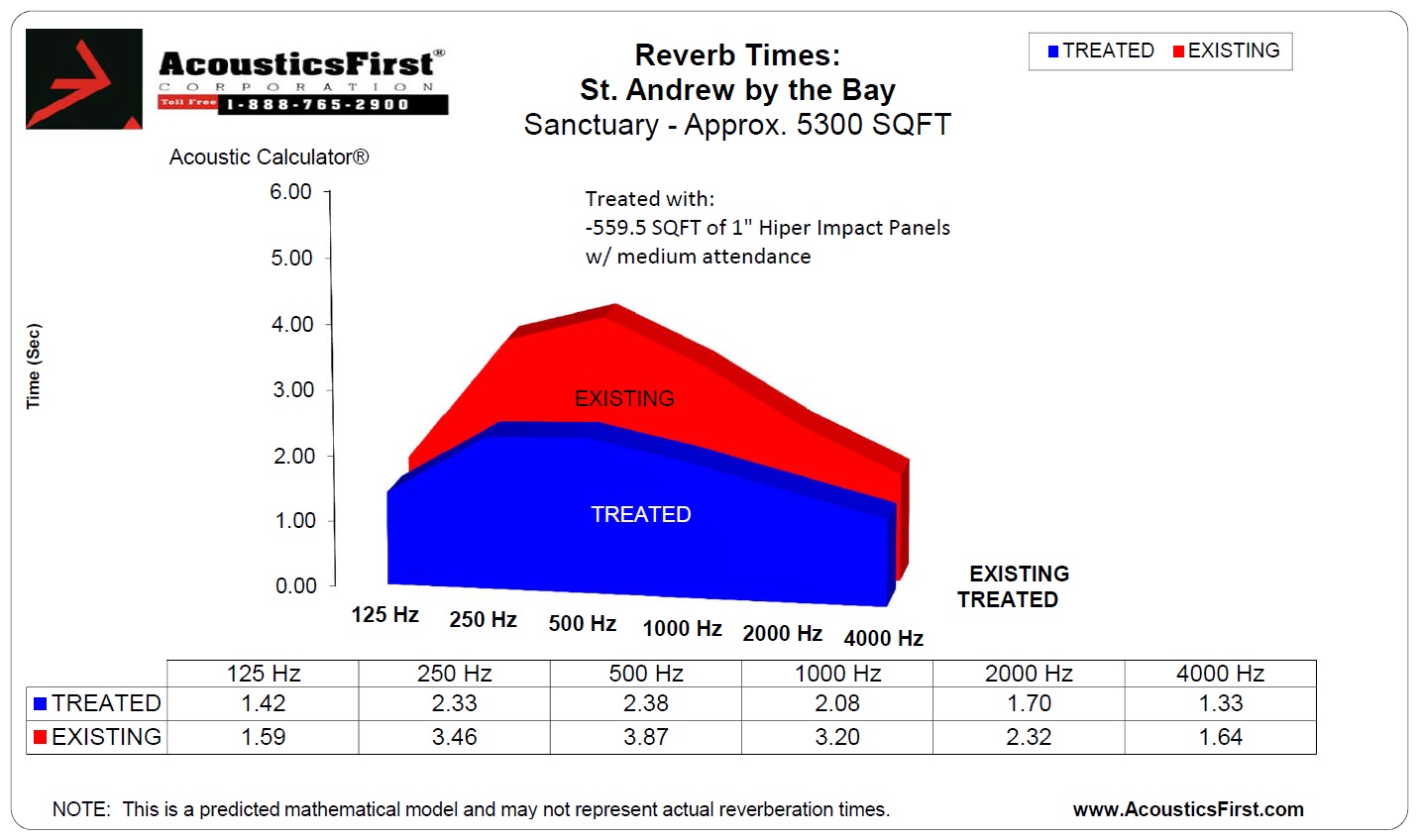
To correct the slap-back and curb excessive reverb without “over deadening” the space, we recommend distributing approx. 550 SQFT 1” HiPer® Impact absorber/diffuser panels throughout the rear wall areas (see attached layout). HiPer® Impact panels absorb low frequencies and diffuse high-frequencies, yielding a much more even room response. In addition to controlling bass buildup, the high-frequency scattering will help retain some “life” in the room for acoustic and choral performances.
Reverb Prediction – Historically, churches relied on an abundance of hard surfaces to propagate sound to the rear of the nave, so they benefited from very long reverb times (upwards of 4-5s). Modern sound systems allow for a much more focused sound and equitable listening environment , so these extreme reverb tails are no longer necessary and can actually degrade the experience of the congregation. Churches of this size with a sound system and traditional worship services should have a reverb time somewhere in the 1.5-2.25s range. We entered the sanctuary’s dimensions and construction materials into our acoustic calculator and made a prediction of reverb times before and after treatment.
From Lee Hartman & Sons who performed the install “Here are some photos of the finished panels at St. Andrew by the Bay. It turned out great and client is very happy. Many thanks to Cameron for the detailed layout.”

John Bullard Live Room – Tuning a Live Room for Classical Banjo
Posted by Acoustics First in Absorption, Customer Feedback, Diffusion, HOW TO, Music Tracking Room, Product Applications, Products, Recording Facilities on May 3, 2023
When you think of classical music; what instruments come to mind? Piano? Violin? Cello? …What about Banjo?
In the summer of 2022, classical banjoist John Bullard reached out to Acoustics First for assistance with his newly renovated home-studio. John is one of a select group of classical musicians aiming to showcase the versatility of this uniquely American instrument. The banjo, with John’s expertise, lends a very distinct, melancholy sound to contemporary and traditional compositions.

Having recorded a number of albums already, John knew he wanted his live room to be catered specifically to tracking solo, classical banjo as well as small acoustic ensembles. Acoustics First analyzed John’s live room and came up with a treatment design that would achieve an “ideal-as-possible” acoustic environment for recording classical instruments.
The largely reflective live room had walls comprised of unfinished, reclaimed wood planks over plywood, a drywall ceiling, stone fireplace and a polished concrete floor. The parallel, hard surfaces contributed to a poor tracking environment; with standing waves and “flutter” echoes adding unwanted coloration to recordings, inhibiting music definition.
Spaces used for rehearsing and recording classical music often benefit from elevated levels of reverberation, which add a sense of warmth and ambience to acoustic music. Although the reverb in John’s untreated room was only slightly excessive when measured, it was far from “diffuse”, with the majority of energy coming from early reflections.
The primary challenge in the live room was to address the early specular reflections and standing waves without taking too much “life” out of the room. To achieve this delicate balance, wide band diffusion was recommended as the primary ceiling and wall treatment with selective sound absorptive treatment with fabric-wrapped Sonora® panels.

Double Duty Diffusers™ and Aeolian® sound diffusers were recommended as they would also provide some much needed low-frequency absorption in addition to broadband diffusion.
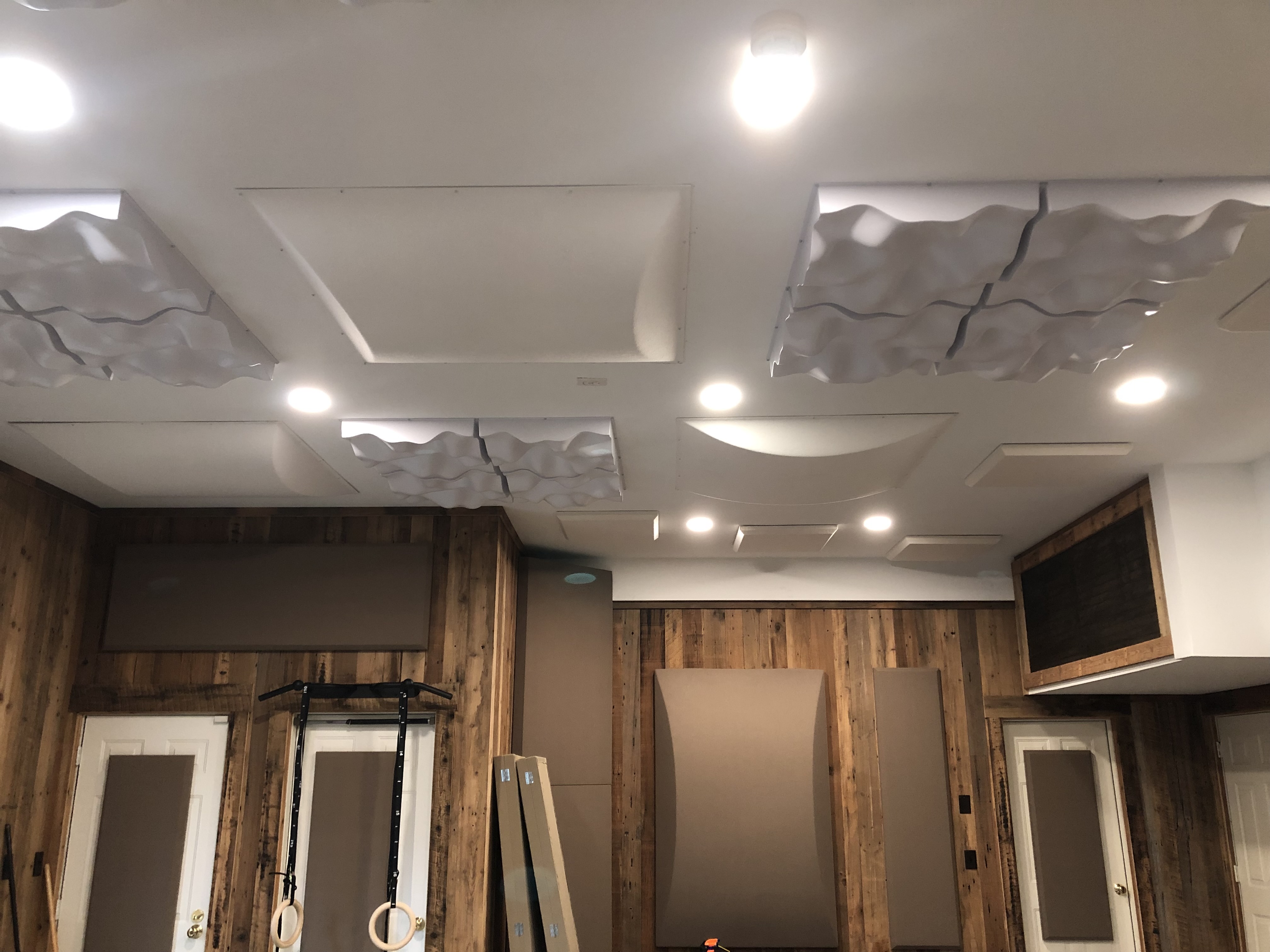
After the treatments were installed, John got right to work on experimenting…
“…ready to start doing extensive test recordings to locate the best spot and rug configuration for solo banjo… It sounds really good to my ear – now to see how the microphones hear it!”
John Bullard

Please check out John Bullard’s music!! – https://www.johnbullard.com/
 Acoustics First BLOG
You must be logged in to post a comment.