Posts Tagged baffles
Sabins, SAC, & NRC — a practical guide.
Posted by Acoustics First in Absorption, Articles, HOW TO on September 18, 2025
When optimizing a room’s acoustics, you’re often balancing how much sound is absorbed (loss) against how much bounces around (reverberation). Some common ways to describe absorption — sabins, SAC, and NRC — look different, but they’re closely related.
Sabins
A sabin is a direct measure of absorption: One sabin equals the sound-absorbing effect of one square foot of a perfectly absorbing surface (like an open window – sound goes out, but doesn’t come back.) In practice, manufacturers or labs will report a component’s equivalent absorption area in sabins at various frequencies. Sabins are additive: add the sabins of all items in a space to get the room’s total absorption for use in reverberation calculations.

SAC
Sound absorption coefficients (SAC) are used to simplify large square footage calculations. Each SAC itself is derived from the measured equivalent sabins of a test sample divided by the sample’s area. This allows you to multiply the square footage of a certain material by the SAC and it will tell you how many sabins it will absorb at a certain frequency. You may also see an average of all the SACs, or a subset of those values… a specific, often-used subset is the Noise Reduction Coefficient (NRC).
NRC and how it’s calculated
NRC (Noise Reduction Coefficient) is a number that represents a material’s average absorption performance at mid-to-high frequencies. It’s calculated by taking the arithmetic average of the material’s sound absorption coefficients (SACs) at 250 Hz, 500 Hz, 1000 Hz and 2000 Hz (per ASTM C423 or other standard test procedures). NRC is typically reported to the nearest 0.05 and runs from 0.00 (reflective) to 1.00 (very absorbent). Being an average, it isn’t the most accurate method, but it can give you a quick estimate which can be useful in the planning stages.

Practical Mathematic Relationship
- From measured data: SAC = measured sabins ÷ sample area.
- NRC is the average of SACs across four bands (250 Hz, 500 Hz, 1000 Hz and 2000 Hz).
- To convert NRC into a working absorption number for a planar surface:
sabins = NRC × area (ft²). - For discrete units (baffles, clouds): manufacturers often give sabins per unit, so total absorption is sabins per unit × number of units.
Why sabins for baffles and NRC for wall/ceiling panels?
Hanging devices like baffles are three-dimensional, exposed on multiple faces, and their effective absorption depends on orientation, spacing, and edge behavior. It’s more accurate and user-friendly to report their absorption as “# sabins per unit.” Flat-mounted wall or ceiling panels cover a known area and behave predictably per square foot, so SAC or an NRC (per ft²) is a convenient, normalized way to estimate absorption across a room.
Putting it into RT60 calculations
RT60 calculations depict the amount of time it takes for a sound to decay 60dB in a particular space with specific treatments. (60dB is roughly a 1000-fold reduction in sound pressure.) Reverberation-time formulas (like Sabine’s) use the room’s total absorption in sabins in the function. A basic average will use NRC × area for planar coverage and add sabins-per-unit for baffles. Sum everything up to get total sabins, then plug that into your RT calculation to estimate RT60.
If using feet your calculation is…
RT60 = 0.049 x Room Volume ÷ Total Sabins
If using metric your calculation is…
RT60 = 0.161 x Room Volume ÷ Total (Metric) Sabins
In summary:
NRC is an area-based average (for flat-coverage estimates); SAC is a sabins per square foot coefficient (for efficient absorption calculations using area); sabins per unit are direct, measured absorption values (better for discrete, hung, multi-faced items).
Taming the Cube with Cloudscape®
Posted by Acoustics First in Absorption, Classrooms, Customer Feedback, Manufacturing, Media Room, Product Applications, School & Educational Facilities, Teaching Rooms, Universities on October 21, 2022
When the University of the Pacific reached out to help tame the acoustics of their makerspace called “The Cube”, many different concerns were underlined about the space, its uses, and the problems they faced.
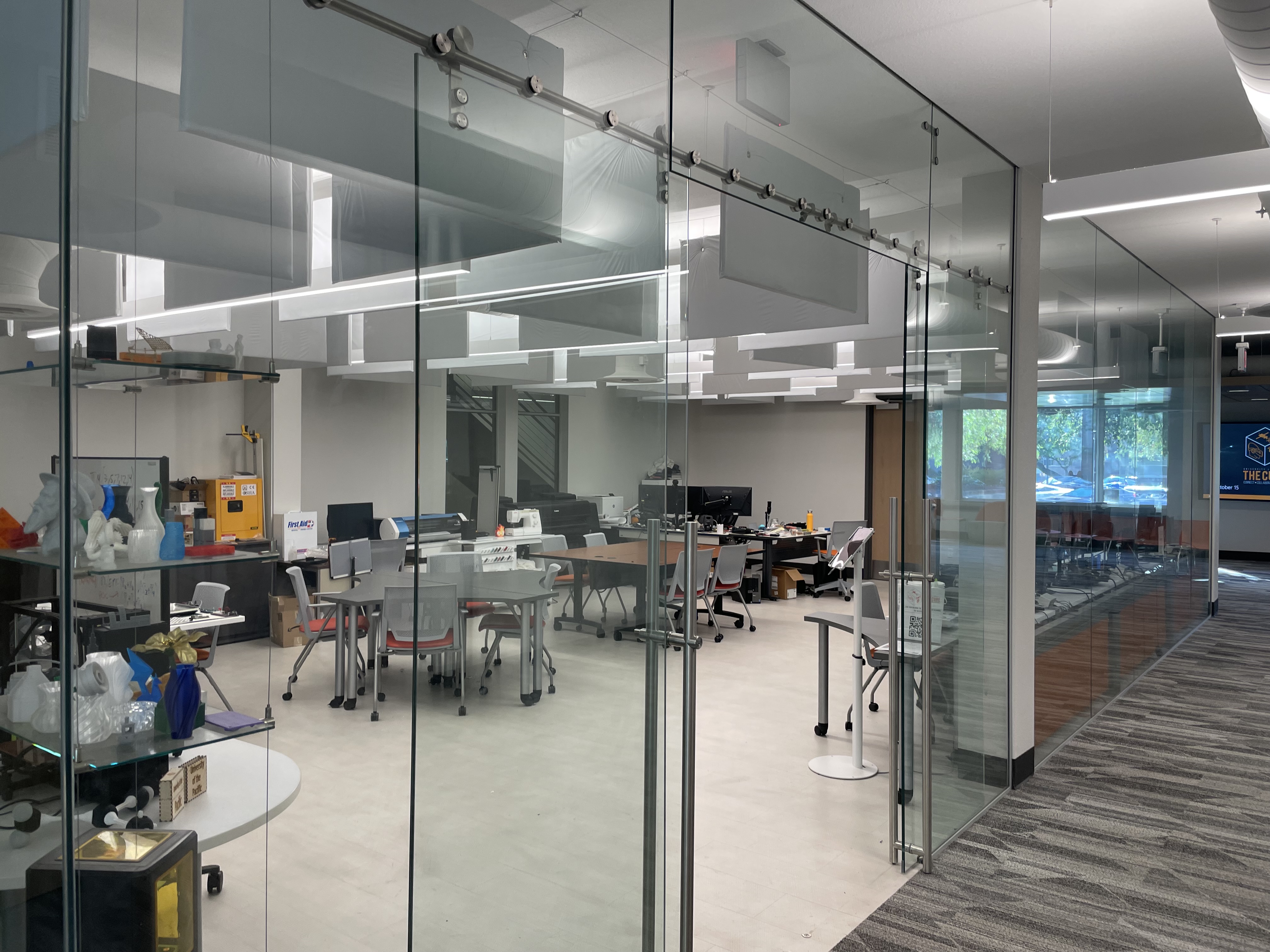
These concerns covered more than just the room dimensions – size, height, HVAC, glass walls, etc…. there were functional requirements for collaboration, classes, and workshops. The overwhelming acoustic problems involved the near constant noises generated by the vast array of equipment in this space – sewing machines, large format printers, plotting cutters, 3D printers, scanners, and every other modern tool for allowing the creative minds at their school to create. It was a cacophony of stepper motors, fans, and moving parts – which made collaboration very difficult.
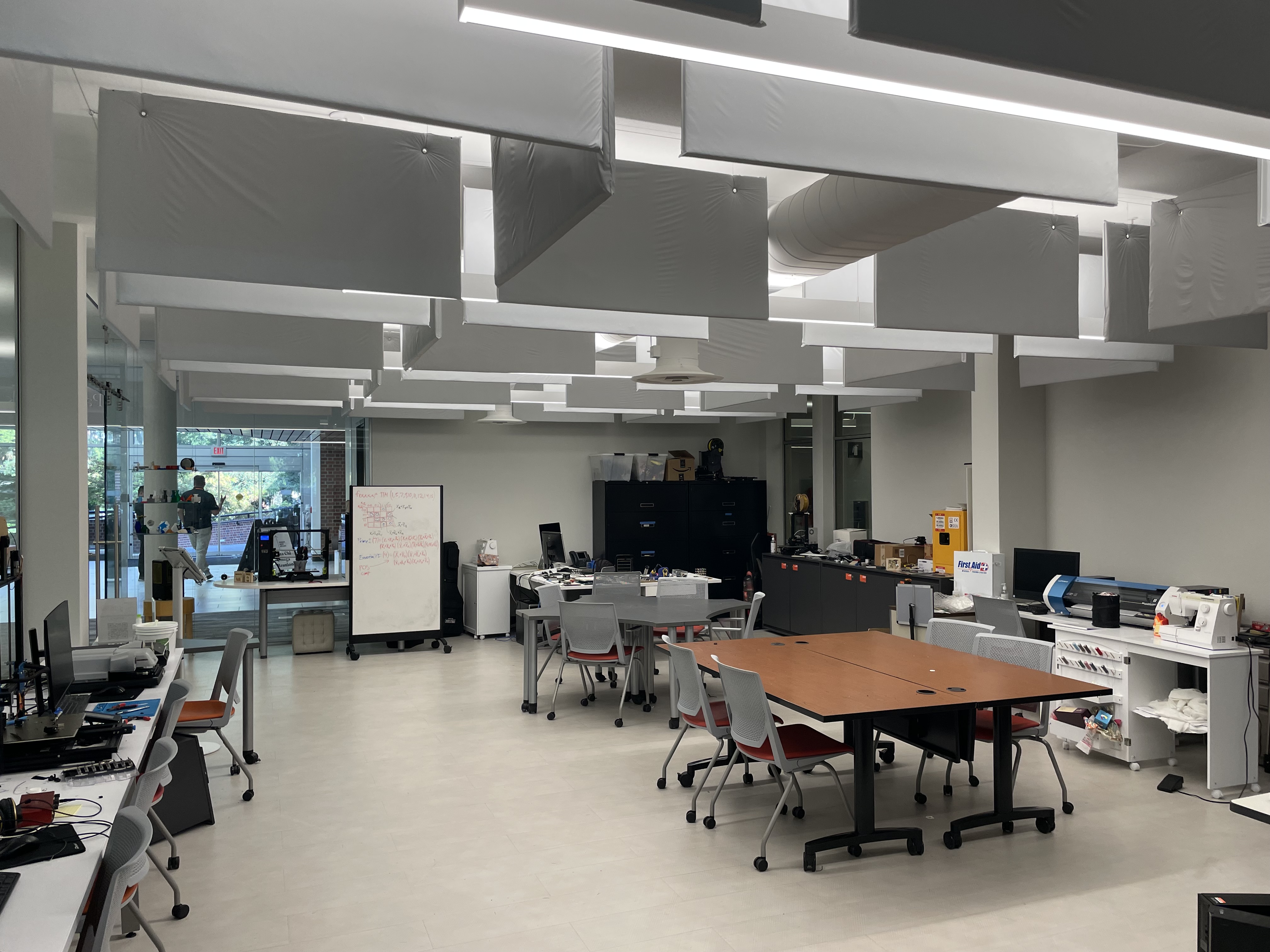
The other parameter that needed to be maintained was the ability to reconfigure the layout of the equipment without affecting the acoustic treatment in the space. This removed almost all of the walls in the space as possible locations for treatment. This left the ceiling as the only viable space left for treatment, but with an array of lights and exposed HVAC systems, there were few treatments that would be easy to implement and still be effective.

The decision was made to creatively weave Cloudscape® Baffles into all the spaces available in the ceiling. Dodging duct-work and suspended lighting rails was made possible with careful planning and execution – and the results were immediately notable. (Also noticeable was that the baffles had very little impact on the lighting which is vital in any makerspace.)
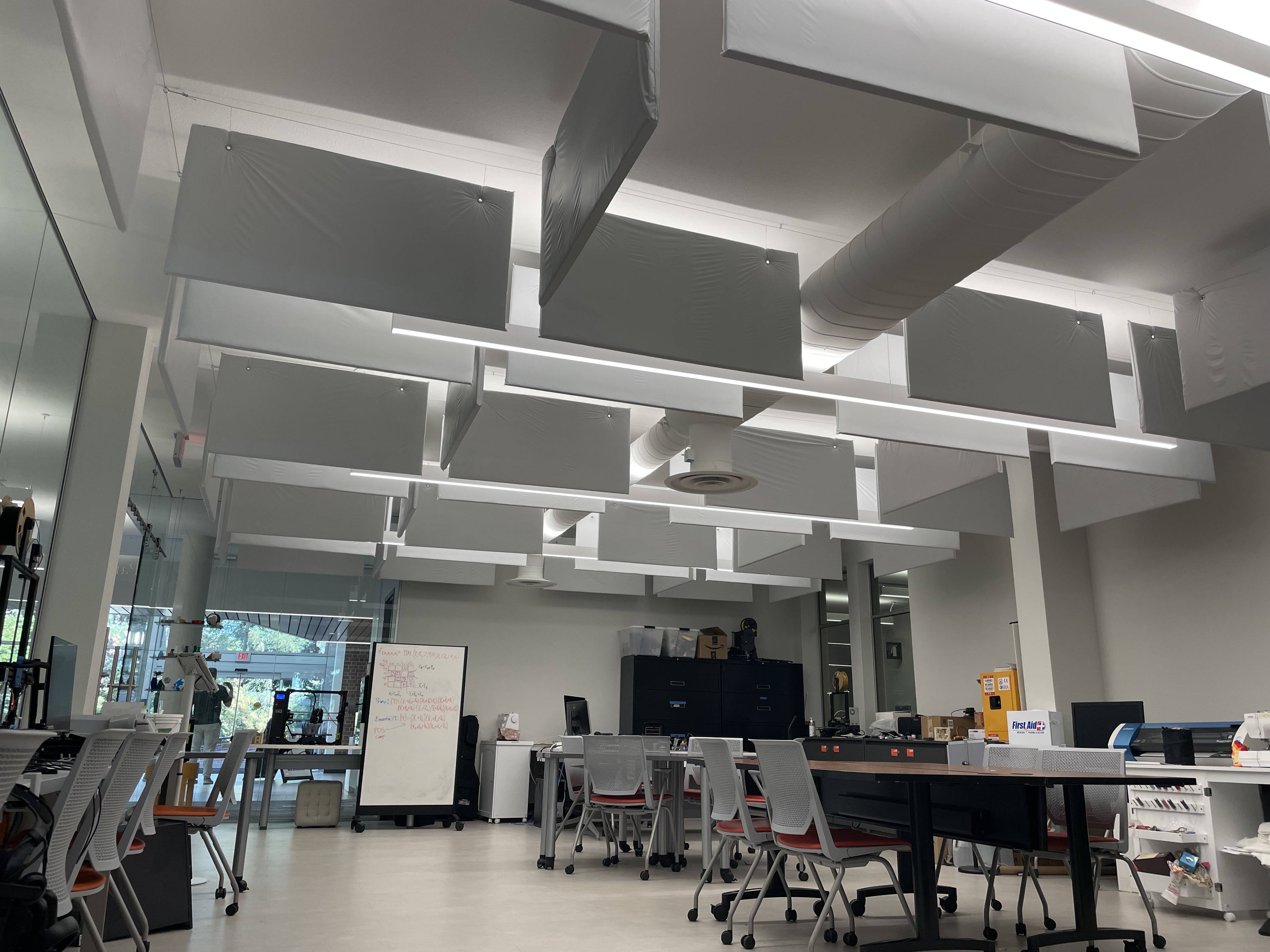
“…The sound baffles you recommended finally got installed in my makerspace about two weeks ago and I wanted to send a quick thank you since they’ve made a very noticeable acoustic difference to the room, and it’s a lot more pleasant in here now. “
Chris Crawford – Innovation Spaces Manager (University of the Pacific)
FireFlex™ Wave – Cloud or Baffle
Posted by Acoustics First in Absorption, Product Applications, Products on June 21, 2022
It’s good to have options in ceiling treatments. Some environments have high ceilings that benefit from vertically-hanging baffles, while other environments have lower ceilings in which clouds are more appropriate. In some cases the aesthetic will dictate which product would be best – but what if there was one product that could do both?
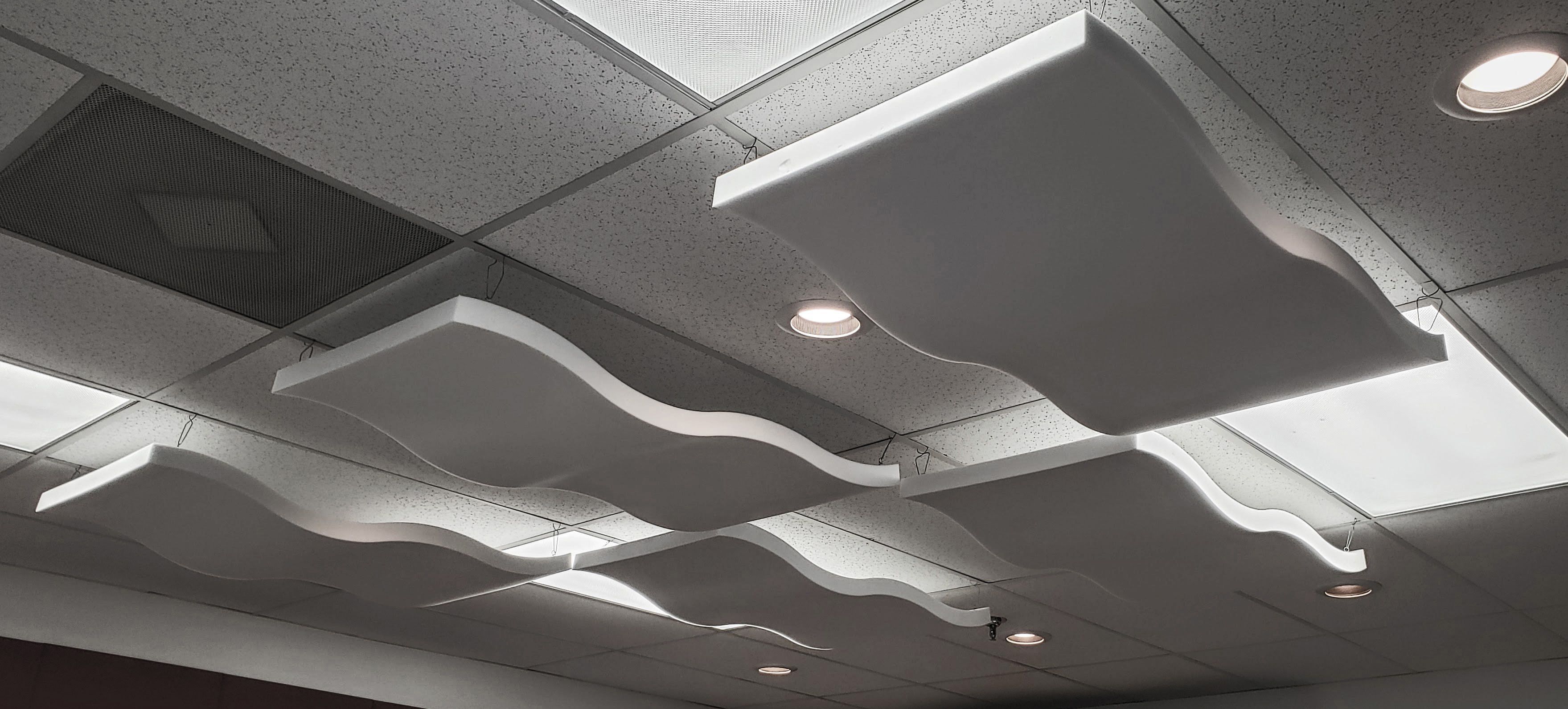
The Fireflex™ Wave has a unique, undulating shape that adds visual interest along with acoustic absorption – but it has another feature which few materials can boast. Due to the Class 1(A) melamine foam construction, the corkscrew mounting hardware can be installed wherever it is needed – including on the edges.

By installing the hardware on the edges instead of the face, you are given the option to also hang the Waves in a vertical orientation as baffles. The wave shape works well aesthetically in either orientation – horizontal or vertical.
In rooms with a lower ceiling, the horizontal orientation of clouds provides more headroom while the undulating shape optimizes the Wave’s surface area for absorption. In larger spaces with high ceilings, you can add more absorptive surface area by hanging the Waves as baffles, and provide a more organic look than you get with flat baffles.
When overhead acoustic absorption is required, turn to Acoustics First®.
Boys & Girls Club is (Cloudscape®) Baffled!
Posted by Acoustics First in Absorption, Customer Feedback, Fitness, Gymnasium, Multipurpose Rooms, Product Applications, Products on February 3, 2021

The Boys & Girls Club is enjoying their improved acoustics! (Photo by: Rennie Fish)
A large gymnasium/basketball court made of concrete blocks and metal is not an acoustically tame place. Add dozens of active boys and girls and the cacophony of sound can be a little overwhelming. This is exactly the reason why the Boys & Girls club reached out to Acoustics First®.
After a quick consultation, it was decided that the most efficient and cost effective option was installing Cloudscape® baffles to tame the overall reverb and sound pressure levels in the gym. Because the baffles are hanging with all of the sides are exposed, this increases their effective surface area and, in turn, improves their ability to absorb noise. This efficiency, ease of installation, and their relatively low cost is why they were the perfect option for this space.
The Gymnasium is Baffled!
Posted by Acoustics First in Absorption, Fitness, Gymnasium, School & Educational Facilities on January 18, 2019

Cloudscape Baffles
Cloudscape® Baffles are a wonderful product! This batch of baffles was installed in a middle school gymnasium/multi-purpose room by one of our dealers. Note how they were installed not just in the ceiling, but also on the walls by ‘chaining’ the baffles together. Most of the time we recommend hi-impact Sonora® Panels for the walls in school gyms such as this, but with a little ingenuity baffles can also get the job done!


 Acoustics First BLOG
You must be logged in to post a comment.