Archive for category Worship Facilities
St. Mary Magdalen Worship Center – Kerfed panels to fit curved walls!
Posted by Acoustics First in Absorption, Product Applications, Products, Worship Facilities on June 28, 2024
The Mary Magdalen Mission Center has an oval-shaped sanctuary that was experiencing extremely poor speech and music clarity. Their Worship services are traditional leaning (spoken word, piano and congregational singing) with the occasional contemporary music service.

Parabolic Focusing – A primary feature of the sanctuary are 4 large curved walls (two at the front and two at the rear). Concave, uniform, curved surfaces are very problematic in room acoustics. Curved surfaces “focus” sound reflections to a point, akin to a magnifying glass focusing light passing through the curved lens.
If you’ve ever stood in the center of dome, you’ve probably experienced a few interesting acoustic anomalies. First is the “whisper” effect, where sound produced near the foci of the dome/curve, is amplified, allowing a faint whisper to be heard throughout the room (and conversely, all the sound produced in the room focused to this point, causing a cacophony of reflections at the center foci) . Another is the “creep” effect, where sound produced at the edge of arc, travels along the curved surface, losing little energy until it reaches the opposite end of the arc.
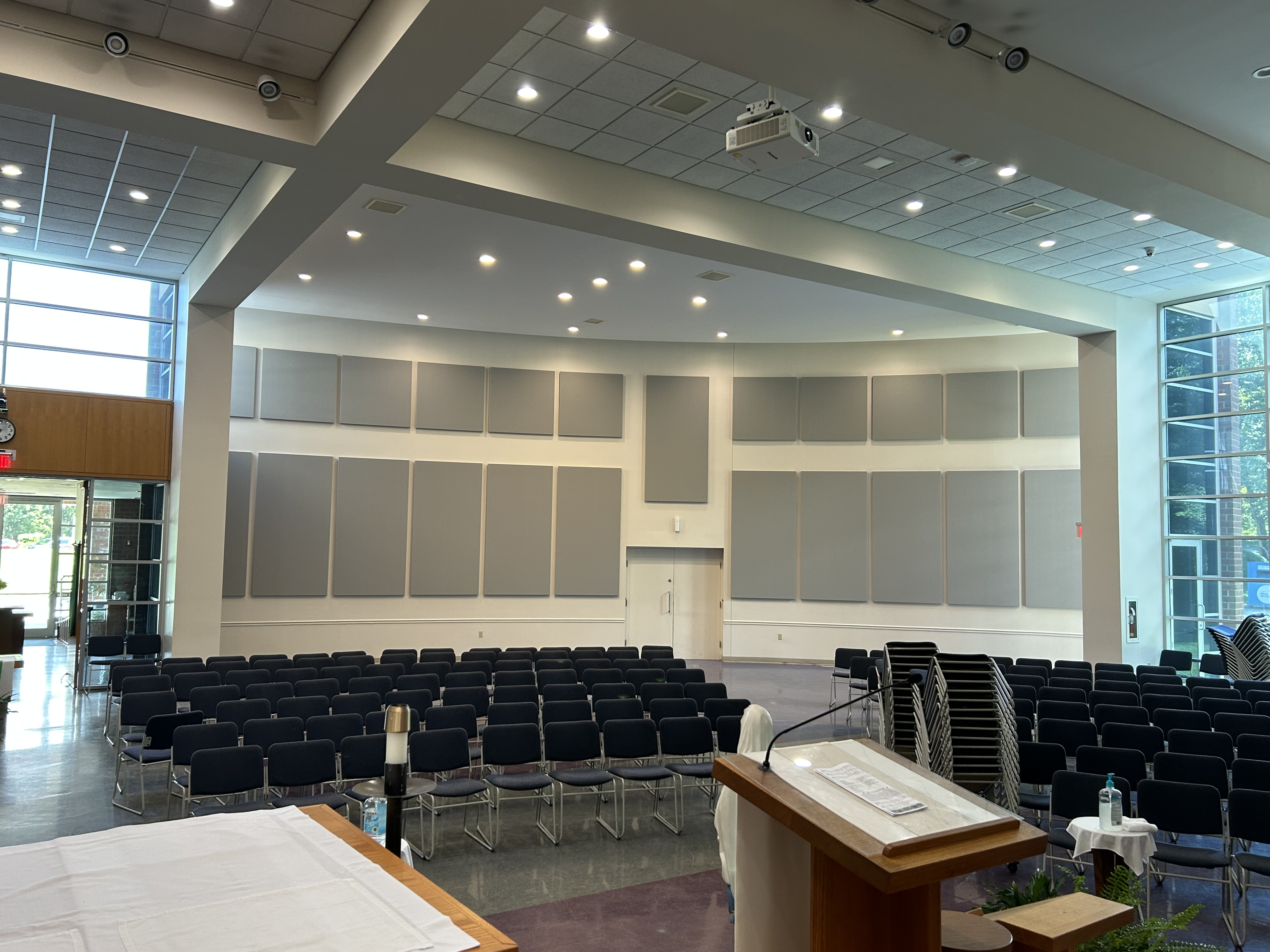
Not only do the hard wall and floor surfaces of the Mary Magdalen Mission Center contribute to excessive sound buildup, but the parabolic focusing from the curved wall surfaces caused extreme comb filtering (pockets of destructive and constructive interference as a result of overlapping waves), exacerbating intelligibility issues. These conditions contribute to an acoustically uncomfortable environment in which music is hard to perform and enjoy while speech is also difficult to understand.
To significantly reduce excessive reverberation and destructive reflections, we recommended installing approx. 1200 SQFT of 2” back-scored Hi Impact Sonora Wall Panels across the rear wall surfaces. We specified kerfed/back-scored Hi Impact Sonora Wall Panels that can “bend” to fit curved surfaces and come with a high-density adder that improves acoustic performance and durability. View Sonora Panel information on our website.
https://www.acousticsfirst.com/sonora-wall-panels.htm
Reverb Predictions – Worship spaces of this size with a blend of traditional and contemporary music should have a reverb time below 1.6s. We entered the room’s dimensions and construction materials and made a prediction of reverb times before and after treatment. In addition to controlling distracting echoes and comb filtering, installing approx. 1248 SQFT of 2” Hi Impact Sonora wall panels across the rear wall reduced reverberation by approx. 35%, significantly improving speech intelligibility and music clarity.
St. Andrew by the Bay – Custom HiPer® Impact Panels to absorb and diffuse sound!
Posted by Acoustics First in Absorption, Diffusion, Product Applications, Worship Facilities on April 10, 2024
St. Andrew by the Bay is a traditional worship facility with a focus on spoken word worship and congregational singing. The large volume and hard surfaces in this space are the physical features most at fault for excessive reverberation, comb filtering and distracting “slap” echoes (discrete sound reflections usually caused by a distant, reflective back-wall).
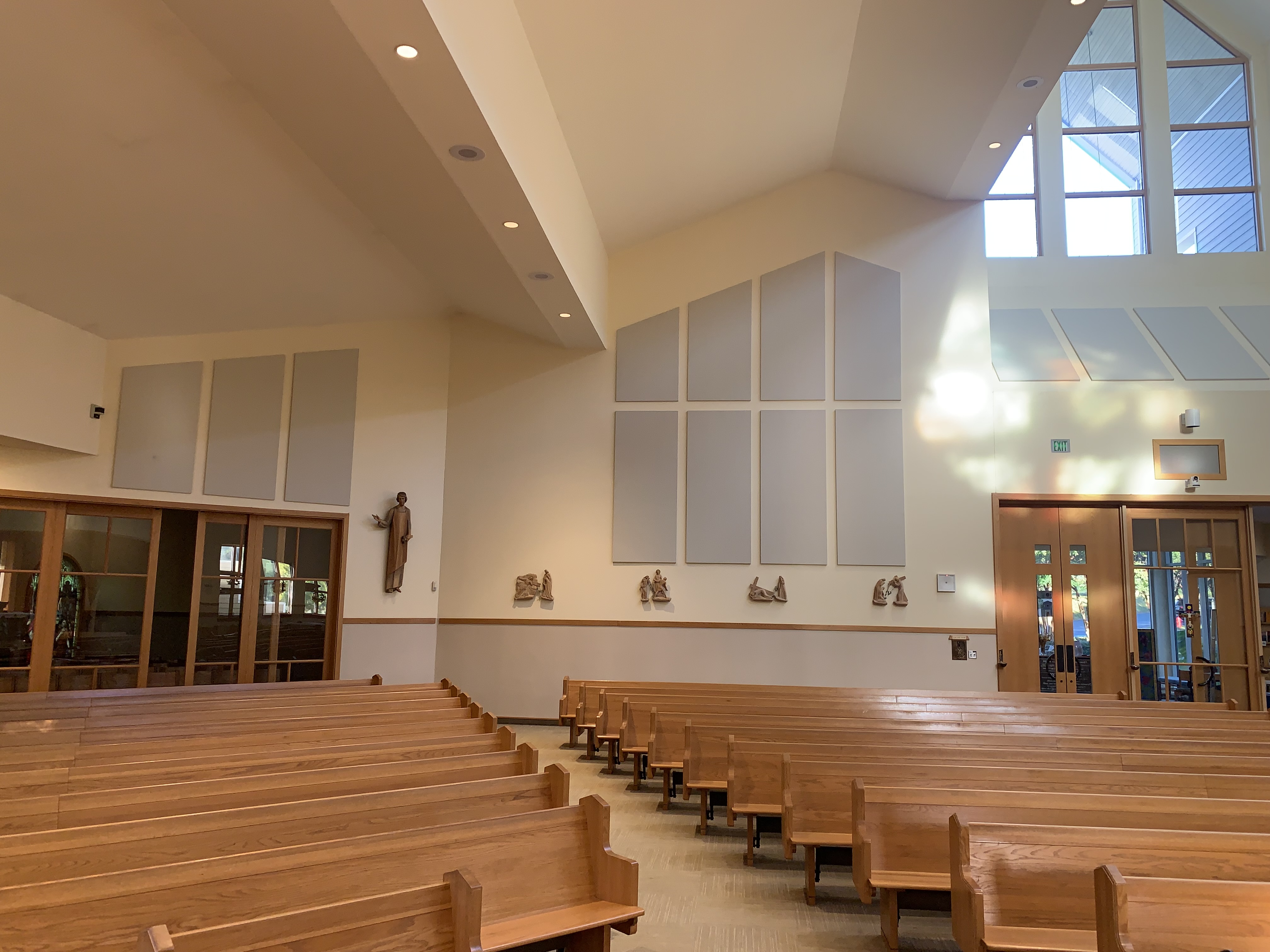
To correct the slap-back and curb excessive reverb without “over deadening” the space, we recommend distributing approx. 550 SQFT 1” HiPer® Impact absorber/diffuser panels throughout the rear wall areas (see attached layout). HiPer® Impact panels absorb low frequencies and diffuse high-frequencies, yielding a much more even room response. In addition to controlling bass buildup, the high-frequency scattering will help retain some “life” in the room for acoustic and choral performances.
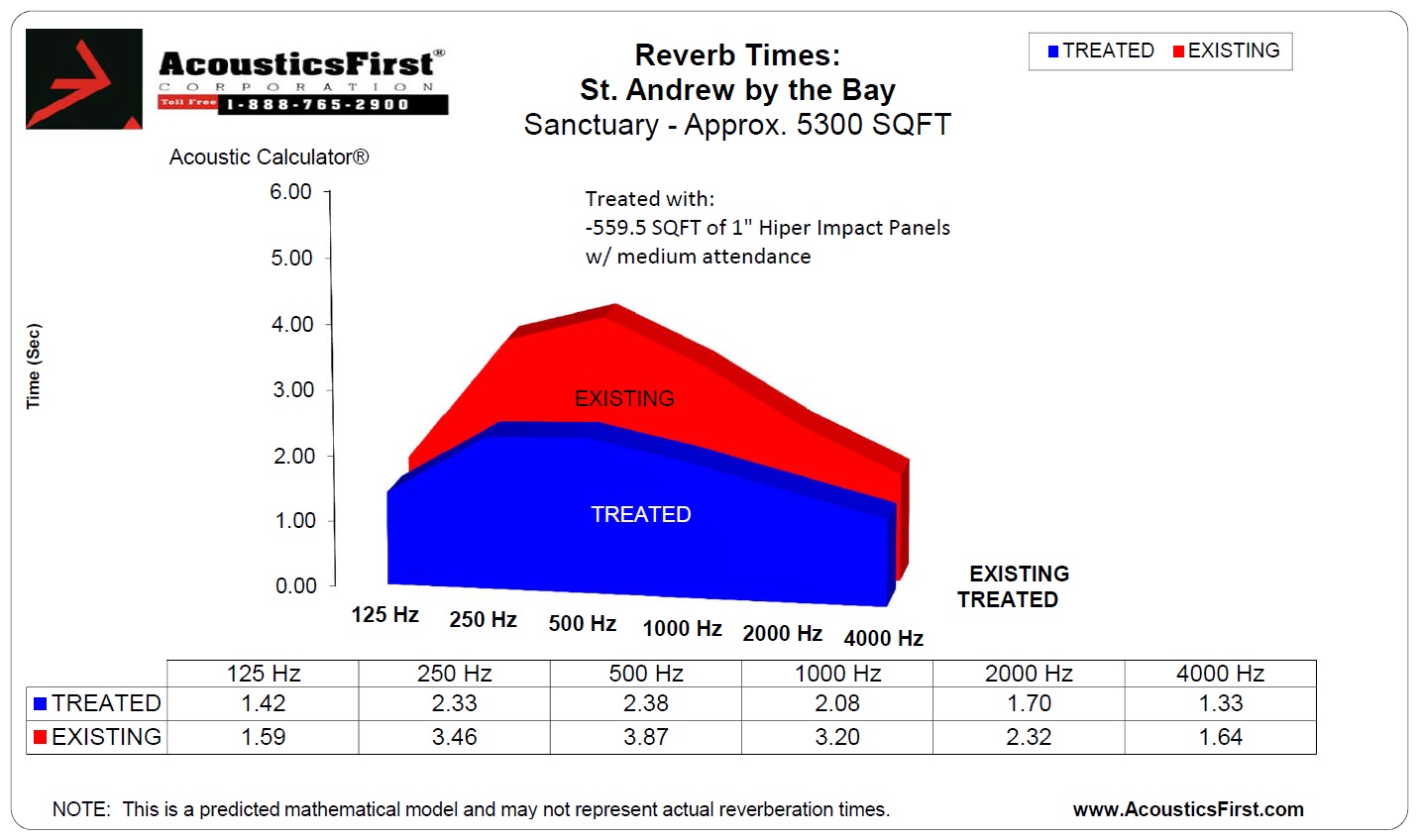
Reverb Prediction – Historically, churches relied on an abundance of hard surfaces to propagate sound to the rear of the nave, so they benefited from very long reverb times (upwards of 4-5s). Modern sound systems allow for a much more focused sound and equitable listening environment , so these extreme reverb tails are no longer necessary and can actually degrade the experience of the congregation. Churches of this size with a sound system and traditional worship services should have a reverb time somewhere in the 1.5-2.25s range. We entered the sanctuary’s dimensions and construction materials into our acoustic calculator and made a prediction of reverb times before and after treatment.
From Lee Hartman & Sons who performed the install “Here are some photos of the finished panels at St. Andrew by the Bay. It turned out great and client is very happy. Many thanks to Cameron for the detailed layout.”

Project: Richmond Friends Retreat Center
Posted by Acoustics First in Absorption, Media Room, Multipurpose Rooms, Product Applications, Products, Worship Facilities on October 26, 2023

Earlier this summer, Richmond Friends Meeting reached out to Acoustics First® for assistance with their new Retreat Center in Amelia, VA. Their multi-purpose community hall was overly live with reverb and echoes, contributing to a poor listening environment. As this space is used for worship, meetings and social events, speech intelligibility is very important and more control was needed to “reign-in” excessive noise.
To correct these issues, Acoustics First® recommended a combination of 1” Hi-Impact Sonora® Wall Panels and 2” Sonora® Ceiling Panels. The acoustic design utilized “staggered” 2’x6’ ceiling panels to maximize coverage, in addition to the custom-shaped wall panels which match the slope of the ceiling.

With approx. 400 SQFT of panels between the wall and ceiling, reverb was reduced by approx. 50%, drastically improving speech intelligibility and general room comfort.
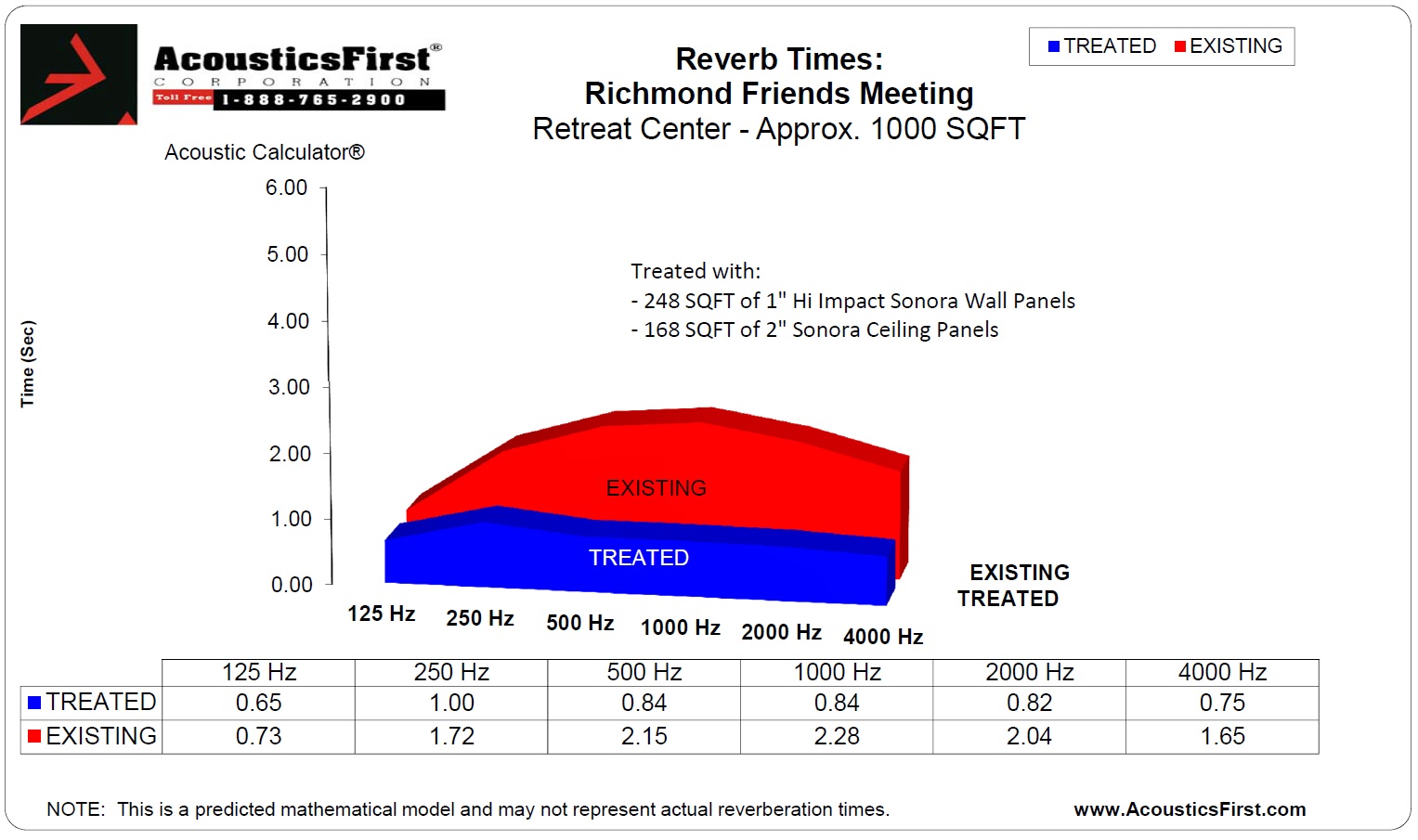

The treatment tamed the acoustics of the room, which improved speech intelligibility by reducing the reverberance… and they were very happy with the result!
Similar, Yet Different: Aeolian® vs. MiniAeolian™
Posted by Acoustics First in Broadcast Facilities, Home Entertainment, Home Theater, Media Room, Multipurpose Rooms, Music Rehearsal Spaces, Music Tracking Room, Product Applications, Products, Recording Facilities, Recording Studio, Studio Control Room, Uncategorized, Vocal Booth, Worship Facilities on September 28, 2023
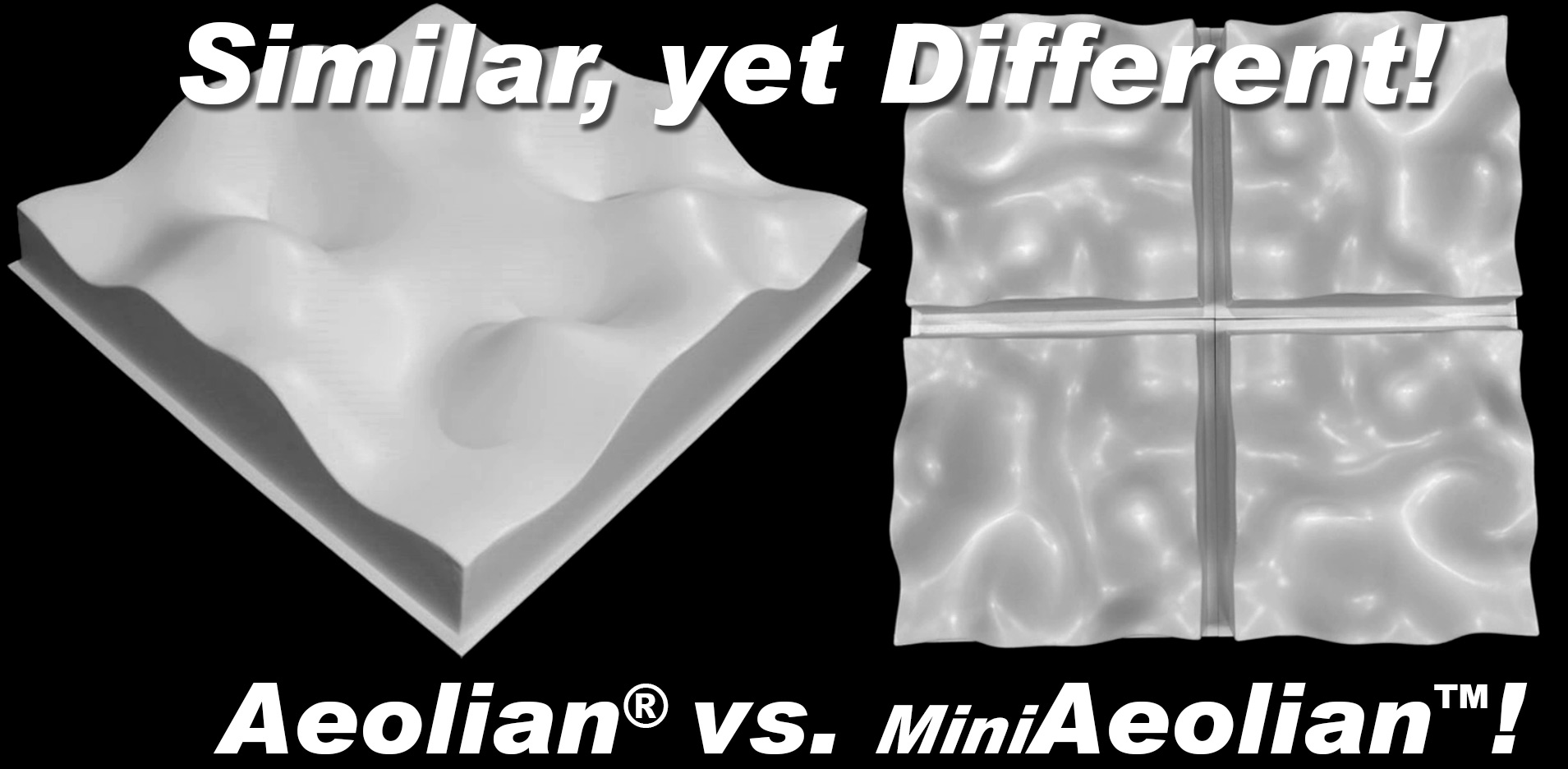
In this installment of “Similar, Yet Different”, we are going to compare the two current variations of the popular Aeolian® Diffuser – the original 2’x2′ Aeolian and the 1’x1′ MiniAeolian™!
Design
This comparison has some similarities to the very first “Similar, Yet Different” post we made comparing the ArtDiffusor® Model C to the ArtDiffusor® Model F. We are looking at a diffuser that uses identical mathematic functions to create the shape… both the Aeolian® and the MiniAeolian™ are an “Organic Quadratic” constructed from a Bicubic Interpolation of a Quadratic Residue Function. They are both truncated so that they are completely asymmetric, even to the edge. The MiniAeolian™ IS an Aeolian®, only it is scaled differently.
You may recall that the Model F was constructed of 4 scaled down Model C diffusers in a monolithic 2’x2′ tile – This is not the case with the MiniAeolian™. The Original Aeolian® Diffuser is a 2’x2′ footprint that is 5″ tall, and will fit in a standard 2’x2′ ceiling grid. The MiniAeolian™ is a single scaled down unit, and it is a little different – The 1’x1′ footprint stands alone as a single unit, but it is only scaled down in height to 4″.
In this case, form follows function. The MiniAeolian™ was built to fill a specific function as a smaller wall-mount unit, or a direct-mount ceiling unit for smaller spaces. Part of this wall-mount function was to have a version of the Aeolian® that would fit in tight areas or in spaces that didn’t have enough clearance for the 5″ standard Aeolian® (or would require modification to those areas (or diffusers) to allow this extra height). Some people implement configurations that have tighter footprint requirements, and the 1’x1′ footprint of the Mini allow it to be used in these types of layouts.
Performance
So how does this change affect the performance of the unit? Surprisingly, they are quite similar. The Organic curved design, with only a 20% reduction in height, shows only minor differences in performance of their overall frequencies ranges – with both primary ranges starting at about 1500Hz-1600Hz with and average between 150° and 170° of horizontal and vertical dispersion up to between 5Khz and 7Khz. While the primary range is a good indicator, when we look at the actual polar response, we can get a better picture of their full range performance.

A quick glance shows two very similar performing diffusers, except for the low-frequency performance. The larger elements and deeper formfactor of the original Aeolian® are more effective at the 1000Hz range, where the MiniAeolian™ appears to be mostly specular. There are some surprises however. It appears that at the 2000Hz range leans slightly in the favor of using 4 MiniAeolians™ in an array verses the single Aeolian®. There is more surface variation over the same footprint (2’x2′ in the array of 4), and the size of the Mini’s features are a bit more optimal for diffusing the 2Khz wavelength. This swings back slightly into the favor of the single Aeolian® at 4Khz, where the larger elements have a wider throw, and the elements of the Mini have steeper wells. At 8Khz, it tips back to the Mini, and then at 16Khz, they are both neck-and-neck.
The amazing similarity is that the variations are quite subtle through their entire effective ranges, and even quite a bit above those ranges. While there are slight differences in the performance of the diffusers when we compare the directly, these are really very minimal except for the low-frequency edge in performance of the larger original Aeolian®.
Closing
With the similarity of performance in the two diffusers, they can almost be used interchangeably – or even used together in the same environment to implement an aesthetic vision or add more randomness/variety to the diffusion in the space.
There are several occasions where you may require one over the other.
- If you need more 1Khz diffusion, you should add some 2’x2′ Aeolians® – as they perform better in that range.
- If you need to install diffusers that fit in a ceiling grid… you will also want to use the original.
- If you want the Aeolian® but need diffusers that will fit in a space that is less than 2’x2’x5″, you may want to go with the MiniAeolian™.
Currently the MiniAeolian™ is a custom order item only, and is subject to minimum order quantities.
Contact Acoustics First® for more information and pricing.
Sonora® & Sonora® Lite – together in Michigan
Posted by Acoustics First in Absorption, Customer Feedback, Product Applications, Products, Worship Facilities on November 30, 2022
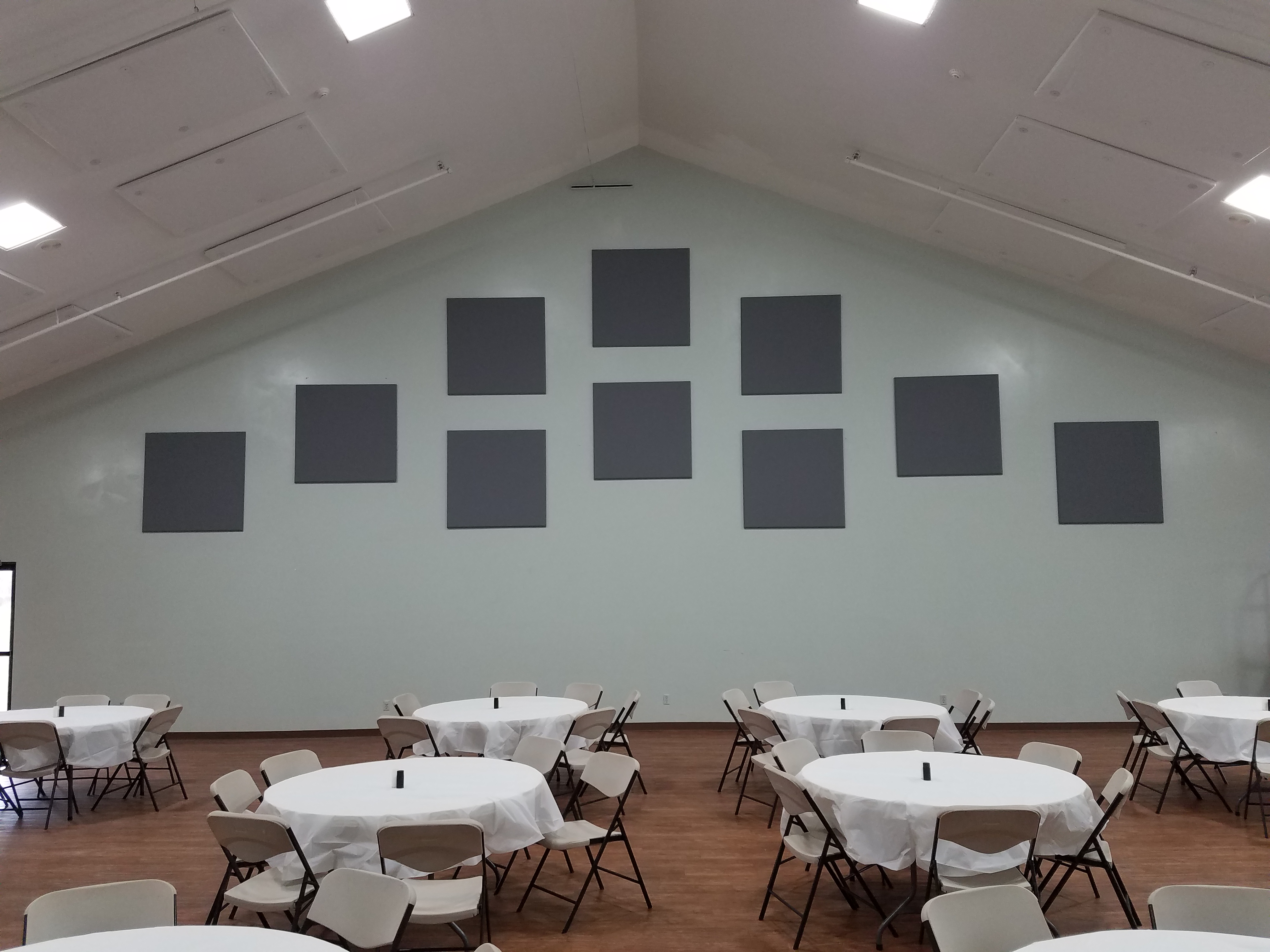
Here are a couple of fresh install photos – courtesy of SLS Productions in Michigan. For this fellowship hall at Kalamazoo Missionary Church, a mix of standard Sonora® Panels and Sonora® Lite PVC encapsulated panels were used. The Steel Grey Sonora® Panels, installed on the wall, are the standard 6-7# density panels that have become ubiquitous in so many churches and schools throughout the country for improving speech clarity and taming harsh reverb times.
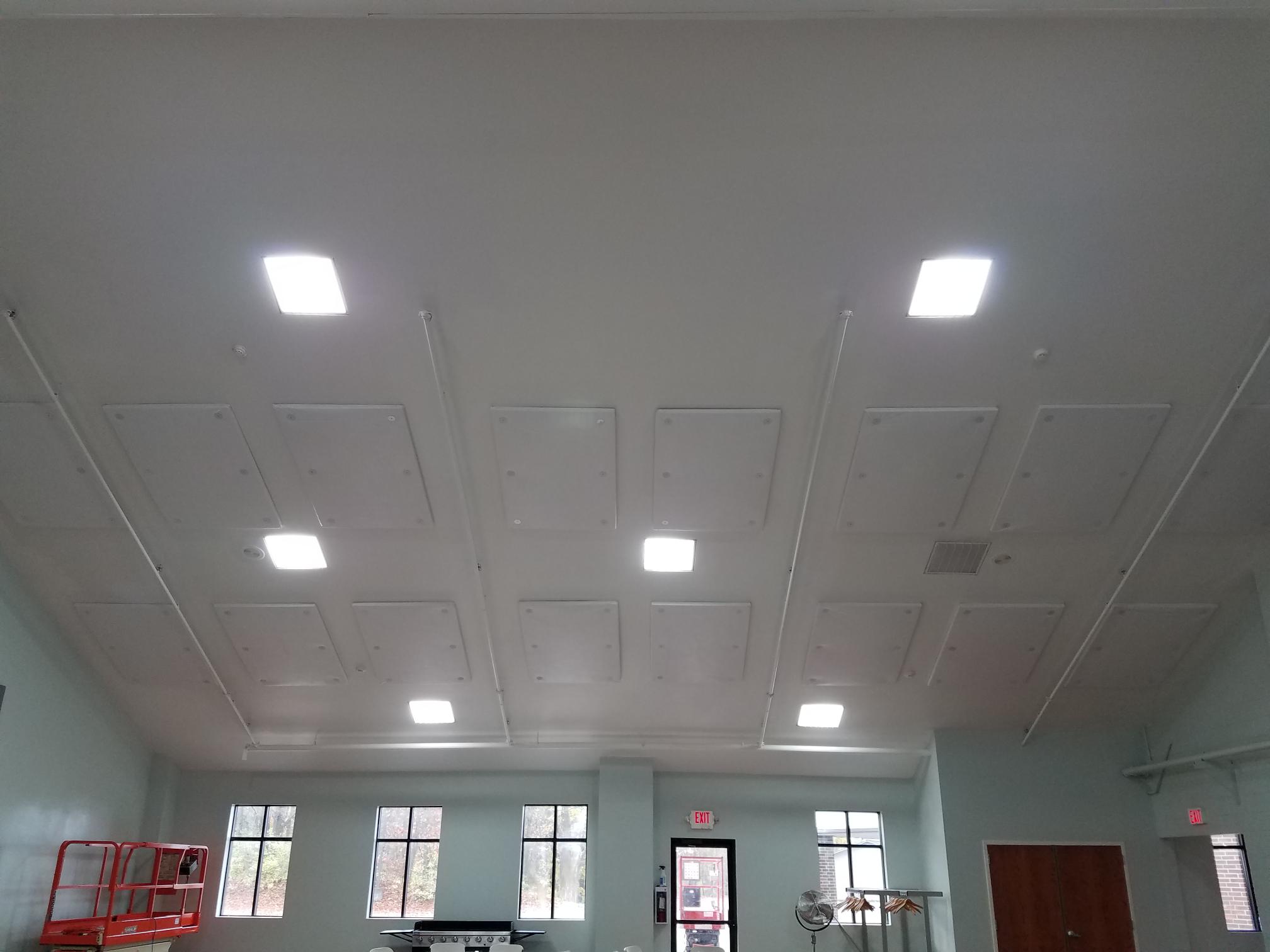
For the ceiling of the room, Sonora® Lite Panels were used. Notice how the white PVC covering and clear washer plates help the panels blend aesthetically into the ceiling. These lower density (1.65#) PVC encapsulated panels could be thought of as a ‘direct mount’ cousin of our Cloudscape® baffles and are an excellent budget friendly choice when treating ceilings. The final results turned out great and all were pleased.
 Acoustics First BLOG
You must be logged in to post a comment.