Archive for category Product Applications
Throwback Thursday – Diffusion and Binaural Bob from 10 years ago!
Posted by Acoustics First in Diffusion, Offices, Product Applications, Products, Uncategorized, Video on February 27, 2025
In June of 2015, Acoustics First® posted about our experiment which allowed people to hear the effects of sound diffusers in a small space. The experiment consisted of treating a small office with varying numbers of our new (at the time) Art Diffusor® Model D sound diffusers, then providing various sonic stimuli and capturing and measuring the results with a custom binaural head (called “Binaural Bob.”) This experiment received great feedback and with that input, future experiments were conducted using a similar method, mixing absorbers and diffusers, and having a wider range of stimuli.

But here we look back to the first… This is the video we produced during that experiment way back in 2015 with Binaural Bob, a bunch of Model D’s, a small office, some balloons, bang snaps, and one very heavy book.
If you would like to revisit the original post in it’s entirety, here is the link!
https://acousticsfirst.info/2015/06/09/want-to-hear-acoustic-diffusion-audio-demo/
Acoustic Treatment in the 1920’s – A look at the Guardian Building
Posted by Acoustics First in Absorption, Offices, Uncategorized on January 14, 2025
The bank wanted the building be a “show-piece” and communicate its principles of “security” and “fidelity” (remember, this was at a time before the FDIC), to impress customers and convince them to store their valuables at their bank. Incredibly, the building was completed in just one year; construction began in 1928 and finished just before the Stock Market Crash of 1929 (so much for fidelity).
Head designer Wirt C. Rowland had far from a subdued vision for the building. Blending Native American, Aztec, and Arts & Crafts designs, Rowland wanted to make an indelible impression on anyone who walked in. He said “We no longer live in a leisurely age…the impression must be immediate, strong and complete. Color has this vital power.”

Colorful, luxury materials grace every surface of this building. Italian Travertine marble was used for steps and wall surfaces, contrasting with deep-red Numidian marble imported from Africa. Brilliantly colored tiles fill the lobby’s vaulted ceiling, and a massive multi-colored mosaic adorns the vestibule wall. Monel metal was used in the large ornamental gate dividing the banking hall and main lobby, supporting a pair of Tiffany & Co. Glass clocks. Even the office corridors and restrooms are lined in a Tavernelle marble from Tennessee.

Obviously, these beautiful materials are also extremely sound reflective. Having worked on similar buildings, Rowland understood the need for acoustic treatment in the banking hall as there would be hundreds of customers, tellers and their managers trying to conduct important business in this large, cathedral-like space. If they used the same ceramic tiles they used on the ceiling of the lobby, conversations would be drowned out by a cacophony of typewriters. In lieu of the tiles, the banking hall has an incredibly appointed, intricate system of stretched canvas over wood frames backed with sound-absorbing horse hair. The canvas was hand painted with real gold and silver and requires regular maintenance. In fact, the same Italian family that made the ceiling nearly 100 years ago has been caring for it ever since!

I recently had the pleasure of touring the Guardian building, and walking through the Monel gate from the lobby to the banking hall, you can hear the difference. Though the banking hall is much larger, it feels much more intimate and comfortable, in large part because of the ceiling. Although the horse hair and canvas materials may not meet fire code today, modern stretched-fabric acoustic assemblies owe a lot to this sort of early innovation.

The Guardian Building is a symbol of creativity and achievement. Designed for the future, it is no surprise that Rowland’s masterpiece still dazzles and inspires visitors to this day.
For more information on the Guardian Building’s long history, visit https://www.guardianbuilding.com/history
Similar, yet different: HiPer Panel® vs. HiPer Panel® Impact
Posted by Acoustics First in Absorption, Diffusion, Product Applications, Products on December 11, 2024
While the HiPer Panel® and the HiPer Panel® Impact may appear to be identical on the surface, there are some key differences that may change which one you would use, and why you would use it. They are both layered, flat-panel diffuser products, with perforations, and they are both covered in fabric. However, their construction, below the surface, is drastically different. One is a broadband absorber with a modified frequency response which focuses on reduction of specular energy, and cancellation of noise – where the other is a high frequency diffuser and reflector with a tuned bass absorption which is constructed to maintain acoustic energy in the space.

Construction
The HiPer Panel® was originally designed to optimize the capabilities of a standard broadband absorber. Its internal membrane and perforations create a material that works to modify the range of absorption, and create high frequency diffraction… but that isn’t all. The cavities are backed up to the membrane, which changes the reflection characteristics, where high frequencies can be reflected, and higher energy waves are absorbed more than if it was just fiberglass. This extended range is random, as the perforation density is gaussian in nature, but the membrane is also randomly backed by more cavities.
This design creates 4 different physical conditions that acoustic energy has to contend with… in a gaussian distribution.
- areas of the panel with 2 layers of fiberglass and a membrane in the middle.
- one layer of fiberglass with a rear membrane over a cavity.
- a cavity with a membrane back… sitting on fiberglass.
- a cavity with a membrane back… stretched over another cavity.
The random distribution of multiple acoustic obstacles is what gives this device its unique characteristics. It’s an absorber that changes its performance depending on where sound hits it, and at which frequency. Some frequencies pass into the cavities and reflect off the membrane, while others are dampened by the membrane… while longer wavelengths see the membrane as a stretched diaphragm or limp mass.
The HiPer Panel® Impact has a very different construction and may be used for a very different reason. The HiPer Panel® Impact uses the same pattern of holes, but the holes aren’t cut into an absorber… they are cut out of a reflective face, which is attached to an absober. Unlike the first HiPer Panel®, the “Impact” can be used to maintain more of the energy in the space, break up some of the higher frequencies with that gaussian hole pattern, and be a low frequency bass trap. The design is simple and effective, but is not necessarily used in the same places where you would use the first HiPer Panel®.
Use cases.
The first Hiper Panel® is often used in theaters, and listening spaces where focusing on the source is of primary importance. Its broadband absorption, gentle high frequency diffusion, and smooth mid frequency control are ideal for critical listening environments such as mixing rooms, media rooms, theaters, or even voice over spaces. The performance is about removing the acoustic elements that could interfere with the focus on the source speakers.
The HiPer Panel® Impact is often used in performance spaces, where you want to maintain energy, break up high frequency flutter, and remove low bass. The reflective face doesn’t remove as much energy from the space, however it does change the characteristics of the space. This helps break up some frequencies, reduce bass, and keep the energy moving around the room. Music halls, churches, auditoriums, and any space that relies on the room helping to reinforce the sound will benefit from these taking the edge off the highs and dampening the lows – which is how the HiPer Panel® Impact controls the sound… while helping it maintain its “impact.”
In summary, while these two products are in the same family, they have a different core construction, which changes their performance. There are scenarios where you may use them both, however since they address different problems in a space, they are not always interchangeable. Contact Acoustics First® if you have questions about any of our products.
Similar, yet Different: Pyramid vs. QuadraPyramid
Posted by Acoustics First in Articles, Product Applications, Products on November 15, 2024

Based on the golden-ratio, offset pyramid… both the Acoustics First® Pyramids and QuadraPyramids have a great deal in common. They are asymmetric in their scattering, which reduces lobing. They have different sized surfaces of different angles, which impose different polar radiation patterns at different frequencies. Both allow for redirection, while allowing much of the signal phase to remain intact, which keeps a great deal of energy moving together, which works great for performance spaces. However, there are some subtle differences which change how these units perform and how you maximize their use.
While both the Pyramidal and the QuadraPyramid come in a 2’x2′ format, the QuadraPyramid packs 4 pyramids into that footprint. That isn’t the only difference though. The depth of the QuadraPyramid is only about 2-3/4″ to the 8″ deep single peak of the classic Pyramidal. On top of that, the Pyramidal comes in different sizes and ratios of length to width including a 4’x4′ and a 2’x4′ at up to 13″ deep.
These different sizes do more than change their aesthetic. The large pyramid geometry allows for greater impact on lower frequencies, as the longer wavelengths are less skewed by small surfaces. The different ratios and sizes also changes the angle of throw off the surfaces, allowing for more options to redirect the sound. The larger surfaces also impose some limitations to their use. Being physically larger means that the listener will need to be further away from the device to allow the reflections to spread out, and the greater depth means that, at certain angles, the geometry can place other devices in their acoustic shadow. The larger pyramids work great in larger rooms with high ceilings, where they can be placed higher in the room. This makes them ideal for performance spaces and large band/music practice rooms – where everyone is spread around and needs to be able to hear everyone else.

The QuadraPyramids have a higher density of reflective faces per square foot. There are 16 facets on a 2’x2′ QuadraPyramid, which means more smaller faces to reflect sound. These faces are optimized for higher frequencies which have shorter wavelengths – but the profiles are actually better suited for smaller rooms with lower ceilings. In smaller studios, listening rooms, and media spaces, space is at a premium, and having a large diffuser hanging a foot down from the ceiling would be more of an impediment. This is where the QuadraPyramids shine. Their low-profile and many facets allow for sounds to spread out while breaking up flutter echoes and reducing other higher frequency artifacts.

Finally, the size of the cavity behind the larger pyramid allows for greater bass trapping, especially with the ability to fill the cavity with fluffy insulation. While the QuadraPyramid still imparts some absorption due to the resonance of the thermoformed plastic material, it is more focused at the resonant frequency (250Hz) – while the larger pyramids have a wider frequency range they affect.
| Device | 125hz | 250Hz | 500Hz | 1000Hz | 2000Hz | 4000Hz | NRC |
| 2’x2′ Pyramid (insulated) | 0.57 | 0.41 | 0.38 | 0.21 | 0.16 | 0.16 | 0.30 |
| 2’x2′ Quadra Pyramid | 0.23 | 0.58 | 0.05 | 0.04 | 0.04 | 0.11 | 0.20 |
While the Pyramid and the QuadraPyramid have their roots in the same geometry, their specific implementation changes their performance characteristics to provide more options in treating your space. Using the right treatment changes depending on the space and its function… even two identical rooms can have drastically different performance requirements – needing drastically different treatments. Acoustically, a Quadrapyramid is drastically different than a 2’x4′ Pyramid – but fundamentally, at their core, they are very similar.
Acoustical Considerations for Classrooms
Posted by Acoustics First in Absorption, Articles, Classrooms, Product Applications, Products, School & Educational Facilities, Teaching Rooms on September 19, 2024
Poor classroom acoustics has long been the invisible problem that has the farthest reaching implications for learning. Excessive noise and reverberation degrade speech intelligibility, resulting in reduced understanding and therefore reduced learning. In many classrooms in the United States, the speech intelligibility rating is 75% or less. That means, in speech intelligibility tests, listeners with normal hearing can only understand 75% of the words read from a list. Imagine reading a textbook with every fourth word missing. Wouldn’t that make comprehension near impossible? Fortunately, poor classroom acoustics can usually be remedied with some basic knowledge and commercially available treatment. But before getting into specific treatment, let’s go over some basic acoustic principles.
Noise
Obviously, it’s difficult to understand what the instructor is saying when there is a lot of naturally occurring noise in the room. A glut of factors can be considered noise sources, including HVAC “rumble”, traffic outside the building and students moving in their chairs. These sources contribute to a “noise floor” that makes understanding speech very difficult. Since there is no one “cure-all” for an excessive noise floor, it is often best to seek the assistance of a professional acoustical consultant to properly diagnose and find a solution to these issues.
Reverberation: Undesirable vs Useful Reflections
When not attributed to a noise issue, the culprit of poor classroom acoustics is often excessive reverberation. In simple terms, reverberation is the sound energy that remains in the listening environment as a result of lingering reflections. As mentioned before, these reflections can easily interfere with speech intelligibility. As you may have experienced at some point, it can be difficult to understand what is being said when reflections from old information cover up what is newly spoken.
The reverberation time (RT or RT60) is used to determine how quickly sound decays. The RT is dependent upon the volume and surface materials of a given room. Large spaces with hard materials (tile, drywall, etc.) have longer reverberation times, while small rooms built with “softer” materials sound more “dead”. Ideally, classrooms should have relatively short RT’s, somewhere in the .6-.8 second range.
A long reverberation time is not the only factor that should be considered when treating a classroom with poor acoustics. Flutter echo is a particularly significant problem when it occurs between the side walls at the front of the classroom where the teacher is speaking. This condition can be heard as a “ringing” sound (when one claps) as the sound rapidly bounces back and forth between two parallel walls. Flutter and other discrete echoes are considered “undesirable reflections” and should be controlled with absorptive or diffusive materials.
Not all reflections are bad though. There are “useful reflections” that reinforce spoken word, rather than cover it up. The teacher’s voice can be propagated throughout the room by shaping a sound reflecting gypsum board ceiling over the front of the room or by making the center of the ceiling a hard, reflecting surface (see figure 1). This will help project the speaker, so they don’t have to strain their voice to be heard over the students.

Reducing Reverberation
Often reducing the dimensions of a classroom to attain a more suitable reverberation time is not feasible, but one can improve the acoustics by introducing sound absorptive materials. Typical classrooms usually have a dropped “acoustical” ceiling that has some absorptive qualities. In classrooms that don’t have this ceiling, reverberation can be reduced by installing an acoustical ceiling or a number of fabric faced fiberglass panels, like Sonora® Ceiling Clouds. Likewise, if there isn’t carpeting in the room, you can marginally reduce the reverberation time by installing sound absorptive flooring.
Wall treatment: Acoustic Panels
If the ceiling and floor are at least rudimentarily treated, then hard walls are usually at fault for poor speech intelligibility. Absorptive wall panels, like Acoustics First Sonora® panels, are a common treatment to control lateral reflections and reverberation.
These panels are popular because they can be customized with a variety of colors, edge designs and fabric facings. They also can come with a high-density fiberglass adder that improves durability. In classrooms, these “Hi-impact” panels are particularly useful because the adder allows for the panels to be used as tack boards. This brings an extra level of functionality to the panels outside of their absorptive properties.
Though wall panels are a perfectly suitable treatment, uncovered areas between the panels can sometimes allow a few hard reflections and/or flutter echo to still occur (although full treatment of the walls would likely result in a room sounding too “dead”). For these situations, Acoustics First often recommends Sound Channels® acoustic wall fabric.

Acoustical Wall Fabric
In many instances, acoustic wall fabric is actually a viable alternative to traditional wall panels. Unlike a typical “wall carpet”, Sound Channels® is made of 100% recycled content and has ridges to increase surface area and absorption. Perhaps most importantly, the uniform coverage you get by treating the walls with acoustic wall fabric eliminates the flutter/slap from reflective parallel walls (without making the space too “dead”). Acoustic wall fabrics are generally light weight and most can be put up just like any other wallcovering.
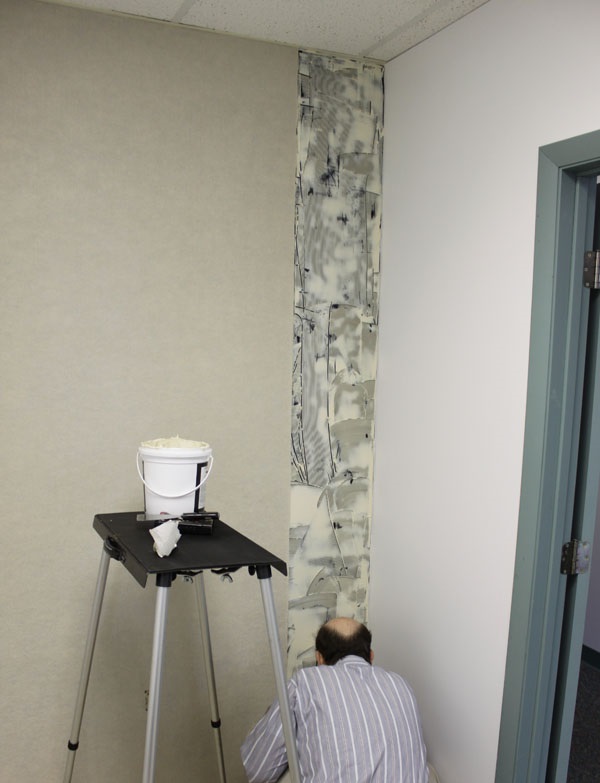
Also of note are the additional benefits when using Sound Channels® in early education classrooms. The effective range that this wall fabric controls is the higher speech frequencies, which is the ideal range for classrooms with younger children (there are not many bass/baritone kindergarteners). Another advantage is in keeping the treatment clean. Wall panels may suck up sound, but they can also absorb fluids (like the occasional juice box). Sound Channels®, on the other hand, is resistant to moisture, mildew and rot. It is also is non-allergenic, easy to clean, and is highly resilient to common wear.
Acoustical Considerations for Classrooms
Although this knowledge has been around for decades, classrooms across the country continue to be plagued by a lack of acoustical forethought. Perhaps as this information becomes more readily available to architects, contractors, administrators and teachers we will begin to see (and hear) better sounding classrooms. School is challenging enough on students and teachers as it is, let’s not compound their daily obstacles by continuing to overlook classroom acoustics.
(Originally published in Christian School Products Magazine – November, 2015)
 Acoustics First BLOG
You must be logged in to post a comment.