Posts Tagged similar yet different
Similar, yet different: Angled QRD vs. Standard QRD
Posted by Acoustics First in Diffusion, Product Applications, Products on August 19, 2025
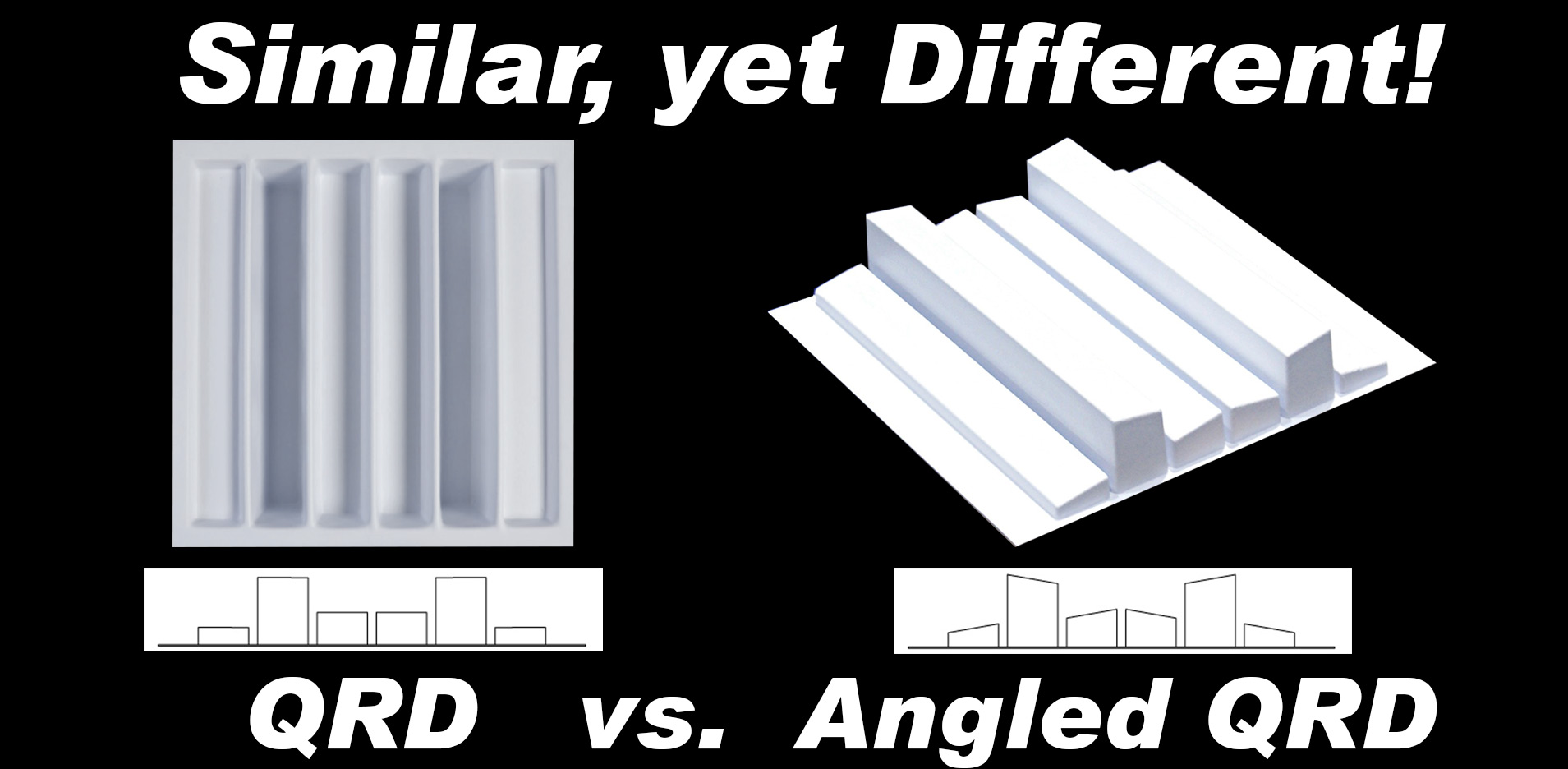
In this installment of “Similar, yet Different,” we explore the similarities and subtle differences between a classic, standard 1D QRD and a modern, angled 1D QRD. While being based on the same mathematic function for their design, there are a couple subtle differences in the performance of these devices.
Quick review. A Quadratic Residue Diffuser is based on a mathematic equation that states that the Well Depth is decided based on the square of the position of the cell and the remainder of when it is divided by a prime number. (We know it sounds really complex… but this is how the ratios of the wells are calculated to maintain a balance of magnitude across the face of the device.)
The equation looks like this:
Well Depth = (n² modulo p)
(Note: there will not be a quiz!)
As it was stated, both of the devices use the identical calculation when coming up with their wells… but there is one important change – the well bottoms are flat on the standard QRD and angled on the angled quadratic. This change makes this diffuser perform differently in 2 key ways:
- The Diffusion Pattern is wider on the angled QRD.
- There is a more subtle transition from one frequency to the next on the angled QRD.


When you look at the two sets of polar pattern above, you will notice that the Angled QRD has a wider pattern, as shown in the first-column, horizonal polar pattern (at 2000Hz especially), where the standard QRD is a more forward-focused pattern.
What does that mean in practice?
Both of these diffusers have a 1D pattern, but the flat bottoms of the standard QRD primarily use diffraction and incidence angle to widen the diffusion… the rest of the diffusion works on the principal of phase offset from the depth of the wells and the time of travel. The Angled QRD introduces an angle which means that one side of the well is deeper than another. This changes the reflection angle, time of travel, and, in turn, degrees of phase shift depending on where the sound strikes the inside of the well. This modification smooths the transition of phase from well to well – as the wells themselves have a range of phase change. This angle also causes the sound to be redirected toward the inner walls of the wells, causing it to change direction from the angle of incidence – widening the pattern further, changing the travel time, and basically bouncing sound around more.
There are some situations where the standard QRD‘s narrow pattern and well-defined transition frequencies may be preferable. In some practice rooms or larger listening spaces, there may be a need for the diffusion to be a little more directional, maybe to hit (or avoid) a certain position in the room. In these scenarios, the standard quadratic may be the recommended choice. In other spaces where you want the reflections to spread out more rapidly – maybe in smaller rooms or spaces where you need to get more coverage from ceiling reflections – then the angled quadratic may be more appropriate.
In closing, while these two devices have a nearly identical design, a small difference can have a big effect on the performance of the diffuser – and how you use them.
Similar, yet different: HiPer Panel® vs. HiPer Panel® Impact
Posted by Acoustics First in Absorption, Diffusion, Product Applications, Products on December 11, 2024
While the HiPer Panel® and the HiPer Panel® Impact may appear to be identical on the surface, there are some key differences that may change which one you would use, and why you would use it. They are both layered, flat-panel diffuser products, with perforations, and they are both covered in fabric. However, their construction, below the surface, is drastically different. One is a broadband absorber with a modified frequency response which focuses on reduction of specular energy, and cancellation of noise – where the other is a high frequency diffuser and reflector with a tuned bass absorption which is constructed to maintain acoustic energy in the space.

Construction
The HiPer Panel® was originally designed to optimize the capabilities of a standard broadband absorber. Its internal membrane and perforations create a material that works to modify the range of absorption, and create high frequency diffraction… but that isn’t all. The cavities are backed up to the membrane, which changes the reflection characteristics, where high frequencies can be reflected, and higher energy waves are absorbed more than if it was just fiberglass. This extended range is random, as the perforation density is gaussian in nature, but the membrane is also randomly backed by more cavities.
This design creates 4 different physical conditions that acoustic energy has to contend with… in a gaussian distribution.
- areas of the panel with 2 layers of fiberglass and a membrane in the middle.
- one layer of fiberglass with a rear membrane over a cavity.
- a cavity with a membrane back… sitting on fiberglass.
- a cavity with a membrane back… stretched over another cavity.
The random distribution of multiple acoustic obstacles is what gives this device its unique characteristics. It’s an absorber that changes its performance depending on where sound hits it, and at which frequency. Some frequencies pass into the cavities and reflect off the membrane, while others are dampened by the membrane… while longer wavelengths see the membrane as a stretched diaphragm or limp mass.
The HiPer Panel® Impact has a very different construction and may be used for a very different reason. The HiPer Panel® Impact uses the same pattern of holes, but the holes aren’t cut into an absorber… they are cut out of a reflective face, which is attached to an absober. Unlike the first HiPer Panel®, the “Impact” can be used to maintain more of the energy in the space, break up some of the higher frequencies with that gaussian hole pattern, and be a low frequency bass trap. The design is simple and effective, but is not necessarily used in the same places where you would use the first HiPer Panel®.
Use cases.
The first Hiper Panel® is often used in theaters, and listening spaces where focusing on the source is of primary importance. Its broadband absorption, gentle high frequency diffusion, and smooth mid frequency control are ideal for critical listening environments such as mixing rooms, media rooms, theaters, or even voice over spaces. The performance is about removing the acoustic elements that could interfere with the focus on the source speakers.
The HiPer Panel® Impact is often used in performance spaces, where you want to maintain energy, break up high frequency flutter, and remove low bass. The reflective face doesn’t remove as much energy from the space, however it does change the characteristics of the space. This helps break up some frequencies, reduce bass, and keep the energy moving around the room. Music halls, churches, auditoriums, and any space that relies on the room helping to reinforce the sound will benefit from these taking the edge off the highs and dampening the lows – which is how the HiPer Panel® Impact controls the sound… while helping it maintain its “impact.”
In summary, while these two products are in the same family, they have a different core construction, which changes their performance. There are scenarios where you may use them both, however since they address different problems in a space, they are not always interchangeable. Contact Acoustics First® if you have questions about any of our products.
Similar, yet Different: Pyramid vs. QuadraPyramid
Posted by Acoustics First in Articles, Product Applications, Products on November 15, 2024

Based on the golden-ratio, offset pyramid… both the Acoustics First® Pyramids and QuadraPyramids have a great deal in common. They are asymmetric in their scattering, which reduces lobing. They have different sized surfaces of different angles, which impose different polar radiation patterns at different frequencies. Both allow for redirection, while allowing much of the signal phase to remain intact, which keeps a great deal of energy moving together, which works great for performance spaces. However, there are some subtle differences which change how these units perform and how you maximize their use.
While both the Pyramidal and the QuadraPyramid come in a 2’x2′ format, the QuadraPyramid packs 4 pyramids into that footprint. That isn’t the only difference though. The depth of the QuadraPyramid is only about 2-3/4″ to the 8″ deep single peak of the classic Pyramidal. On top of that, the Pyramidal comes in different sizes and ratios of length to width including a 4’x4′ and a 2’x4′ at up to 13″ deep.
These different sizes do more than change their aesthetic. The large pyramid geometry allows for greater impact on lower frequencies, as the longer wavelengths are less skewed by small surfaces. The different ratios and sizes also changes the angle of throw off the surfaces, allowing for more options to redirect the sound. The larger surfaces also impose some limitations to their use. Being physically larger means that the listener will need to be further away from the device to allow the reflections to spread out, and the greater depth means that, at certain angles, the geometry can place other devices in their acoustic shadow. The larger pyramids work great in larger rooms with high ceilings, where they can be placed higher in the room. This makes them ideal for performance spaces and large band/music practice rooms – where everyone is spread around and needs to be able to hear everyone else.

The QuadraPyramids have a higher density of reflective faces per square foot. There are 16 facets on a 2’x2′ QuadraPyramid, which means more smaller faces to reflect sound. These faces are optimized for higher frequencies which have shorter wavelengths – but the profiles are actually better suited for smaller rooms with lower ceilings. In smaller studios, listening rooms, and media spaces, space is at a premium, and having a large diffuser hanging a foot down from the ceiling would be more of an impediment. This is where the QuadraPyramids shine. Their low-profile and many facets allow for sounds to spread out while breaking up flutter echoes and reducing other higher frequency artifacts.

Finally, the size of the cavity behind the larger pyramid allows for greater bass trapping, especially with the ability to fill the cavity with fluffy insulation. While the QuadraPyramid still imparts some absorption due to the resonance of the thermoformed plastic material, it is more focused at the resonant frequency (250Hz) – while the larger pyramids have a wider frequency range they affect.
| Device | 125hz | 250Hz | 500Hz | 1000Hz | 2000Hz | 4000Hz | NRC |
| 2’x2′ Pyramid (insulated) | 0.57 | 0.41 | 0.38 | 0.21 | 0.16 | 0.16 | 0.30 |
| 2’x2′ Quadra Pyramid | 0.23 | 0.58 | 0.05 | 0.04 | 0.04 | 0.11 | 0.20 |
While the Pyramid and the QuadraPyramid have their roots in the same geometry, their specific implementation changes their performance characteristics to provide more options in treating your space. Using the right treatment changes depending on the space and its function… even two identical rooms can have drastically different performance requirements – needing drastically different treatments. Acoustically, a Quadrapyramid is drastically different than a 2’x4′ Pyramid – but fundamentally, at their core, they are very similar.
Similar, Yet Different: Model C vs. Model D!
Posted by Acoustics First in Diffusion, Home Entertainment, Home Theater, Media Room, Multipurpose Rooms, Music Rehearsal Spaces, Music Tracking Room, Product Applications, Products, Recording Facilities, Recording Studio, Studio Control Room, Theater on January 5, 2024
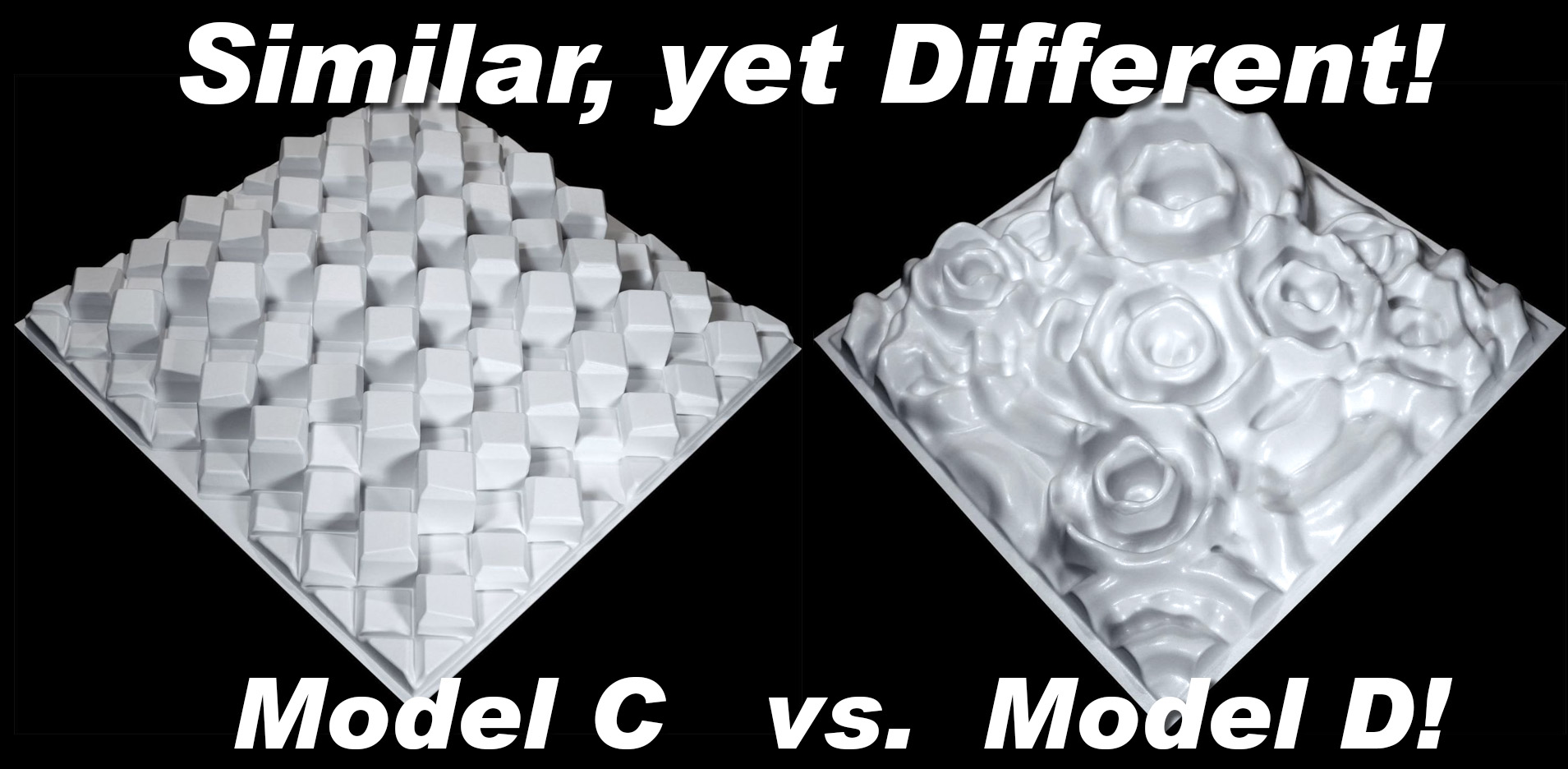
In this installment of “Similar, Yet Different,” we take a good look at two very different looking diffusers in the 2’x2′ size… the classic ArtDiffusor® Model C and the organic, rippled ArtDiffusor® Model D – while there are some similarities, there are some key differences in how they look (obviously) and how they perform.
Quick Similarities.
The ArtDiffusor® Model C and Model D are both 2’x2′ diffusers which are made to be either wall mounted or installed in a standard drop-tile ceiling grid. They are both formed from a Class A fire-rated polymer in a single piece. Both are mathematical diffusers, which create their different physical features in a “form follows function” methodology. They also cover roughly the same frequency bands, with some minor variation in how they execute their control.
Difference in Math
The Model C is an interesting configuration. Often you will see quadratic residue diffusers with flat blocks or wells in a relatively standard quadratic cell formula configuration. The Model C runs in a much different alternating binary configuration. The basic idea is that cells are placed in a 45° array with each cell adjacency calculated as an alternating array of higher and lower cells starting in the middle and working in a pattern of alternating low/high cell clusters decreasing toward the edges of the diffuser. These diffusers also do not have flat tops on the blocks – they are angled at 10°. The orientation is then rotated in 90° steps in a pattern that maximizes the spatial redistribution of reflected sound. This was a vast design departure over the original quadratic design, and created a diffusion profile that was distinctly different.

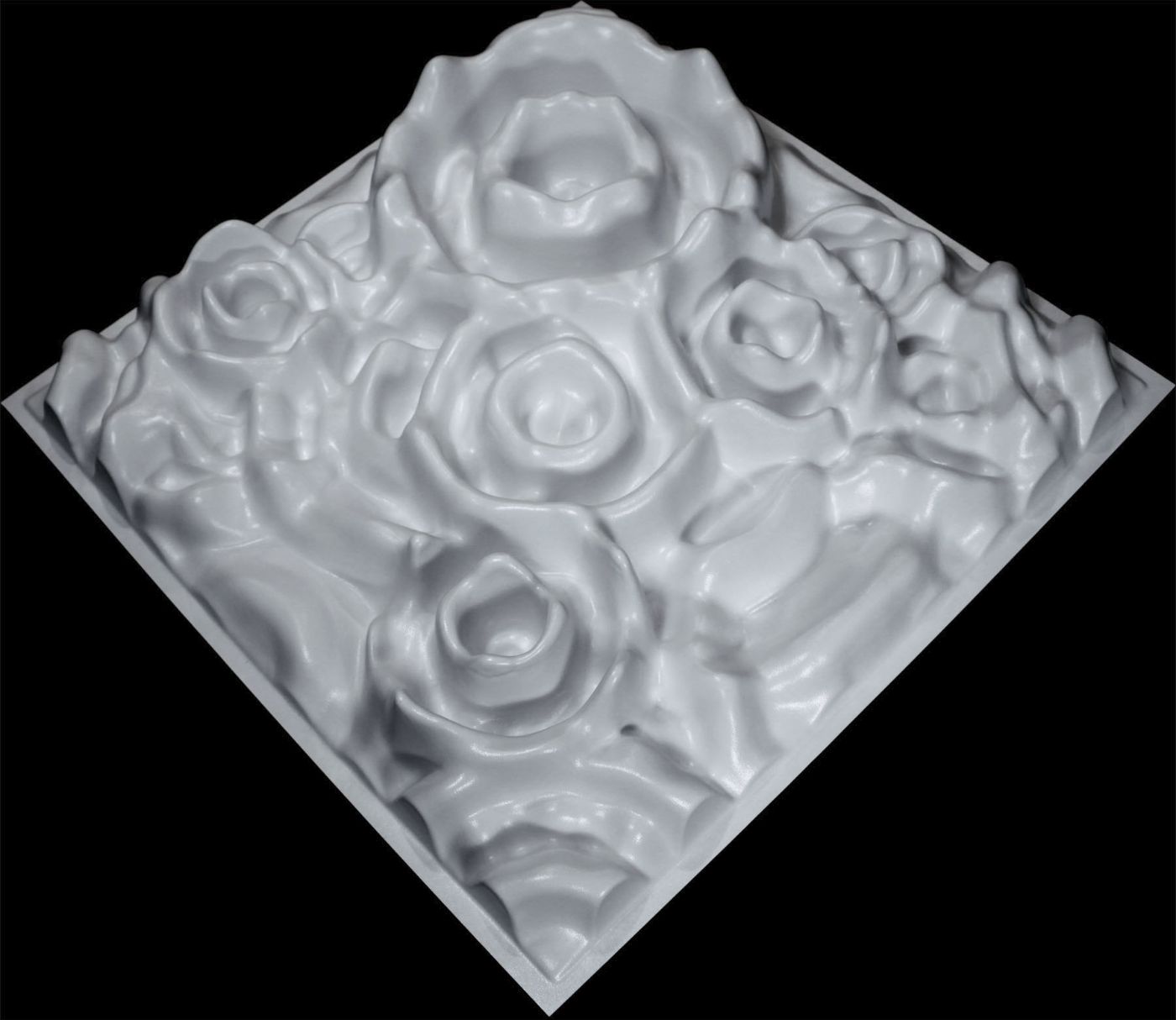
The Model D was an even greater departure. It began with a Maximum Length Sequence (MLS) concept that first changed the varied straight channels into rings of different dimensions. These rings then broke from the MLS mold by getting varied height profiles based on the QRD sequence. As if having different size rings at different heights wasn’t enough… the randomness was further perpetuated through a Boolean process of assigning certain rings a random property that would either add or subtract height from any other ring that they crossed. Finally, the entire surface geometry was smoothed using a bicubic interpolation, creating the organic undulating surface which gracefully spans the entire profile.
What this difference in math does to the acoustic performance.
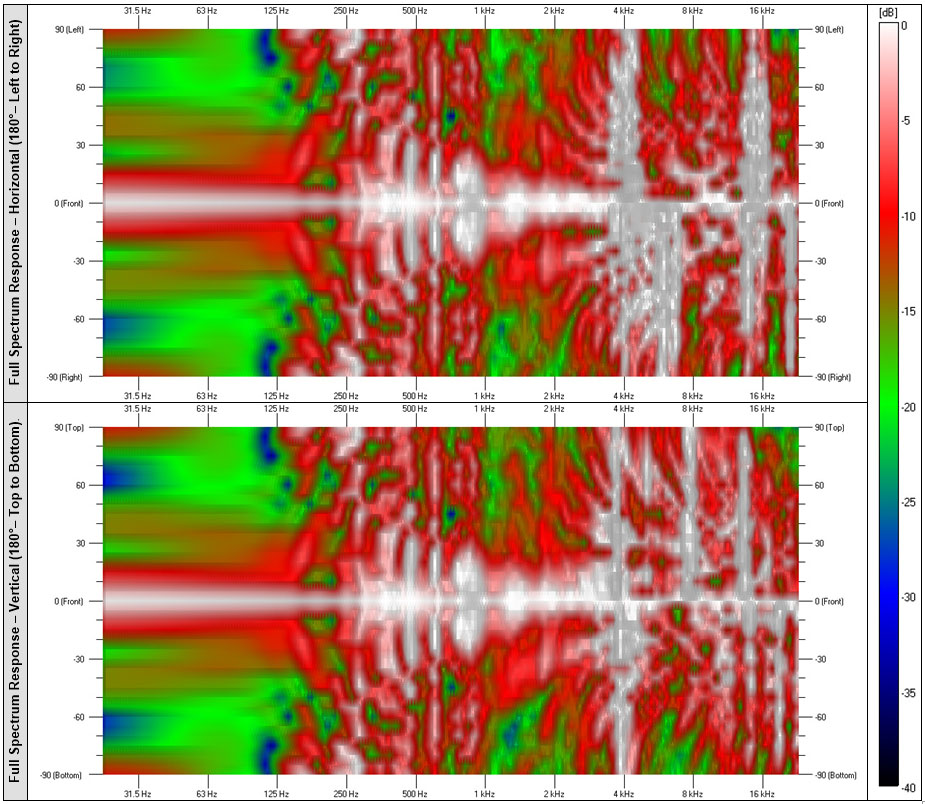
The Model C has a nice even diffusion profile through it’s primary working range. This is a product of the QRD design and binary distribution. The set size for the blocks guarantees a solid primary frequency range from about 1KHz to over 4Khz. This tunes the Model C squarely in the most sensitive bands of the human hearing range. Below this range the device becomes a bit of an absorber. Above this range and the performance becomes more effective at intervals, which can be seen in the areas of wide diffusion at 6KHz – 18 KHz. These repeating zones are common in “stepped” quadratic designs. Due to the heights of the well being at specific intervals, the intervals repeat at octaves of their effective bands.

The Model D doesn’t have the same stepping. The spline interpolation and the random Boolean shifts smooth the transition from one quadratic height to the next, and the MLS sequence causes a bit of a high-pass filter pushing the start of the primary range to around 2KHz – which is a little higher than the Model C. The main difference is that once the Model D starts it’s range it diffuses everything up to and over 20KHz without the banding that can happen in other quadratic designs.
Another difference in symmetry.
The ArtDiffusor® Model C is a fairly symmetric design, but it’s 45° angle pushes that symmetry along the diagonal (corner to corner) across the unit. The asymmetry is subtle but allows for enough variation to account for any “lobing” issues that can occur in more simple geometric devices The 10° block faces being at varied orientations is key to increasing the spatial directivity over the older “flat-faced” Quadratics. This was a very novel design when it was first introduced, and those benefits are crucial to the longevity of the Model C’s reign – It just works. It’s predictable and musical… and that’s why it’s here to stay!
The ArtDiffusor® Model D is a completely different animal from the Model C when it comes to symmetry… as a matter of fact… there isn’t really much on it that is symmetric! The Model D was designed as a departure from symmetry. Focusing on the mid to high frequencies, which are very specular, the organic geometry creates an asymmetric reflection pattern. This pattern can be used to steer the sound into a wider field.. and that profile changes with the wavelength of the sound that hits it. This steering ability and the wide frequency range has made the Model D a favorite in mixing and mastering environments, where they can get smooth performance through the entire frequency spectrum.
How these differences benefit everyone.
We have stated before that there isn’t really a one-size-fits-all solution in acoustics. Many environments will use various treatments to achieve their desired goals. You will often have different devices to address different problems, in different frequencies, in different locations, in the same space. Bass traps for controlling the lows. Absorption to reduce gross energy across the board. Large geometric surfaces to break up parallel reflections and steer the projection of sources. Mid range diffusers to create clarity to the sources and reduce artifacts. High frequency diffusers to reduce flutter and add a feeling of envelopment and airiness in the space. These devices all have their place – from the smaller listening rooms, to critical listening environments, and large multifunction spaces and venues.
It is also worth noting that these two devices have a very different aesthetic visually. The classic blocks of the Model C have become a signature look for quality sound environments, and people recognize them as they would classic geometric pyramids and barrels. The Model D aesthetic provides a visual accent that people take advantage of to set their space apart from others. The undulating, asymmetric pattern changes drastically when you rotate the individual units in the array. This allows for not only varied acoustic performance, but also a unique visual possibilities – with numerous variations.

The ArtDiffusor® Model C and Model D are two tools that are used to craft ideal listening environments around the world… and in those roles they are indeed Similar, Yet Different.
Similar, yet different: Quadratic vs. Itself?
Posted by Acoustics First in Diffusion, Product Applications, Products on July 6, 2023
For this installment of “Similar, yet different,” we will take a classic welled-quadratic sound diffuser, The Model Q, and compare its performance to itself – only installed backwards!

Taking “similar” to the extreme in this case, we are testing the difference in performance of a 1-dimensional, welled-quadratic diffuser installed in the standard welled configuration, and then installed reversed – with the sound impeding on the back side of the wells. For a bit of history, the Classic Quadratic Diffuser (or Schroeder diffuser) was designed with a grid separating the reflectors – creating wells of different depths proportional to the remainders of n2 (mod N). This design has some interesting facets.
- They are inherently symmetric if left in the original sequence.
- They are periodic (i.e. they repeat.)
- The discrete Fourier transform of the exponentiated sequence has constant magnitude.
The design principal is simple if you tear apart the math, and it’s simply wells that have a different effect on different frequencies, depending on the geometry of the wells. The Model Q is an advanced 1D-Quadratic with angled well-bottoms, which assist in smoothing out the performance and widening the 1D polar radiation. So if this design is relying on the wells to be effective, why would we reverse it?
An acoustically diffuse environment develops due to many factors, and while the frequency focus of the wells is useful, there are other scenarios where different methods may be preferred. If the geometry of the elements were flipped around, you would get the same (albeit reversed) ratio of distance, but you lose the containment and channeling that the wells provide. This imparts a diffraction on the unrestrained elements. This also allows for a different interaction between the elements, as the face of the unit is no longer planar.
Let’s look at the effect this has on the performance of the device at some different frequencies – starting low and moving up…
First, we will look at the 1150Hz performance of the devices… standard welled-install on the left, reversed on the right.

At 1150Hz, there is a little variation in the performance. Both are front focused, with a strong 1D horizontal polar response, but they are not identical. The welled-design (left) shows a broad frontal response, while the reversed design has a smoother vertical response, sharper front lobes, and stronger side performance. Overall, this difference is relatively small at this frequency.
Now, we will look at 2300Hz.

Again, we have two similar looking balloons, but there seems to be a bit more variation. The welled-design (left) shows a smoother 1D pattern in the front as the wells release sound within the same plane – at the front face of the wells. On the right you will notice sharper and more discreet lobes, but you will also notice that it has wider horizontal performance again, as it isn’t as front focused due to its free standing elements. The vertical performance is also a bit different – the welled design is broad and smoother vertically, while the reversed installation shows sharp lobes again.
Step up to 2800Hz, and we see some more drastic differences.
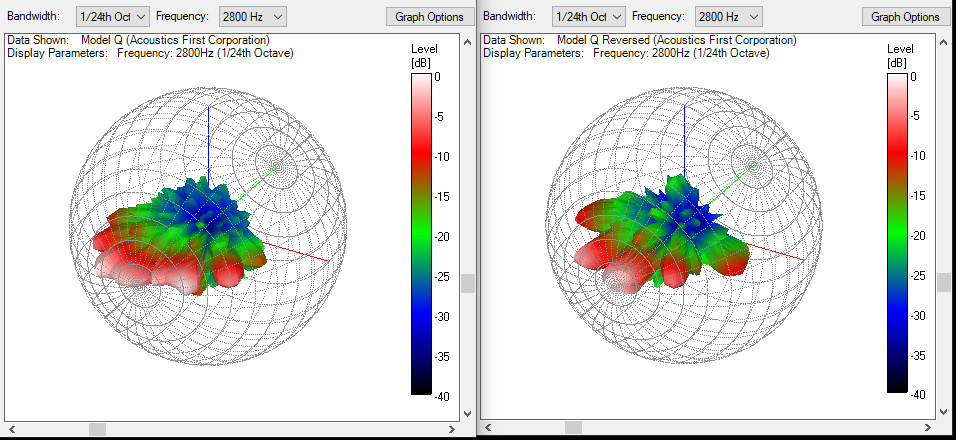
The performance of the standard welled-install (left) stays smooth and front-focused, while the lobes of the reversed install (right) have become even more distinct. Interestingly, the side lobes are even larger, showing an even wider polar pattern than before. These two instances show a marked difference between the smooth front-focused wells and the wide sharp scattering of the unrestrained elements. These two configurations are both very different, but are still both very effective at helping to disperse the incoming energy. Remember that the room develops diffusion through sound travelling in many different directions – these are not simple reflectors sending the specular energy in a single direction.
Now at 3650Hz we see a shift toward the reverse installation.
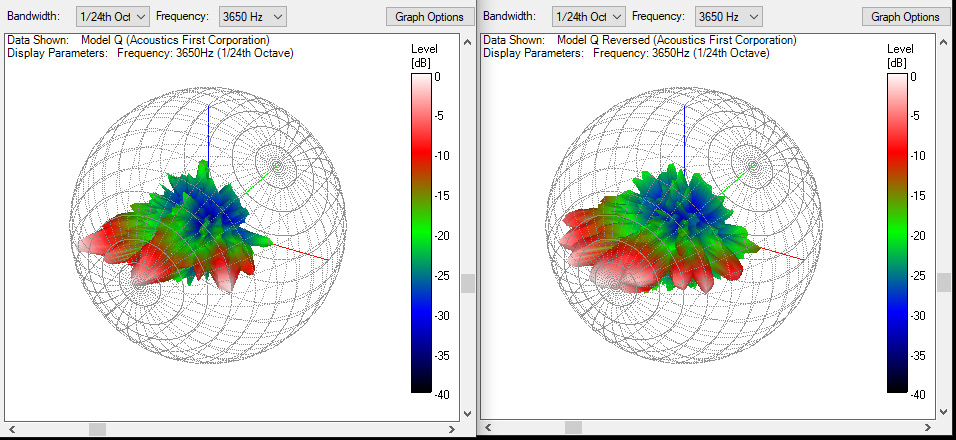
At around 4K the welled-installation (left) begins to move back front and center. It’s primary method of diffusion uses the wells to channel the energy, and at higher frequencies sound becomes much more directional. This directionality is used to create a temporal shift in the sound, as the reflections will occur out of phase from the source, and controlling that reflection is paramount to tuning this method of diffusion. However, as stated before, there are other mechanisms contribute to diffusion. The unrestrained elements on the right balloon, have hit their stride and still maintain a wide 1D polar pattern. The lobes are still sharp, showing the interaction of the elements with sound. This installation is showing the strength of its spatial dispersion, which will send acoustic energy in more directions and use the travel through the space to create a diffuse environment. It loses some of the frequency tuning of the wells, but makes up for it in the wide polar pattern.
Now for the super high frequencies – we jump straight to 10Khz.
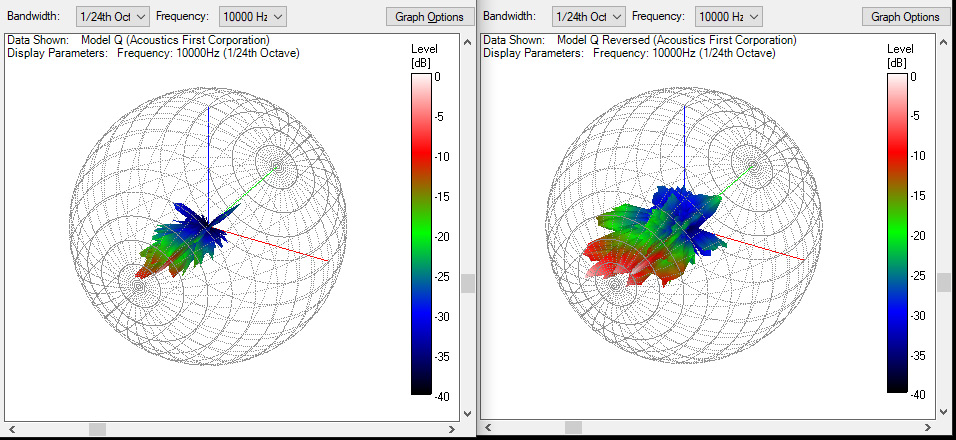
This final set shows two diffusers pushed to the limits. The welled-installation (left) is a very narrow focused beam now. You will note that it has some variance due to the interactions with the walls of the wells but all of its work is done through phase shifting at this point. In contrast, the exposed elements (right) are still allowing for a bit of diffraction to occur, and the angled faces are still allowing for a bit of spatial redirection. Also note that these polar patterns were generated with a sound source directly in front of the device at 0° incidence, and the exposed elements would offer more exposure to its surface area than a welled design at wider angles of incidence.
In summary…
Diffusion develops using many different variables, including the untreated walls of the space. While both of these installations are functioning in nearly identical frequency ranges due to their geometry, the mechanisms which they work are slightly different and have different strengths. The welled-design (in classic temporal Schroeder configuration) uses the wells to channel sound and address the frequencies in a tuned and controlled fashion. By simply flipping the device around, however, you change its performance from a controlled time shift, to an unrestrained spatial redirector, which imparts time shift through dispersion, diffraction, and distance travelled – further reducing intensity by having a wide 1D diffusion polar pattern. Both have scenarios which one configuration would be preferable over the other, making the Model Q diffuser a very versatile device.
Both configurations are literally two sides of the same coin… they work in different ways, over the same frequencies, providing results – no matter how you flip them.
 Acoustics First BLOG
You must be logged in to post a comment.