Archive for category Uncategorized
Lessons from 2020 – Acoustics and More.
Posted by Acoustics First in Articles, Uncategorized on December 23, 2020

International Year of Sound opening ceremony in Paris… Pre-COVID-19 restrictions.
On January 31, 2020, the International Year of Sound held its opening ceremony at Sorbonne University in Paris – where there was much optimism for the education and advancement in the understanding of sound and how it affects our daily lives. COVID-19 was just starting to enter into the world vocabulary, and we all met with no masks, no social distancing, and no restrictions (France had only just identified a few cases that very week.) Little did we know how the year would eventually evolve. Lock downs, Zoom meetings, working-from-home, and the virtualization of our interactions brought to light some issues that many of us had taken for granted.
Our personal spaces have become full of sound, with adults working and doing virtual meetings, while the children are taking classes from home. The dogs are barking, the toddlers are toddling, the neighbors are jamming, and we are all becoming keenly aware of our acoustic environments. This is a situation that we didn’t know we were going to be facing at that opening ceremony in Paris. Some people never considered having to work from home, much less having a home office and having to work from home daily. Even if you had a home office, did you really consider what it looked like… or sounded like?

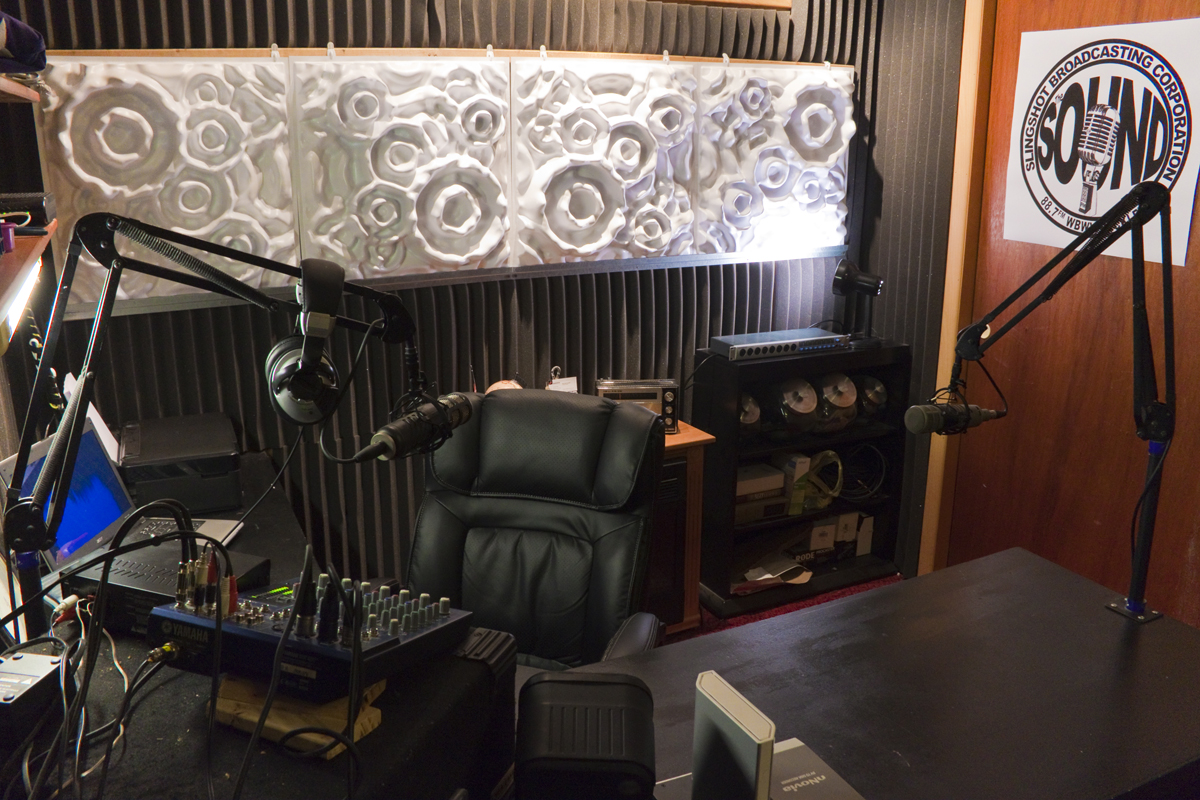
Adding Sonora® Panels improves acoustics and creates an interesting backdrop for those Zoom meetings.
This melding of personal space and workspace has created some conflicts. When you want a quiet space to work, you may be competing with your child’s virtual gym class in the other room, or your neighbor upstairs trying their best to stay active while the lock down has closed the gym – but these aren’t the only issues. Maybe earbuds hurt your ears, or you are using the microphone on your webcam and people keep complaining about how it’s hard to understand you. Speech intelligibility declines in poor acoustic environments and the acoustics of your home office may now have become an issue to others… not just if you understand them – but if they can understand you.

Adding diffusers to make it sound more like a home theater.
And it’s not just work and school… we are spending much more time in our homes this year. People are realizing that their TV’s are becoming home theaters, and the room maybe doesn’t sound that good. We are asking more of our home environments – we are asking them to be our offices, gyms, theaters, workshops, studios, as well as where we eat and sleep. Many are making improvements to their homes to block sounds from their offices, improve the sound within the home office, make a better sounding TV room, and acoustically treating the kids’ rooms – to hopefully improve sanity for everyone.
However, not everything is so easily solved. If you are in a multi-family dwelling, your neighbors may have different schedules than you. They may be night-shift tech-support, or sales for a different time-zone, or work for an international company. Maybe their home office is directly adjacent to your bedroom, or your home theater is causing them problems. Some have learned to adapt with sound masking solutions, acoustic treatments, or improvising their own home-grown solutions to address sound problems.
So, 2020 has not been the year we thought it would be in January. We have had to learn to compromise in the face of adversity to improve this situation for everyone – and it’s more than just making our home sound better for work or leisure. This goes beyond our own walls, and our own ears. Improving acoustics helps our neighbors work and their children learn. We are helping our co-workers and our customers. We are making the best of a difficult situation – while looking to the future with hope and optimism.
Here we sit at the end of 2020… and the International Year of Sound has been extended into 2021. We have learned many lessons, and have had to solve problems we never thought we would have to face. The world sounds very different now – we have found new ways to experience entertainment, new ways to work, new ways to play, and new ways to socialize.
Moving forward, we will need to integrate these solutions into our future reality. The Year of Sound has taught us lessons through adversity that we would have never learned otherwise – and those lessons of hope, optimism, tolerance, ingenuity, and compromise will serve us well as we face whatever the future holds.
ASA 2020 – Acoustics Virtually Everywhere
Posted by Acoustics First in Press Release, Uncategorized on December 4, 2020

ASA Acoustics Virtually Everywhere Meeting 2020.
December 7-11, 2020: The Acoustical Society of America (ASA) is running their first fully-virtual meeting, Acoustics Virtually Everywhere (AVE). The format is just like a real-life convention with a few interesting twists. If you’ve ever had a scheduling conflict and needed to choose one presentation over another – you don’t necessarily have to! Many of the sessions are prerecorded, so you can watch the presentations when you have time, and if you have questions you can reach out before, during, or after their allotted time!
There will be poster sessions where you can meet the presenters, and there are chat and social platforms for networking as well! Jim DeGrandis from Acoustics First® will be in attendance.
So… if you are an ASA member and were wondering about how this virtual meeting is going to work… check out the “Acoustics Virtually Everywhere” overview here
https://acousticalsociety.org/overview-ave/
If you aren’t an ASA member, you can find out more about the benefits of becoming a member here.
https://acousticalsociety.org/asa-membership/
We look forward to seeing you there… Virtually.
ArtDiffusor® Model D vs. Aeolian®: Similar, yet different.
Posted by Acoustics First in Diffusion, Product Applications, Products, Uncategorized on November 12, 2020

Today on, “Similar, yet different…” we are going to analyze two more of our acoustic diffusers and compare/contrast their designs and functionality… and this one is a doozy; The Model D vs. The Aeolian®. These two diffusers have some very interesting similarities and some surprising differences – so lets get started!
We have discussed the Aeolian® construction before, so we will start here with a quick recap as a reference point. The Aeolian® started life as a blocky-looking diffuser – just like the Model C, but the implementation is different. While the Model C retains its “blocky” appearance, the Aeolian® has run through a mathematical process called “bicubic interpolation.” This smooths the transition from one block to the next, creating the wavy appearance of the Aeolian® diffuser.
So, keep that in mind: The diffuser was tuned with different height blocks and then the transitions were smoothed.

Look at the smooth curves of the Aeolian®.
The Art Diffusor® Model D has multiple layers of math below its curved surface. While the Aeolian® started life as “Blocks” of different heights… the Model D started life as “Rings” of different sizes and heights. The calculation for the heights is identical to the mathematics used in tuning the Aeolian®, but why different sized rings?
There is an older diffuser design known as a Maximum Length Sequence (MLS) diffuser. These were tuned to different frequencies using a specific depth, and different spacings of “lands and valleys.”
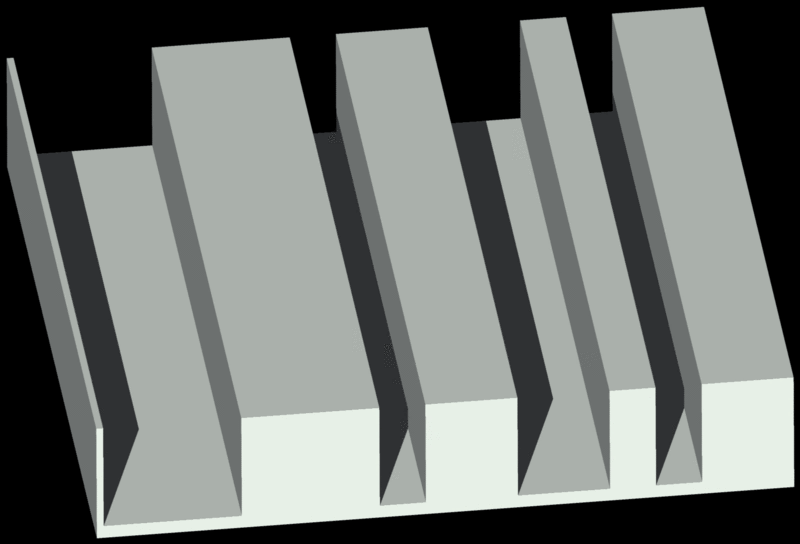
MLS Diffusers had same depth wells of different sizes and spacings…
The Model D started with the concept of twisting the MLS spacings into rings, and changing the size of the rings. Then to break the “MLS mold” of having the same depth, this MLS ring structure is raised to different heights using Quadratic Residue calculations… effectively combining the rings of MLS spacings with different QRD heights. While this could have been where this stopped, we wanted to interject more randomness into the equation.
Wherever the rings of different heights intersected, we decided to change the heights by values relative to the difference between the two rings. This height variation is what is responsible for the “random” waviness. This was accomplished with different Boolean Functions, to either add or subtract height where the rings intersected.
You can really see the variation in the geometry of the Model D… look at the ripples in the rings.
This method of using Boolean Functions inserts a known-height randomization into a hybrid MLS/Quadratic system. (That’s a mouthful.) The final step, after refining the ring size, height, position and intersection parameters… was to smooth the whole geometry with “Bicubic Interpolation.” That’s right. This final step smooths all the transitions from the heights, just like the blocks of the Aeolian®.
So onto the Simple Similarities!
Both diffusers use a quadratic residue calculations to get the main heights of the diffusive elements. Both diffusers are finished off with a helping of “Bicubic Interpolation” to smooth it all out. This gives them both a very organic look… The Aeolian® looks a bit like rolling waves, and the Model D resembles droplets of rain in a puddle…
They do perform quite a bit differently though.
The Aeolian® has great lower mid-band performance… while the Model D is a beast in the upper mid-bands starting about 2.5K. The difference is in the severity of the geometry. The Aeolian® is a gently rolling surface which redirects the waveforms uniformly through a wide range of frequencies. The Model D has a very irregular surface. With the different ring sizes, heights, locations and boolean functions… it’s meant to target and shred mid to high frequencies. Both diffusers are asymmetric – and affect different frequencies in different ways.
The Aeolian® is also deeper than the Model D – and this depth is a single resonant cavity… allowing it to be a great bass absorber as well. The Model D is useful in environments where you have bass control in place, but really need to diffuse the upper mid range and bring those frequencies to life… or maybe shred some flutter echos or comb filtering. There are scenarios where both are used in the same environment – but for different reasons.
In Conclusion...
While both the ArtDiffusor® Model D and the Aeolian® both look like liquids frozen in time, they have some other similarities in the math behind them… Yet they are still as different as rolling waves versus droplets of rain in a puddle.
ArtDiffusor® Model C vs. Aeolian®: Similar, yet different.
Posted by Acoustics First in Diffusion, Product Applications, Products, Uncategorized on September 24, 2020

For this installment of “Similar, yet different” we look at The ArtDiffuser® Model C and the Aeolian® Sound Diffuser.
While these two diffusers look very different, there are a fair amount of similarities between them. Their physical size and depth allow them both to be great mid-frequency diffusers, but did you know that the Aeolian® started life as a blocky-looking diffuser – just like the Model C? It’s true!

ArtDiffusor® Model C array on a hanging bass trap.
The mathematics behind the two diffusers is similar, but the implementation is different. While the Model C retains its “blocky” appearance, the Aeolian has run through a mathematical process called “bicubic interpolation.” Without turning this into a math-heavy post, if you take a “blocky” design like the Model C and run its geometry through bicubic interpolation, you get a “curvy” surface like the Aeolian® – It “smooths” the transition from one block to the next in a 3 dimensional matrix.
While they did not begin as identical geometries, they were similar in their height ratios – with the Aeolian® starting with fewer blocks in a more random distribution, and a slightly taller maximum height. They both effect similar frequency ranges, with the Aeolian® going slightly lower and higher due to its depth and interpolated surface. The pattern and type of the diffusion is also different because of the different geometries – the Model C has blocks, and the edges of those blocks introduce a great deal of edge “diffraction” – which is what happens when a wave interacts with an edge, or corner, of a surface. It bends and shears around the edge, which helps break up the continuity of the waveform, where the Aeolian® takes the approach of redirecting most of the energy off a randomized and continually-curved surface.

Aeolian® Diffuser array on the back wall of Big3 Studios.
It is important to note that the two are similar, yet different in their absorption numbers as well. With the Aeolian® being deeper with a single large cavity, it provides a bit more absorption in the low frequencies than the Model C, which is a more rigid geometry containing smaller elements. Depending on the space, this may be a useful addition to the diffusive properties. While some spaces need the extra absorption, some are pretty well balanced already and are just looking to “sweeten” the sound a bit.
On the surface, they are both a nominal 2’x2′ square of thermoformed Class A plastic with lightly textured surface. That is the extent of the visual similarities, and we cannot hide the aesthetic differences between the two devices. The ArtDiffusor® Model C is a “classic” diffuser. Many have been looking at these for the better part of 3 decades now. It’s a classic design at this point with no need for introduction – it is what the quintessential diffuser “looks” like. In fact, when many people think of a diffuser – the Model C is what they visualize! The Aeolian® is a modern rendition of the classic design. Using modern calculation techniques, we can now present the type of diffusion the Model C is famous for, in a different way.
While the two geometries look entirely different, and perform a bit differently, they have a common heritage as mathematical, 2-dimensional diffusers. You could say that the Model C is the grandparent of the Aeolian®, and that pedigree has been passed on – having a similar foundation, but a different final interpretation.
ArtDiffusor® Model C and Model F – Similar, yet different.
Posted by Acoustics First in Diffusion, Media Room, Music Tracking Room, Product Applications, Recording Facilities, Recording Studio, Studio Control Room, Theater, Uncategorized, Vocal Booth, Voice Over on August 20, 2020

We often get asked about the functionality of the different diffusers, and one of the frequently asked questions is about the differences between the ArtDiffusor® Model C and ArtDiffusor® Model F. We will cover some of similarities and differences in the design, functionality and use of these two devices.
Design.
The Model C and Model F use identical math to come up with their basic structure, they even have angled faces – the main difference between the two is that the Model F elements are ½ of the Model C’s height, length and width – and then it is duplicated 4 times in the same footprint… The Model C is nominally 2’ x 2’ x 4” deep. The Model F is four quadrants that are nominally 1’ x 1’ x 2” deep – like little scaled down Model C’s… This makes them visually similar and aesthetically compatible. This low profile design makes the Model F more desirable for ceiling installs in spaces with very limited headroom – like basement studios that have low ceilings.
Performance
Due to the different size of the elements on the two devices, they have very different frequencies at which they are most effective. The Model C is a mid-frequency diffuser by design… having larger elements and deeper wells than the Model F. The Model F is primarily a high-frequency diffuser, due to the small elements and lower profile. Both diffusers are tuned to different frequencies as their “primary range,” and while they do affect lower and higher frequencies than they are designed for – it is to a lesser degree, or the product of absorption.
What does this mean?
The Model C has a primary design range of 1KHz to 4KHz. This is where it is primarily designed to work. It can and does diffuse below 1KHz and over 4KHz – just to a lesser degree than its primary design range.
The Model F has a primary design range of 2KHz to 8KHz, and again, it does diffuse outside of that range, but to a lesser degree.
The angled caps of both the Model C and Model F help to extend their high frequency range by reflecting sound in different directions at higher frequencies – causing the sound to scatter spatially. The different heights of the elements cause sound reflections to be offset “temporally,” or in time. The sound that hits the higher elements is reflected sooner than the sound that hits the lower elements – travelling further before it is reflected. This time offset, changes the “Phase Coherency” of the reflection; the larger the difference in the heights, the greater the offset in time.
The size of the elements matters as well. The shorter wavelengths of high frequencies can diffract and scatter off of the smaller elements of the Model F more readily than low frequencies, which see the Model F as a slightly angled & mostly flat surface. However, the lower frequencies are more affected by the larger and deeper elements of the Model C.
How do these differences help define their use?
The Model C is a great all around diffuser – it covers a wide range of frequencies, throws a very predictable 2D diffusion pattern, and it is tuned to a very musical range.
The Model F is a great high-frequency diffuser. It targets a few very specific, yet important issues. High frequencies are responsible for some nasty problems in rooms. Flutter echoes, ringing, comb filtering, and other artifacts are particularly noticeable in higher frequencies. If your room is otherwise performing well acoustically, the Model F can help tackle that last hurdle to make a good room into a great room.

Many critical listening environments use both the Model C and Model F to tune the diffusion in their space.

While the white Aeolians® on the back wall are the visual focal-point on in Big3 Studio A, look closely at the ceiling and you will notice a large array of black Model C’s and Model F’s. These help to intermix the diffusion of different frequencies in the large control room.
Due to their aesthetic and functional compatibility, many rooms benefit from using both. Model C’s addressing the bulk of the Mid-range diffusion, and the Model F smoothing out the top end.
I hope that this highlights the unique properties of both the ArtDiffusor® Model C & ArtDiffusor® Model F – and helps to demystify their function and use in your space.
 Acoustics First BLOG
You must be logged in to post a comment.