Archive for category Uncategorized
Joint ASA/ASJ Meeting – 2025 Recap
Posted by Acoustics First in Press Release, Uncategorized on January 23, 2026
The joint meeting of the Acoustical Society of America (ASA) and the Acoustical Society of Japan (ASJ), held in Honolulu in December 2025, was a welcoming gathering for the international acoustics community. This joint congress happens only once every ten years, making it a rare opportunity for researchers, consultants, and students from both societies to come together, reconnect, and exchange ideas. Hosting the meeting in Hawaiʻi—literally and figuratively a bridge between the two countries—added to the collaborative and relaxed atmosphere.
Across the week, a wide range of ASA and ASJ technical committees organized sessions that showcased the diversity of acoustics research and practice. These included:
- Architectural Acoustics
- Noise
- Physical Acoustics
- Psychological and Physiological Acoustics
- Speech Communication
- Musical Acoustics
- Computational Acoustics
- Engineering Acoustics
- Education in Acoustics
- Structural Acoustics and Vibration
- Underwater Acoustics
- Signal Processing in Acoustics
- Biomedical Acoustics
- Animal Bioacoustics
- Acoustical Oceanography
Together, these sessions reflected the breadth of the field—from fundamental physics to human perception, from engineered systems to the natural environment.
One such session was organized by the Architectural Acoustics Technical Committee and focused on the Advances in Absorption Measurement and Design. Presentations explored how these materials are evaluated in the lab, how they are specified and integrated into buildings, and how they ultimately shape the acoustic experience of everyday spaces. This session was co-chaired by Jim DeGrandis (Acoustics First Corporation) & Daniel Robinson (Sublime) from the ASA, as well as Toshiki Hanyu (Nihon University) and Tetsuya Sakuma (The University of Tokyo) from the ASJ.
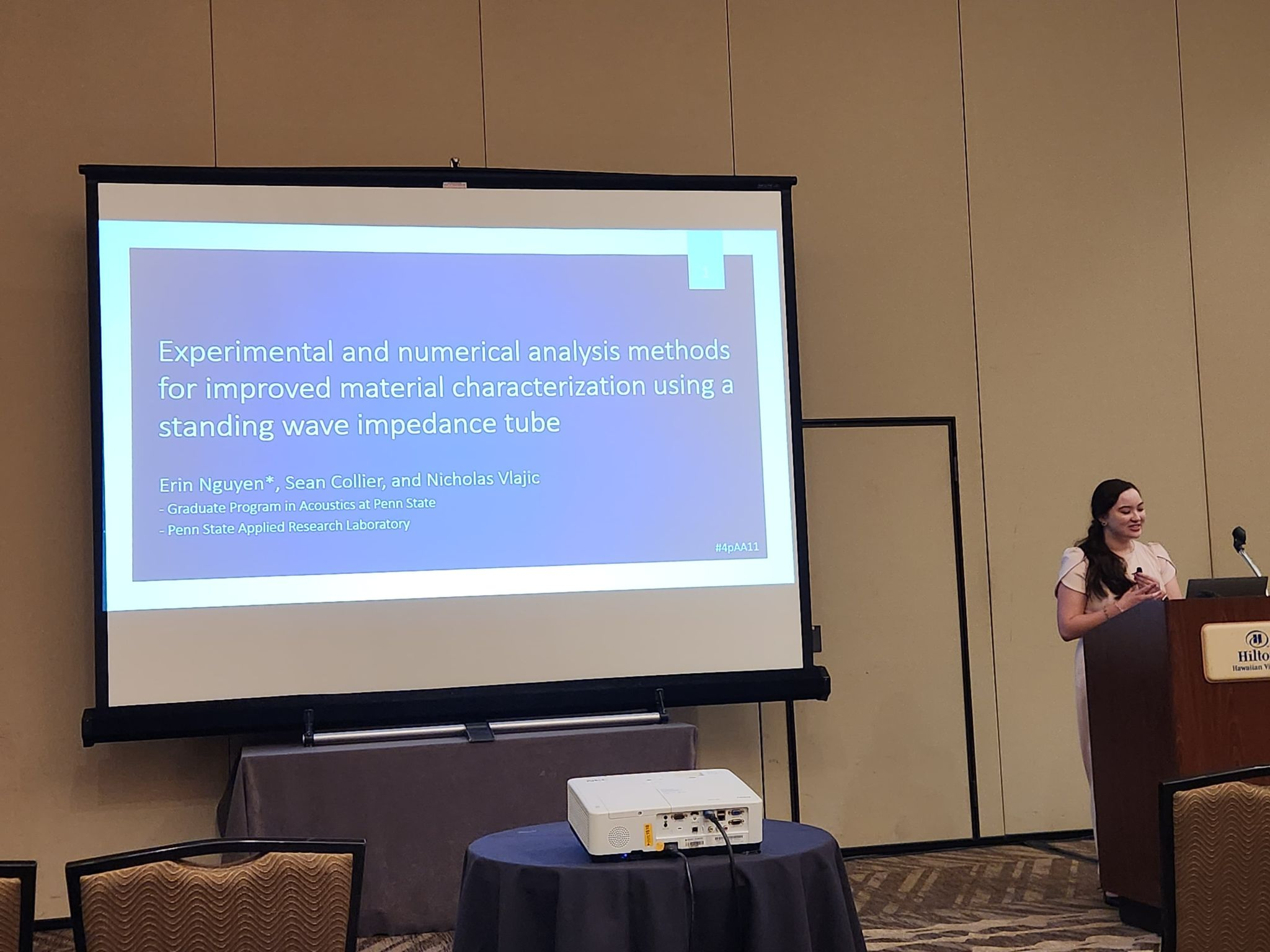
A highlight of the session was a three-part breakdown of a developing Japanese acoustics standard for general spaces—such as lobbies, sporting facilities, and multipurpose rooms. The proposed standard is being informed by the well-established German DIN 18041 room acoustics standard, with thoughtful adaptations for Japanese building practices and cultural expectations. The presentation sparked lively and friendly discussion, illustrating how international collaboration can help refine tools and standards that benefit practitioners worldwide.
Overall, the session captured the spirit of the once-a-decade ASA–ASJ meeting: technically rigorous, openly collaborative, and genuinely enjoyable.
You say “Diffuser,” I say “Diffusor”
Posted by Acoustics First in Diffusion, Q&A, Uncategorized on November 11, 2025
If you’ve spent any time around acoustic treatment—especially sound diffusion—you’ve probably noticed something odd: sometimes the product is called a “diffuser“, and other times it’s a “diffusor“. For newcomers, this can feel like a secret code or a subtle technical distinction – But the truth is much simpler.

Many trace the dual spelling back to Manfred Schroeder, the German physicist who developed the mathematically designed Quadratic Residue Diffusor (QRD).
In German, the word is spelled “Diffusor.” When Schroeder’s work entered the academic world, the spelling likely came with it.
Because his research became foundational in architectural acoustics, the German spelling spread through physics papers, textbooks, and graduate-level acoustics programs. Over time, “diffusor” became a common spelling when discussing mathematical or Schroeder-style diffusors specifically.
As manufacturers began producing these mathematically derived designs—like the ArtDiffusor® line from Acoustics First® (and many other early products)—they retained the “diffusor” spelling as a nod to the academic and scientific origins.
Before long, the industry ended up with two spellings that referred to the same thing:
- Diffuser – the standard English spelling
- Diffusor – the academically inherited, German-influenced spelling tied to Schroeder’s work
Both spellings appear throughout the professional audio world, and both are correct.
Is There Any Practical Difference?
No. None. Zero.
There is no technical difference between a “diffuser” and a “diffusor.” They both refer to devices used to redistribute sound energy and improve the acoustic quality of a space through accelerating the development of sound field diffusion. The spelling variation is purely linguistic.
Think of it like “colour” vs. “color” or “flavour” vs. “flavor.” British English keeps the “u,” American English drops it. (However, if you ask a Brit, they’ll tell you Americans are obviously spelling it wrong.)
The “diffusor/diffuser” split works the same way—just with a German twist.
So Which Should You Use?
Use whichever feels natural or matches the context you’re writing in. Many engineers and academics use “diffusor” when referring to Schroeder-type or other mathematical designs, simply out of tradition. Others stick with the standard English “diffuser.”
Tomato. Tom-ah-to.
The Spellbinding World of Owl Acoustics…
Posted by Acoustics First in Articles, Uncategorized on October 16, 2025
Today we thought we’d take a break from the usual Acoustics First blog topics and talk about owls and the fascinating way in which they experience acoustics. Owls possess some of the sharpest hearing in the animal kingdom. But what makes their hearing so exceptional and how does it differ from our own?
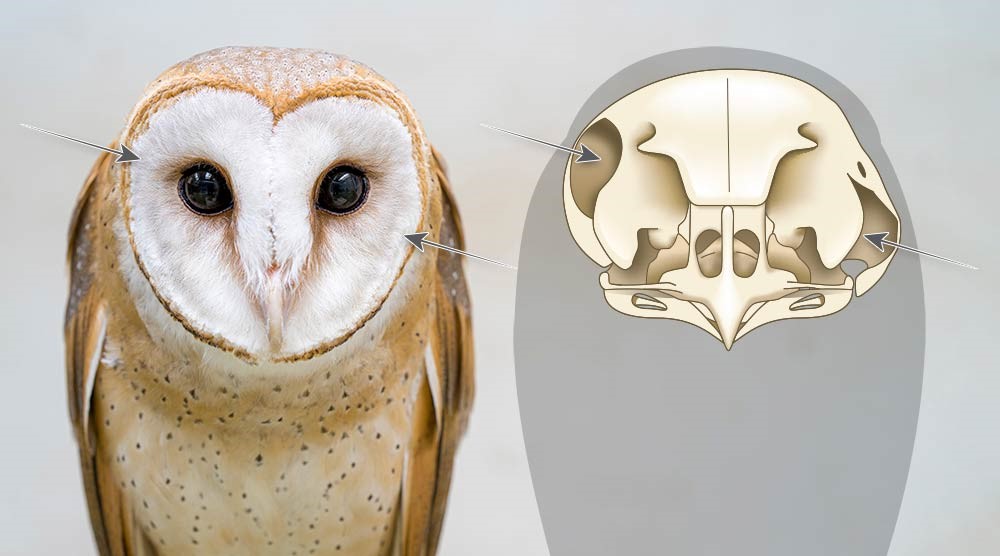
The secret lies in the unique structure of their faces and ears. Owls have flat, circular faces which gives them an incredible ability. Their facial discs, a set of specialized feathers arranged in a ring around their face, act like a natural sound collector, similar to a satellite dish picking up signals. These feathers are flexible, allowing them to adjust their position for optimal sound gathering. The sound they collect is then funneled into their ear openings located on the sides of their head. Imagine if we could move our ears to “zero in” on a particular sound!

Now, you might be wondering about those “ears” that stick up from an owl’s head. These aren’t actually ears at all! Those feathers are called plumicorns, and while they help with camouflage and communication between owls, they don’t contribute to hearing. The true ear openings are located on the sides of the owl’s head, much like humans. These openings are protected by a layer of feathers, and in some species, they even have movable flaps that can cover the ears. These flaps don’t interfere with hearing; they help reduce the sound of air turbulence when the owl is in flight.
What makes an owl’s hearing even more extraordinary is the position of its ear-holes. Unlike most animals, owl ear openings are asymmetrical, meaning one ear sits higher than the other. This unique design allows them to pinpoint sounds not only left or right, but also above or below. Thanks to this setup, owls can triangulate the source of a sound with incredible precision—sometimes within millimeters! This ability allows them to swoop down and catch prey they’ve never seen. The degree of asymmetry varies among owl species—some, like the Northern Saw-Whet, have a noticeable difference in ear placement, while others have more subtle variations. Either way, it’s an impressive adaptation!
Humans, like many other animals, have symmetrical ear-holes, making it more difficult for us to pinpoint whether a sound is coming from above, below or directly in front of us. This is why central clusters of speakers installed above a lectern effectively make the sound feel like it’s coming directly from the orator, not from the ceiling speakers.
Owls also have a “sound-location memory” that further enhances their hearing. When they hear a sound, their brains create a mental map of its location relative to the owl’s position. Special cells in their brain help process sounds from different directions, allowing them to track and locate the sound later.

Finally, like dogs, owls have a broader range of hearing than humans, and they can detect finer details within sounds. According to researchers, owls can hear sounds much faster than we can. While humans process sounds in increments of about 50 milliseconds, birds can discern sounds as short as 5ms. This means that where humans might hear a single note, owls may hear up to 10 distinct notes. Their auditory skills are truly out of this world—and it makes you wonder what we might be missing in our own world of sound!
Don’t Knock the Knock: Acoustics and the Pursuit of the Perfect Watermelon
Posted by Acoustics First in HOW TO, Uncategorized on July 3, 2025
After being outside on a hot summer’s day, nothing quite hits the spot like a slice of a cool, crisp, sweet watermelon. Unfortunately, not every watermelon is the same, and everyone has different methods for selecting the best ones.
There are number of visual clues that one can rely on to help identify a good watermelon. A large, yellow field spot on the bottom indicates that the watermelon was on the vine longer and is probably sweeter. Also, the coloring of a “ripe” melon will have strong, consistent stripe pattern; dull dark green stripes alternating with light yellow/pale stripes.
However, even when I followed these visual tells, I would often cut into my purchase only to be dismayed by a Styrofoam-like, flavorless inside or an over-ripened, mushy mess.
This melon melancholy haunted me until a few years back when I saw a middle-aged woman kneeling on the concrete floor of the supermarket with 5 watermelons circling her. I watched as she bent over and carefully knocked on each one, listening and nodding her head like she was holding a séance with the “other side” of the produce aisle. She repeated this process, rearranging the melons in front of her, until she picked up “the one” and put it in her cart, returning the other watermelons to the display bin.

I greeted the woman, trying not to startle her, and admitted that I often struggled to pick out watermelons. Clearly, she knew what she was doing and I was curious if she might share her system with me.
She kindly told me that she was listening for a “hollow” sound, that was full, but not too deep in pitch. I told her that I had heard that this “knock” test is a good way to judge the water content, but I never had much luck. She said that people will make the mistake of holding onto the melon when knocking, which quickly dampens the sound, so you can’t hear much of a tonal difference between melons (like palming the string of a guitar will change its sound to a shorter, more percussive, note).

Her strategy is to pick out 4-6 similar sized melons that have a large, yellowish sugar spot and strong striping, then sets each down so the only point of contact is with the hard floor. Without external dampeners, the melon can really “sing” when knocked, telling her how far along the fruit is. Too deep of a sound and the fruit is over-ripe/mushy, too high-pitch (or not hollow at all) and the watermelon is not ripe enough. She organizes the melons from lowest to highest in pitch and she simply selects from the middle melons to find one or two that are “just right”.
She said that this ritual, as ridiculous as it might appear to other shoppers, is the best way to guarantee a good watermelon and it’s worked for me ever since; so, don’t knock the knock!
Throwback Thursday – Diffusion and Binaural Bob from 10 years ago!
Posted by Acoustics First in Diffusion, Offices, Product Applications, Products, Uncategorized, Video on February 27, 2025
In June of 2015, Acoustics First® posted about our experiment which allowed people to hear the effects of sound diffusers in a small space. The experiment consisted of treating a small office with varying numbers of our new (at the time) Art Diffusor® Model D sound diffusers, then providing various sonic stimuli and capturing and measuring the results with a custom binaural head (called “Binaural Bob.”) This experiment received great feedback and with that input, future experiments were conducted using a similar method, mixing absorbers and diffusers, and having a wider range of stimuli.

But here we look back to the first… This is the video we produced during that experiment way back in 2015 with Binaural Bob, a bunch of Model D’s, a small office, some balloons, bang snaps, and one very heavy book.
If you would like to revisit the original post in it’s entirety, here is the link!
https://acousticsfirst.info/2015/06/09/want-to-hear-acoustic-diffusion-audio-demo/
 Acoustics First BLOG
You must be logged in to post a comment.