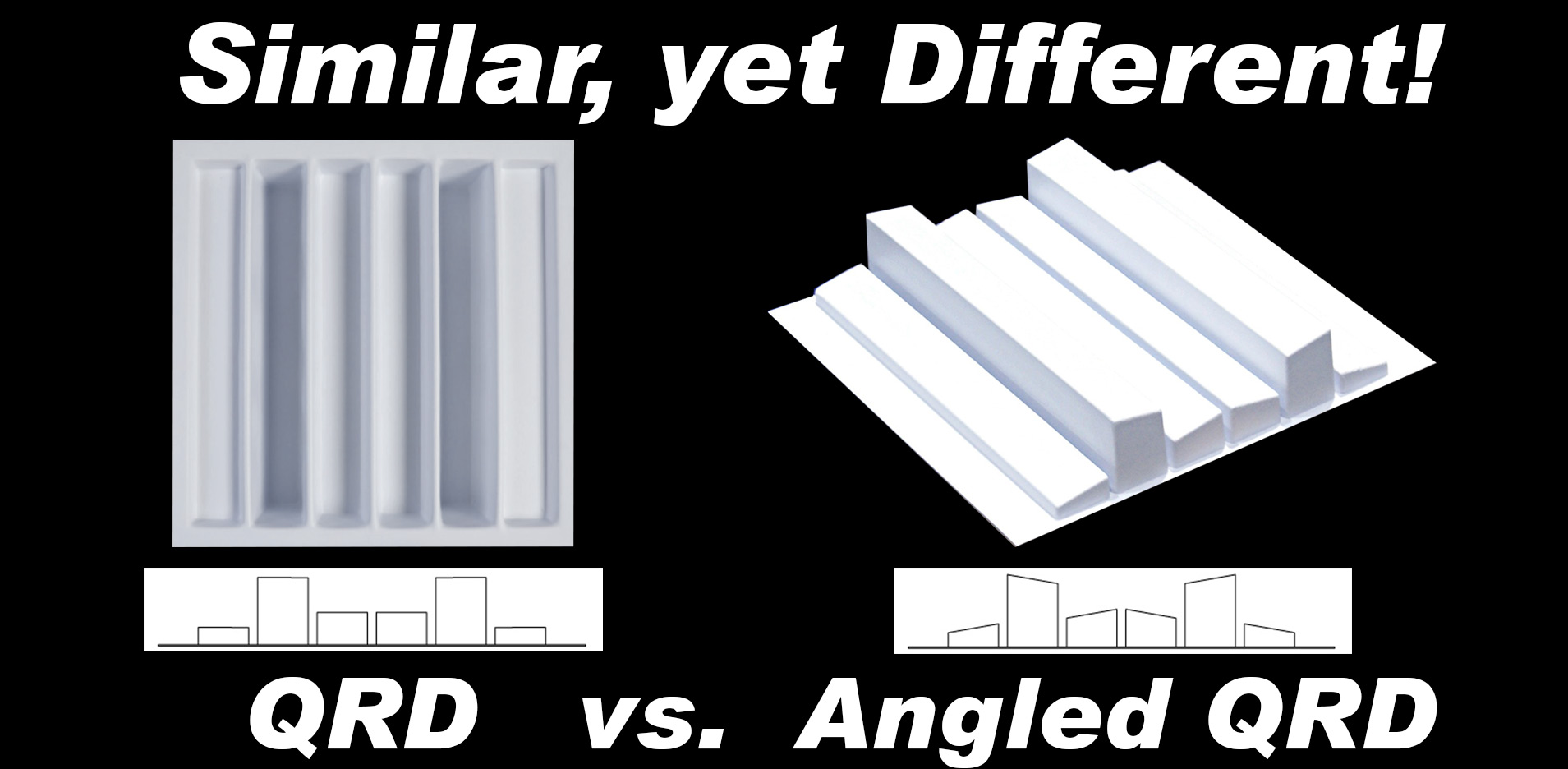
In this installment of “Similar, yet Different,” we explore the similarities and subtle differences between a classic, standard 1D QRD and a modern, angled 1D QRD. While being based on the same mathematic function for their design, there are a couple subtle differences in the performance of these devices.
Quick review. A Quadratic Residue Diffuser is based on a mathematic equation that states that the Well Depth is decided based on the square of the position of the cell and the remainder of when it is divided by a prime number. (We know it sounds really complex… but this is how the ratios of the wells are calculated to maintain a balance of magnitude across the face of the device.)
The equation looks like this:
Well Depth = (n² modulo p)
(Note: there will not be a quiz!)
As it was stated, both of the devices use the identical calculation when coming up with their wells… but there is one important change – the well bottoms are flat on the standard QRD and angled on the angled quadratic. This change makes this diffuser perform differently in 2 key ways:
- The Diffusion Pattern is wider on the angled QRD.
- There is a more subtle transition from one frequency to the next on the angled QRD.


When you look at the two sets of polar pattern above, you will notice that the Angled QRD has a wider pattern, as shown in the first-column, horizonal polar pattern (at 2000Hz especially), where the standard QRD is a more forward-focused pattern.
What does that mean in practice?
Both of these diffusers have a 1D pattern, but the flat bottoms of the standard QRD primarily use diffraction and incidence angle to widen the diffusion… the rest of the diffusion works on the principal of phase offset from the depth of the wells and the time of travel. The Angled QRD introduces an angle which means that one side of the well is deeper than another. This changes the reflection angle, time of travel, and, in turn, degrees of phase shift depending on where the sound strikes the inside of the well. This modification smooths the transition of phase from well to well – as the wells themselves have a range of phase change. This angle also causes the sound to be redirected toward the inner walls of the wells, causing it to change direction from the angle of incidence – widening the pattern further, changing the travel time, and basically bouncing sound around more.
There are some situations where the standard QRD‘s narrow pattern and well-defined transition frequencies may be preferable. In some practice rooms or larger listening spaces, there may be a need for the diffusion to be a little more directional, maybe to hit (or avoid) a certain position in the room. In these scenarios, the standard quadratic may be the recommended choice. In other spaces where you want the reflections to spread out more rapidly – maybe in smaller rooms or spaces where you need to get more coverage from ceiling reflections – then the angled quadratic may be more appropriate.
In closing, while these two devices have a nearly identical design, a small difference can have a big effect on the performance of the diffuser – and how you use them.
 Acoustics First BLOG
You must be logged in to post a comment.